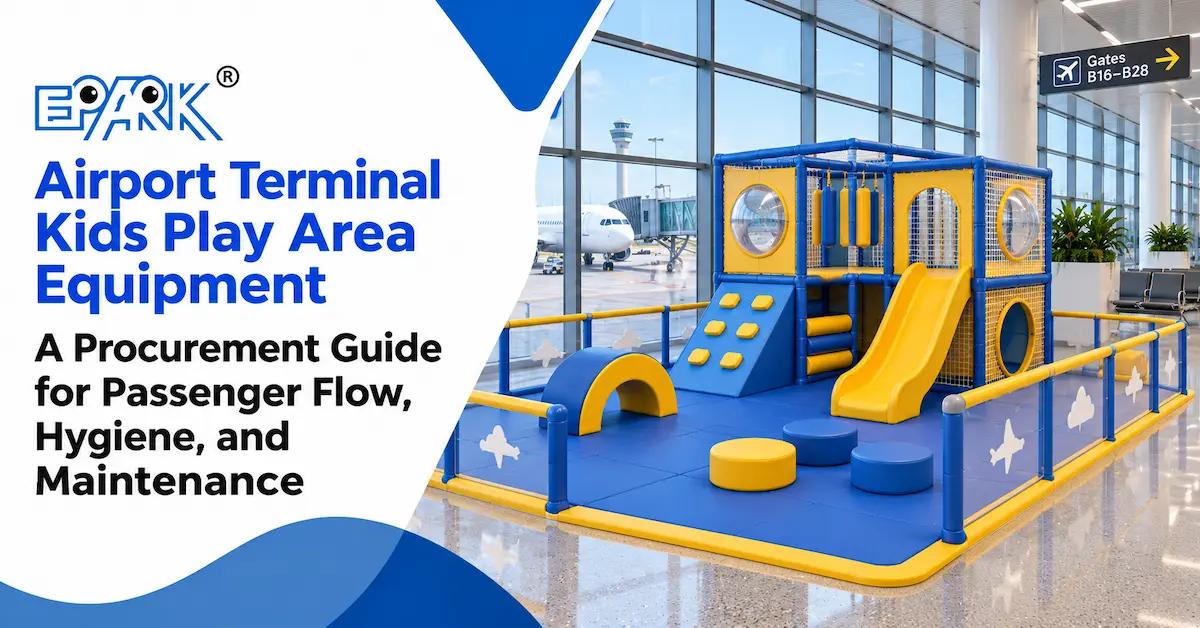
Buying airport terminal kids play area equipment is a public-space procurement decision, not simply a request for colorful soft play. Children may arrive tired, excited, jet-lagged, or unfamiliar with the language. Adults may be monitoring boarding screens, managing passports, carrying bags, using wheelchairs or strollers, and supervising siblings of different ages. Visits can last five minutes or forty minutes, and the next family may enter immediately. These conditions change the equipment brief.
Why an Airport Play Area Requires a Different Procurement Brief
A conventional indoor playground is usually a destination. Families choose to visit, understand the rules, and expect a defined session. An airport play area is an amenity inside a transport process. The child may use it only while a parent waits for a gate change, during a connection, before boarding, or after completing security. The equipment therefore has to work inside an operating system controlled by aviation security, passenger processing, cleaning contractors, airport fire and safety teams, accessibility requirements, airline operations, and commercial concessions.
The play area should reduce travel friction without creating a new source of uncertainty. Parents need to recognize the intended age group, see the entrance and main activities, understand whether shoes or adult accompaniment are required, and leave quickly when boarding begins. Airport staff need to know who inspects the equipment, who isolates a defect, who cleans contamination, and who contacts the supplier for a replacement component.
| Airport condition | Design consequence | Buyer evidence to request |
|---|---|---|
| Short and unpredictable visits | Activities should be understandable immediately and easy to exit | Play-flow diagram and average route length |
| Luggage, strollers, and mobility devices | Keep baggage outside active play routes without narrowing circulation | Dimensioned perimeter and stroller/luggage waiting position |
| Continuous public turnover | Favor durable, wipeable, replaceable high-contact surfaces | Project bill of materials and cleaning compatibility |
| Boarding announcements and screens | Protect sightlines and avoid excessive noise near gate operations | Location plan, acoustic assumptions, and equipment intensity |
| International users | Rules should use simple language and recognizable symbols | Sign artwork, language schedule, and approval record |
| Restricted maintenance windows | Components must be reachable and zones capable of partial closure | Service access plan and replaceable-parts schedule |
Choose the Terminal Location Before Choosing Equipment
The same equipment can succeed in one airport location and fail in another. Begin by defining whether the proposed play area is landside, airside, inside a premium lounge, beside a family waiting zone, or near a gate cluster. Each location has different passenger dwell patterns, security restrictions, cleaning access, and operational ownership.
Gate-area play zones
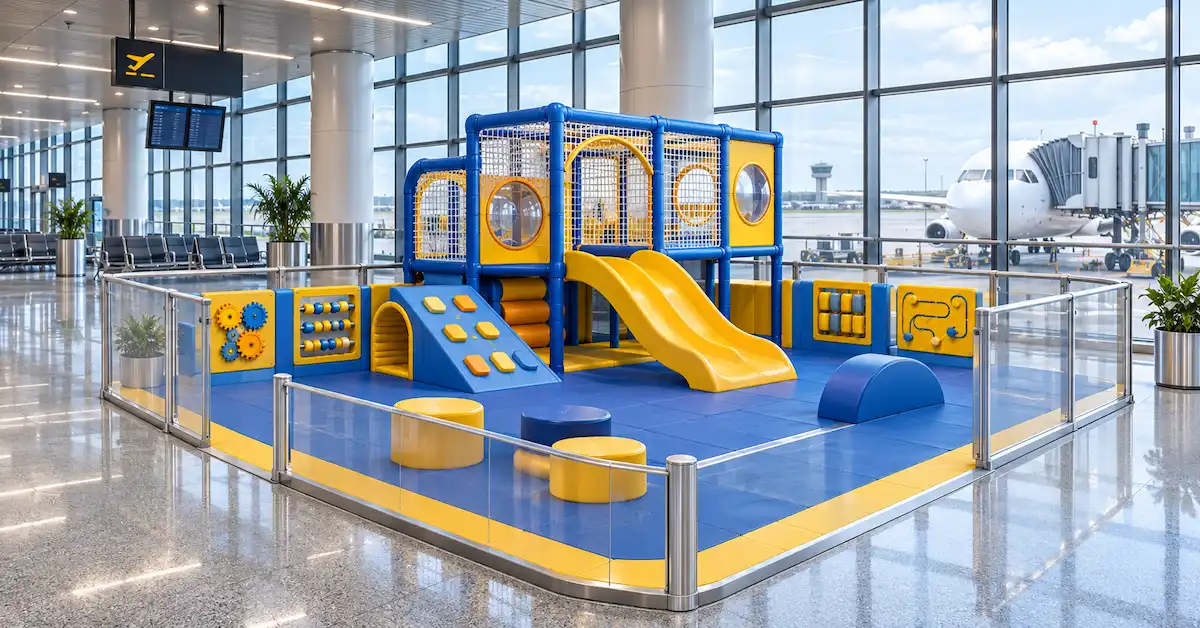
A gate-area zone must coexist with changing queues, priority boarding, airline announcements, and passengers moving between seats and boarding lanes. Low-height activities and a controlled perimeter generally make more sense than a tall structure that blocks sightlines. The exit should not discharge children into a boarding queue. Parents should be able to monitor both the play entrance and flight information without standing in the main circulation path.
Central terminal family zones
A central family zone can serve passengers from several gates and may justify a broader activity mix. It also faces greater turnover, more diverse ages, and a higher risk of becoming a through-route. The layout should make the play boundary unmistakable and prevent travelers from cutting through active play. The airport should confirm whether families are expected to remain for ten minutes or use the space during longer connections.
Airport lounge play rooms
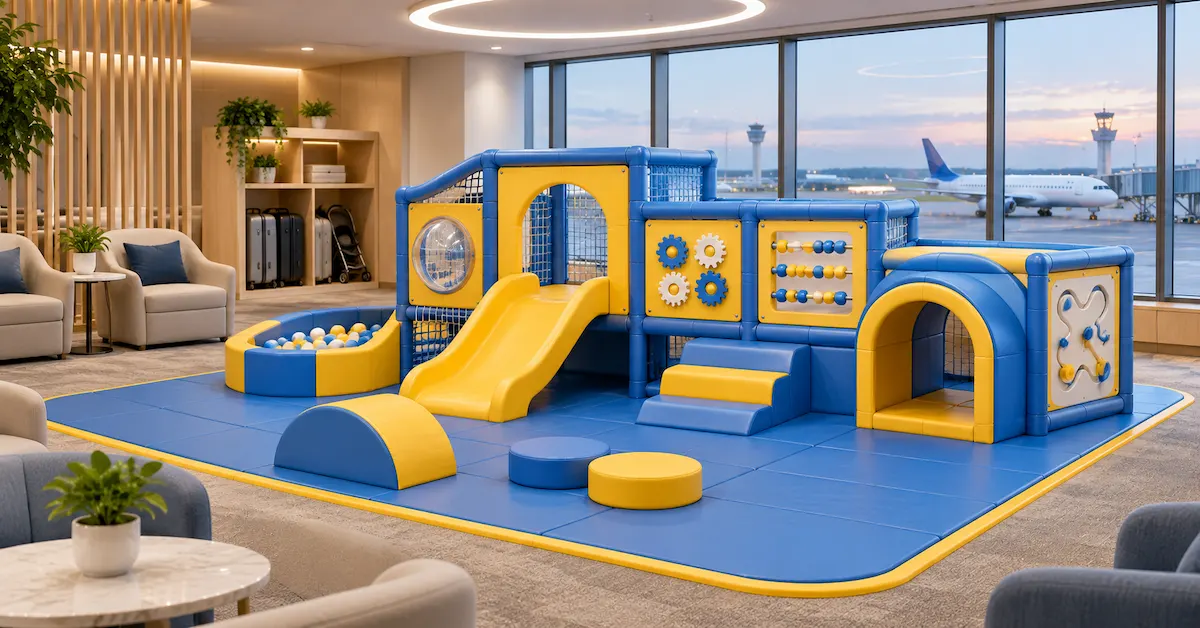
A lounge has controlled admission and may offer better opportunities for staff oversight, quieter finishes, and a smaller toddler-focused play room. However, lounge cleaning standards, hospitality finishes, food service, and limited floor area influence the design. A compact room with sensory panels, low soft forms, role play, and a gentle slide may be more appropriate than a dense multi-level structure.
Arrivals and baggage-claim areas
These areas involve carts, large baggage, reunions, and passenger movement. A play amenity should not encourage children to separate from adults during baggage collection. If considered, it requires unusually clear containment, visibility, and operating ownership. In many terminals, a family waiting zone outside the baggage-handling flow is the more practical location.
Define the Play Mission in Airport Language
Do not ask a supplier to "make the airport family-friendly" without defining the job. A useful play mission might be: give children aged two to six a ten-minute movement break near family seating; provide a quiet sensory activity inside a premium lounge; or give connecting families a visible thirty-minute play option without crossing gate circulation. The mission determines activity intensity, size, age range, cleaning access, and staffing.
Airport teams should avoid broad claims such as “suitable for all children.” A toddler, a preschooler, and an older child have different movement speeds and challenge expectations. If the footprint cannot support meaningful separation, serve a narrower age group and state it clearly rather than installing one crowded route for everyone.
Select Equipment for Short, Repeatable Play
The best airport equipment is not necessarily the equipment with the longest route or most components. It is the equipment a child can understand quickly, use without creating a long queue, and leave without conflict when the family must board.
| Equipment family | Airport value | Specification concern | Best-fit condition |
|---|---|---|---|
| Low soft-play route | Immediate climbing, crawling, and movement | Sightlines, padding condition, cleaning access | Open family waiting zone |
| Sensory or activity panels | High play value with little floor depth | High-touch cleaning, moving-part access, noise | Gate wall or lounge room |
| Mini slide | Recognizable activity and short play cycle | Entry queue, landing visibility, adjacent circulation | Low-height enclosed zone |
| Role-play element | Calmer imaginative play | Loose-piece inventory and hidden cleaning work | Staffed lounge or larger family room |
| Small ball-pool feature | Sensory play and visual attraction | Ball management, hidden floor, contamination response | Only where cleaning ownership is explicit |
| Interactive projection | Variable content without many loose parts | Electrical scope, glare, software, maintenance | Controlled indoor family zone |
High-energy trampoline, ninja, racing, or drop-style activities usually require a different operating model and may be unsuitable beside ordinary passenger seating. If an airport wants a larger active attraction, it should be treated as a separately supervised commercial facility rather than a casual open-access amenity.
Plan Entry, Exit, Luggage, and Sightlines Together
Use one legible entrance
A single controlled entrance makes age rules, footwear, supervision, and capacity easier to understand. It also gives parents a predictable point for reuniting with a child. Multiple openings may improve emergency access in some designs, but casual gaps in the perimeter create confusion and uncontrolled entry.
Keep luggage beside adults, not inside play
Suitcases, carts, backpacks, and stroller straps can obstruct active routes. Provide an adult waiting position where luggage remains under the traveler's control without becoming a barrier. The airport security team should review any storage concept; unattended-bag procedures take priority over playground convenience.
Map real sightlines
Show what a seated adult can see from the actual furniture position. Include the entrance, slide landing, enclosed sections, and transition between age zones. Transparent tubes or open nets may improve visibility, but reflections, graphics, structural posts, and crowds can still create blind areas. Test the installed sightlines rather than relying only on a 3D rendering.
Protect the rapid-exit path
A family must be able to collect a child and leave promptly. Avoid activities that end deep inside a long one-way route. Provide a clear adult access or staff response route for a child who refuses to exit, becomes unwell, or needs help. Boarding pressure is predictable; design for it.
Specify Materials for Continuous Public Use
An airport buyer should approve a project material schedule, not accept a generic “commercial grade” statement. The schedule should connect each material to its location, function, cleaning method, replacement route, and supporting evidence.
EPARK's public Safety and Quality information describes structural and protective material families used in its playground systems. For an airport project, request the exact specification for the quoted configuration. Galvanized steel may form the supporting structure; high-density foam and soft coverings may protect contact areas; EVA or PU systems may be proposed for floors; FRP or composite resin may be used for formed slides; and netting or railings may provide containment. No single material makes the entire installation suitable. Design geometry, connections, installation, inspection, and maintenance must work together.
High-contact surfaces
Ask whether the approved airport disinfectant is compatible with PVC, PU, printed graphics, adhesives, plastics, FRP, nets, and flooring. Record contact time, drying procedure, and materials that should not receive the chemical. A surface that is easy to wipe but damaged by the terminal's cleaning product is not a maintainable specification.
Replaceable wear areas
Entrance pads, step edges, slide landings, activity controls, and floor transitions receive repeated use. Require component codes, color references, material thicknesses, and replacement instructions. Consider an initial spare-parts package for high-wear items, but make it project-specific rather than copying a generic kit.
Fire and smoke requirements
The airport's fire consultant or authority should identify applicable material, smoke, flame, evacuation, and sprinkler requirements. A supplier report should be reviewed for the tested sample, method, date, result, and relevance to the installed product. Do not assume that a general certificate displayed on a website covers every customized airport configuration.
Hygiene Must Be Designed Into the Layout
Airport cleaning cannot depend on closing an entire gate area whenever one component is contaminated. Divide the playground into cleanable zones and define how staff isolate a small area. Surfaces behind panels, below platforms, inside ball-pool edges, and around slide exits must be reachable.
| Cleaning event | Required response | Design feature that helps |
|---|---|---|
| Routine high-touch wipe | Clean controls, handholds, rails, and entry surfaces | Open access and compatible finishes |
| Visible contamination | Isolate, clean, dry, inspect, and release the affected zone | Sectional barriers and clear staff route |
| Ball-pool service | Remove balls, inspect hidden floor and borders | Service opening and manageable pool depth |
| Damaged cover or net | Close the affected component until repaired | Component-level isolation and part identification |
| Deep clean | Reach undersides, seams, corners, and structure | Documented access points and maintenance window |
The cleaning contract should identify who provides consumables, who records completion, who authorizes reopening, and how incidents are escalated outside normal hours. This is particularly important where the equipment supplier, airport facility team, airline lounge operator, and cleaning contractor are different organizations.
Standards and Approval: Build a Project Matrix
The applicable safety framework depends on the destination country, equipment category, user age, surfacing, and local authority. Public-use soft-contained play, conventional playground equipment, impact surfacing, interactive electrical components, fire safety, accessibility, and building approval may involve different requirements. The airport should appoint the party responsible for interpreting current local requirements.
Ask the supplier to state the standard number and edition used for each equipment family, the scope of any test report or certificate, the tested sample, and any exclusion. Review EPARK's certificate and report page as an evidence index, then request documents that apply to the actual airport order. A material report, ISO management certificate, or laboratory logo does not by itself prove that the complete installed play area meets every destination requirement.
Accessibility is more than an entrance width
Consider the accessible route to the play area, companion seating, stroller and wheelchair positions, transfer opportunities, sensory load, communication signs, and whether a child with different abilities can participate meaningfully. Accessibility requirements vary, so the airport's accessibility advisor should review the concept before design approval.
Write the RFQ Around Evidence and Responsibilities
A useful RFQ allows suppliers to quote the same scope. Send a dimensioned CAD plan, terminal location, clear height, columns, glazing, doors, building services, passenger routes, seating, expected age group, typical visit duration, operating hours, cleaning products, destination market, installation restrictions, and required opening date.
| RFQ section | Information from airport | Required supplier response |
|---|---|---|
| Site and operation | Plan, passenger flow, operating hours, security limits | Layout assumptions and exclusions |
| Equipment | Age, activity intensity, footprint, desired capacity | Equipment schedule, dimensions, intended users |
| Materials | Cleaning and airport material requirements | Bill of materials, samples, evidence scope |
| Documentation | Destination standards and approval route | Drawings, reports, manuals, document language |
| Logistics | Delivery access, security screening, storage window | Package list, dimensions, weights, labeling |
| Installation | Working hours, permits, local labor, site readiness | Method, tools, technicians, responsibilities |
| After-sales | Airport response and closure expectations | Warranty, spares, service contact, response route |
MOQ should be stated for the specific equipment scope. A customized airport zone may be treated as a project rather than a standard unit order. Production lead time should begin from a defined trigger, normally after drawings, materials, artwork, documentation, and commercial terms are approved. Packaging should connect package numbers to component and installation references so the airport or contractor can verify delivery without opening every item at once.
Factory and Pre-Shipment Evidence to Request
Original evidence matters because a rendering does not prove what was manufactured. Before shipment, request dated production photographs, material approvals, dimensional checks, component counts, assembly or fit checks where applicable, surface and seam inspection, hardware verification, packing photographs, and a final packing list. Where a load, material, or other test is required, ask for the method, sample, acceptance criterion, result, and relationship to the ordered configuration.
EPARK's website shows factory activities including design, cutting, assembly, welding, and grinding and publishes commercial project examples. For airport procurement, connect that general factory evidence to a project number and approved bill of materials. A useful pre-shipment record identifies what was checked, who checked it, when it was checked, and how any nonconformity was closed.
Installation and Handover at an Operating Airport
Airport installation may be limited to night windows, controlled loading docks, security-screened tools, approved workers, restricted waste routes, and strict dust or noise controls. Confirm these conditions before production and dispatch. A late discovery can leave equipment stored off-site while installation permits or access passes are arranged.
The handover package should include the final as-installed drawing, equipment schedule, material schedule, inspection record, cleaning instructions, maintenance plan, spare-parts references, warranty, defect-contact route, staff training record, and unresolved punch list. The airport should perform a pre-opening inspection and compare the installation with the approved drawing. Verify entrances, barriers, floor edges, slide landings, fasteners, nets, padding, signage, visibility, emergency routes, and cleaning access.
Frequently Asked Questions
What airport terminal kids play area equipment works best?
Low-height soft play, sensory panels, gentle slides, and compact role-play activities often fit an open terminal or lounge better than high-energy equipment. The correct mix depends on location, target age, visit duration, supervision, passenger circulation, and maintenance ownership.
How large should an airport play area be?
There is no universal size. Calculate the usable footprint after preserving passenger routes, emergency access, seating, luggage positions, service access, and required clearances. A smaller, well-observed zone can be more useful than a large structure that conflicts with gate operation.
Can an airport play area be unattended?
The operating model must be defined by the airport and local requirements. Even when parents supervise children, the airport still needs assigned responsibility for inspection, cleaning, defect isolation, emergency response, and capacity or rule enforcement.
Which materials should an airport buyer specify?
Specify the exact structure, padding, covering, flooring, slide, net, hardware, adhesive, and graphic materials for the project. Confirm cleaning compatibility, fire-related requirements, wear replacement, and supporting document scope.
Should a ball pool be used in an airport?
Only where the operator can manage balls, inspect the hidden floor, respond to contamination, and provide service access. A shallow or smaller integrated feature may be easier to operate than a large deep pool, but the decision is project-specific.
What information should be sent for a quotation?
Send a CAD plan, clear height, location within the terminal, passenger and gate routes, target age, expected visit duration, operating hours, cleaning products, desired activities, destination standards, installation restrictions, and opening schedule.
What evidence should be requested before shipment?
Request approved drawings, bill of materials, production photos, component and dimensional checks, inspection records, applicable report scope, packing photos, numbered packing list, installation documents, and closure evidence for defects.
Can EPARK guarantee airport approval?
EPARK can support project design, manufacturing, documentation, packaging, installation planning, and after-sales discussions. Final airport, building, fire, accessibility, security, and local authority approval depends on the destination project and assigned reviewers.
Conclusion
Airport terminal kids play area equipment should be purchased as part of passenger operations. Start with the terminal location, target age, visit duration, supervision model, baggage relationship, cleaning ownership, emergency access, and local approval route. Then select a limited set of immediately understandable activities with clear sightlines, durable and maintainable materials, component-level isolation, and an exit path that supports rapid boarding.
EPARK can review site information through its commercial playground product and customization process. Final equipment, MOQ, materials, test evidence, lead time, packaging, installation, and warranty must be confirmed for the airport's actual scope. Send the dimensioned plan and operational brief through the official contact page so the first proposal is tied to passenger flow rather than a generic catalogue layout.
General Disclaimer
All data on https://www.eparki.com is for general guidance only. As a leading indoor playground manufacturer and trampoline supplier, EPARK strives for accuracy but gives no express or implied warranty regarding completeness, performance or project fitness. Product specs, designs and results may vary with use and customer requirements. Buyers must verify technical details, compliance and suitability before purchase. EPARK OEM/ODM is not liable for any direct, indirect or consequential damages arising from site use. For custom solutions, contact our manufacturer and supplier team via the Contact page.
Intellectual Property
Text, images, videos, CAD files and software are Guangzhou EPARK Electronic Technology Co., Ltd. All rights reserved. No part may be copied, republished or used commercially without prior written permission. We will pursue legal action for copyright or design-patent infringement.
Trademarks
"EPARK", the EPARK logo and related graphics are registered trademarks of Guangzhou EPARK Electronic Technology Co., Ltd. Unauthorized use in ads, domain names or packaging is prohibited.
Governing Law
These terms are governed by the laws of the People's Republic of China.
Contact
Questions? Email sales@nanyuetech.com or WhatsApp +86 139 0307 9263.