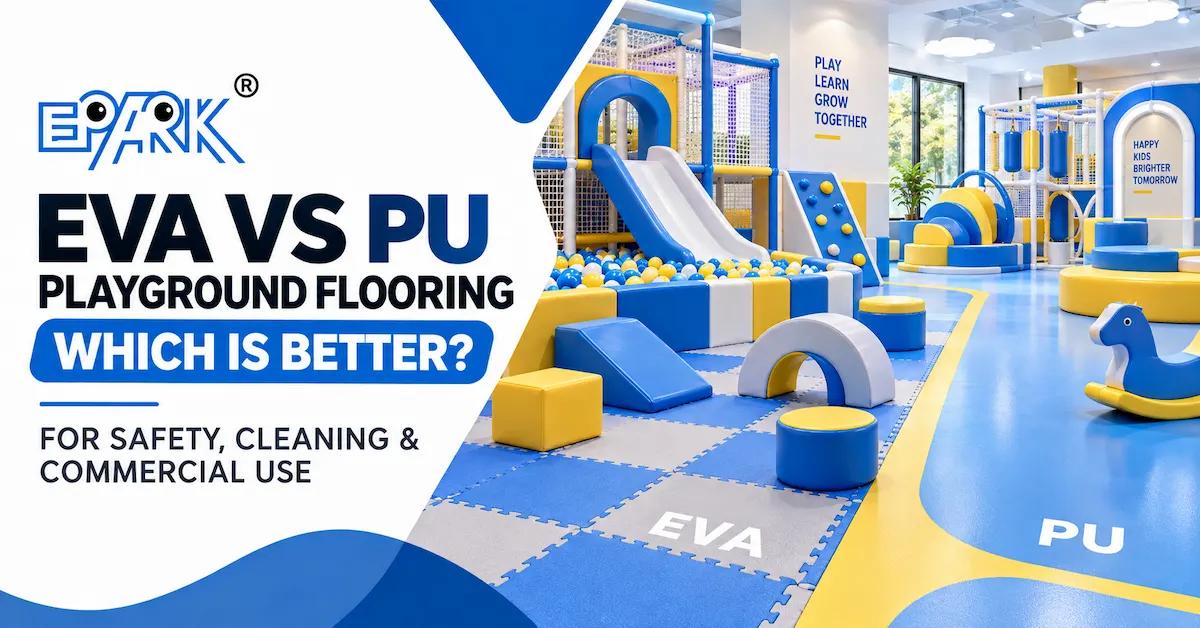
EVA vs PU Flooring for Indoor Playgrounds: Which Is Better?
There is no universal winner.
For commercial playground buyers, EVA vs PU flooring for indoor playgrounds should be decided according to the activity zone, target age group, traffic level, cleaning routine, installation method, replacement strategy, and project requirements—not the material name alone.
EVA and PU are both used in playground and soft-play flooring systems, but they can be formulated, manufactured, finished, and installed in different ways.
That means two EVA floors can perform differently from each other, just as two PU flooring products can differ significantly in density, thickness, surface finish, cushioning, wear behavior, and maintenance requirements.
The most useful procurement question is therefore not:
“Is EVA better than PU?”
It is:
“Which flooring specification is better for this exact activity zone, venue, user group, traffic level, and maintenance plan?”
EPARK’s indoor playground safety and quality standards identify high-density EVA or PU foam mats as flooring options for children’s activity zones, alongside structural steel, protective padding, PVC coverings, FRP components, and safety netting.
For buyers, that makes flooring one part of the complete playground system rather than an isolated purchase.
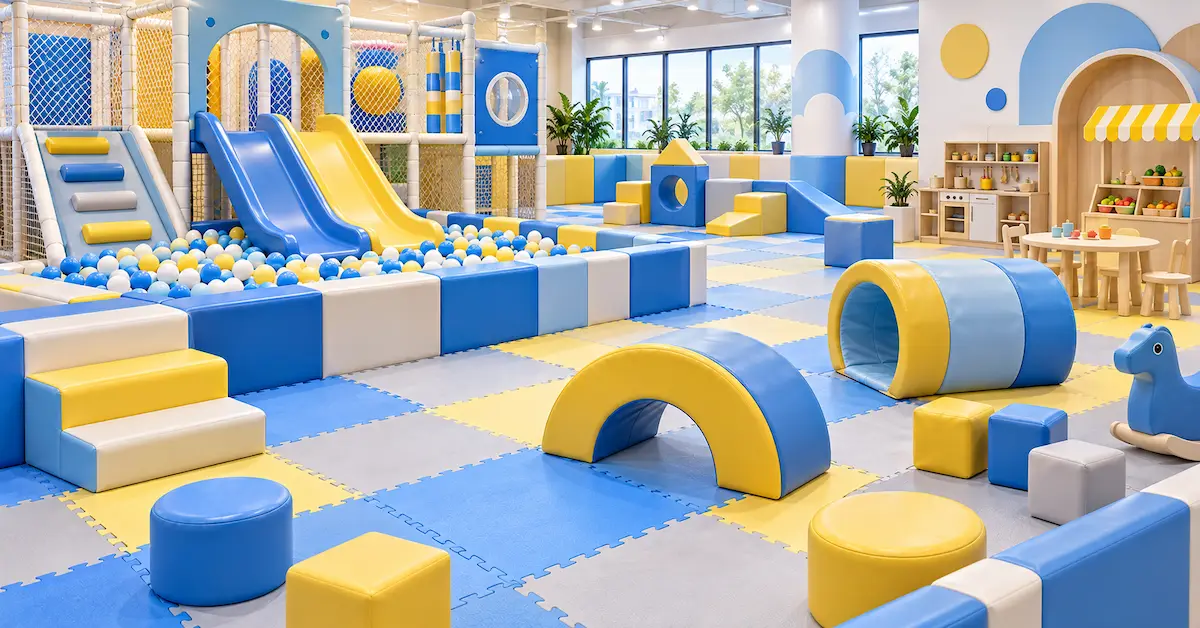
Quick Comparison: EVA vs PU Playground Flooring
The following table provides a practical starting point.
It should not replace a project-specific specification because density, thickness, surface construction, installation, and formulation can change actual performance.
| Buying Factor | EVA Flooring | PU Flooring | Buyer Should Verify |
|---|---|---|---|
| Material family | Ethylene-vinyl acetate foam | Polyurethane foam/material system | Exact product formulation |
| Typical format | Often mats or interlocking sections | Mats, foam systems, or project-specific constructions | Actual supplied format |
| Cushioning | Depends on density and thickness | Depends on density, formulation, and thickness | Impact/cushioning requirement |
| Surface feel | Can range from firm to soft | Can range widely from soft to resilient | Sample and specification |
| Cleaning | Often practical with simple surfaces | Can also be practical with appropriate finish | Surface finish and seams |
| Installation | Interlocking formats can simplify installation | Depends on product system | Site installation method |
| Replacement | Individual mat replacement may be convenient | Depends on modular construction | Spare-part strategy |
| Moisture management | Depends on structure and joints | Depends on formulation and finish | Drying and subfloor access |
| High traffic | Depends on density and wear layer | Depends heavily on specification | Wear resistance |
| Design flexibility | Many colors and tile combinations possible | Project dependent | Color consistency |
| Maintenance | Can be simple when modular | Can be simple with serviceable construction | Access and replacement |
| Best use | Application dependent | Application dependent | Zone-by-zone evaluation |
The key point is simple:
Do not buy “EVA” or “PU.” Buy a defined flooring system.
What Is EVA Flooring?
EVA stands for ethylene-vinyl acetate.
In indoor playground environments, EVA is commonly associated with foam mats, padded floor surfaces, interlocking tiles, and activity-zone cushioning.
Commercial buyers often recognize EVA flooring by its modular appearance.
Depending on the product, EVA flooring may be supplied as:
- Interlocking tiles
- Larger modular mats
- Padded floor sections
- Custom-cut sections
- Multi-color floor layouts
Its commercial appeal often comes from the ability to create a cushioned surface using relatively manageable sections.
Why EVA is common in soft-play environments
Playground operators frequently value flooring systems that can:
- Create a softer activity surface
- Cover larger areas efficiently
- Support color zoning
- Be cleaned routinely
- Allow localized replacement
- Fit around modular equipment
These benefits can make EVA useful in toddler areas, soft-play zones, circulation areas, and other activity spaces.
However, the word “EVA” alone does not tell the buyer:
- Density
- Thickness
- Compression behavior
- Surface texture
- Wear resistance
- Joint design
- Chemical compatibility
- Actual expected service life
Those details should be confirmed in the quotation or technical specification.
What Is PU Flooring?
PU refers to polyurethane, which is a broad material family.
In playground projects, PU may appear in foam mats, padded flooring systems, or other resilient components depending on the manufacturer and application.
PU products can vary significantly.
That is why buyers should avoid assuming that every PU floor has the same softness, density, wear behavior, or cleaning characteristics.
A commercial specification should identify:
- Product construction
- Thickness
- Density or relevant performance specification
- Surface layer
- Installation format
- Intended application
- Cleaning method
- Replacement procedure
In other words, “PU flooring” is a category description—not a complete technical answer.
Why Material Name Alone Is Not Enough
This is the most important lesson in the entire EVA vs PU comparison.
Imagine two quotations.
Supplier A
Writes:
Flooring: EVA.
Supplier B
Defines:
- Flooring type
- Thickness
- Intended activity zone
- Surface texture
- Installation format
- Color
- Replacement method
- Cleaning guidance
Supplier B gives the buyer much more useful information.
The same applies to PU.
A material name without a project specification makes meaningful comparison difficult.
When reviewing commercial indoor playground products, buyers should therefore consider not only the visible flooring color but also how the proposed floor system fits the equipment layout, age zones, traffic flow, cleaning requirements, and long-term maintenance plan.
1. Cushioning: EVA vs PU
Cushioning is one of the first factors buyers consider.
But material type alone does not determine how a floor feels or performs.
Important variables include:
- Density
- Thickness
- Compression
- Internal structure
- Surface layer
- Subfloor condition
- Installation method
A thicker low-density product can behave differently from a thinner high-density product.
Similarly, a flooring system that feels soft under hand pressure may not necessarily be the right choice for every activity zone.
Toddler areas
Toddler zones often benefit from surfaces that support crawling, sitting, low-height movement, and softer contact.
Floor selection should be coordinated with:
- Equipment height
- Child age
- Activity type
- Fall exposure
- Cleaning routine
Higher-activity areas
Zones with repeated running, climbing access, or high visitor turnover may need a different balance between cushioning and dimensional stability.
The best solution should be specified according to the activity rather than using one floor construction everywhere.
2. Firmness and Underfoot Feel
Commercial buyers sometimes describe flooring simply as “soft” or “hard.”
Those terms are too subjective.
A better evaluation considers:
- How much the floor compresses
- How quickly it recovers
- Whether equipment creates permanent impressions
- Whether wheeled cleaning equipment can move across it
- Whether adults can walk comfortably
- Whether children can maintain stable footing
A very soft floor may feel comfortable but create other operational concerns.
A firmer floor may provide better stability in some zones but may not provide the cushioning desired for others.
This is another reason a single venue may use different flooring specifications in different areas.
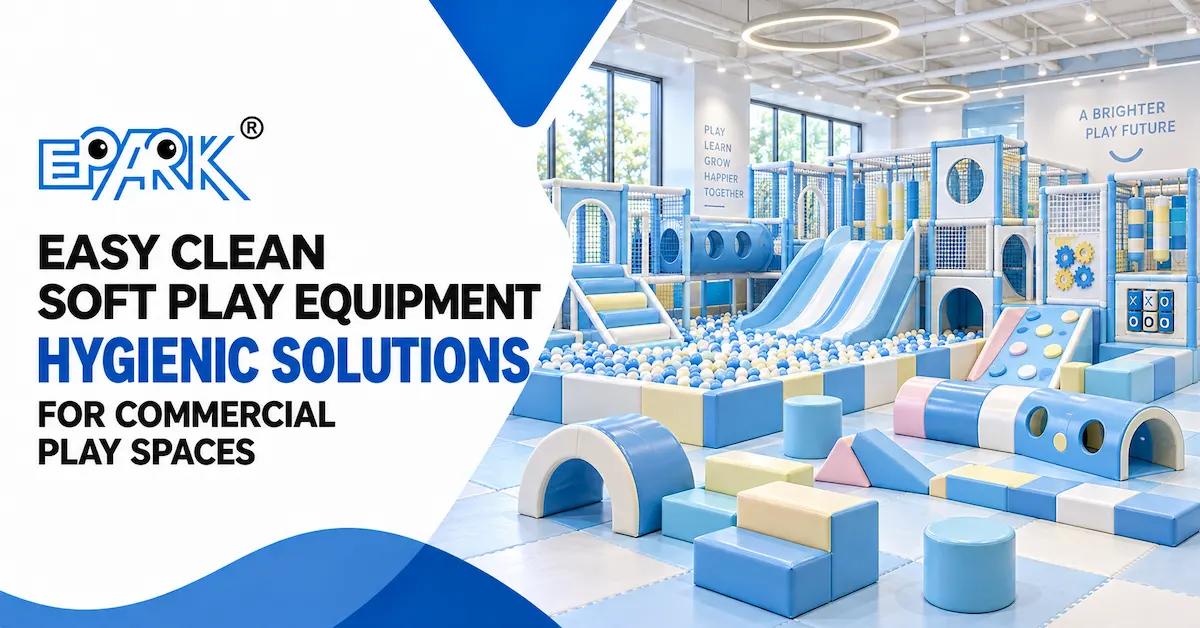
3.EVA vs PU for Cleaning and Hygiene
Cleanability is particularly important for commercial indoor playgrounds.
Flooring is continuously exposed to:
- Shoes or socks
- Dust
- Food debris
- Spills
- Ball-pit debris
- Cleaning products
- Repeated traffic
EPARK’s current material guidance describes EVA or PU foam mats with interlocking designs that can support installation and cleaning convenience.
However, actual cleanability depends heavily on how the floor is designed and installed.
Surface texture
Heavy texture can create additional dirt-collection points.
A simpler surface may be easier to wipe or mop.
Joints
Interlocking flooring creates joints.
Buyers should ask:
- How tight are the joints?
- Can individual sections be removed?
- Can liquid enter below the floor?
- How is the subfloor cleaned if needed?
Edge conditions
Floor edges can become high-wear locations.
Check transitions near:
- Walls
- Entrances
- Ball pits
- Slides
- Equipment bases
- Other floor materials
For projects where easy maintenance is a priority, cleanability should be discussed during custom indoor playground material selection, not after installation.
4. Moisture Management
A floor can look clean on top while moisture remains below or between sections.
This matters because commercial cleaning introduces water or cleaning solution.
Buyers should understand:
- Whether flooring is removable
- Whether the subfloor can be inspected
- How the floor dries
- Whether edges trap moisture
- How spills are handled
- Whether equipment prevents access to affected sections
Neither EVA nor PU should automatically be described as “maintenance free.”
The installed system matters.
A well-planned modular floor can simplify local inspection, but only if operators know how to remove, dry, and reinstall the sections correctly.
5. Slip Resistance and Surface Control
Indoor playground flooring should support stable movement.
Buyers should evaluate slip performance according to the actual environment.
Relevant factors include:
- Dry conditions
- Cleaning residue
- Socks
- Foot traffic
- Surface texture
- Wear over time
Do not judge anti-slip performance only from appearance.
A highly textured floor is not automatically better.
Too much texture can also increase cleaning difficulty.
The correct surface should balance traction with cleanability.
6. Wear Resistance in High-Traffic Playgrounds
A commercial FEC may experience substantially more traffic than a small daycare play corner.
That changes the flooring decision.
High-traffic locations include:
- Entrances
- Slide exits
- Stairs
- Ball-pit access points
- Queue areas
- Parent access routes
- Main circulation paths
These zones may wear faster than the middle of an open activity area.
Evaluate wear by zone
Instead of asking:
“How durable is this flooring?”
ask:
“Which areas are expected to wear fastest, and how will those sections be replaced?”
This is especially important for:
- Shopping malls
- Busy FECs
- Commercial play centers
- Chain playgrounds
A replaceable flooring system may provide operational value even if no flooring material can eliminate wear completely.
7. Replacement and Repair
Replacement strategy is one of the strongest arguments for modular flooring.
If one section is damaged, the operator may be able to replace only that area rather than the complete floor.
But buyers should verify:
- Are spare sections available?
- Will future colors match?
- Is the same specification likely to remain available?
- Can staff remove the section?
- Does equipment need to be dismantled first?
- Is the replacement part coded?
Create a flooring spare-part plan
For multi-location operators, retain:
- Product code
- Color
- Thickness
- Dimensions
- Supplier reference
- Installation photo
This reduces uncertainty when replacements are needed later.
8. Installation Speed and Site Coordination
Flooring installation can affect project schedule.
Interlocking EVA-style systems are often attractive in commercial projects because modular sections can make installation and localized replacement easier.
PU flooring systems can also be practical, but the actual installation process depends on the product format.
Buyers should confirm:
- Subfloor preparation
- Installation sequence
- Adhesive requirements, if any
- Edge finishing
- Expansion considerations
- Equipment installation order
- Time before use
The playground floor should be coordinated with the larger installation plan rather than treated as the final decorative layer.
9. Subfloor Quality Matters
Even a good flooring product can perform poorly on an unsuitable base.
Before installation, check whether the subfloor is:
- Level
- Clean
- Dry
- Structurally suitable
- Free from sharp irregularities
An uneven base can create:
- Visible joints
- Movement
- Premature wear
- Cleaning problems
- Poor appearance
Turnkey project planning should therefore identify who is responsible for subfloor preparation before the playground installation begins.
10. Flooring and Equipment Layout Must Be Designed Together
The floor should not be designed separately from the playground.
Consider:
- Ball-pit boundaries
- Structural posts
- Soft blocks
- Slide exits
- Role-play zones
- Walkways
- Parent seating
- Equipment access
If equipment is fixed over replaceable floor sections, maintenance may become more difficult.
The buyer should understand which floor areas remain accessible after the complete structure is installed.
EVA vs PU for Toddler Play Areas
Toddler areas typically involve:
- Crawling
- Sitting
- Soft climbing
- Low slides
- Balance development
- Parent-assisted play
Flooring should support both comfort and stable movement.
Important purchasing factors include:
- Appropriate cushioning
- Smooth transitions
- Easy cleaning
- Low trip risk
- Replaceable sections
- Visual zoning
Neither EVA nor PU is automatically the correct answer.
The actual product construction should be evaluated.
EVA vs PU for Family Entertainment Centers
FEC floors face different challenges:
- Higher traffic
- Longer opening hours
- More frequent cleaning
- Multiple age groups
- Larger activity areas
- More operational staff
The flooring system should therefore emphasize:
- Durability
- Local replacement
- Easy inspection
- Consistent appearance
- Cleaning efficiency
In large commercial spaces, different zones may justify different flooring specifications.
For example:
Toddler zone
Higher priority on cushioning and comfort.
Main circulation zone
Higher priority on traffic resistance and stability.
Interactive activity zone
Balance between movement, traction, and maintenance.
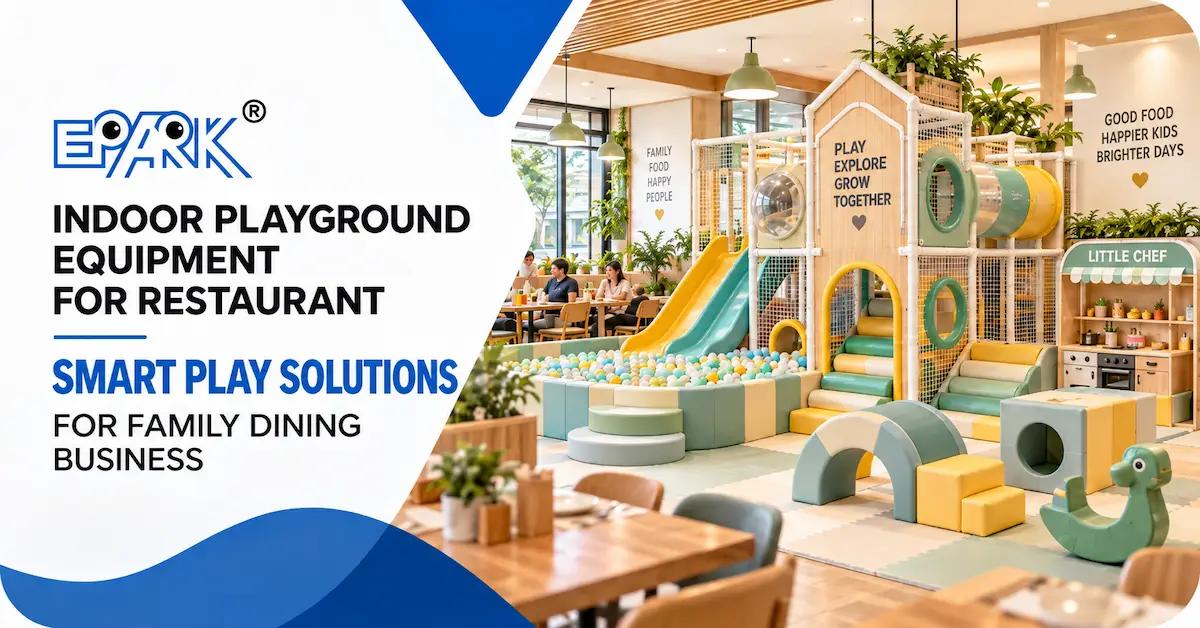
EVA vs PU for Restaurants and Kids Cafés
Restaurants and kids cafés have unique requirements.
The playground is located near a food-service environment.
Operators usually care strongly about:
- Visible cleanliness
- Easy daily cleaning
- Compact layouts
- Spill management
- Appearance
- Maintenance access
Flooring should therefore be evaluated as part of the hygiene workflow.
A modular floor that can be locally lifted or replaced may be operationally useful, but joints and subfloor moisture still need attention.
EVA vs PU for Daycare and Preschool
Daycare centers often clean play spaces frequently.
They may also rearrange equipment more often than large FECs.
Useful flooring characteristics may include:
- Comfortable surface
- Easy wipe-down
- Modular replacement
- Visual zoning
- Stable footing
Low-height activity environments may place different demands on flooring than a multi-level commercial playground.
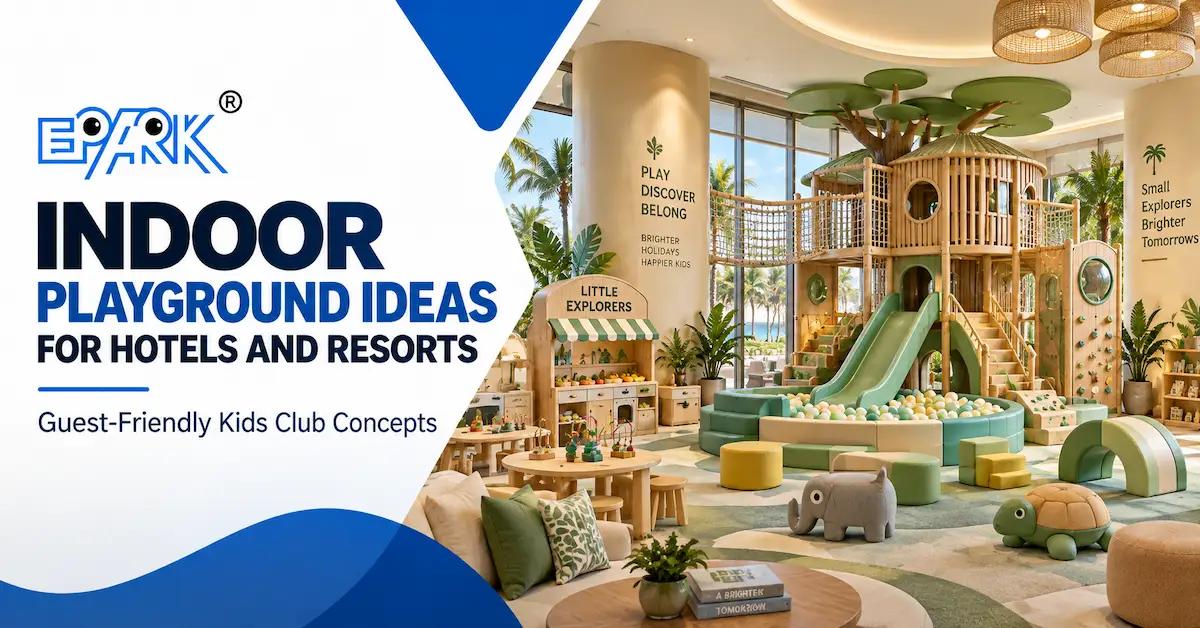
EVA vs PU for Hotels and Resorts
Hotels often prioritize:
- Premium appearance
- Low visual clutter
- Quiet atmosphere
- Easy maintenance
- Consistency with interior design
The flooring color, joint pattern, and transition to surrounding interior finishes may matter as much as basic cushioning.
A hotel kids club may prefer a refined visual floor rather than a highly segmented bright tile pattern.
That design preference should still be balanced against replacement and maintenance requirements.
EVA vs PU for Mall Playgrounds
Shopping mall projects may operate for long hours and experience high traffic.
Flooring decisions should consider:
- Entry wear
- Cleaning windows
- Replacement downtime
- Visual durability
- Public visibility
A heavily worn floor can negatively affect the perceived quality of the entire playground even when the equipment itself remains in good condition.
For mall operators, replacement planning should therefore begin before opening.
What About Ball-Pit Flooring?
The area under a ball pool deserves separate consideration.
Although visitors do not constantly see it, it still requires:
- Cleaning
- Inspection
- Access
- Drying
Buyers should ask:
- Can the balls be removed efficiently?
- Can staff access the floor?
- Is the flooring removable?
- Are corners accessible?
- Can moisture dry?
- Can worn sections be replaced?
The same EVA vs PU decision may have a different answer inside a ball pit than in a main walkway.
Compare Flooring by Function, Not Only Material
A better procurement method is to create a zone matrix.
| Zone | Main Requirement | Flooring Question |
|---|---|---|
| Toddler zone | Comfort and cushioning | Which system matches low-age activity? |
| Main play zone | Balanced performance | What handles daily commercial use? |
| Entrance | Wear resistance | Can high-wear sections be replaced? |
| Ball pit | Cleaning access | Can the floor be serviced easily? |
| Role-play area | Cleanability | Is routine cleaning simple? |
| Parent area | Comfort/appearance | Does flooring match interior design? |
| Service route | Stability | Can staff and equipment move safely? |
This is more useful than choosing one material for the entire project.
EVA vs PU: Appearance and Theme Design
Flooring contributes significantly to the visual character of a playground.
EVA modular mats can support:
- Color blocks
- Patterns
- Age-zone identification
- Pathways
- Contrasting play areas
PU flooring options may also support color customization depending on the selected product system.
For commercial buyers, color planning should consider:
- Theme
- Dirt visibility
- Replacement consistency
- Long-term color availability
- Brand colors
Very light flooring can look bright and premium but may make dirt more visible.
Very dark flooring can hide some marks but may conflict with a soft family-oriented theme.
The right solution is both operational and visual.
Flooring Color Can Support Wayfinding
Flooring can be used to separate:
- Toddler areas
- Main play zones
- Parent walkways
- Queue areas
- Activity zones
This is particularly useful in large FECs.
Color zoning can make the environment easier to understand without adding more physical barriers.
Consider Seams as Part of the Visual Design
Interlocking floors create visible lines.
Some buyers dislike this appearance.
Others use the joints intentionally as part of the pattern.
If a seamless appearance is important, discuss that during design.
Do not assume the finished floor will look identical to a 3D rendering.
Lifecycle Cost: EVA vs PU Flooring
Initial material price is only one part of cost.
Commercial buyers should think about:
Lifecycle Flooring Cost = Initial Flooring + Installation + Cleaning Labor + Repair + Replacement + Downtime
This is a management framework, not an EPARK price formula.
A lower-cost floor can become expensive if:
- It wears quickly in entrances
- Replacement sections are unavailable
- Cleaning takes longer
- Installation is difficult
- Repair requires major equipment removal
A higher initial price does not automatically guarantee a lower lifecycle cost either.
The most economical solution is the one that performs appropriately in its intended zone.
What Drives Flooring Cost?
Important cost variables may include:
- Material system
- Thickness
- Density
- Surface finish
- Area
- Custom colors
- Cutting
- Installation
- Subfloor condition
- Shipping volume
- Replacement inventory
That is why buyers should request a project-specific quote rather than relying on a generic per-square-meter number.
How to Compare Two Flooring Quotations
Suppose two suppliers offer flooring for the same playground.
Quote A
States:
EVA mats included.
Quote B
Defines:
- Material
- Thickness
- Zone
- Surface
- Installation method
- Color
- Quantity
- Spare sections
Quote B is easier to evaluate.
The same principle applies to PU.
A professional specification reduces ambiguity.
Ask for a Flooring Sample When the Decision Matters
A physical sample can help buyers evaluate:
- Surface feel
- Texture
- Color
- Thickness
- Edge finish
- Joint appearance
A small sample cannot prove long-term durability, but it can help confirm whether the proposed product matches the intended project.
For branded or multi-location projects, an approved sample can become part of the purchasing reference.
Build a Flooring Approval Sheet
Before production, the approval record can include:
| Item | Approved Information |
|---|---|
| Material | EVA or PU system |
| Product code | Supplier reference |
| Thickness | Project specification |
| Color | Approved reference |
| Zone | Installation location |
| Surface | Approved finish |
| Installation | Method |
| Spare quantity | Agreed amount |
| Cleaning guidance | Confirmed |
| Replacement method | Confirmed |
This is much stronger than “blue EVA floor.”
Quality Control for Playground Flooring
Floor QC should be included in pre-shipment or installation review.
Possible checks include:
- Correct material
- Correct thickness
- Correct color
- Surface condition
- Joint compatibility
- Complete quantity
- Edge pieces
- Replacement pieces
- Packaging identification
The exact checklist depends on the selected flooring system.
Certification and Documentation
Buyers should separate material selection from certification.
The fact that a material is called EVA or PU does not tell you which report, test, or documentation applies.
Different markets and projects may have different requirements.
Before ordering, ask:
- What documentation is available for the actual floor product?
- What does the document cover?
- Is it material-specific or product-specific?
- Is it relevant to the destination market?
- Are local requirements separate?
EPARK provides a dedicated page where buyers can review available testing and certification documents, but the applicable scope should be confirmed for the flooring included in the actual project.
Common EVA Flooring Buying Mistakes
Choosing only by low price
Low unit cost does not show density, wear performance, or replacement availability.
Ignoring joints
Interlocking floors are practical, but joints need cleaning and installation attention.
Choosing one thickness for every zone
Different activities may have different needs.
No spare tiles
Later color matching may be difficult.
Installing over an unsuitable subfloor
Floor quality cannot compensate for poor site preparation.
Common PU Flooring Buying Mistakes
Assuming all PU is the same
Polyurethane products vary substantially.
Ask for the actual specification.
Assuming PU is automatically “more premium”
Material label is not proof of performance.
Ignoring replacement method
If the system is difficult to repair locally, downtime may increase.
Comparing only softness
Softness is only one factor.
Traffic, stability, cleaning, and maintenance also matter.
Which Is Better for Easy Cleaning?
The better answer is:
Whichever installed system has the more practical surface, joints, access, replacement method, and cleaning compatibility for the venue.
Material chemistry alone does not determine daily cleaning labor.
For example:
A simple modular EVA floor with clean joints may be easier to maintain than a poorly detailed PU installation.
A well-designed PU flooring system may be easier to maintain than EVA mats with damaged or poorly fitted joints.
Evaluate the complete construction.
Which Is Better for High Traffic?
Again, the material name is not enough.
Evaluate:
- Density
- Thickness
- Surface wear
- Recovery
- Installation
- Traffic concentration
- Replacement access
High-traffic projects should also consider keeping spare flooring for entrance zones and other wear areas.
Which Is Better for Toddlers?
For toddlers, the floor should prioritize:
- Age-appropriate cushioning
- Stable movement
- Warm, comfortable feel
- Easy cleaning
- Low trip risk
Both EVA and PU may be suitable when correctly specified.
The supplier should recommend a project-specific construction rather than relying on one generic material label.
Which Is Better for Large Commercial FECs?
Large FECs often benefit from a zone-based flooring strategy.
Rather than selecting one floor for the entire site, buyers can define different performance priorities by area.
For example:
- Toddler soft play: cushioning priority
- Main circulation: wear/stability priority
- Ball pit: service-access priority
- Themed zone: design/cleaning balance
- Staff access: stability priority
This approach is often more practical than asking which single material is “best.”
When a Mixed EVA + PU Flooring Strategy Makes Sense
A playground does not necessarily need only one flooring material.
Different zones may justify different systems.
A mixed specification may make sense where:
- One area needs greater modularity
- Another area prioritizes surface appearance
- A toddler area needs different cushioning
- Parent circulation requires another finish
- Replacement strategy differs by zone
However, transitions between floor types must be planned carefully.
Check:
- Height differences
- Edge treatment
- Trip risks
- Visual consistency
- Cleaning compatibility
Use the 80/20 Flooring Rule
For many commercial projects, most of the floor may use one standardized system while a smaller percentage uses special flooring for specific zones.
This can simplify:
- Procurement
- Spare inventory
- Installation
- Maintenance
while still allowing performance customization where it matters.
The exact ratio should follow the project, not a fixed formula.
EVA vs PU Flooring Decision Matrix
Use this matrix when discussing the project with a supplier.
| Buyer Priority | EVA May Be Considered When | PU May Be Considered When | Final Check |
|---|---|---|---|
| Modular replacement | Interlocking system is suitable | Modular PU product is available | Spare-part system |
| Toddler comfort | Correct density/thickness specified | Correct formulation specified | Actual sample/spec |
| Cleaning | Joints and surface are manageable | Surface construction is manageable | Cleaning method |
| High traffic | High-density commercial product selected | Commercial-grade PU specified | Wear requirement |
| Visual zoning | Tile colors support layout | PU color system fits design | Color consistency |
| Fast replacement | Individual tiles can be changed | Local repair/replacement possible | Downtime |
| Ball pit | Floor can be serviced | Floor can be serviced | Access |
| Chain projects | Repeat SKU can be controlled | Repeat specification can be controlled | Supplier consistency |
The matrix intentionally avoids declaring one material universally better.
That is the correct commercial approach.
Questions to Ask Your Flooring Supplier
Before approving EVA or PU flooring, ask:
- What is the exact material construction?
- What thickness is proposed?
- What density or performance specification is available?
- Which playground zone is it intended for?
- How is it installed?
- How are joints handled?
- How should it be cleaned?
- Can damaged sections be replaced?
- Are spare sections available?
- What documentation applies to this product?
These questions turn a vague material comparison into a procurement decision.
What Should Be Included in an RFQ?
When requesting a flooring quotation, include:
- Playground floor area
- Venue type
- Target ages
- Activity zones
- Expected traffic
- Ball-pit areas
- Cleaning priorities
- Design colors
- Existing subfloor
- Destination country
- Installation responsibility
- Spare-floor requirement
- Relevant project documentation needs
For customized projects, also provide:
- Floor plan
- Ceiling height
- Equipment layout
- Planned opening schedule
This allows the supplier to recommend flooring within the context of the whole project.
How Flooring Connects to the Complete Playground System
Flooring should be coordinated with:
- Steel structures
- Soft padding
- Slides
- Nets
- Ball pits
- Climbing areas
- Toddler equipment
- Activity panels
That is why material selection should happen alongside layout and equipment planning.
EPARK’s custom indoor playground design and material selection process connects site planning, materials, manufacturing, inspection, installation, and after-sales support in one project workflow.
This is more useful than choosing a floor from a catalogue before the playground design is complete.
Why Flooring Matters for Brand Perception
Visitors see the floor continuously.
Worn, lifted, stained, or mismatched flooring can make an otherwise attractive playground feel poorly maintained.
Commercial operators should therefore think about:
- Color aging
- Replacement consistency
- Visible seams
- Cleaning appearance
- Transition quality
A flooring system is both a functional component and part of the visual experience.
Flooring Strategy for Multi-Location Operators
Chains should standardize more than color.
Create a flooring standard containing:
- Material family
- Approved products
- Thickness
- Color codes
- Cleaning guidance
- Replacement policy
- Spare inventory
This allows new venues to start from an established specification.
Local adaptations can still be made when necessary.
Flooring Strategy for Distributors
Distributors need a slightly different approach.
They may serve:
- Daycare customers
- Restaurants
- Hotels
- Mall playgrounds
- FECs
Instead of promoting one floor as “best,” create application-based recommendations.
For example:
Toddler Package
Flooring optimized for younger users and frequent cleaning.
FEC Package
Flooring selected for higher traffic and maintenance efficiency.
Restaurant Package
Flooring focused on cleanability and compact soft-play use.
This makes the sales conversation more professional.
Total Cost of Ownership Checklist
Before selecting EVA or PU, evaluate:
- Initial flooring cost
- Installation cost
- Cleaning labor
- Expected replacement
- Spare inventory
- Downtime
- Future matching
- Removal/reinstallation complexity
A product with a low purchase price may not be the lowest-cost flooring over the life of the playground.
Final Buyer Recommendation
If a supplier tells you:
“EVA is better.”
or:
“PU is always better.”
ask for the specification behind the claim.
A professional recommendation should explain:
- Why the material suits the activity
- What thickness is proposed
- How it is installed
- How it is cleaned
- How it is replaced
- What documentation is available
The buyer should approve a flooring system, not a material buzzword.
Frequently Asked Questions About EVA vs PU Flooring
Is EVA or PU better for indoor playground flooring?
Neither is universally better. Performance depends on product construction, density, thickness, surface finish, installation, activity zone, traffic, and maintenance. Buyers should compare project-specific specifications rather than material names alone.
What is EVA playground flooring?
EVA playground flooring generally refers to flooring made from ethylene-vinyl acetate foam, often supplied in modular or interlocking mat formats for indoor play and soft-play areas.
What is PU playground flooring?
PU playground flooring uses polyurethane-based materials or foam systems. Actual performance varies widely according to formulation, density, construction, finish, and installation method.
Is EVA flooring easier to replace?
Many EVA flooring systems use modular interlocking sections, which can make local replacement practical. However, buyers should confirm whether the exact proposed system is removable and whether matching spare tiles will remain available.
Is PU flooring better for high-traffic playgrounds?
Not automatically. High-traffic performance depends on the exact PU product specification. EVA products can also vary in commercial durability. Compare wear, density, thickness, installation, and replacement strategy.
Which flooring is easier to clean?
Either material can support efficient cleaning when the surface, joints, layout, and installation are well designed. Cleanability should be evaluated at the system level rather than by material name.
Which flooring is best for toddler areas?
Both EVA and PU may be suitable. Buyers should prioritize age-appropriate cushioning, stable footing, easy cleaning, smooth transitions, and project-specific safety requirements.
Can EVA and PU flooring be used in the same playground?
Yes, different zones can use different flooring systems when appropriate. Transitions, thickness differences, edge treatment, cleaning, and visual consistency should be planned carefully.
How much does EVA or PU playground flooring cost?
Cost depends on material construction, thickness, density, quantity, custom colors, installation, shipping, and site conditions. Buyers should request a project-specific quotation rather than rely on one universal square-meter price.
What information should I send for a flooring recommendation?
Provide the venue type, floor plan, target ages, activity zones, traffic level, cleaning requirements, ball-pit areas, design preference, destination market, and installation conditions. You can request a project-specific indoor playground flooring recommendation based on your actual layout.
Conclusion
For EVA vs PU flooring for indoor playgrounds, neither material is automatically better. The correct choice depends on cushioning, traffic, cleaning, installation, replacement, activity zone, and lifecycle cost.
Before approving flooring, compare the complete specification—not just “EVA” or “PU.” Buyers planning a commercial project can review EPARK’s indoor playground material and safety approach and request a project-specific flooring quotation based on the actual venue and equipment layout.
General Disclaimer
All data on https://www.eparki.com is for general guidance only. As a leading indoor playground manufacturer and trampoline supplier, EPARK strives for accuracy but gives no express or implied warranty regarding completeness, performance or project fitness. Product specs, designs and results may vary with use and customer requirements. Buyers must verify technical details, compliance and suitability before purchase. EPARK OEM/ODM is not liable for any direct, indirect or consequential damages arising from site use. For custom solutions, contact our manufacturer and supplier team via the Contact page.
Intellectual Property
Text, images, videos, CAD files and software are Guangzhou EPARK Electronic Technology Co., Ltd. All rights reserved. No part may be copied, republished or used commercially without prior written permission. We will pursue legal action for copyright or design-patent infringement.
Trademarks
"EPARK", the EPARK logo and related graphics are registered trademarks of Guangzhou EPARK Electronic Technology Co., Ltd. Unauthorized use in ads, domain names or packaging is prohibited.
Governing Law
These terms are governed by the laws of the People's Republic of China.
Contact
Questions? Email sales@nanyuetech.com or WhatsApp +86 139 0307 9263.