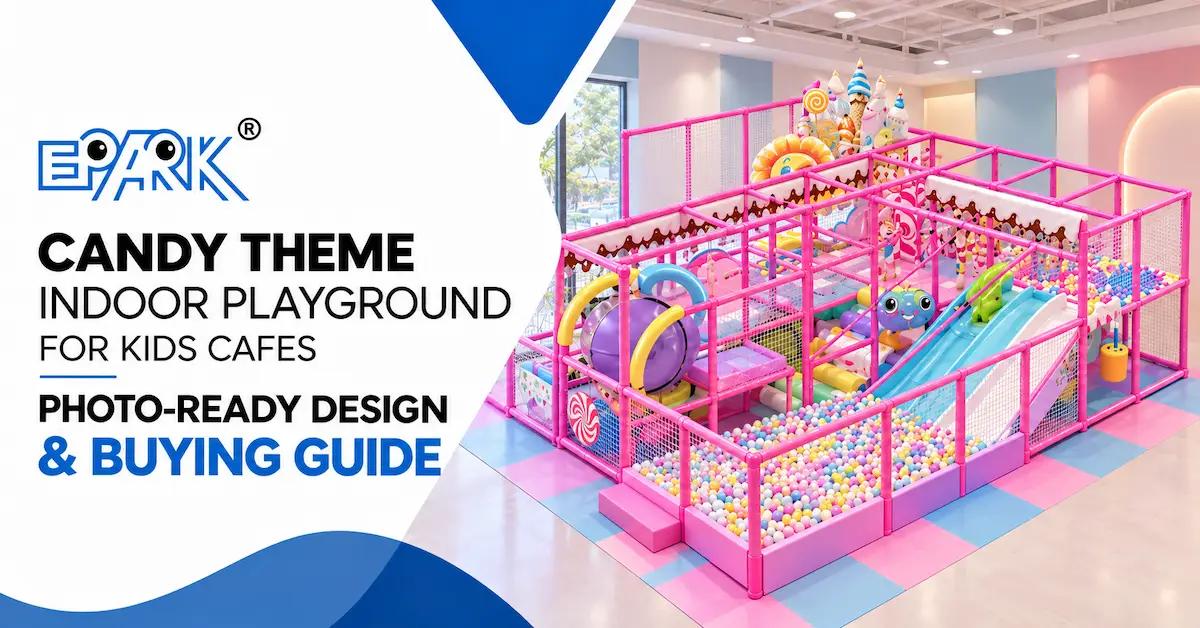
A candy theme indoor playground is a strong choice for a kids cafe when the operator wants one recognizable visual world to connect the entrance, seating, play structure, photo points, menu graphics, and social content. The design should begin with age zoning, circulation, parent sightlines, cleaning access, and the cafe workflow. Candy colors and oversized sweets can then make those functional decisions easier to see and share. A photo-friendly design is a business asset only when it remains safe, durable, maintainable, and easy to operate.
Families searching for a candy theme indoor playground are often looking for more than a colorful structure. A kids cafe owner needs a concept that can be recognized from the mall corridor, photographed without blocking the queue, understood by young children, and refreshed without rebuilding the entire venue. A procurement team needs the same concept translated into drawings, materials, activity modules, signage, artwork permissions, cleaning instructions, and a clear quotation.
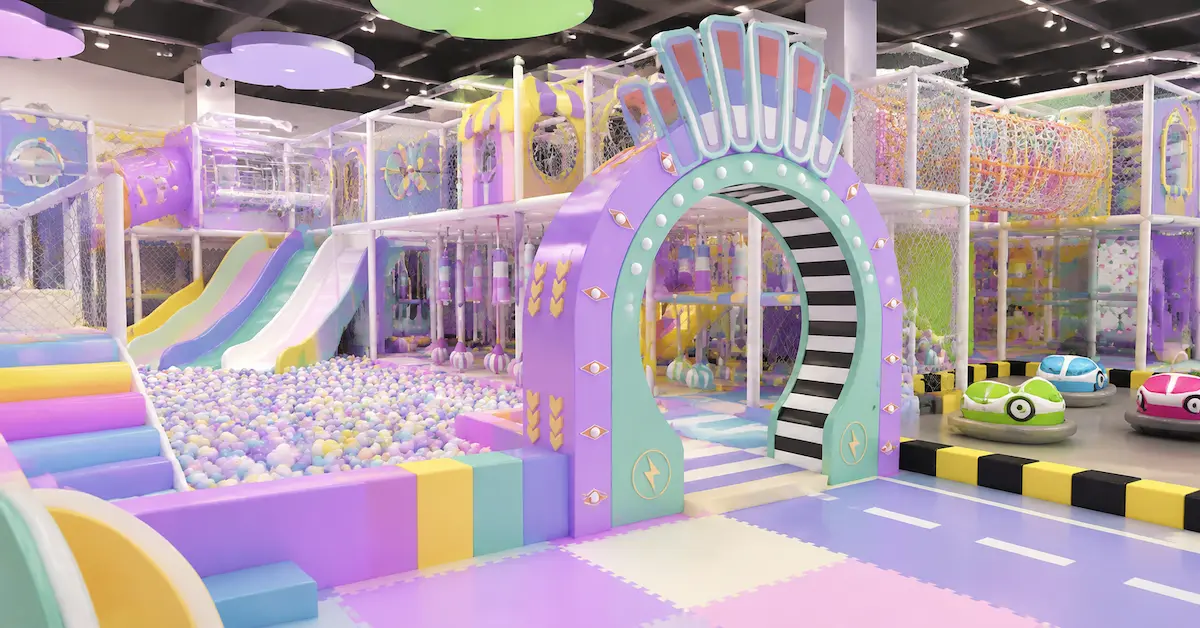
Turn the theme into a design brief. Share your cafe plan, usable play area, clear height, target ages, seating layout, brand colors, menu style, and the moments you want families to photograph.
Request a Candy Theme ConceptWhy Theme Choice Affects a Kids Cafe’s Attraction
A candy theme indoor playground works best when the theme is treated as an operating system for the cafe, not as a layer added after the equipment has been selected.
A theme reduces decision friction
Parents often decide whether to enter a kids cafe before they know the equipment list. A clear theme can communicate the venue’s age profile, mood, and experience from the storefront. Candy is immediately legible: bright color families, rounded forms, playful scale, and familiar shapes such as lollipops, cupcakes, candy drops, ice cream, and wrapped sweets. That visual shorthand can make a small venue feel intentional rather than assembled from unrelated modules.
The commercial value is not the color itself. The value is the reduction of uncertainty. A parent can see where the entrance is, where children play, where adults sit, and what kind of birthday or photo moment the cafe supports. The designer should therefore use the theme to organize the journey from arrival to checkout, not only to decorate a slide.
Theme can support menu and service design
A candy concept can align a cafe menu, party packages, table signs, staff aprons, birthday backdrops, loyalty cards, and seasonal content. That alignment makes it easier to create a repeatable brand system. It also creates a useful design constraint: if the main play structure uses soft pastel colors, a very different menu palette or generic black signage can break the experience.
Keep the operational layer visible. A themed counter still needs a clear queue, washable work surfaces, storage, power, and service access. A photo wall still needs to avoid blocking exits or making a narrow corridor narrower. Brand consistency is useful only when it supports safe movement and efficient work.
Theme is not a substitute for play value
Children do not play with a color palette. They crawl, climb, slide, balance, pretend, hide, and repeat a route. The candy story should help them understand those actions: a “mixing kitchen” for role play, a “candy bridge” for crossing, a “sugar cloud” for a soft landing, or a “lollipop lookout” for a visual landmark. The names can be playful, but the activity schedule must remain explicit in the technical brief.
Which Candy Theme Fits Which Age and Cafe Scenario?
A candy theme can serve several audiences, but the scale, contrast, texture, and activity intensity should change with the users. The table below is a planning framework. It is not a universal age or capacity specification; the approved design and local operating rules control.
| Cafe scenario | Design emphasis | Suitable activity direction | Operational question |
|---|---|---|---|
| Toddler-led cafe | Parent visibility, low height, gentle contrast, easy cleaning | Soft crawl modules, mini slides, sensory panels, role-play counter | Can one staff member see the entire zone and clean touch points between sessions? |
| Preschool family cafe | Short routes, imaginative story, clear age separation | Ball pool, padded climbing, bridges, themed playhouses, small slides | Where do children enter, queue, remove shoes, and return to parents? |
| Mixed-age FEC cafe | Visual landmarks with different challenge levels | Soft play core plus climbing, role play, interactive or sports add-ons | How are younger and higher-energy users separated during peak times? |
| Birthday-focused venue | Arrival reveal, group photo point, party room access | Signature cake or candy arch, flexible party area, themed play route | Can staff reset the photo and party areas without closing the whole venue? |
| Mall pop-up or compact site | Fast recognition, compact footprint, modular installation | One hero element, low soft play, branded panels, visible seating edge | Can the solution fit access, fire, landlord, and removal requirements? |
Toddler and preschool design logic
Use rounded visual language and low-impact activity, but do not let decorative forms create hidden corners, narrow passages, or hard-to-clean cavities. A candy “kitchen” can be a role-play panel with clear access, while a “marshmallow” can be a padded landmark rather than a loose object that becomes a trip hazard. Place the most photogenic feature where parents naturally stand, not in the staff-only or emergency route.
Mixed-age design logic
For an FEC or larger cafe, use color families and signs to make age zones obvious. A pastel toddler area can sit near seating; a stronger color and more vertical structure can identify the junior challenge zone. Avoid relying on color alone when the palette is similar. Use height, entry geometry, activity rules, and staff sightlines as well.
How to Combine Candy Visuals with Functional Modules
Start with the activity schedule
Before choosing candy props, list the play actions the venue needs. A useful schedule may include crawl-through play, climbing, sliding, ball play, balancing, role play, parent-child interaction, quiet sensory activity, and a clear rest point. The schedule should state who uses each item, how staff inspect it, how children leave the zone, and how the cafe cleans it.
EPARK’s broader soft play category shows how padded structures, ball pools, interactive panels, and themed arrangements can be combined. Ask the designer to annotate the layout with activity, age, material, and maintenance information instead of presenting only a rendered image.
Build a visual hierarchy
A photo-friendly space needs one or two primary landmarks, several secondary details, and quiet background surfaces. If every wall is a hero image, photographs become noisy and the main brand cue disappears. A practical hierarchy could be:
- Primary landmark: a large cake, candy arch, lollipop tower, or signature slide visible from the entrance.
- Activity landmark: a playhouse, ball pool, climbing route, or role-play counter that explains what children do.
- Photo frame: a safe standing or seated zone where families can take a picture without entering an active route.
- Navigation layer: color blocks, icons, signs, and floor cues that help parents find shoes, seating, toilets, and exits.
- Quiet background: durable panels and surfaces that keep the space legible between seasonal campaigns.
Use real materials to carry the theme
EPARK’s public materials and safety page describes cold-rolled steel pipes with hot-dip galvanization, high-density foam, soft PVC sleeves, EVA or PU mats, FRP or composite-resin slides, safety nets, railings, and padded components. Those descriptions can inform a candy concept, but they are not a project bill of materials. Ask which material applies to each panel, cover, slide, floor, barrier, and structural component in the approved configuration.
Color consistency is also a material issue. Ask for a sample or finish schedule, color references, print method, cleaning instructions, and replacement process. A rendering cannot prove how a finish behaves under frequent wiping, sunlight through a storefront, food spills, or repeated contact.
Use the public project examples as scale references, not packages. EPARK’s candy category lists pages named around examples such as 140 m2, 195 m2, 267 m2, 285 m2, 630 m2, 638 m2, and 650 m2. Those page labels show that the category is used for different project scales; they do not establish a standard footprint, capacity, price, MOQ, or repeatable bill of materials for a new cafe. Request a new plan based on the measured venue.
Keep service and safety zones out of the story only visually
Every candy theme indoor playground still needs a real reception, shoe change, cleaning store, staff route, accessible route, emergency access, and parent seating strategy. These areas can use the same palette without becoming cluttered. A candy-wrapped column should not hide a sprinkler, reduce a corridor width, or make a door difficult to identify.
Photo-Friendly Design, Brand Recognition, and Repeat Visits
The photo strategy for a candy theme indoor playground should be designed at the same time as the parent route, queue, seating, and staff access.
Design for photographs people can actually take
Families photograph moments, not floor plans. Give them a stable position, a clear background, good face height, and enough space to stand without blocking play. A hero prop can be wide and low enough for a group photo. A slide or tower can appear behind the subject as context, while the main standing area remains outside the landing or queue path.
Plan several distances: an entrance photograph that shows the whole candy world, a medium shot at the signature landmark, and a close detail such as a menu board, character panel, or textured prop. This creates more usable content than one oversized wall. Check sightlines from parent tables and from the cafe corridor, not only from a camera placed in the center of the room.
Connect user-generated content to the cafe brand
Photo propagation works better when the visual cue is unique to the venue. Use a consistent logo placement, branded color pair, custom phrase, mascot, or signature shape. Leave room for seasonal overlays without covering the core identity. If the design includes a licensed character, the buyer must confirm usage rights; the supplier should not be asked to reproduce protected artwork without documented authorization.
Use repeat-visit hooks without overbuilding
A themed environment can support repeat visits through rotating role-play prompts, birthday scenes, seasonal menu tie-ins, collectible stamps, or small replaceable panels. These updates should be planned as maintenance and content modules, not improvised after opening. Ask which elements can be changed without removing a main structure, and record the spare or replacement route.
Measure the business question honestly
Do not promise that photos equal revenue. Define the metrics the cafe can actually track: tagged posts, branded search mentions, birthday inquiry source, repeat-visit questions, party-package selection, dwell time by session, and cleaning downtime after high-traffic periods. Compare the data with the operating schedule and local promotion. The manufacturer can provide a design and equipment scope; the cafe owner must validate demand and financial performance.
Theme Design Pitfalls to Avoid
Choosing decoration before the building
A candy concept that ignores low beams, columns, doors, food-service routes, exits, and sprinkler clearances will be expensive to redraw. Start with measured drawings and a site photo set. EPARK’s customization process describes consultation, space planning, 3D design, material selection, production, inspection, packaging, delivery, installation, and after-sales support. Those stages only work well when the source site information is accurate.
Using too many saturated colors
Bright colors can help children orient themselves, but a wall-to-wall mix of pink, yellow, blue, and red can make photographs unreadable and hide important signs. Choose a controlled palette with one primary brand color, one or two supporting colors, and neutral surfaces that show faces and activity. Use contrast where parents need to identify edges and entrances.
Making props that are attractive but not cleanable
Food-shaped forms collect fingerprints, crumbs, and cleaning residue. Ask how each surface is accessed, wiped, dried, repaired, and replaced. Confirm whether covers are removable, whether seams are protected, and which cleaning agents are permitted. A photo detail that cannot be maintained becomes a visible trust problem.
Blocking the cafe’s commercial flow
Do not place the hero prop in front of reception, menus, toilets, party-room doors, or the best parent tables. Mark queues and stroller parking. Keep staff access distinct from child routes. A designer should show the cafe workflow at peak times, not only an empty-room render.
Copying a reference image without a scope
A reference image is useful for mood, not for engineering. Convert it into a component schedule: structure, activity, size, material, finish, artwork, lighting, fixing, cleaning, and replacement. Ask the supplier to label which items are included, optional, unavailable, or subject to local confirmation.
Overpromising safety or certification
EPARK’s website references standards and certificate images across different pages, but the public pages do not establish that every configuration carries every certificate for every market. Request the relevant documents with issuer, date, scope, tested sample, and standard. Treat local approval and destination requirements as a separate workstream.
Procurement warning: “Photo-friendly,” “non-toxic,” “certified,” and “easy to clean” are not complete specifications. Put the exact finish, material, inspection method, document, maintenance instruction, and acceptance condition into the project file. If a detail matters to opening or marketing, it must be visible in the quotation and approval record.
Custom Design Brief for a Candy Theme Indoor Playground
Send the following information before asking for a final layout or price. It gives the designer enough context to connect the theme to a workable kids cafe.
- Site envelope: dimensioned CAD or measured plan, clear height, columns, doors, exits, windows, services, floor levels, and loading route.
- Usable play area: reception, seating, party rooms, food service, toilets, storage, staff areas, and circulation marked separately.
- Audience: target ages, adult accompaniment, peak periods, school groups, birthday groups, and accessibility objectives.
- Activity brief: crawl, climb, slide, ball play, role play, sensory, sports, quiet area, and preferred supervision model.
- Brand system: logo files, colors, fonts, mascot, menu style, signs, phrases, and any licensed artwork permissions.
- Photo plan: entrance landmark, group photo location, close-up details, social-media orientation, lighting constraints, and seasonal update ideas.
- Material and finish needs: wipeability, texture, replacement preference, color samples, flooring, covers, and visible hardware expectations.
- Project scope: design, 3D renderings, technical drawings, manufacturing, inspection, packing, freight, installation, training, manuals, and spare parts.
- Commercial constraints: budget range if approved internally, opening target, destination market, landlord requirements, and quote validity.
- Approval gates: who signs the concept, materials, drawings, artwork, inspection, packing, and final acceptance.
| Design layer | What the supplier should show | What the cafe owner should approve |
|---|---|---|
| Theme concept | Palette, landmark, story, sign style, photo locations | Brand fit, readability, seasonal flexibility, rights to artwork |
| Space plan | Play zones, seating, reception, party area, circulation, exits | Parent sightlines, staff route, cleaning access, queue behavior |
| Activity schedule | Component, age, action, intensity, access, supervision | Fit with menu, session length, local rules, and operating policy |
| Materials | Framework, foam, covers, mats, slides, nets, finishes | Samples, cleaning method, replacement plan, document scope |
| Delivery package | Drawings, BOM, inspection, packing, install, manuals, spares | Inclusions, exclusions, responsibilities, acceptance evidence |
How EPARK’s Published Process Supports Custom Theme Work
When a buyer asks for a candy theme indoor playground, the design review should turn the visual brief into controlled drawings, materials, inspection evidence, packaging, and handover information.
EPARK describes a seven-stage route: consultation and needs assessment; space planning and professional design; material selection and safety compliance; custom manufacturing and production; quality inspection and secure packaging; delivery and professional installation; and after-sales support and maintenance. It also refers to 3D renderings, detailed floor plans, technical drawings, project management, installation support, staff training, and spare parts.
For a candy theme indoor playground, ask the supplier to make each stage visible in the proposal. The concept approval should identify the landmark, palette, and photo points. The technical package should identify dimensions, fixing, activity interfaces, exits, and service clearances. The material schedule should identify the actual covers, flooring, slide surfaces, nets, and panels. The production and inspection plan should explain how the approved design is checked before packing.
EPARK’s materials and safety page and certificate page are useful evidence entry points. The buyer should still request the order-specific document pack and confirm the scope of each test or certificate. A certificate image on a website is not a substitute for a readable file tied to the proposed product and destination.
Ask the quotation to state MOQ, packaging, and delivery boundaries explicitly. The website does not publish one universal MOQ for every candy theme component, replacement cover, or branded graphic. It does describe secure packaging and an inspection stage in the general process, so the buyer should ask for carton labels, hardware identification, packing photos, component counts, freight responsibilities, installation scope, and the process for reporting damage. Public pages also do not expose a universal test-data table for every configuration; any required impact, flame, chemical, or structural result should be requested as an order-specific report with sample and scope.
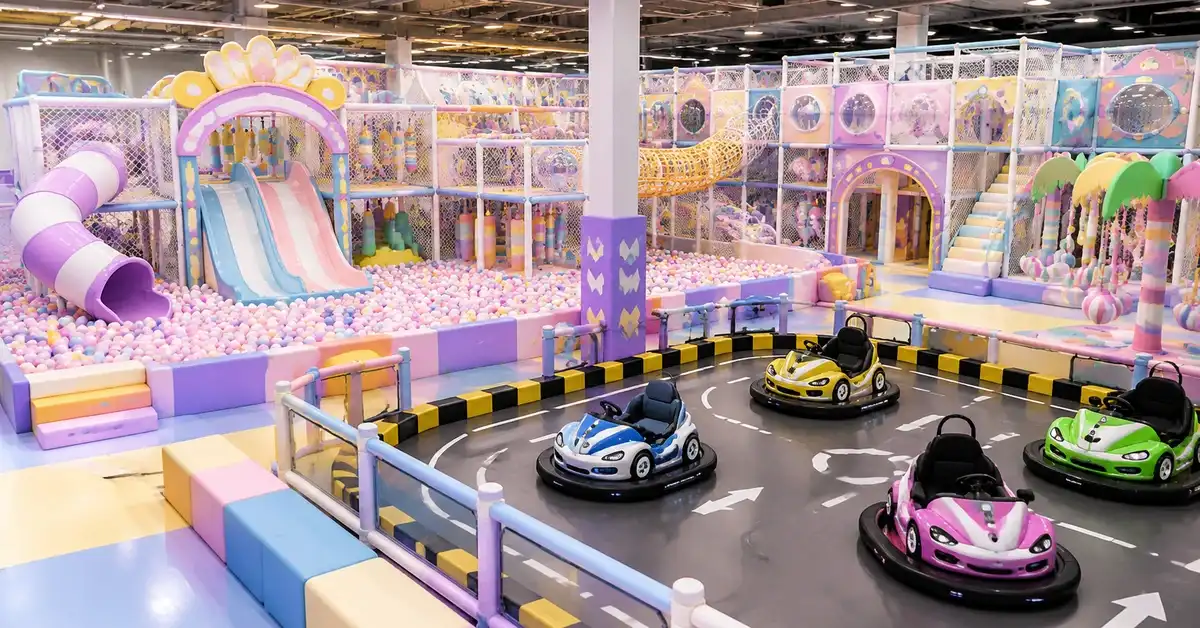
Frequently Asked Questions
Why choose a candy theme for a kids cafe?
Candy has an immediately recognizable visual language that can connect the storefront, play equipment, menus, party packages, and family photos. It is most useful when the theme supports clear activities, parent sightlines, cleaning, and a consistent brand system rather than acting as surface decoration only.
Is a candy theme indoor playground suitable for toddlers?
It can be, when the layout uses age-appropriate scale, low-impact activities, clear access, parent visibility, and a maintenance routine. The theme does not determine suitability by itself. Confirm the approved equipment, age policy, supervision, and local requirements.
Can the same candy design serve older children?
Yes, if the concept includes a separate challenge level and the visual language is not limited to tiny decorative props. Use climbing, slides, role play, sports, or interactive elements appropriate to the target users, with clear zoning and operating rules.
How do I make the playground more photo-friendly?
Plan one primary landmark, a safe group-photo position, clear backgrounds, face-height details, and an entrance view that explains the whole concept. Keep photo positions outside active routes and queues. Use a controlled palette and a unique venue brand cue so content remains identifiable.
Does a photo-friendly design guarantee more revenue?
No. Photos can support recognition and social content, but the cafe must test local demand, pricing, party sales, repeat visits, menu attachment, and operating costs. Track the source of inquiries and visits rather than treating visual appeal as proof of return on investment.
What materials are publicly described by EPARK?
EPARK describes hot-dip galvanized cold-rolled steel pipe, high-density foam, soft PVC sleeves, EVA or PU mats, FRP or composite-resin slides, safety nets, railings, and padded components. Ask for the project-specific material schedule, samples, test documents, and cleaning instructions.
Can I use a reference candy character or brand?
Only with the necessary rights. Provide the supplier with approved artwork and written authorization for any licensed character, logo, or branded packaging. The quotation should state which files are supplied by the buyer and which custom graphics are created for the project.
What information is needed for a custom quote?
Send the measured site or CAD plan, clear height, non-play functions, target ages, activities, theme direction, brand files, destination, opening target, and required scope for design, production, packing, shipping, installation, training, documents, and after-sales support.
What is EPARK’s reference design and production timeline?
The company FAQ publishes a general design reference of 3-7 days and production of 15-30 days after design confirmation. Other product pages may show different references. Use the current project quotation and its approval dependencies as the controlling schedule.
Conclusion
A candy theme indoor playground can give a kids cafe a strong first-viewport identity and a repeatable content system, but the theme has to earn its place in the operating plan. Start with users, activities, usable area, clear height, parent sightlines, cleaning, and service flow. Then use candy landmarks, controlled color, role-play details, and safe photo points to make the venue recognizable.
EPARK’s candy theme product category, soft play range, customization process, materials and safety information, and certificate gallery provide useful starting evidence for a supplier discussion. Convert every important visual idea into a project record: a dimensioned drawing, activity schedule, material and finish schedule, artwork approval, inspection plan, packing list, installation scope, and maintenance file. That is how a photo-friendly concept becomes a durable commercial kids cafe rather than a short-lived decoration.
Ready to develop the concept? Ask EPARK to review your site envelope and brand brief, then request a candy theme layout that separates visual inspiration from confirmed equipment, materials, documents, and delivery responsibilities.
Explore Candy Theme Products Discuss a Custom DesignGeneral Disclaimer
All data on https://www.eparki.com is for general guidance only. As a leading indoor playground manufacturer and trampoline supplier, EPARK strives for accuracy but gives no express or implied warranty regarding completeness, performance or project fitness. Product specs, designs and results may vary with use and customer requirements. Buyers must verify technical details, compliance and suitability before purchase. EPARK OEM/ODM is not liable for any direct, indirect or consequential damages arising from site use. For custom solutions, contact our manufacturer and supplier team via the Contact page.
Intellectual Property
Text, images, videos, CAD files and software are Guangzhou EPARK Electronic Technology Co., Ltd. All rights reserved. No part may be copied, republished or used commercially without prior written permission. We will pursue legal action for copyright or design-patent infringement.
Trademarks
"EPARK", the EPARK logo and related graphics are registered trademarks of Guangzhou EPARK Electronic Technology Co., Ltd. Unauthorized use in ads, domain names or packaging is prohibited.
Governing Law
These terms are governed by the laws of the People's Republic of China.
Contact
Questions? Email sales@nanyuetech.com or WhatsApp +86 139 0307 9263.