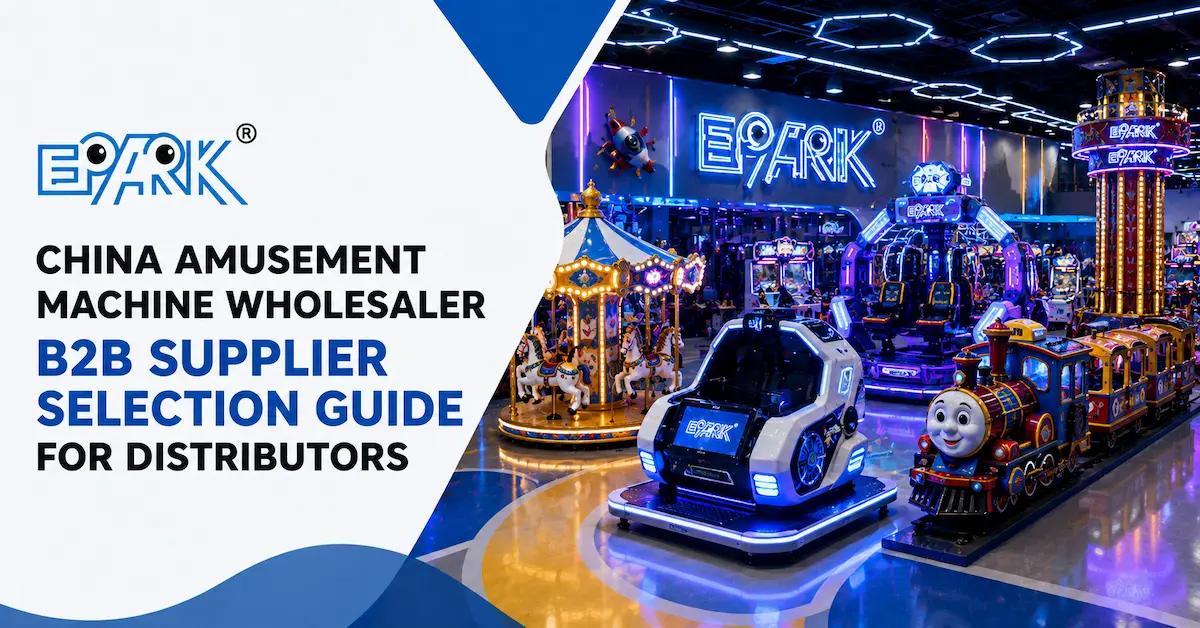
What Is a China Amusement Machine Wholesaler?
A China amusement machine wholesaler supplies commercial amusement and arcade equipment to distributors, importers, arcade operators, family entertainment centers, and project buyers, often across several machine categories rather than a single product line.
That sounds straightforward, but the useful part of a wholesale relationship is not the size of the catalog.
A distributor may see 300 machines online and still struggle to answer basic questions:
Which products are regularly supplied? Which models can be reordered next season? Who controls the final configuration? Are spare parts still available after the machines have been sold locally? If an order combines five equipment categories, who takes responsibility when something goes wrong?
Those questions matter more than the number of product thumbnails on a website.
For B2B buyers, a capable wholesaler should help coordinate:
- Product selection
- Mixed-machine orders
- Specifications
- Payment configurations
- OEM requirements
- Quality checks
- Spare parts
- Packing
- Export preparation
- Repeat orders
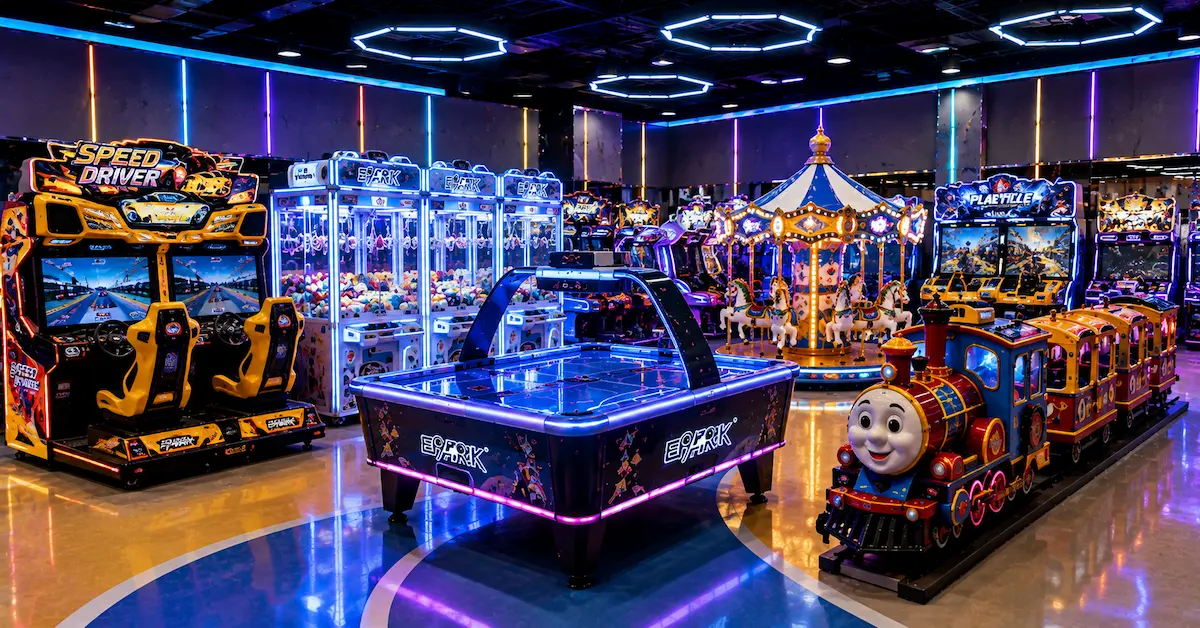
Buyers can review EPARK commercial arcade and amusement equipment when building an initial product shortlist.
Who Benefits Most From Working With an Amusement Machine Wholesaler?
A wholesaler is most useful when the buyer needs variety, coordination, or continuous supply.
Regional Distributors
Distributors rarely build a useful catalog around one machine.
Their customers may ask for racing games this month, claw machines next month, and a full FEC package later.
That makes product breadth important, but only if the products can be supported after sale.
A distributor normally needs:
- Several commercially useful categories
- Predictable specifications
- OEM or private-label options
- Replacement parts
- Repeat availability
- Clear after-sales responsibility
Importers
Importers often want to combine different products into fewer purchasing relationships.
Instead of coordinating separately with multiple suppliers, they may prefer one commercial contact for:
- Quotations
- Specifications
- Order consolidation
- Packing information
- Documentation
- Shipment preparation
The benefit is coordination, not simply convenience.
FEC and Arcade Operators
A new FEC may require racing, prize, sports, redemption, and family-oriented machines in the same project.
For these buyers, a wholesaler can be useful when it understands equipment mix rather than merely offering individual machines.
Arcade Chains
Chains often value consistency more than selection.
A machine that works well in one location may need to be reordered for three more venues. The second order should not arrive with an unexpected controller, different payment hardware, or artwork that no longer matches the first batch.
Private-Label Buyers
Private-label distributors need an even stronger record of approved specifications because branding has to survive beyond the first shipment.
When a Single Factory May Be a Better Choice
A wholesaler is not automatically the right answer.
Suppose a distributor needs 80 units of one mature racing model, with one configuration, one artwork package, and no additional product categories.
In that case, dealing directly with a specialized manufacturer may offer simpler production communication.
A wholesaler tends to create more value when the buyer needs:
- Multiple machine categories
- Mixed orders
- Project coordination
- Wider resale inventory
- One point of responsibility
The right supplier model depends on the order, not on the label printed on a business card.
Wholesaler vs Manufacturer: What Should Buyers Actually Compare?
The old question—“factory or trading company?”—is too simple for many amusement projects.
| Supplier Model | Often Stronger For | What Buyers Need to Verify |
|---|---|---|
| Manufacturer | Core product lines and direct production | Actual in-house capability |
| Wholesaler | Wider product assortment | Supplier transparency and QC |
| Integrated supplier | Products plus project coordination | Clear responsibility boundaries |
A manufacturer may know one machine category deeply.
A wholesaler may be better at coordinating a broader commercial range.
An integrated supplier may combine production with sourcing and project management.
What matters is who owns the result.
Before placing an order, ask:
- Who approves the specification?
- Who performs final QC?
- Who handles mixed-order problems?
- Who supplies spare parts?
- Who supports a reorder?
If those responsibilities remain unclear, the company type is almost irrelevant.
A Big Catalog Is Not the Same as a Strong Wholesale Range
Catalog size can be misleading.
A website may show hundreds of products, but a distributor needs to know which ones are commercially stable.
Ask four better questions.
Which Models Are Core Products?
Core models are typically easier to quote, support, and reorder than products that appear only occasionally.
Which Models Are Regularly Reordered?
Repeat demand is a useful signal because it suggests the supplier has experience maintaining the product over time.
Which Machines Have Stable Spare-Parts Support?
A machine may sell well initially but become difficult to service if a model-specific board or sensor cannot be supplied later.
Which Models Support OEM?
Not every product is equally suitable for customized artwork, branding, payment changes, or private labels.
A good wholesaler should be able to distinguish what is practical from what is merely possible in theory.
How to Build a Distributor-Friendly Amusement Machine Range
A distributor catalog should solve different customer needs.
It should not be ten cabinets that all do roughly the same job.
Anchor Products
These are visually strong products that can attract buyers and venue visitors.
Examples may include:
- Racing machines
- Shooting games
- Large sports games
- Immersive interactive machines
Repeat-Play Products
These may suit locations where short, repeatable play sessions are important.
Examples include:
- Claw machines
- Prize games
- Redemption equipment
Family-Oriented Products
For FEC and mall customers, the range may also need:
- Kiddie rides
- Simple skill games
- Accessible family games
Flexible Inventory Products
Not every customer has space for a large simulator.
Smaller machines can give distributors more options when selling to:
- Compact arcades
- Mall corners
- Restaurants
- Family venues
- Mixed entertainment spaces
A distributor catalog should cover different venue needs, not simply different cabinet colors.
Mixed-Order Capability Is a Real Test of a Wholesaler
Anyone can quote one machine.
The harder test is a mixed order.
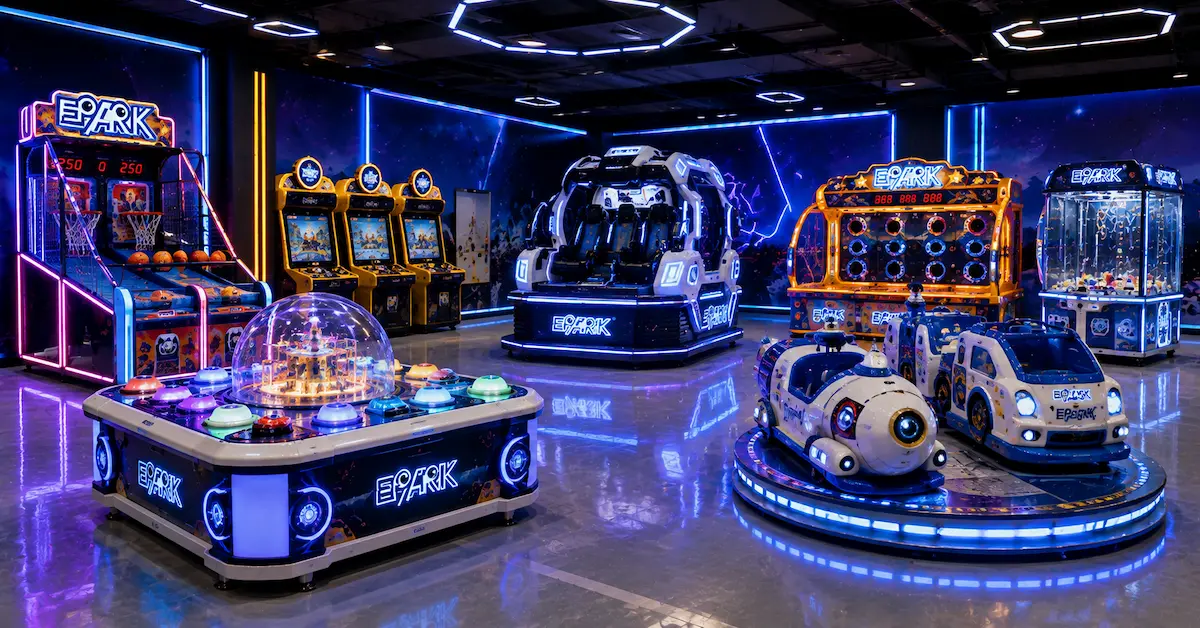
Imagine a purchase containing racing machines, claw machines, basketball games, redemption units, and kiddie equipment.
Those products may have different:
- Dimensions
- Electrical requirements
- Payment hardware
- Accessories
- Spare parts
- Packing methods
The wholesaler has to keep the order organized.
A professional mixed-order process should make it clear:
- Which specification belongs to each model
- Which accessories belong to each machine
- How spare parts are labeled
- Who completes final checks
- Who owns after-sales responsibility
One useful question to ask is:
If one machine in the mixed order has a problem, who is responsible for resolving it?
The answer tells you a great deal about how the supplier operates.
Reorder Consistency Matters More Than Buyers Expect
The first order gets most of the attention.
The second order exposes the supply system.
A distributor may reorder a popular machine six months later and discover:
- A different controller
- Another payment interface
- New buttons
- Changed artwork
- Incompatible spare parts
None of those changes may look serious on their own. Together, they make local service harder.
A useful solution is a reorder specification record.
It can include:
- Model
- Display
- Controller
- Main controls
- Voltage
- Frequency
- Plug
- Payment setup
- Artwork
- Accessories
- Spare parts
A wholesaler should be able to quote a reorder from an approved specification, not rebuild the order from old messages.
How Should a Wholesaler Handle Quality Control?
When machines come from more than one production source, QC responsibility becomes especially important.
A buyer does not need to know only whether “QC exists.”
The better question is:
Who performs the final check before the machines are released for shipment?
Functional Checks
Depending on the machine, this may include:
- Gameplay
- Controls
- Sensors
- Displays
- Sound
- Lighting
- Scoring
- Ticket functions
Payment Checks
Commercial machines should be tested using the agreed payment configuration.
That may involve:
- Coin
- Token
- Card
- Cashless preparation
Configuration Checks
Verify:
- Voltage
- Plug
- Artwork
- Payment setup
- Accessories
- OEM details
Appearance Checks
Confirm that cabinet surfaces, panels, doors, artwork, and visible components are in acceptable condition.
Packing Checks
Accessories and spare parts should be traceable to the correct machines.
Buyers comparing suppliers can review EPARK's safety and quality approach as part of the evaluation.
OEM Support Should Be Designed for Reorders
Distributors often ask about OEM at the beginning of a conversation, but many focus only on how the first batch will look.
The more difficult question is whether the branding can be reproduced consistently.
Depending on the model, quantity, and project requirements, customization may include:
- Logo placement
- Cabinet graphics
- Color schemes
- Language
- Product labels
- Payment configuration
Before production, confirm exactly what has been approved.
Keep artwork files, color references, specification records, and product identification organized so future orders do not depend on someone remembering an old conversation.
Buyers can review the EPARK customization process when planning an OEM or private-label project.
Spare Parts Are Part of the Wholesale Product
For a distributor, a machine is not finished when it is delivered to the customer.
Someone still has to support it.
That makes spare parts part of the commercial offer.
Common Wear Areas
Depending on machine type:
- Buttons
- Joysticks
- Pedals
- Handles
- Sensors
Revenue-Critical Parts
A small part can stop the machine from operating.
Examples may include:
- Coin acceptors
- Card interfaces
- Ticket-related components
- Power supplies
Model-Specific Parts
Some components may be difficult to replace locally:
- Dedicated control boards
- Special controllers
- Unique sensors
- Machine-specific assemblies
A distributor should ask whether each important part can be:
- Identified by model
- Reordered separately
- Matched to later production batches
A simple spare-parts matrix helps.
| Machine Category | Typical Service Risk | Parts Planning |
|---|---|---|
| Racing | Controls and pedals | Stock key wear items |
| Claw | Crane mechanism | Confirm compatible parts |
| Redemption | Ticket/scoring system | Keep revenue-critical items |
| Basketball | Sensors | Prepare common replacements |
The actual parts list should always be matched to the machine models purchased.
Stock Availability and Production Availability Are Not the Same
“In stock” sounds reassuring.
For distributors, it may not be enough.
There is an important difference between:
- Ready stock
- Regular production
- Temporary availability
- End-of-line inventory
A product available today may not be available for replenishment later.
That matters if the distributor spends money introducing the product to the local market, creating brochures, training sales staff, and stocking spare parts.
Ask whether the machine is part of a stable supply program or simply available at the moment.
What Makes a Wholesaler Good for Repeat Orders?
Repeat-order reliability is one of the strongest signs of a useful B2B wholesaler.
Look for five things.
Specification Memory
Can the supplier retrieve the approved configuration from the previous order?
Product Continuity
Can it explain whether the model remains in regular supply?
Artwork Records
Can private-label graphics be reproduced without restarting the design process?
Spare-Part Compatibility
Are later replacement parts compatible with earlier machines?
Faster Reorder Communication
A repeat order should become easier, not require the buyer to explain everything from the beginning.
For distributors, repeatability is part of product quality.
How to Compare China Amusement Machine Wholesalers
Do not reduce supplier comparison to three columns labeled price, quality, and service.
Use questions that relate to the actual business.
| Evaluation Area | Better Buyer Question |
|---|---|
| Product range | Are these categories commercially useful? |
| Core products | Which models have stable supply? |
| Mixed orders | Who coordinates the complete order? |
| Specifications | Can approved configurations be reproduced? |
| OEM | Can distributor branding be repeated? |
| QC | Who owns final inspection? |
| Spare parts | Can parts be identified and reordered? |
| Reorders | Can successful models be replenished? |
| Export support | Are packing and shipment details clear? |
Buyers considering EPARK can also review company information alongside equipment, QC, customization, and commercial requirements.
Red Flags When Choosing a China Amusement Machine Wholesaler
Hundreds of Products but No Clear Core Models
A long catalog is less useful if the supplier cannot explain what it consistently sells and supports.
Reorder Specifications Cannot Be Confirmed
This creates unnecessary risk for distributors.
QC Responsibility Is Unclear
Mixed sourcing is manageable. Unclear responsibility is not.
Spare Parts Are Described Only as “Available”
Ask for model-specific identification.
OEM Requirements Are Not Recorded
Important branding and technical details should not live only inside chat history.
Technical Questions Move Between People Without an Owner
Someone should be responsible for resolving configuration and service questions.
Availability Changes Without Warning
Distributors need enough visibility to manage their own customers.
Every Conversation Returns to Price
Price matters. A wholesale supply relationship also depends on product continuity, configuration, QC, serviceability, and reorder support.
What Should Buyers Include in a Wholesaler RFQ?
A detailed inquiry saves time for both sides.
Include:
- Buyer type: distributor, importer, FEC, arcade chain, or project buyer
- Destination country
- Required machine categories
- Preferred models
- Quantity by model
- Mixed-order requirements
- Voltage and frequency
- Plug type
- Payment system
- OEM or private-label requirements
- Spare-parts requirements
- Expected reorder needs
- Destination port
- Preferred Incoterm
- Target shipment date
Instead of sending only “Please send wholesale price,” give the supplier enough information to understand the business.
A stronger inquiry might contain:
machine categories + quantities + destination + payment setup + branding needs + spare-parts requirements + expected reorder plan.
Buyers can contact EPARK with those details for a project-specific equipment proposal and quotation.
FAQ
What is a China amusement machine wholesaler?
A China amusement machine wholesaler supplies commercial amusement and arcade machines to distributors, importers, venue operators, and project buyers, often coordinating multiple product categories, mixed orders, QC, spare parts, OEM requirements, and repeat supply.
Who should buy from an amusement machine wholesaler?
Wholesalers can be particularly useful for distributors, importers, FEC operators, arcade chains, and buyers who need several machine categories or ongoing replenishment.
Is a wholesaler better than an arcade machine factory?
Not necessarily.A factory may be better for a large order concentrated on one product line, while a wholesaler may be more useful when the buyer needs a broader equipment mix and coordinated sourcing.
Can one wholesaler supply different amusement machine categories?
Potentially, yes. Buyers should confirm which products are core lines, which are sourced externally, and who takes responsibility for final specifications and QC.
How can distributors check whether products can be reordered?
Ask whether the supplier keeps approved specifications, artwork records, configuration details, and spare-part references for previous orders.
Can amusement machines be private labeled?
Depending on the model and project requirements, customization may include logos, cabinet artwork, colors, language, product labels, and selected payment configurations.
How should a wholesaler manage quality control?
The wholesaler should clearly define who is responsible for functional testing, payment checks, configuration verification, appearance inspection, accessories, and packing before shipment.
What spare parts should distributors keep locally?
Prioritize common wear parts, revenue-critical components, and model-specific items that may be difficult to source quickly in the local market.
Can different machines be combined in one order?
Mixed orders may be possible depending on product availability, quantities, specifications, and logistics arrangements. Responsibility for coordination and QC should be clear before the order is confirmed.
What should I send when requesting a wholesale quotation?
Send your buyer type, machine categories, model preferences, quantity, destination, voltage, payment system, OEM requirements, spare-parts needs, reorder expectations, and target shipment date.
Conclusion
Choosing a China amusement machine wholesaler is not a contest to find the longest catalog.
For distributors, importers, FEC operators, and arcade chains, the better wholesaler is the one that can turn a complicated order into a repeatable supply system:
Useful Product Range → Clear Responsibility → Mixed-Order Coordination → Specification Control → OEM → QC → Spare Parts → Reorder Reliability
That last point deserves particular attention.
A machine that sells successfully in your market becomes more valuable when it can be supplied again with the same configuration, compatible spare parts, and recognizable branding.
Explore EPARK commercial amusement and arcade equipment, learn more about EPARK, review the customization process and quality approach, or contact EPARK with your target machine categories, quantities, destination, payment requirements, OEM needs, spare-parts plan, and expected reorder requirements for a more relevant wholesale proposal.
General Disclaimer
All data on https://www.eparki.com is for general guidance only. As a leading indoor playground manufacturer and trampoline supplier, EPARK strives for accuracy but gives no express or implied warranty regarding completeness, performance or project fitness. Product specs, designs and results may vary with use and customer requirements. Buyers must verify technical details, compliance and suitability before purchase. EPARK OEM/ODM is not liable for any direct, indirect or consequential damages arising from site use. For custom solutions, contact our manufacturer and supplier team via the Contact page.
Intellectual Property
Text, images, videos, CAD files and software are Guangzhou EPARK Electronic Technology Co., Ltd. All rights reserved. No part may be copied, republished or used commercially without prior written permission. We will pursue legal action for copyright or design-patent infringement.
Trademarks
"EPARK", the EPARK logo and related graphics are registered trademarks of Guangzhou EPARK Electronic Technology Co., Ltd. Unauthorized use in ads, domain names or packaging is prohibited.
Governing Law
These terms are governed by the laws of the People's Republic of China.
Contact
Questions? Email sales@nanyuetech.com or WhatsApp +86 139 0307 9263.