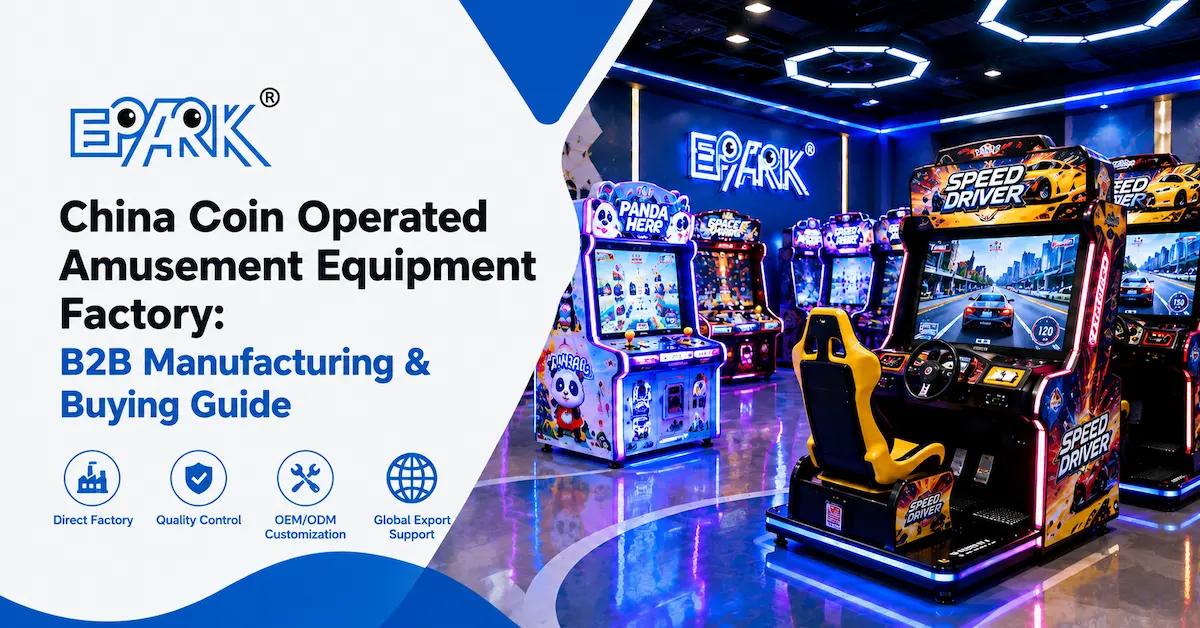
What Is a China Coin Operated Amusement Equipment Factory?
A China coin operated amusement equipment factory manufactures commercial arcade and amusement machines in which the payment system, game controller, electrical system, cabinet, controls, and operator-access components must work together as one complete operating system.
The phrase “coin operated” sounds simple. Put money in, play the game.
From a buyer's perspective, however, there are several things happening between those two actions.
The payment unit has to recognize the correct coin or token. The machine must register the right number of credits. The start logic has to deduct those credits correctly. Operators need practical access to the payment area. Replacement components need to remain available. If the buyer later orders another batch, the same configuration should be reproducible.
That means a coin-operated machine is not simply an ordinary arcade cabinet with a coin acceptor added at the end.
A better procurement sequence is:
Payment Requirement → Machine Integration → Sample Approval → Production → Payment Testing → QC → Spare Parts → Export Configuration → Repeat Order
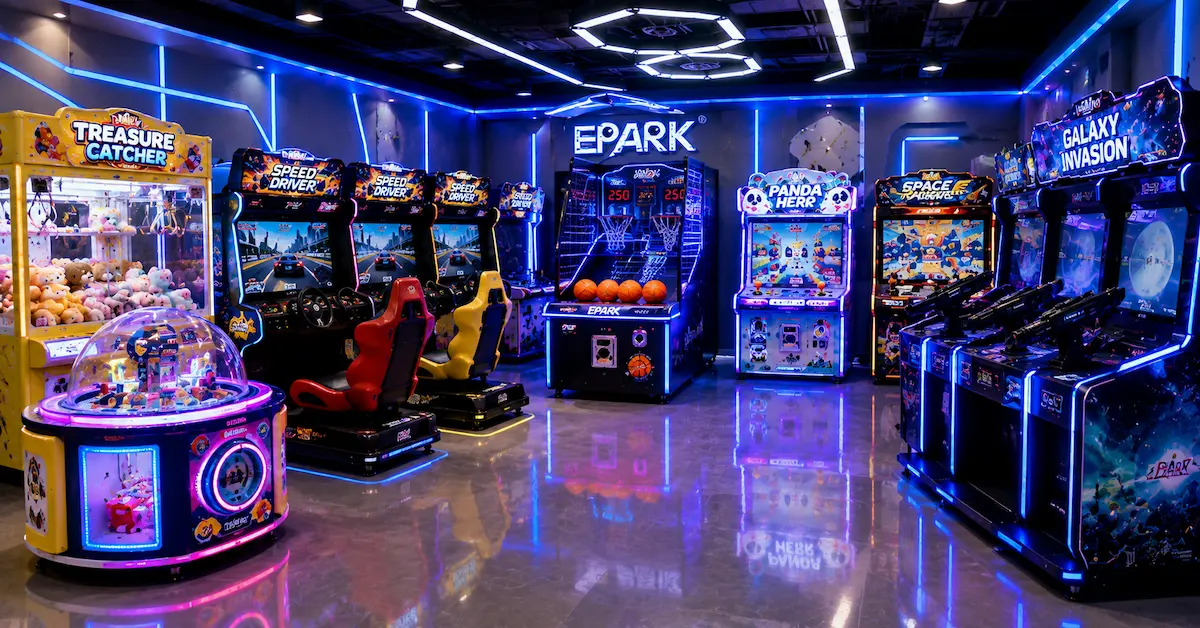
Buyers preparing a commercial project can review EPARK arcade and amusement equipment before deciding which machine categories need coin, token, card, or other payment arrangements.
What Does “Coin Operated” Actually Include?
For purchasing purposes, “coin operated” should be treated as a system rather than a single component.
Coin or Token Acceptor
This is the payment-entry point.
Buyers should identify whether the machine is expected to recognize:
- Local coins
- Venue tokens
- Another approved payment medium
The correct specification should be confirmed before production rather than assumed from a product photo.
Credit Logic
Once payment is accepted, the machine controller has to determine how many credits are added.
One payment may equal one play in one venue, while another operator may use a different commercial setup.
That logic needs to be documented.
Start Logic
The game must then use the credit correctly.
For example, the buyer should verify whether:
- One game consumes one credit
- Several credits can be accumulated
- Unused credits remain available
- Multiplayer operation changes the credit requirement
The exact behavior depends on the machine.
Coin Box and Operator Access
Payment hardware also has an operational side.
Operators need reasonable access for:
- Coin collection
- Inspection
- Component replacement
- Troubleshooting
A payment system that works electronically but is difficult to reach can still create unnecessary maintenance time.
Why Payment Integration Matters in Commercial Operation
For an arcade or FEC operator, a payment failure is different from a decorative lighting failure.
If a light stops working, the machine may still generate revenue.
If the machine cannot accept payment, it may stop generating revenue entirely.
That changes the importance of payment-system testing.
Payment Recognition
The machine should reliably recognize the intended coin or token configuration.
Credit Accuracy
The amount paid must correspond to the agreed credit setting.
A machine that occasionally adds the wrong credit count creates both revenue and customer-service problems.
Repeated Transactions
One successful test is not enough.
Commercial machines may receive repeated payments throughout the day. The system should remain stable during multiple payment-and-start cycles.
Maintenance Access
If a payment component needs replacement, technicians should not have to dismantle unrelated parts of the machine.
This is one reason payment integration should be considered during cabinet and internal-layout design.
Coin, Token, Card or Cashless: What Should Buyers Confirm?
Commercial venues increasingly use different payment models, so the factory should understand the actual operating environment.
| Payment Method | Factory-Side Requirement | Buyer Should Confirm |
|---|---|---|
| Coin | Appropriate acceptor/configuration | Local coin requirement |
| Token | Token-compatible mechanism | Token specification |
| Card | Reader mounting/interface preparation | Reader and integration responsibility |
| Cashless | Hardware/interface compatibility | System and credit-logic requirements |
Not every machine supports every payment method in the same way. Compatibility should therefore be confirmed according to the machine design and project requirements.
If the venue may later migrate from coin to card operation, mention this before the order is finalized. A future conversion may depend on physical space, controller logic, wiring, and third-party payment-system requirements.
Different Machines Need Different Payment Checks
A useful factory inspection does not treat every arcade product identically.
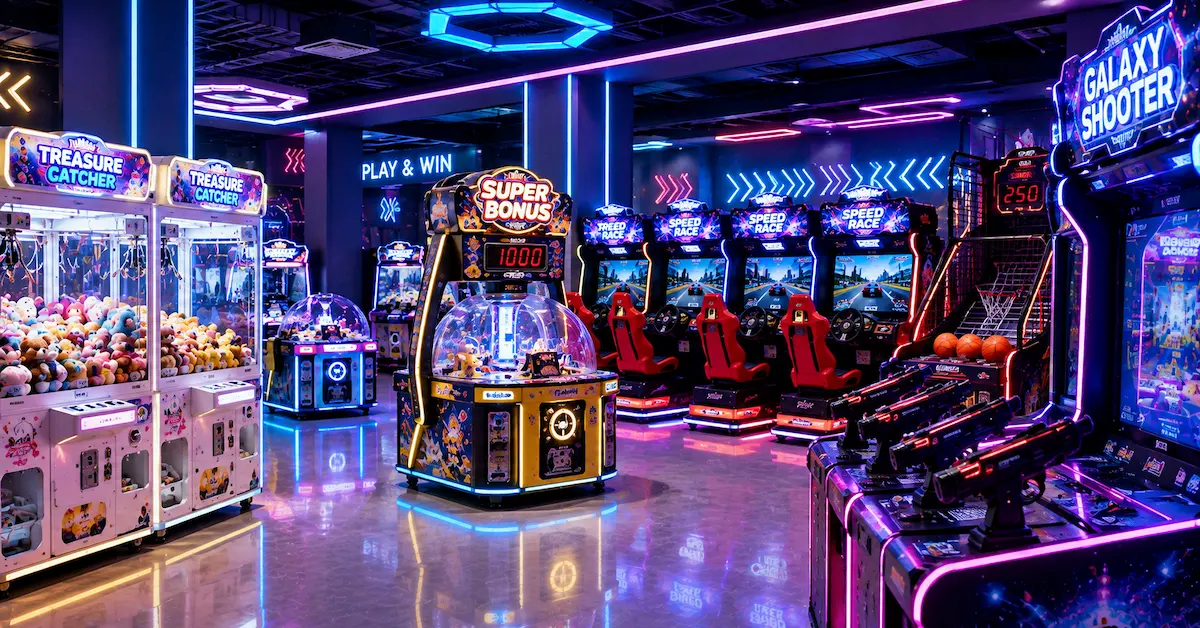
Claw Machines
For claw equipment, buyers should verify the relationship between:
- Payment
- Credit
- Crane activation
- Play cycle
- Prize access
A machine that accepts payment correctly but uses the wrong credit logic still has an operational problem.
Racing Machines
Driving games may require confirmation of:
- Individual-player credits
- Linked-machine operation
- Start logic
- Steering and pedal activation
- Multiplayer behavior
Basketball Machines
The payment system normally needs to work together with:
- Game timer
- Scoring activation
- Start sequence
Redemption Games
These machines can add another layer because buyers may need to verify:
- Payment
- Game credit
- Score
- Ticket output
Kiddie Rides
For rides, payment may control a defined operating cycle.
The buyer should understand how the cycle starts, how long it runs, and how operator controls interact with the payment system.
Shooting Games
Payment should be tested together with game start, gun or controller activation, sensors, and any multiplayer logic.
How Should a Factory Integrate the Payment System?
The complete transaction chain can be viewed as:
Payment Input → Controller → Credit → Game Start → Game Result → Next Transaction
A factory should understand each stage.
Physical Installation
The payment hardware needs a secure, accessible mounting position.
That position should make sense for both players and operators.
Wiring
The payment unit has to communicate correctly with the machine controller.
Poorly organized wiring can make later troubleshooting harder even if the machine works initially.
Credit Configuration
The agreed commercial logic should be recorded rather than left as an informal verbal instruction.
Operator Access
Coin collection, reader servicing, and payment-component replacement should be considered during machine assembly.
Final Testing
Before shipment, the factory should test the actual relationship between payment, credit, and game activation rather than testing gameplay alone.
Standardizing Payment Systems Across a Mixed Order
A new FEC may order racing machines, basketball games, claw machines, redemption equipment, and shooting games at the same time.
If each machine arrives with a different payment logic, the venue has created a service problem before opening.
Where practical, buyers can standardize:
- Payment method
- Credit rules
- Operator access approach
- Common spare components
A useful internal document is a Payment Configuration Sheet.
| Machine | Payment Type | Credit Setting | Interface | Critical Spare |
|---|---|---|---|---|
| Claw machine | Confirm | Confirm | Confirm | Payment unit |
| Racing game | Confirm | Confirm | Confirm | Interface/controller |
| Redemption game | Confirm | Confirm | Confirm | Payment/ticket parts |
| Basketball game | Confirm | Confirm | Confirm | Payment/sensor parts |
The values should be completed according to the actual equipment ordered.
A mixed arcade order becomes easier to operate when payment configurations are standardized wherever practical.
How to Evaluate a Coin Operated Amusement Equipment Factory
A large workshop or long product catalog does not automatically prove that a factory handles payment integration well.
Ask questions directly related to the operating system.
Who Configures the Payment Hardware?
Determine whether payment installation and setup are handled by the factory's production or technical team.
Who Sets the Credit Logic?
The person responsible should understand how the payment unit communicates with the game controller.
Is Payment Tested on Every Relevant Machine?
A buyer should know whether payment is checked during final testing, not assumed to work because the game itself starts in service mode.
Can Configurations Be Standardized Across Models?
This matters particularly for arcade chains and FEC operators.
Can the Same Setup Be Reproduced Later?
For distributors, repeat-order consistency can be as important as the first-order price.
Buyers considering EPARK can also review EPARK company information when assessing manufacturing, project, and supply capabilities.
A Sample Should Test Payment, Not Just Gameplay
Samples are often evaluated emotionally.
The buyer sees the cabinet, plays the game, checks the lighting, and decides whether the product feels attractive.
That is useful, but incomplete.
A commercial sample should also be operated like a machine in a real venue.
Test the First Payment
Confirm that the intended payment medium is recognized.
Test Repeated Payments
Run multiple payment-and-play cycles.
Test Multiple Credits
If the machine supports accumulated credits, confirm that they are counted correctly.
Test Game Start
Check whether the correct amount of credit is consumed.
Restart the Machine
Verify expected behavior after power cycling.
Open the Payment Area
Check whether operators can realistically collect coins or replace the payment unit.
Sample approval is much stronger when both gameplay and commercial operation are evaluated.
Quality Control for Coin Operated Amusement Equipment
Statements such as “strict QC” tell a buyer very little.
The more useful question is: what is actually tested?
For coin-operated equipment, inspection may cover several areas.
Payment Activation Test
Confirm that payment correctly triggers the intended credit.
Credit-Logic Check
Verify that the number of credits added and consumed matches the approved setting.
Control and Sensor Testing
Depending on equipment type, this may include:
- Buttons
- Joysticks
- Steering
- Pedals
- Guns
- Sensors
- Scoring
Display, Sound and Lighting
These systems should function alongside the payment-controlled game cycle.
Wiring Inspection
Review connections and organization around important control and payment components.
Configuration Verification
Before packing, confirm:
- Model
- Quantity
- Payment method
- Credit setting
- Voltage
- Frequency
- Plug
- OEM details
- Accessories
- Spare parts
Buyers can review EPARK's safety and quality approach when defining their own inspection requirements.
One Correct Sample Does Not Guarantee a Correct Batch
This matters in wholesale and project orders.
Imagine a batch of machines where most use the agreed credit setting but one has been configured differently.
The cabinet may look identical. The game may work. Yet the operator has a commercial inconsistency.
For that reason, batch quality should also include:
- Same payment-unit specification
- Same credit setting
- Same electrical configuration
- Same interface
- Same agreed accessories
Payment consistency is part of batch quality.
For large orders, the approved configuration should be recorded so the production team is not working from memory.
OEM and Private-Label Coin Operated Machines
Distributors and regional brands may also require customized equipment.
Depending on the machine and project requirements, OEM work may involve:
- Logo
- Cabinet artwork
- Color scheme
- Product labels
- Language
- Selected hardware configuration
- Payment settings
Buyers can review the EPARK customization process when preparing an OEM project.
An important distinction is worth making:
Artwork approval and payment-configuration approval are not the same thing.
A machine can have the correct logo and still have the wrong credit setting.
Keep technical and branding approvals separately documented.
Spare Parts Planning for Payment Systems
For commercial machines, spare parts are easier to plan before the container leaves than after a machine stops working.
Payment-related planning may include:
Payment Components
Depending on the machine:
- Coin acceptor
- Token acceptor
- Relevant interfaces
- Payment wiring
Revenue-Critical Parts
Any component whose failure prevents the machine from accepting payment or completing a game deserves special attention.
Machine-Specific Components
Some controllers, boards, and sensors may be difficult to replace locally.
For distributors, the important questions are:
- Can the part be identified by model?
- Can it be reordered separately?
- Will it remain compatible with repeat-production machines?
That last question matters more than receiving a random bag of generic spare parts.
Can Coin Operated Machines Be Converted to Card or Cashless?
Sometimes—but buyers should not assume the conversion is automatic.
A change may depend on:
- Controller logic
- Physical mounting space
- Wiring
- Payment interface
- Credit settings
- Third-party system requirements
If a buyer knows that a venue may later adopt card or cashless payment, it is better to discuss that possibility during the original specification stage.
Retrofitting after arrival may require additional hardware, labor, or technical changes.
How to Compare Factory Quotations Correctly
Two coin-operated machines are not directly comparable simply because their cabinet dimensions and gameplay look similar.
| Quote Item | Buyer Should Confirm |
|---|---|
| Machine | Exact configuration |
| Payment unit | Agreed specification |
| Credit setting | Exact operating logic |
| OEM | Included or additional |
| Spare parts | Included or optional |
| QC | What is actually tested |
| Packing | Export preparation |
| Repeat order | Can the same setup be reproduced? |
A low quotation can hide a different payment configuration, fewer accessories, or a narrower supply scope.
Compare the system being purchased, not only the cabinet.
Payment Failure Has a Commercial Cost
The purchase price is visible on the quotation.
The cost of a payment problem usually is not.
A payment mismatch after arrival can create:
- Technician time
- Replacement-part costs
- Retrofit work
- Delayed installation
- Machine downtime
- Lost operating revenue
A machine that is cheaper at the factory can become more expensive if its payment system has to be modified after delivery.
That is why the payment requirement should be frozen before mass production.
Red Flags When Choosing a Factory
Several warning signs deserve attention before a commercial order is finalized.
Payment Configuration Is Never Written Down
Important operating logic should not exist only in chat messages.
The Factory Cannot Explain Credit Logic
Someone should understand how payment translates into gameplay.
Every Model Is Described as Using a “Standard Coin System”
Ask what “standard” actually means.
Sample and Bulk Configurations Differ
Any change should be identified and approved.
Payment Testing Is Not Part of Final QC
Gameplay testing alone is insufficient for coin-operated equipment.
Spare Payment Components Cannot Be Identified
This makes future maintenance harder.
Card or Cashless Compatibility Is Promised Immediately
Integration should be technically reviewed rather than treated as a universal feature.
Configuration Changes Without Buyer Approval
This is especially risky for distributors and multi-location operators.
What Should Buyers Include in a Factory RFQ?
A detailed RFQ helps the factory prepare a configuration-specific quotation instead of guessing.
Include:
- Destination country
- Venue type
- Required machine categories
- Preferred models
- Quantity by model
- Coin, token, card,or cashless requirement
- Coin or token specification where applicable
- Required credit logic
- Voltage and frequency
- Plug type
- OEM or private-label requirements
- Spare-parts requirements
- Repeat-order expectations
- Destination port
- Preferred Incoterm
- Target shipment or venue-opening date
Buyers can contact EPARK with these details.
Instead of asking only for the “best price,” a stronger inquiry would include:
machine list + quantity + destination + payment method + credit requirements + voltage + OEM needs + spare-parts plan + target delivery date
That gives the factory enough information to prepare a commercially meaningful proposal.
FAQ
What is a China coin operated amusement equipment factory?
A China coin operated amusement equipment factory manufactures commercial arcade and amusement machines in which payment hardware, credit logic, game controls, electrical systems, cabinet components, and operator access are integrated for commercial use.
What types of coin operated amusement equipment can factories produce?
Depending on the manufacturer, product categories may include claw machines, racing games, basketball machines, redemption games, shooting equipment, kiddie rides, and other commercial amusement machines.
How does a coin operated arcade machine payment system work?
The payment device recognizes the approved coin or token, sends a signal to the controller, adds the configured credit, and allows the game to start according to the programmed credit logic.
Can arcade machines use tokens instead of coins?
Some machines may support token-based operation when the appropriate acceptor and configuration are specified. Buyers should confirm the token requirements before production.
Can coin operated machines be converted to card or cashless payment?
Potentially, but compatibility depends on controller logic, interfaces, physical mounting, wiring, credit settings, and the third-party system. Technical confirmation is required.
What should buyers test on a sample machine?
Test payment recognition, repeated transactions, accumulated credits where applicable, game-start logic, controls, power restart behavior, and operator access to the payment area.
How should a factory test coin operated equipment before shipment?
Testing should cover payment activation, credit logic, gameplay, controls, relevant sensors, electrical configuration, appearance, accessories, and the agreed final machine specification.
Can coin operated arcade machines be customized?
Depending on the model and project, customization may include logos, artwork, colors, language, labels, selected hardware configurations, and payment settings.
What spare parts should buyers order for payment systems?
Focus on compatible payment hardware, interfaces, wiring, controllers, and other revenue-critical or machine-specific parts according to the models purchased.
What information should I send for a factory quotation?
Provide machine categories, quantities, destination, payment method, credit logic, voltage, plug, OEM requirements, spare-parts needs, preferred trade term, and target delivery date.
Conclusion
Choosing a China coin operated amusement equipment factory should not be reduced to finding a machine with a coin acceptor installed on the front panel.
The commercial system is broader:
Payment Requirement → Integration → Sample Approval → Production → Payment Testing → QC → Batch Consistency → OEM → Spare Parts → Repeat Supply
The right factory needs to deliver a machine in which payment hardware, credit logic, electronics, controls, operator access, and service requirements work together.
That matters to a single arcade operator, but it matters even more to distributors, FEC chains, and project buyers who need dozens of machines to behave consistently.
Explore EPARK commercial arcade and amusement equipment, learn more about EPARK, review its customization process and quality approach, or contact EPARK with your machine list, quantities, destination, payment method, credit settings, OEM needs, spare-parts requirements, and target delivery date for a configuration-specific project proposal and quotation.
General Disclaimer
All data on https://www.eparki.com is for general guidance only. As a leading indoor playground manufacturer and trampoline supplier, EPARK strives for accuracy but gives no express or implied warranty regarding completeness, performance or project fitness. Product specs, designs and results may vary with use and customer requirements. Buyers must verify technical details, compliance and suitability before purchase. EPARK OEM/ODM is not liable for any direct, indirect or consequential damages arising from site use. For custom solutions, contact our manufacturer and supplier team via the Contact page.
Intellectual Property
Text, images, videos, CAD files and software are Guangzhou EPARK Electronic Technology Co., Ltd. All rights reserved. No part may be copied, republished or used commercially without prior written permission. We will pursue legal action for copyright or design-patent infringement.
Trademarks
"EPARK", the EPARK logo and related graphics are registered trademarks of Guangzhou EPARK Electronic Technology Co., Ltd. Unauthorized use in ads, domain names or packaging is prohibited.
Governing Law
These terms are governed by the laws of the People's Republic of China.
Contact
Questions? Email sales@nanyuetech.com or WhatsApp +86 139 0307 9263.