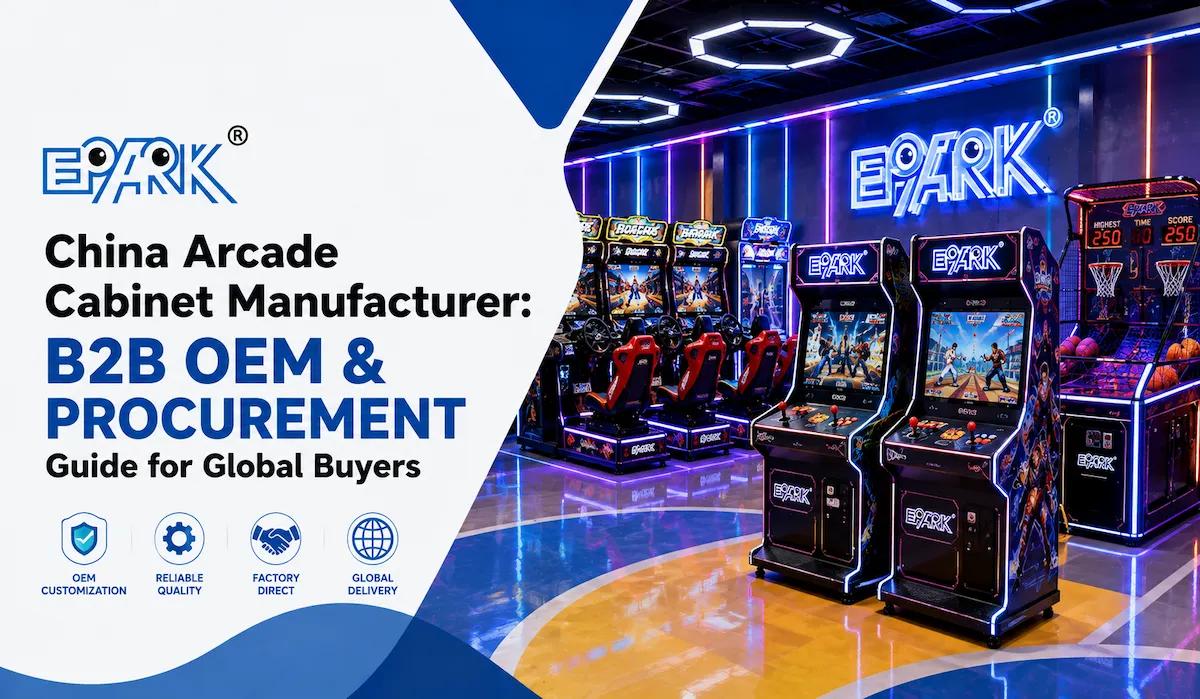
What Does a China Arcade Cabinet Manufacturer Actually Do?
A China arcade cabinet manufacturer develops and produces the enclosure and structural platform that brings an arcade machine together. The cabinet has to accommodate the display, controls, electronics, payment hardware, lighting, audio components, wiring, service doors, and the visual design players see from across the venue.
That makes an arcade cabinet much more than a decorative shell.
For a commercial buyer, the cabinet influences how the machine is assembled, transported, installed, operated, maintained, branded, and eventually reproduced.
A cabinet that looks excellent in a rendering can still create problems if the technician cannot reach the power supply, the monitor mount is awkward to service, wiring routes are difficult to trace, or a replacement control requires removing several unrelated panels.
A better way to evaluate a cabinet is therefore:
Appearance + Structure + Integration + Serviceability + Repeatability
Buyers developing a complete commercial game rather than only an empty enclosure can also review EPARK arcade and amusement equipment to understand how different cabinet formats are used in finished machines.
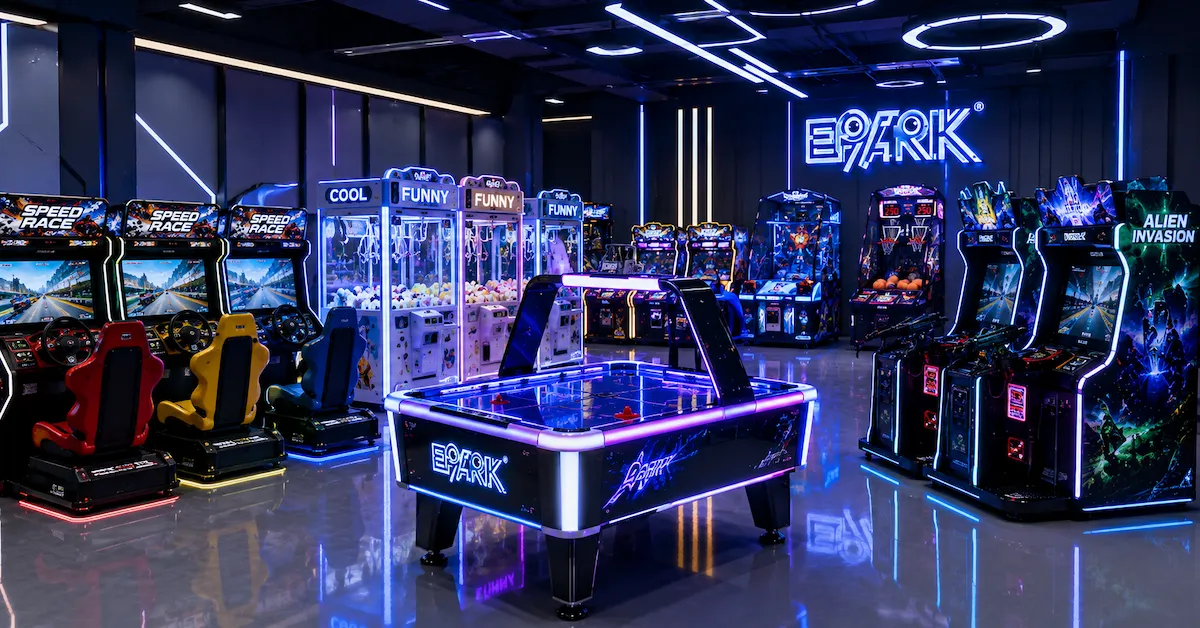
Arcade Cabinet Manufacturer vs Complete Arcade Machine Manufacturer
These terms are often used interchangeably, although the purchasing scope can be quite different.
| Supplier Type | Typical Scope | Better Fit For |
|---|---|---|
| Cabinet manufacturer | Enclosure and cabinet-focused production | Buyers integrating their own hardware |
| Complete machine manufacturer | Cabinet, electronics,controls and game system | Buyers purchasing finished machines |
| Integrated OEM supplier | Cabinet development plus machine integration | Brands and distributors developing customized products |
A buyer who already has a game board, monitor, controller system, and software may mainly need an enclosure engineered around those components.
Another buyer may want the supplier to deliver a complete commercial machine with:
- Display
- Controls
- Wiring
- Audio
- Payment hardware
- Lighting
- Game system
- Finished cabinet
The RFQ should make that boundary clear. Otherwise, one supplier may quote an empty cabinet while another quotes a substantially more complete machine.
Why Commercial Arcade Cabinets Need Different Engineering
An arcade cabinet installed in a commercial venue has a harder life than a display prototype.
Players interact with it repeatedly. Operators open it for maintenance. The machine may be moved, packed, shipped internationally, unloaded, installed, and serviced many times during its operating life.
That changes the design priorities.
Repeated Public Use
Controls, doors, panels, mounting points, and structural joints should be considered in the context of regular commercial use.
The buyer should ask how the cabinet supports the parts players touch most often.
Maintenance Access
A beautiful rear panel becomes less useful if routine service requires dismantling half the machine.
Access should be considered during design, not after the prototype has already been built.
Hardware Protection
Internal components need suitable positioning and protection.
The cabinet layout should consider:
- Wiring
- Electronics
- Moving components
- Payment hardware
- Displays
- Ventilation space
Shipping and Installation
The cabinet also has to survive the journey between factory and venue.
Large dimensions, fragile protrusions, access panels, and decorative features can all influence packing and handling.
Brand Presentation
For distributors and private-label buyers, the cabinet is also part of the product identity.
Its silhouette, artwork, lighting, control panel, and visible finish may determine whether a product line looks consistent across multiple models.
What Should Buyers Check in Cabinet Structure?
Descriptions such as “strong cabinet” or “durable construction” are not enough for an OEM purchasing decision.
Ask for the actual specification.
Cabinet Material
Depending on the cabinet design, buyers should confirm:
- Material type
- Material specification
- Structural reinforcement
- Surface treatment
- Finish
There is no single material specification that is ideal for every cabinet. A compact prize machine and a larger driving cabinet may need different structural solutions.
Joints and Fasteners
Look at how major sections are connected.
Questions worth asking include:
- Can important fasteners be reached during service?
- Are heavily loaded areas reinforced?
- Which panels are intended to be removable?
- How are repeated-opening areas handled?
Access Panels and Doors
The location of a service door often matters more after the machine is installed than it does in a product photo.
Check access to:
- Main electronics
- Payment components
- Power system
- Controls
- Frequently serviced parts
Base and Stability
Larger cabinets deserve additional attention to footprint, weight distribution, stability, and movement during installation.
A cabinet should be evaluated as an operating structure rather than only as furniture around electronics.
Internal Layout Can Matter More Than Exterior Appearance
One of the easiest mistakes in OEM development is spending weeks discussing the exterior and only a few minutes discussing the inside.
That is backwards.
The internal layout affects assembly, troubleshooting, cooling, maintenance, and component replacement.
Display Mounting
Confirm the monitor size, mounting method, viewing angle, and service path.
Ask whether the display can be removed without dismantling unrelated parts of the cabinet.
Control Panel
Buttons, joysticks, steering systems, guns, pedals, or other controls need suitable mounting positions and access.
A control layout should work for players and technicians.
Electronics Area
Main controllers and power components should not simply be placed wherever empty space remains.
The buyer should review how technicians reach them and how cables connect to them.
Payment Hardware
Coin, token, card, or cashless hardware should be accessible to the operator without exposing unrelated electronics unnecessarily.
Wiring Paths
Good cable routing can make later troubleshooting much easier.
A commercial cabinet should be designed for the technician who repairs the machine, not only for the player who sees it.
Serviceability: The Detail Buyers Often Notice Too Late
Imagine two cabinets that look almost identical from the front.
On the first, a technician opens one door and reaches the controller in seconds.
On the second, the technician has to remove an external panel, disconnect lighting, move a bracket, and then reach behind the monitor.
The difference may never appear in a sales photo. During commercial operation, it becomes very real.
| Design Area | Useful Buyer Question |
|---|---|
| Access door | Can technicians reach key components quickly? |
| Wiring | Can individual circuits be traced? |
| Control panel | Can common controls be replaced easily? |
| Display | Can the screen be serviced without major disassembly? |
| Payment module | Can operators reach it conveniently? |
| Power area | Is replacement practical? |
For distributors, serviceability also affects their customers.
A difficult cabinet can create more after-sales calls even if the electronics themselves are reliable.
How Different Arcade Cabinet Types Change the Design
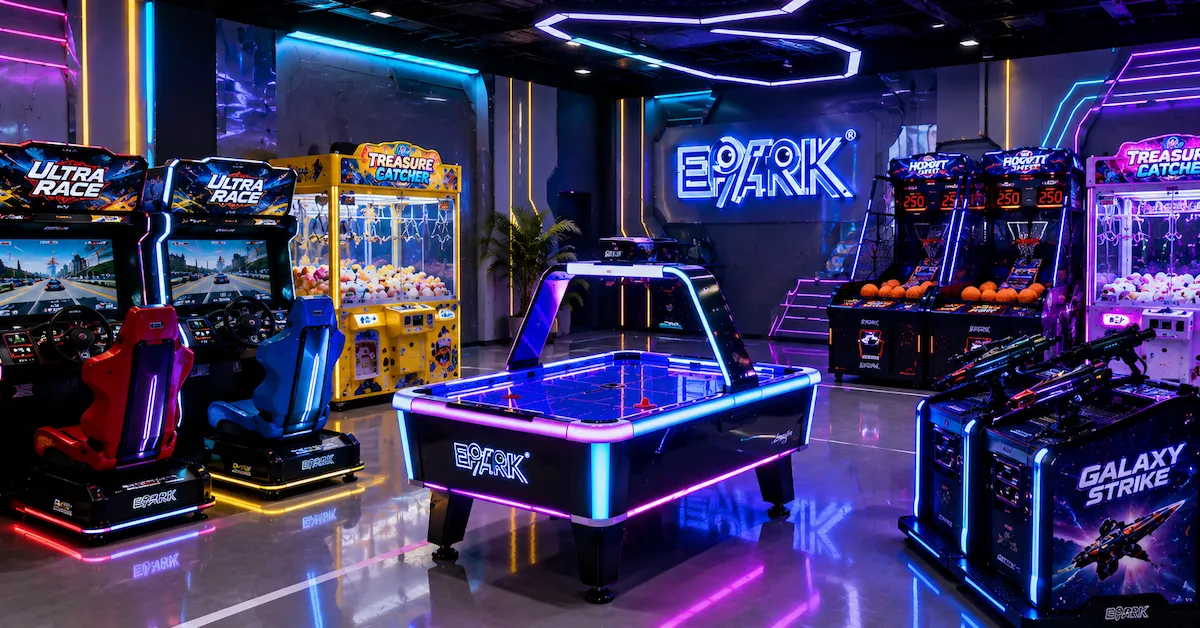
A manufacturer should not treat every arcade cabinet as the same rectangular enclosure.
Upright Cabinets
Important considerations may include:
- Display angle
- Player posture
- Control-panel height
- Floor footprint
- Front service access
Racing Cabinets
Driving games often require more integration between:
- Seat
- Steering
- Pedals
- Display
- Control hardware
Their larger footprint also makes packing and installation more important.
Shooting Cabinets
Design may need to account for:
- Controller placement
- Gun storage
- Sensor or tracking hardware
- Player distance
- Display position
Prize and Redemption Cabinets
These can require additional attention to:
- Prize or ticket mechanisms
- Player access
- Payment hardware
- Operator doors
- Internal storage
Multiplayer and Interactive Cabinets
Larger interactive machines can introduce more wiring, more service zones, and more structural coordination.
A buyer should provide the intended machine type before asking a manufacturer to recommend the cabinet architecture.
Prototype Approval Should Go Beyond Appearance
A prototype is one of the most useful stages in custom cabinet development, but only when it is evaluated properly.
Do not approve it simply because the artwork looks good.
Check the Overall Dimensions
Confirm whether the physical size matches:
- Venue requirements
- Hardware requirements
- Player ergonomics
- Shipping expectations
Check the Screen Position
The display should be reviewed from the actual player position rather than only from a drawing.
Check the Controls
Confirm reach, spacing, mounting, and usability.
Check Service Doors
Open them.
Make sure technicians can actually reach the intended components.
Check Wiring and Electronics Space
Confirm that the internal layout is practical once the real components are installed.
Check Payment Hardware
The physical opening and mounting arrangement should match the agreed payment system.
Check Artwork and Lighting
Review:
- Position
- Alignment
- Visible edges
- Brand presentation
- Illuminated areas
A prototype should validate both the player experience and the maintenance experience.
Approved Drawing and Approved Sample Serve Different Purposes
For OEM projects, buyers often ask whether drawings or physical samples matter more.
They solve different problems.
The drawing controls dimensions. The sample validates actual usability.
Before mass production, it is useful to lock:
- Approved drawings
- Product reference photos
- Hardware layout
- Artwork files
- Configuration
- Approved revisions
This creates a clearer production reference than relying on old emails or messaging-app conversations.
If a dimension or opening changes, the revision should be traceable.
OEM Arcade Cabinet Customization
OEM work is one reason buyers search specifically for a China arcade cabinet manufacturer instead of purchasing a standard enclosure.
Depending on the model, quantity, and engineering requirements, customization may cover several areas.
Cabinet Form
Some projects begin with an existing cabinet platform. Others require deeper structural changes.
The manufacturer should evaluate feasibility before promising a completely new shape.
Artwork and Logo
Customization may include:
- Brand logo
- Side graphics
- Header graphics
- Control-panel artwork
- Product labels
Color and Finish
Color consistency matters especially for distributors developing a recognizable product line.
Control Layout
The cabinet may need to fit different:
- Buttons
- Joysticks
- Steering systems
- Guns
- Interactive controls
Screen Integration
The monitor size and mounting solution should be specified early because they influence the front structure.
Lighting
Lighting can become part of the brand identity, but it should also remain accessible for service.
Payment Hardware
Coin, token, card, or cashless requirements may affect openings, brackets, wiring, and operator access.
Buyers planning branded equipment can review the EPARK customization process.
Cabinet Branding Is More Than Adding a Logo
For an OEM distributor, branding should survive beyond the first order.
That means controlling more than the logo file.
A consistent product family may use:
- Similar cabinet language
- Recognizable colors
- Repeated lighting details
- Consistent control-panel graphics
- Product labels
- Artwork style
If one order uses noticeably different blue tones or altered artwork placement, the product may still function perfectly, yet the brand presentation becomes inconsistent.
For this reason, buyers should maintain approved artwork and branding references alongside the technical specification.
How to Control Batch Consistency
One prototype can be excellent while a production batch slowly drifts away from the approved version.
Critical items may include:
- Overall dimensions
- Openings
- Mounting holes
- Control positions
- Access panels
- Artwork
- Color
- Lighting positions
- Hardware interfaces
A cabinet can be visually similar and still be operationally different if mounting points, openings, or internal layouts change.
That is why batch control matters.
For higher-volume OEM programs, the buyer should know which version of the drawing and specification the production line is following.
How Should Arcade Cabinet Quality Control Be Evaluated?
Cabinet QC should focus on cabinet-specific risks rather than generic claims about quality.
Dimensional Checks
Verify critical dimensions against the approved drawing.
Structural Checks
Review major joints, panels, mounting points, and stability.
Door and Panel Fit
Doors should open, close, and align as intended.
Control Opening Checks
Buttons, joysticks, steering assemblies, and other controls need openings that match the approved hardware.
Display Mount Checks
Mounting positions should fit the specified display.
Surface and Artwork Checks
Look for:
- Visible finish issues
- Artwork alignment
- Color inconsistencies
- Surface damage
Lighting Checks
Where lighting is included, confirm operation and installation.
Internal Layout Verification
Check whether the agreed mounting and service arrangement has been maintained.
Packing Checks
The completed cabinet still has to reach the buyer in acceptable condition.
Buyers can review EPARK's safety and quality approach when assessing production and inspection requirements.
Sample Approval vs Mass Production: Where Problems Appear
| Risk | Why It Happens | Buyer Control |
|---|---|---|
| Wrong opening size | Drawing revision error | Approved drawing |
| Misaligned controls | Layout mismatch | Prototype approval |
| Artwork difference | Wrong file/version | Artwork reference |
| Changed internal layout | Production adjustment | Controlled specification |
| Reorder mismatch | No revision history | Version control |
These problems are easier to prevent before production than to solve after cabinets have been packed.
How to Compare China Arcade Cabinet Manufacturers
Instead of using a generic supplier scorecard based only on price, quality, and service, evaluate how well the manufacturer handles the actual cabinet-development process.
| Evaluation Area | Buyer Question |
|---|---|
| Engineering | Can the team understand my hardware layout? |
| Cabinet structure | Is the design suitable for commercial operation? |
| Prototype | Can practical changes be validated before production? |
| Internal layout | Is maintenance realistic? |
| OEM | Can structure,artwork and branding be controlled? |
| QC | How are critical dimensions and fit checked? |
| Batch control | How is the approved version maintained? |
| Reorder | Can the same cabinet be reproduced later? |
The supplier that sends the fastest quote is not necessarily the one best prepared for an OEM project.
What Makes a Cabinet Manufacturer Useful for Distributors?
Distributors have one concern that a one-time buyer may overlook: the product needs to remain manageable after it enters the market.
That makes the following particularly important:
- Repeatability
- Branding consistency
- Hardware compatibility
- Documentation
- Revision control
- Spare-parts compatibility
If a customer orders three more machines next year, the distributor should not discover that the cabinet openings, control layout, or internal hardware mounts have changed without warning.
For distributors, a cabinet design becomes more valuable when it can be reproduced and serviced, not merely when it looks impressive in a showroom.
Why Custom Arcade Cabinet Quotations Can Differ
Two cabinet quotations may differ considerably even when the exterior concept looks similar.
Possible reasons include:
- Overall dimensions
- Structural complexity
- Material specification
- Finish
- Artwork requirements
- Lighting
- Control layout
- Hardware integration
- Prototype work
- Order quantity
- Packing requirements
This is why buyers should avoid comparing a basic enclosure quotation with a heavily integrated OEM cabinet quote as though they were identical products.
Ask suppliers to define what is included.
Red Flags When Choosing an Arcade Cabinet Manufacturer
The Conversation Focuses Only on Exterior Renderings
A manufacturer should also discuss the inside of the cabinet.
Internal Layout Is Never Confirmed
This can create avoidable integration and maintenance problems.
Drawings Have No Clear Revision
An outdated drawing should not accidentally reach production.
Service Access Is Discussed After the Prototype Is Finished
Maintenance should influence the design from the beginning.
Production Starts Before Artwork Approval
That creates unnecessary rework risk.
Mounting Points Change Without Notification
Small structural changes can affect hardware installation.
Repeat Orders Depend on Searching Old Chat Messages
A professional OEM program needs controlled references.
The Quotation Does Not Define Scope
Clarify whether the quote includes cabinet only, lighting, wiring, controls, payment hardware, or other components.
What Should Buyers Include in an Arcade Cabinet RFQ?
The more technically specific the inquiry, the more useful the quotation can become.
Include:
- Cabinet application
- Target game or machine type
- Target dimensions
- Display size
- Display mounting requirements
- Control type and layout
- Electronics to be installed
- Payment-system requirements
- Speaker or audio requirements
- Lighting requirements
- Access-door and service requirements
- Artwork and logo files
- Reference images or drawings
- Order quantity
- Destination country
- Prototype requirement
- Target delivery schedule
Buyers can contact EPARK with their cabinet concept and technical requirements.
A much more useful inquiry than “Please quote a custom cabinet” would be:
machine type + cabinet concept + display size + control layout + payment system + dimensions + branding files + quantity + destination
That gives the engineering and commercial teams enough context to discuss feasibility rather than guess.
FAQ
What does a China arcade cabinet manufacturer do?
A China arcade cabinet manufacturer designs and produces cabinet structures used to integrate displays, controls, electronics, payment hardware, lighting, audio, and service access for arcade machines.
What is the difference between an arcade cabinet manufacturer and an arcade machine manufacturer?
A cabinet manufacturer may focus mainly on the physical enclosure, while a complete arcade machine manufacturer may also integrate electronics, controls, software, payment systems, and other operating components.
What should I check before ordering a custom arcade cabinet?
Review dimensions, internal component layout, display mounting, control positions, payment-system integration, maintenance access, artwork, lighting, packing, and the approved production reference.
What materials are commonly considered for arcade cabinets?
Material choices vary by cabinet design, structural requirements, appearance, hardware integration, and commercial application. Buyers should request the actual proposed material specification rather than assume one material is suitable for every machine.
Can an arcade cabinet be customized around my hardware?
Depending on engineering feasibility, a cabinet can potentially be developed around specified displays, controls, electronics, payment hardware, and other components. Detailed dimensions and hardware information should be provided early.
Should I order a prototype before mass production?
A prototype can be particularly valuable for new cabinet designs because it allows the buyer to verify dimensions, ergonomics, hardware fit, internal layout, service access, artwork, and other details before scaling production.
How should buyers check arcade cabinet quality?
Use the approved drawing and specification to check dimensions, structure, door fit, openings, hardware mounts, internal layout, surface finish, artwork, lighting, configuration, and packing.
Can a manufacturer reproduce the same cabinet for repeat orders?
A capable supplier should use controlled drawings, specifications, artwork references, and revision records to improve repeat-order consistency. Buyers should confirm how design changes are documented.
What affects custom arcade cabinet pricing?
Pricing can be influenced by cabinet size, structural complexity, material specification, surface finish, artwork, lighting, control layout, hardware integration, prototype work, quantity, and packing requirements.
What information should I send for an OEM arcade cabinet quote?
Provide the intended machine type, target dimensions, display size, control layout, electronics, payment system, service-access requirements, artwork, reference files, quantity, destination, and whether a prototype is required.
Conclusion
Selecting a China arcade cabinet manufacturer should not begin and end with cabinet appearance.
A commercially useful cabinet has to work through the entire product lifecycle:
Engineering → Structure → Internal Layout → Serviceability → Prototype → OEM → QC → Batch Control → Repeat Production
The right manufacturing partner does more than turn a rendering into an enclosure. It helps translate a machine concept into a cabinet that can be assembled, operated, maintained, branded, transported, and reproduced consistently.
Explore EPARK commercial arcade equipment, learn more about EPARK, review its customization process and quality approach, or contact EPARK with your cabinet concept, display size, control layout, payment requirements, target dimensions, branding files, quantity, and destination for an OEM project discussion and quotation.
General Disclaimer
All data on https://www.eparki.com is for general guidance only. As a leading indoor playground manufacturer and trampoline supplier, EPARK strives for accuracy but gives no express or implied warranty regarding completeness, performance or project fitness. Product specs, designs and results may vary with use and customer requirements. Buyers must verify technical details, compliance and suitability before purchase. EPARK OEM/ODM is not liable for any direct, indirect or consequential damages arising from site use. For custom solutions, contact our manufacturer and supplier team via the Contact page.
Intellectual Property
Text, images, videos, CAD files and software are Guangzhou EPARK Electronic Technology Co., Ltd. All rights reserved. No part may be copied, republished or used commercially without prior written permission. We will pursue legal action for copyright or design-patent infringement.
Trademarks
"EPARK", the EPARK logo and related graphics are registered trademarks of Guangzhou EPARK Electronic Technology Co., Ltd. Unauthorized use in ads, domain names or packaging is prohibited.
Governing Law
These terms are governed by the laws of the People's Republic of China.
Contact
Questions? Email sales@nanyuetech.com or WhatsApp +86 139 0307 9263.