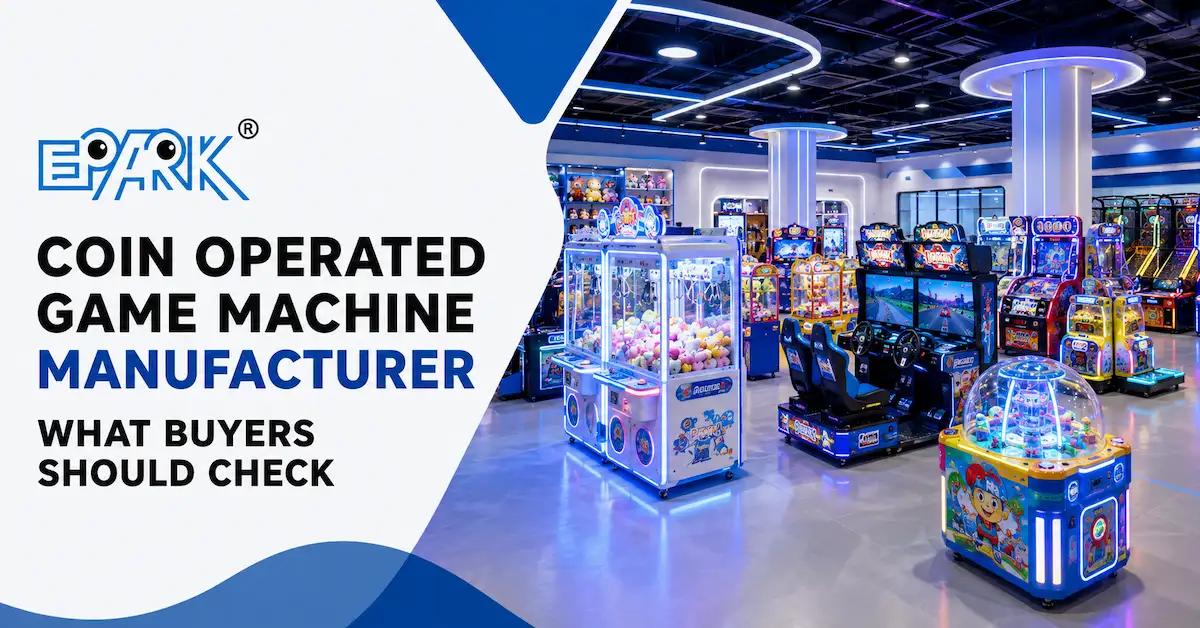
Selecting a reliable coin operated game machine manufacturer is an important step for arcade operators, family entertainment centers, indoor playgrounds, shopping malls, hotels, resorts, and amusement equipment distributors.
Coin-operated machines may appear simple from the customer’s perspective. A player inserts a coin, starts the game, and receives an entertainment experience or a possible prize. However, the commercial system behind that process involves payment recognition, game controls, cabinet construction, mechanical components, electrical safety, maintenance access, and long-term spare-parts support.
A low quotation does not always mean lower project cost. If a machine rejects coins, accepts invalid tokens, breaks down frequently, or cannot be repaired locally, it may create ongoing operating losses.
Commercial buyers should therefore evaluate the manufacturer as carefully as they evaluate the machines.
Buyers can explore EPARK’s commercial amusement equipment when comparing coin-operated claw machines, redemption games, racing machines, kiddie rides, sports games, and complete arcade equipment packages.
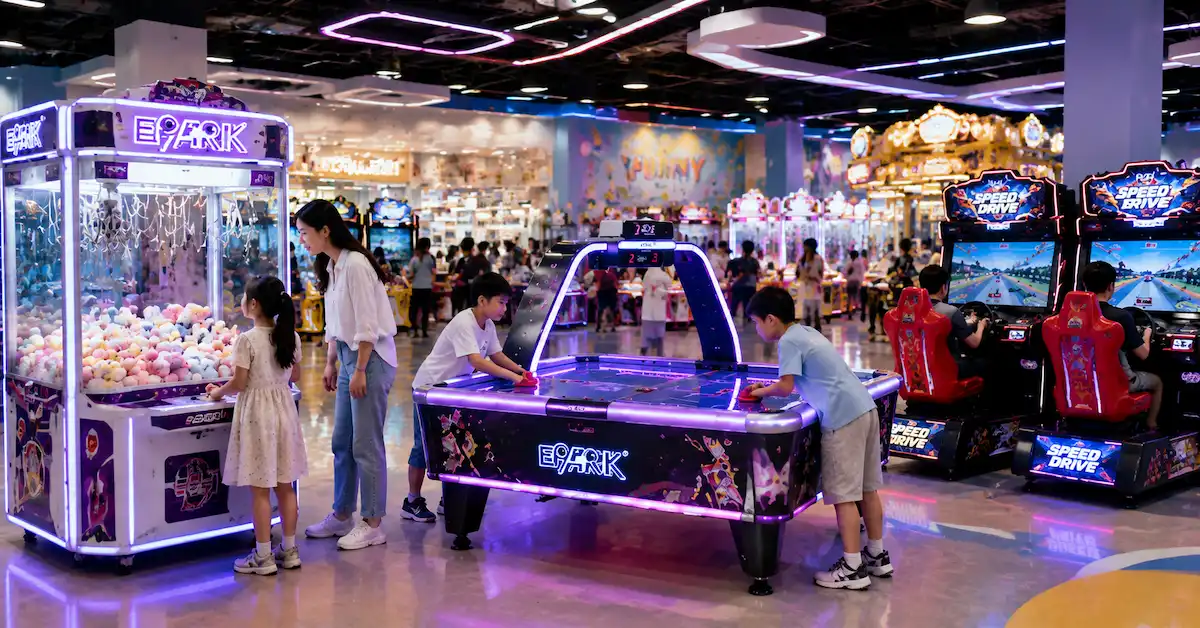
Quick Answer
Before choosing a coin operated game machine manufacturer, buyers should check:
- Whether the supplier is a real manufacturer or a trading intermediary.
- The factory’s experience with commercial arcade equipment.
- Coin acceptor compatibility with the target market.
- Cabinet, electrical, and mechanical component quality.
- Quality-control and machine-testing procedures.
- OEM and payment-system customization capability.
- Spare-parts availability and repair support.
- Export packaging and international shipping experience.
- Warranty terms and response time.
- Total ownership cost rather than unit price alone.
The right manufacturer should provide stable equipment, clear specifications, consistent production, and support after the machines arrive.
Why Manufacturer Selection Matters
Coin-Operated Machines Depend on Payment Reliability
For a commercial arcade machine, the coin acceptor is directly connected to revenue.
Problems may include:
- Valid coins being rejected
- Invalid coins being accepted
- Duplicate credit signals
- Coin jams
- Incorrect pulse settings
- Unstable wiring
- Poor compatibility with local currency
Even when the game itself operates correctly, payment-system problems can interrupt sales and frustrate customers.
A professional manufacturer should understand how to match the coin system with the buyer’s operating market.
Commercial Machines Face Continuous Use
Coin-operated game machines in busy venues may operate for many hours every day.
They must withstand:
- Frequent payments
- Repeated button presses
- Continuous mechanical movement
- Accidental impact
- Different customer behaviors
- Regular cleaning
- Relocation and maintenance
The equipment should be designed for commercial use rather than occasional private use.
Manufacturer Support Affects Long-Term Profitability
When a machine requires a replacement sensor, control board, motor, coin acceptor, or power supply, the manufacturer’s support becomes critical.
Reliable support can reduce:
- Machine downtime
- Technician labor
- Emergency shipping costs
- Customer complaints
- Revenue loss
This is why buyers should consider the complete supplier relationship before placing an order.
Check Whether the Supplier Is a Real Manufacturer
Some suppliers present themselves as factories but outsource most of their production.
This is not always a problem, but buyers should understand who controls:
- Cabinet manufacturing
- Electronic assembly
- Software configuration
- Final testing
- Quality inspection
- Packaging
- Spare-parts inventory
Factory Information to Request
Ask the supplier for:
- Factory address
- Production videos
- Workshop photos
- Business information
- Manufacturing history
- Main product categories
- Export markets
- Quality-control procedures
For larger orders, a factory visit or live video inspection can provide additional confidence.
Why Direct Manufacturing Capability Helps
A genuine manufacturer can usually provide stronger support for:
- Product customization
- Component changes
- Quality consistency
- Large orders
- Repeat orders
- Technical troubleshooting
Direct communication also makes it easier to clarify specifications before production.
Evaluate the Manufacturer’s Product Experience
A factory may produce game machines, but that does not mean it has experience with every equipment category.
Ask whether the manufacturer regularly produces:
- Coin-operated claw machines
- Redemption games
- Racing machines
- Basketball machines
- Kiddie rides
- Arcade cabinets
- Prize machines
- Multiplayer games
A manufacturer with relevant product experience is more likely to understand the maintenance and operating requirements of that machine category.
Confirm Coin Acceptor Compatibility
The coin system should be confirmed before production, not after delivery.
Coin Size and Currency
Provide the manufacturer with information about:
- Coin diameter
- Coin thickness
- Coin weight
- Local currency
- Token requirements
Some projects use national currency, while others use custom arcade tokens.
Single-Coin and Multi-Coin Acceptors
A single-coin acceptor recognizes one coin or token type.
A multi-coin acceptor may support:
- Several coin values
- Different token sizes
- Multiple credit settings
The correct option depends on the venue’s pricing model.
Anti-Fraud Performance
Commercial buyers should ask how the coin acceptor handles:
- Incorrect coins
- Similar foreign coins
- Metal washers
- Repeated coin movement
- Electrical interference
Payment security is especially important in unsupervised or high-traffic locations.
Credit and Pulse Configuration
The coin acceptor must communicate correctly with the machine control system.
Confirm:
- Number of pulses per coin
- Credits per payment
- Pricing adjustment method
- Free-play settings
- Reset procedures
The operator should be able to change the price without replacing the complete payment system.
Check Payment-System Upgrade Options
A coin-operated machine may later need to support another payment method.
Ask whether the machine can be upgraded to:
- Token operation
- Recharge cards
- QR payments
- Bill acceptors
- Contactless payment
- Central management systems
A flexible machine offers more long-term value because it can adapt to future operating requirements.
Inspect Cabinet Construction
The cabinet protects the machine’s internal systems and affects appearance, safety, and lifespan.
Materials
Depending on the machine, the cabinet may use:
- Metal
- Wood
- Fiberglass
- Acrylic
- Tempered glass
- Composite panels
Buyers should ask about material thickness and structural reinforcement.
Surface Finish
The surface should resist:
- Scratches
- Cleaning chemicals
- Moisture
- Fingerprints
- Frequent customer contact
Poor finishing may make a new arcade look old after only a short period of operation.
Doors, Locks, and Maintenance Panels
Maintenance panels should provide convenient access without reducing security.
Check:
- Lock quality
- Door alignment
- Hinge strength
- Access to electronics
- Access to coin storage
- Cable organization
Easy maintenance access can reduce repair time.
Review Electronic Component Quality
Electronic reliability has a major effect on machine availability.
Important components include:
- Main control board
- Power supply
- Display
- Sensors
- Speakers
- Wiring
- Lighting system
- Payment interface
Wiring Quality
Professional wiring should be:
- Organized
- Secured
- Clearly connected
- Protected from moving parts
- Easy to troubleshoot
Loose or disorganized wiring can increase fault rates and make repairs more difficult.
Cooling and Ventilation
Machines containing screens, computers, or high-power lighting may require ventilation.
Confirm whether the machine includes:
- Cooling fans
- Air vents
- Temperature protection
- Easy-to-clean filters
Overheating can shorten component life.
Check Mechanical Durability
Machines with moving components require additional inspection.
Examples include:
- Claw mechanisms
- Steering systems
- Pedals
- Motors
- Gears
- Ticket dispensers
- Ball-return systems
- Ride mechanisms
Ask the manufacturer which parts are expected to wear and how easily they can be replaced.
A modular mechanical system is usually easier to maintain than a design requiring complete disassembly.
Review the Factory’s Quality-Control Process
A professional coin operated game machine manufacturer should inspect machines throughout production.
Incoming Component Inspection
The factory should check important components before assembly.
This may include:
- Power supplies
- Screens
- Motors
- Coin acceptors
- Sensors
- Control boards
Assembly Inspection
During assembly, workers should verify:
- Wiring connections
- Cabinet alignment
- Mechanical movement
- Fasteners
- Safety components
Functional Testing
Before packaging, each machine should be tested for:
- Game operation
- Coin recognition
- Credit output
- Sound
- Lighting
- Controls
- Sensors
- Prize or ticket systems
Aging Testing
Machines may be operated continuously for a period to identify unstable components before shipment.
Buyers should ask how long the supplier tests each machine and whether inspection records are available.
Check Safety and Electrical Requirements
Electrical specifications must match the destination market.
Confirm:
- Voltage
- Frequency
- Plug type
- Grounding
- Power consumption
- Fuse protection
- Emergency switch requirements
For machines used by children, buyers should also evaluate:
- Rounded edges
- Pinch-point protection
- Stable bases
- Secure doors
- Safe access panels
- Clear operating instructions
The buyer remains responsible for confirming local regulations, but the manufacturer should provide accurate technical information.
Evaluate OEM and Customization Capability
A professional factory should be able to adapt machines to different projects.
Visual Customization
Options may include:
- Cabinet colors
- Artwork
- Logos
- Themes
- Language
- Lighting
Functional Customization
Options may include:
- Coin acceptors
- Token systems
- Price settings
- Ticket output
- Game difficulty
- Sound levels
- Payment interfaces
Packaging Customization
Distributors and chain operators may also need:
- Private labels
- Custom manuals
- Branded cartons
- Product codes
- Regional configurations
All customization details should be confirmed in writing before mass production.
Check Spare-Parts Support
Spare-parts availability is one of the most important supplier evaluation criteria.
Common Spare Parts
Depending on the machine, buyers may need:
- Coin acceptors
- Buttons
- Joysticks
- Sensors
- Motors
- Power supplies
- Control boards
- Screens
- Card readers
- Cables
- LED modules
- Locks
Starter Spare-Parts Package
For international projects, adding commonly used parts to the first shipment can reduce future downtime and delivery costs.
Ask the factory to recommend parts based on:
- Machine type
- Order quantity
- Expected daily use
- Local technician capability
Long-Term Parts Availability
Confirm how long the manufacturer expects to supply replacement components.
A machine becomes a poor investment when a small unavailable part makes it unusable.
Evaluate Warranty and Technical Support
Warranty duration alone does not show the quality of after-sales support.
Buyers should confirm:
- Which parts are covered
- Which parts are excluded
- When the warranty starts
- Who pays replacement shipping
- Required diagnostic evidence
- Response time
- Remote-support availability
Remote Troubleshooting
Useful support channels may include:
- Video calls
- Wiring diagrams
- Repair videos
- Error-code guidance
- Software instructions
- Technician communication
Clear technical documentation can help local staff solve common problems without waiting for an overseas technician.
Review Production Capacity and Lead Time
Large FEC and distributor orders require stable production planning.
Ask about:
- Monthly capacity
- Current production schedule
- Sample lead time
- Mass-production lead time
- Customization lead time
- Inspection time
- Packaging schedule
A short promised lead time is not useful if quality becomes inconsistent.
The factory should provide a realistic delivery plan.
Check Export Packaging
Game machines are large, heavy, and sensitive to transportation damage.
Professional export packaging may include:
- Protective film
- Foam
- Reinforced corners
- Wooden frames
- Wooden cases
- Moisture protection
- Secured moving parts
Ask for:
- Packed dimensions
- Gross weight
- Packaging photos
- Loading plan
Packed dimensions are required for accurate freight estimates.
Compare Total Ownership Cost
Do not compare manufacturers only by unit price.
| Cost Area | What Buyers Should Evaluate |
|---|---|
| Machine Price | Included equipment and accessories |
| Payment System | Coin acceptor and configuration |
| Shipping | Packaging volume and weight |
| Maintenance | Replacement frequency and labor |
| Spare Parts | Availability and cost |
| Downtime | Lost revenue during repairs |
| Lifespan | Expected commercial operation period |
| Support | Technical response and documentation |
| Upgrade Potential | Ability to change payment systems |
A machine with a higher initial price may provide a lower total cost if it operates more reliably.
Supplier Comparison Checklist
| Evaluation Item | Supplier A | Supplier B | Supplier C |
|---|---|---|---|
| Real Factory Verification | |||
| Commercial Product Experience | |||
| Coin Acceptor Compatibility | |||
| Component Quality | |||
| Quality-Control Process | |||
| OEM Capability | |||
| Spare Parts | |||
| Warranty | |||
| Technical Support | |||
| Export Packaging | |||
| Delivery Time | |||
| Total Ownership Value |
Using the same checklist for every supplier creates a fairer comparison.
Common Buying Mistakes
Choosing the Lowest Price
A low price may reflect:
- Basic components
- Limited testing
- Weak packaging
- Fewer spare parts
- Minimal support
Failing to Test the Coin System
A machine should be tested with the exact coin or token used by the venue.
Ordering Before Confirming Specifications
Voltage, payment systems, language, ticket settings, and artwork should be approved before production.
Ignoring Maintenance Access
A visually attractive cabinet may still be difficult to repair.
Not Ordering Spare Parts
International buyers should not wait for the first breakdown before preparing replacement components.
Buying Too Many Similar Machines
A commercial venue should create a balanced equipment mix based on customer age, play style, and available floor space.
Why Choose EPARK as a Coin-Operated Game Machine Partner?
EPARK provides commercial amusement equipment for:
- Family entertainment centers
- Indoor playgrounds
- Shopping malls
- Arcades
- Hotels
- Resorts
- Distributors
EPARK can support:
- Coin-operated machine selection
- Arcade equipment packages
- Payment-system configuration
- OEM and ODM customization
- Quality inspection
- Export packaging
- Spare-parts planning
- Technical assistance
Buyers can explore EPARK’s product catalog, learn more about EPARK’s company capabilities, or review common purchasing questions on the EPARK FAQ page.
FAQ About Coin Operated Game Machine Manufacturers
What should buyers check first when choosing a manufacturer?
Start by confirming whether the supplier has real manufacturing capability, relevant commercial product experience, and a clear quality-control process.
Can coin-operated machines use local currency?
Many coin acceptors can be configured for specific coins or tokens. Buyers should provide exact coin dimensions and samples when required.
Can a coin-operated machine later use a card system?
Some machines support payment-system upgrades, but compatibility should be confirmed before production.
What spare parts should buyers order?
Common parts may include coin acceptors, buttons, sensors, power supplies, motors, control boards, cables, and LED modules.
How should machines be tested before shipment?
Testing should cover coin recognition, credit output, game operation, controls, lighting, sound, sensors, mechanical systems, and safety functions.
Can EPARK provide coin-operated equipment for complete FEC projects?
Yes. Buyers can browse EPARK’s commercial game machines or contact EPARK with their venue size, floor plan, target users, and payment requirements.
Conclusion
Choosing a coin operated game machine manufacturer requires more than comparing product photos and quotations.
Commercial buyers should evaluate factory identity, manufacturing experience, coin acceptor compatibility, cabinet strength, component quality, quality control, customization, spare parts, packaging, and after-sales support.
The best supplier is not necessarily the factory offering the lowest unit price. It is the manufacturer that can deliver stable machines, consistent production, and reliable support throughout the equipment lifecycle.
A structured evaluation process helps FEC operators, arcade owners, distributors, and project developers reduce purchasing risk and protect long-term revenue.
General Disclaimer
All data on https://www.eparki.com is for general guidance only. As a leading indoor playground manufacturer and trampoline supplier, EPARK strives for accuracy but gives no express or implied warranty regarding completeness, performance or project fitness. Product specs, designs and results may vary with use and customer requirements. Buyers must verify technical details, compliance and suitability before purchase. EPARK OEM/ODM is not liable for any direct, indirect or consequential damages arising from site use. For custom solutions, contact our manufacturer and supplier team via the Contact page.
Intellectual Property
Text, images, videos, CAD files and software are Guangzhou EPARK Electronic Technology Co., Ltd. All rights reserved. No part may be copied, republished or used commercially without prior written permission. We will pursue legal action for copyright or design-patent infringement.
Trademarks
"EPARK", the EPARK logo and related graphics are registered trademarks of Guangzhou EPARK Electronic Technology Co., Ltd. Unauthorized use in ads, domain names or packaging is prohibited.
Governing Law
These terms are governed by the laws of the People's Republic of China.
Contact
Questions? Email sales@nanyuetech.com or WhatsApp +86 139 0307 9263.