Why a Soft Play Equipment Supplier Needs a Second Review Before Production
Choosing a supplier and approving production are not the same decision.
During the early sourcing stage, buyers usually compare factory capability, product range, theme design, price, customization, and general service. Once a preferred soft play equipment supplier has been selected, the project enters a more detailed stage where small unresolved issues can become expensive production, installation, or maintenance problems.
Before manufacturing begins, buyers should therefore stop comparing suppliers and start locking the actual project.
The goal is to confirm exactly:
- what will be produced;
- which materials will be used;
- which drawing revision is final;
- how equipment fits the site;
- which customization details are approved;
- what QC points will be checked;
- which documents will be supplied;
- how parts will be packed and identified;
- how installation will be handled;
- what happens if replacement parts are needed later.
This stage is especially important for shopping malls, family entertainment centers, indoor playground operators, project contractors, distributors, hotels, kids cafés, and branded play-center chains.
If you are still defining the overall equipment concept, start by reviewing EPARK’s Indoor Playground Products before moving into the production-approval stage.
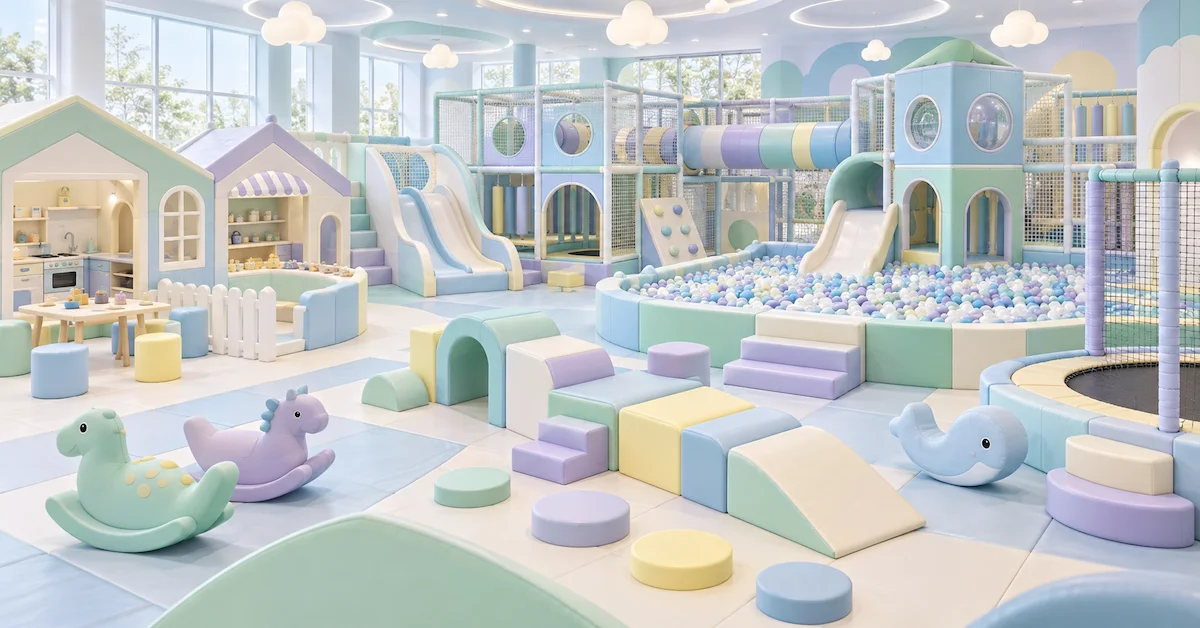
The Difference Between Supplier Selection and Production Approval
Supplier selection asks:
“Can this company handle my project?”
Production approval asks:
“Is this exact project ready to manufacture?”
These are different questions.
| Stage | Main Decision |
|---|---|
| Supplier selection | Is the supplier capable and suitable? |
| Concept design | Does the proposed solution fit the business? |
| Layout review | Does equipment fit the actual venue? |
| Technical approval | Are materials, dimensions, and functions defined? |
| Production approval | Is every critical detail locked? |
| QC | Does production match the approved reference? |
| Shipment approval | Is the complete order ready to leave the factory? |
A professional soft play equipment supplier should be able to move the buyer through these stages without mixing them together.
EPARK’s Customization Process provides a useful reference for how consultation, space planning, design, material selection, manufacturing, inspection, delivery, installation, and after-sales support connect within one project.
1. Lock the Final Floor Plan Before Manufacturing
The floor plan should become the first control document.
Production should not begin while major layout questions are still open.
Confirm:
- total usable area;
- ceiling height;
- column positions;
- entrance and exit locations;
- fixed walls;
- emergency routes;
- installation access;
- parent waiting areas;
- age zones;
- equipment boundaries.
Why this matters
Soft play equipment is highly site-dependent.
Changing a wall position, slide direction, tunnel connection, entrance location, or platform after manufacturing has started can affect multiple components.
A late change may require:
- redesign;
- replacement parts;
- new protective panels;
- revised structure;
- new packaging;
- installation changes.
Buyers should therefore make sure the final production drawing corresponds to the actual site, not only to an early concept sketch.
2. Confirm the Final Drawing Revision
Customized commercial projects often go through multiple design revisions.
For example:
- Version A: initial concept
- Version B: equipment changes
- Version C: updated theme
- Version D: adjusted column position
- Version E: final approved production layout
The risk begins when the buyer approves Version E but the factory accidentally manufactures according to Version C or D.
Before production, create one clearly identified approval reference.
The approval record should include
- drawing name;
- revision number;
- approval date;
- final equipment list;
- approved color direction;
- approved theme;
- final dimensions.
The buyer and soft play equipment supplier should both refer to the same approved version throughout manufacturing and inspection.
3. Match the Equipment List to the Drawing
A 3D image can look complete even when the quotation or equipment list is incomplete.
Before production, compare the drawing against the actual list of equipment.
Check whether the project includes all approved items such as:
- soft blocks;
- mini slides;
- larger slides;
- ball pool;
- crawling tunnels;
- climbing elements;
- padded stairs;
- interactive panels;
- toddler modules;
- themed façades;
- safety netting;
- flooring;
- rocking toys;
- role-play equipment.
Commercial projects should not rely on phrases such as:
“Playground set as shown.”
The equipment scope should be sufficiently clear that both sides know what is included.
You can review different commercial equipment combinations through EPARK’s product range.
4. Approve Materials by Component, Not by General Description
“High-quality material” is not an actionable production specification.
Different playground components serve different functions and may use different materials.
EPARK’s Safety and Quality information identifies material systems including galvanized steel, high-density foam, soft PVC protection, EVA or PU flooring, FRP or composite resin components, and safety netting.
Before approving production, buyers should connect each material to the actual component where it will be used.
| Component | What to Confirm |
|---|---|
| Structural frame | Material and corrosion protection |
| Padding | Foam type and protected areas |
| Surface covering | Material and finish |
| Flooring | Material and zone application |
| Slides | Material and surface finish |
| Safety nets | Position and attachment |
| Decorative elements | Material and maintenance access |
| Hardware | Connection and protection method |
The point is not to request the same material everywhere.
The point is to know exactly what material is intended for each function.
5. Separate Structural Approval From Soft-Surface Approval
One of the most useful ways to audit a commercial playground project is to separate the hidden structure from the visible protective system.
Structural approval
Review:
- supporting frame;
- platform arrangement;
- major connections;
- slide support;
- tunnel support;
- climbing-module support;
- net attachment areas.
Soft-surface approval
Review:
- foam coverage;
- PVC protection;
- corners;
- high-contact areas;
- padded boundaries;
- floor treatment;
- toddler contact surfaces.
A soft play equipment supplier should be able to explain how these two systems work together.
A strong frame does not eliminate the need for appropriate padding, and a soft surface does not compensate for an unsuitable structure.
6. Approve Colors, Theme, and Branding Before Cutting Materials
Theme revisions become increasingly expensive once manufacturing begins.
Before production, confirm the visual system as a complete package.
This may include:
- primary colors;
- secondary colors;
- floor colors;
- PVC colors;
- panel colors;
- printed graphics;
- brand logo;
- mascot;
- themed signage;
- decorative elements.
Avoid approving color only from a screen
Digital rendering colors can look different from physical materials.
Where color consistency matters, the supplier should clarify how the final production colors will be confirmed.
This is particularly important for:
- chain stores;
- franchise projects;
- branded FECs;
- shopping mall concepts;
- OEM/ODM projects.
Buyers developing branded projects can review EPARK’s Customization Process for an overview of project-specific design and manufacturing.
7. Confirm Age Zoning and Activity Difficulty
A commercial playground should not be evaluated only by total area.
The equipment needs to match the users.
Before production, confirm:
- intended age range;
- toddler zone;
- older-child zone;
- low-energy activities;
- climbing difficulty;
- slide configuration;
- supervision visibility;
- transitions between zones.
Why age zoning affects production
Age zoning can influence:
- play height;
- slide type;
- obstacle difficulty;
- padding arrangement;
- entrance design;
- equipment density.
A toddler-focused soft play zone and a more active multi-level play area should not be treated as the same product configuration.
8. Clarify the Quality-Control Reference
Quality control is much more effective when the acceptance standard is defined before production.
Instead of saying:
“Please check quality carefully.”
define what needs to match the approved project.
A practical QC reference may include
| QC Area | What to Verify |
|---|---|
| Dimensions | Match approved design |
| Equipment | Complete against final list |
| Colors | Match approved references |
| Theme panels | Correct design and placement |
| Structural parts | Correct quantity and identification |
| Soft coverings | Surface and seam condition |
| Slides | Finish and connection areas |
| Nets | Correct type and quantity |
| Hardware | Complete and labeled |
| Accessories | Complete |
| Packaging | Correct identification |
| Documents | Prepared before shipment |
This turns “quality” into something that can actually be checked.
9. Confirm What Evidence You Will Receive Before Shipment
International buyers cannot always visit the factory during every order.
The supplier should therefore clarify how production completion will be demonstrated.
Depending on the project, the buyer may request:
- production photos;
- component photos;
- finished-area photos;
- packing photos;
- packing list;
- part identification;
- QC record;
- installation reference.
The exact evidence will vary by project.
The objective is not to create unnecessary paperwork.
It is to reduce uncertainty before the container leaves the factory.
10. Verify Safety and Certification Documents by Scope
This is one of the most important audit points.
Do not ask only:
“Do you have certificates?”
Instead ask:
“Which document applies to my specific equipment and destination?”
EPARK maintains a dedicated Certificates page, while project-specific requirements should still be confirmed before production.
Verify four things
Document type
Is it:
- certificate;
- test report;
- material report;
- declaration;
- inspection report?
Product scope
Which product or material does it cover?
Market relevance
Is the document relevant to the destination country or project requirement?
Revision and validity
Is the document version appropriate for the current project?
A professional soft play equipment supplier should not rely on certification logos alone.
11. Lock the Installation Responsibility
Many project problems appear after shipment because installation responsibilities were never clearly defined.
Before production begins, confirm whether installation will be handled by:
- supplier technicians;
- buyer’s local installers;
- project contractor;
- mixed local/international team;
- remote technical guidance.
Also confirm what installation support is provided
Ask about:
- installation drawings;
- part numbers;
- packing identification;
- assembly sequence;
- tool requirements;
- site preparation;
- technical communication.
For complex projects, the installation plan should influence how the supplier labels and packs the equipment.
EPARK’s FAQ provides additional information on customization, installation, maintenance, shipping, and project support.
12. Approve the Packing and Labeling Method
Packing is part of project delivery, not an afterthought.
A commercial soft play project may contain many individual:
- pipes;
- foam-covered elements;
- panels;
- slides;
- nets;
- hardware packs;
- decorative components;
- accessories.
If parts are not clearly identified, installers may lose time locating the correct components.
Before shipment, ask
- How are packages numbered?
- Are parts linked to drawings?
- Is there a packing list?
- Are small hardware components separated?
- Are fragile decorative pieces protected?
- Are spare parts identified separately?
The larger the project, the more valuable clear package identification becomes.
What Should Be Locked Before You Pay the Next Production Milestone?
Different projects have different payment structures, so buyers should follow the terms in their own contract.
From a project-management perspective, however, the following items should be clearly defined before the project moves deeply into manufacturing:
- final floor plan;
- final drawing revision;
- equipment list;
- material specification;
- colors;
- theme;
- branding files;
- target age zones;
- major technical requirements;
- relevant documents;
- installation responsibility;
- packing requirements.
This reduces arguments later over whether a requirement was “included.”
Soft Play Equipment Supplier Approval Matrix
A simple approval matrix can help procurement teams manage responsibility.
| Item | Buyer Approves | Supplier Confirms | Final Reference |
|---|---|---|---|
| Floor plan | ✓ | ✓ | Final layout |
| Equipment list | ✓ | ✓ | Quotation / BOM |
| Theme | ✓ | ✓ | Approved render |
| Colors | ✓ | ✓ | Color reference |
| Materials | ✓ | ✓ | Material specification |
| Age zoning | ✓ | ✓ | Final layout |
| QC points | ✓ | ✓ | Inspection checklist |
| Documentation | ✓ | ✓ | Document list |
| Installation | ✓ | ✓ | Installation scope |
| Packing | ✓ | Packing method | |
| Spare parts | ✓ | ✓ | Spare-parts list |
This is particularly useful when several people are involved on the buyer side, such as:
- owner;
- project manager;
- designer;
- procurement manager;
- contractor;
- installer.
How to Audit Custom Soft Play Equipment
OEM and customized projects require additional controls because more project details are unique.
Customization may involve:
- colors;
- theme;
- brand logo;
- mascot;
- façade;
- equipment mix;
- dimensional changes;
- custom panels;
- activity modules.
Lock artwork before manufacturing
Avoid submitting new brand files after production has started.
Use one approval contact
Too many people giving conflicting design instructions can create errors.
Record changes
Each approved change should update the project reference.
Check maintainability
A beautiful custom façade should not make important components difficult to inspect, clean, or replace.
The best customization creates commercial differentiation without introducing unnecessary operating complexity.
How to Evaluate a Supplier for Repeat Orders
Distributors, chains, and regional dealers have an additional concern: repeatability.
The first project is only part of the supplier relationship.
Ask whether the soft play equipment supplier can retain the key project references needed for later orders.
Important records can include:
- final drawings;
- material selection;
- color specification;
- logo artwork;
- component configuration;
- packaging;
- spare parts.
Repeatability is especially valuable for:
- franchise expansion;
- mall chains;
- distributor programs;
- multi-location FEC brands.
A repeat order should begin from an approved reference, not from memory.
Warning Signs Before Production Starts
Several situations should trigger a second review.
The supplier keeps changing the equipment list
This can create scope confusion.
The drawing has no clear final revision
Production errors become harder to resolve.
Material descriptions remain vague
The buyer may not know what is actually being manufactured.
Installation is described as “easy” without supporting information
Large projects require clearer planning.
Documentation is discussed only after production
Compliance questions should be addressed earlier.
Packing is not part of the project discussion
This can create installation delays after arrival.
The supplier cannot explain replacement-part identification
This may complicate long-term maintenance.
One warning sign does not automatically mean the supplier is unsuitable, but unresolved issues should be clarified before production begins.
Supplier Approval Scorecard for B2B Buyers
Use a simple scorecard to keep the decision focused.
| Approval Area | Recommended Status |
|---|---|
| Site information | Approved |
| Final layout | Approved |
| Equipment list | Approved |
| Material specification | Approved |
| Theme/colors | Approved |
| Custom branding | Approved |
| Age zoning | Approved |
| QC reference | Confirmed |
| Certification/document scope | Confirmed |
| Installation responsibility | Confirmed |
| Packing/labels | Confirmed |
| Spare-parts plan | Confirmed |
If several critical items remain “to be decided,” the project may not actually be ready for production.
What Information Should Buyers Send a Soft Play Equipment Supplier?
A well-prepared inquiry helps reduce design revisions later.
Before requesting a final proposal, prepare:
- venue type;
- floor dimensions;
- ceiling height;
- column positions;
- entrances and exits;
- target age range;
- preferred theme;
- equipment requirements;
- destination country;
- expected opening schedule;
- branding needs;
- installation plan.
For project-specific evaluation, these details can be submitted through EPARK’s Contact Us page.
Frequently Asked Questions
What should I approve before a soft play supplier starts production?
Approve the final layout, equipment list, materials, colors, theme, branding, age zoning, and major technical requirements. Also confirm QC, documentation, installation, packing, and spare-parts responsibilities.
Is a 3D rendering enough for production approval?
No. A rendering is useful visually, but buyers should also approve dimensions, equipment scope, material specifications, and other project information.
How can I prevent suppliers from using the wrong drawing revision?
Use one clearly named final drawing with a revision number or approval date and require all production and QC references to use that version.
What material information should a soft play equipment supplier provide?
The supplier should be able to explain the materials used for structural frames, padding, coverings, flooring, slides, safety nets, and other important project components.
Should certification be checked before production?
Yes. Buyers should confirm which documentation applies to the exact product, project, and destination market before manufacturing is completed.
What should be included in a QC checklist?
Typical areas include dimensions, equipment completeness, colors, structural components, coverings, slides, nets, accessories, packaging, and project documentation.
Why does packing need to be discussed before shipment?
Large playground projects contain many parts. Clear labels and packing identification can reduce confusion and installation time at the destination.
Should spare parts be ordered with the first project?
The appropriate spare-parts strategy depends on the equipment and project. Buyers should at least clarify which components are replaceable and how future replacements can be identified and ordered.
How should distributors manage repeat orders?
Keep the approved drawings, colors, materials, branding, components, and packaging as the repeat-order reference and require any changes to be identified before manufacturing.
Where can I submit a project for evaluation?
Prepare your site drawing, target ages, preferred theme, equipment needs, destination market, and installation requirements, then submit them through EPARK’s Contact Us page.
Conclusion
A soft play equipment supplier should not receive final production approval until the project’s drawings, materials, equipment scope, customization, QC requirements, documentation, installation responsibilities, and packing method are clear.
For commercial buyers, locking these details before production reduces revision risk, installation confusion, and avoidable after-sales problems. Review EPARK’s Customization Process or submit your project requirements through Contact Us for a project-specific evaluation.
General Disclaimer
All data on https://www.eparki.com is for general guidance only. As a leading indoor playground manufacturer and trampoline supplier, EPARK strives for accuracy but gives no express or implied warranty regarding completeness, performance or project fitness. Product specs, designs and results may vary with use and customer requirements. Buyers must verify technical details, compliance and suitability before purchase. EPARK OEM/ODM is not liable for any direct, indirect or consequential damages arising from site use. For custom solutions, contact our manufacturer and supplier team via the Contact page.
Intellectual Property
Text, images, videos, CAD files and software are Guangzhou EPARK Electronic Technology Co., Ltd. All rights reserved. No part may be copied, republished or used commercially without prior written permission. We will pursue legal action for copyright or design-patent infringement.
Trademarks
"EPARK", the EPARK logo and related graphics are registered trademarks of Guangzhou EPARK Electronic Technology Co., Ltd. Unauthorized use in ads, domain names or packaging is prohibited.
Governing Law
These terms are governed by the laws of the People's Republic of China.
Contact
Questions? Email sales@nanyuetech.com or WhatsApp +86 139 0307 9263.