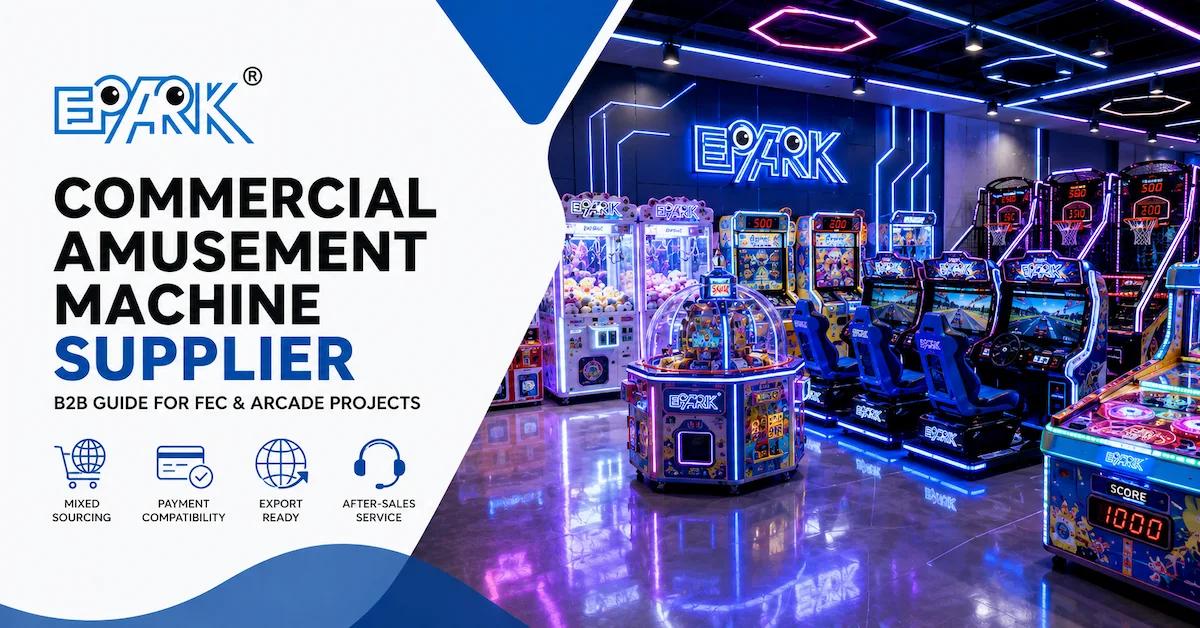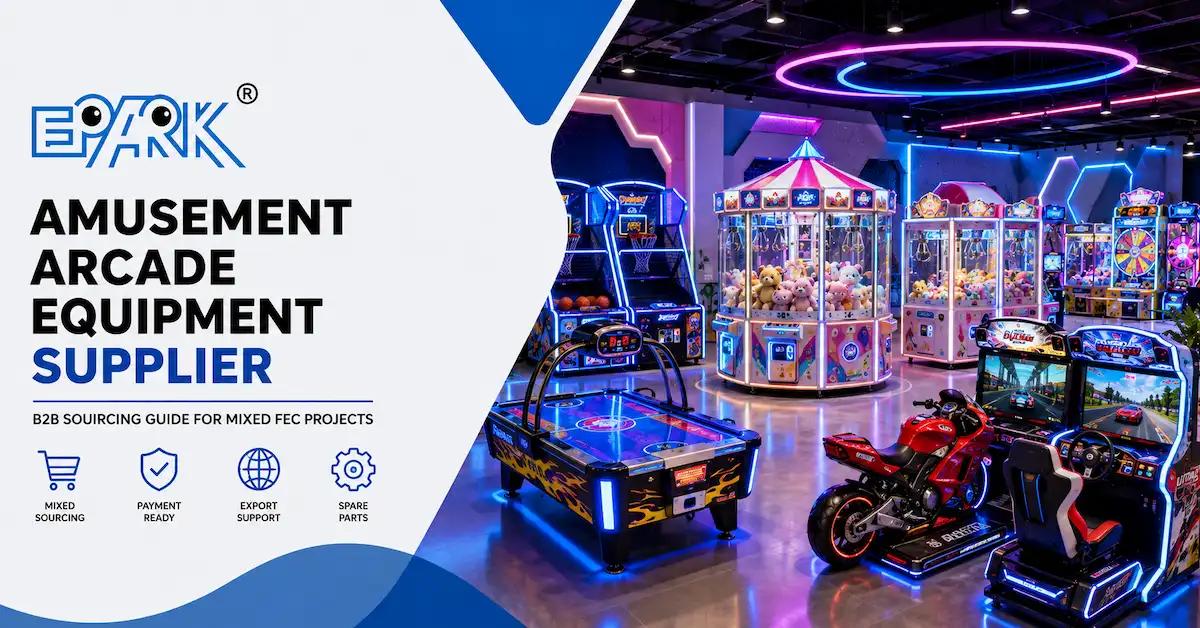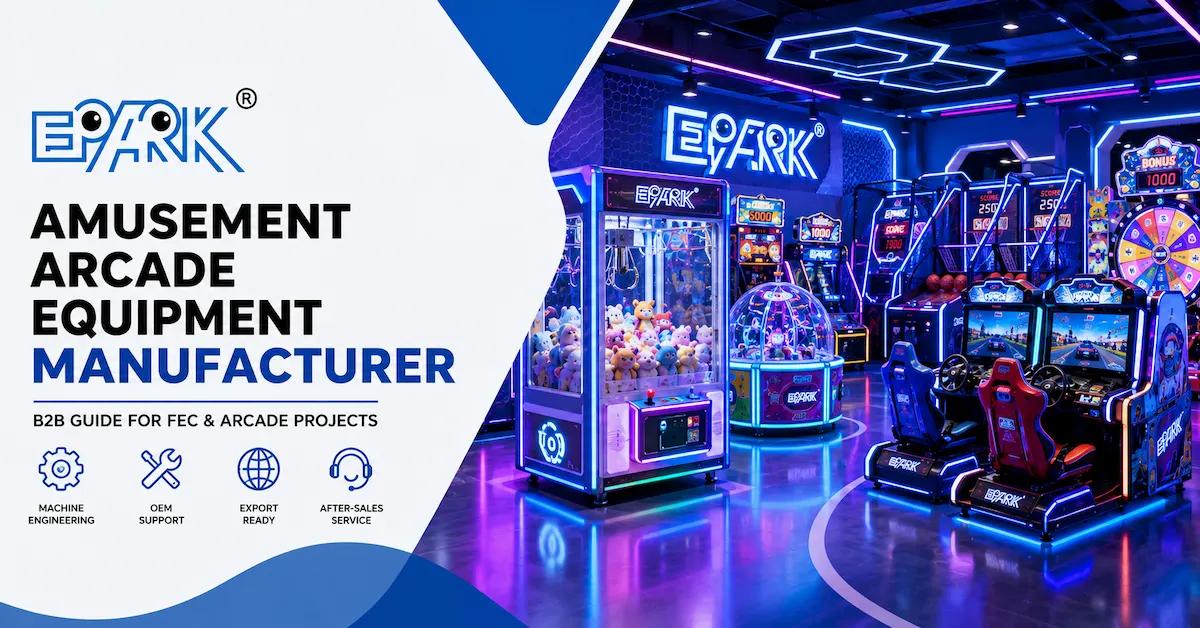
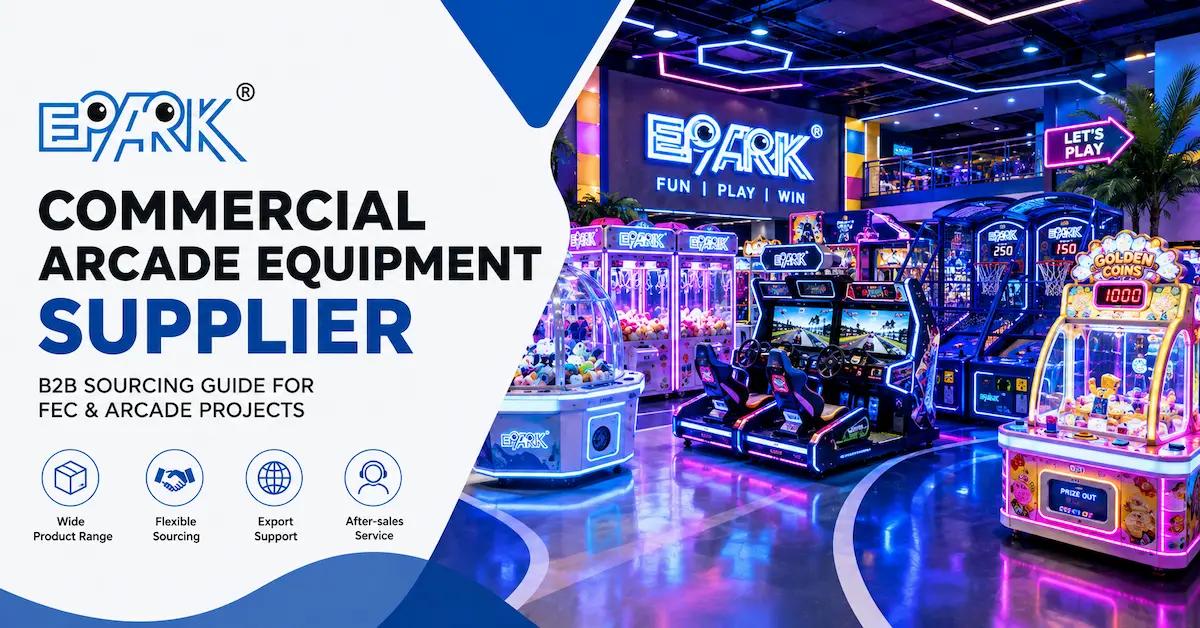
What Should a Commercial Arcade Equipment Supplier Provide?
A reliable commercial arcade equipment supplier should do more than send buyers a catalog and price list. For FEC operators, arcade owners, distributors, importers, and shopping mall entertainment projects, the supplier should help match equipment to the venue, operating model, target customers, technical requirements, and long-term maintenance needs.
The core question is not simply:
Which supplier has the largest number of machines?
A better question is:
Which supplier can provide the right equipment mix, consistent specifications, export-ready configuration, spare parts, and support for my project?
EPARK supplies amusement equipment for commercial entertainment projects and combines arcade and game machine sourcing with broader indoor entertainment solutions. Buyers can first review EPARK’s company and business capabilities and current amusement equipment solutions.
This article focuses specifically on supplier selection and project sourcing, rather than repeating the manufacturing-capability questions covered in a manufacturer-focused buying guide. This distinction also follows the uploaded SEO planning principle that closely related manufacturer/supplier keywords should address different buyer tasks instead of creating near-duplicate pages.
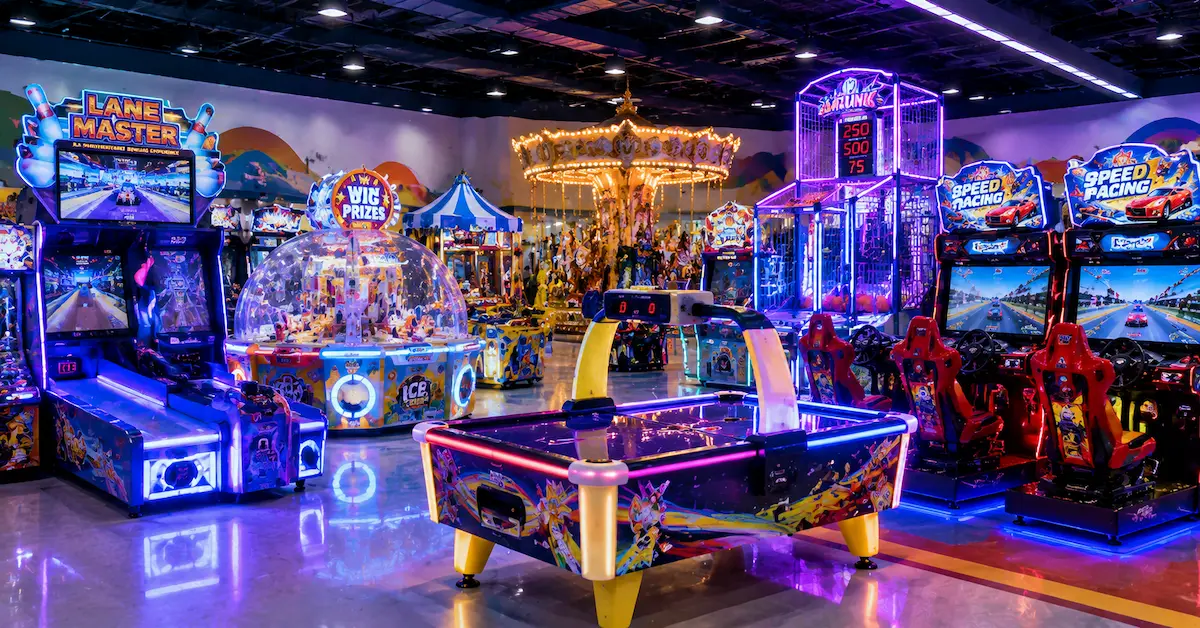
Supplier Selection Starts With Your Business Model
The right machine mix changes according to how the venue makes money and who visits it.
Family Entertainment Centers
A full FEC normally requires several types of attractions rather than one machine category.
Possible combinations include:
- Redemption games
- Claw and prize machines
- Racing simulators
- Shooting games
- Basketball and sports machines
- Kiddie rides
- Interactive games
- Selected VR attractions
The objective is to provide different play experiences while balancing floor space, age groups, repeat play, and operational complexity.
Shopping Mall Arcade Zones
Mall projects usually place greater emphasis on:
- Visual attraction
- Compact footprints
- Family-friendly games
- Easy supervision
- High-frequency operation
- Simple maintenance
Prize machines, racing games, sports machines, and family-oriented interactive games can be combined according to available floor area and customer profile.
Indoor Playground + Arcade Projects
Indoor playground operators may not need a complete standalone arcade.
Instead, arcade equipment can become an additional revenue and engagement zone near:
- Entrances
- Exits
- Waiting areas
- Parent seating
- Party areas
For buyers developing both play equipment and amusement machines, EPARK's indoor entertainment equipment portfolio can provide a broader starting point for project planning.
Distributors and Importers
Distributors have different priorities.
They often need:
- Multiple machine categories
- Repeatable specifications
- Wholesale quantities
- OEM options
- Export packaging
- Spare parts
- Stable reorder availability
For these buyers, supply-chain continuity can matter more than the requirements of a single venue.
Which Arcade Equipment Categories Should Buyers Source?
A good supplier should help buyers build a balanced portfolio rather than simply recommend the most expensive machines.
| Equipment Category | Typical Venue Role | Important Buying Factors |
|---|---|---|
| Claw & prize machines | Prize-driven repeat play | Mechanism, prize settings, cabinet size |
| Redemption games | FEC revenue mix | Ticket system, difficulty settings, service access |
| Racing games | Competitive attraction | Controls, screen, seats, software |
| Shooting games | Teen/family competition | Gun sensors, calibration, display |
| Basketball games | Active entertainment | Frame durability, scoring system |
| Kiddie rides | Younger children | Age suitability, footprint, operation |
| Interactive games | Modern entertainment | Sensors, software, maintenance |
| VR equipment | Immersive zone | Hardware, content, technical support |
A supplier should also be willing to explain why a certain machine is appropriate for the buyer's venue.
That is more valuable than simply filling unused floor space with more equipment.
Compare Suppliers by Equipment-Mix Capability
Ask for Recommendations Based on Floor Area
Instead of sending a message such as:
Send me your best machines.
Provide:
- Floor area
- Floor plan
- Target age group
- Venue type
- Expected customer profile
- Budget
- Destination country
A qualified supplier can then suggest a more practical combination.
For larger projects, the supplier should consider circulation between machines so that racing seats, basketball cabinets, prize machines, and high-traffic attractions do not create unnecessary congestion.
Avoid Too Many Similar Machines
Installing eight visually different machines that provide almost the same experience does not necessarily create a better arcade.
A diversified mix may combine:
- Skill games
- Competitive games
- Prize games
- Active games
- Parent-child games
- High-visual-impact attractions
This creates more reasons for customers to move through the venue and try different activities.
Payment System Compatibility Matters Before Ordering
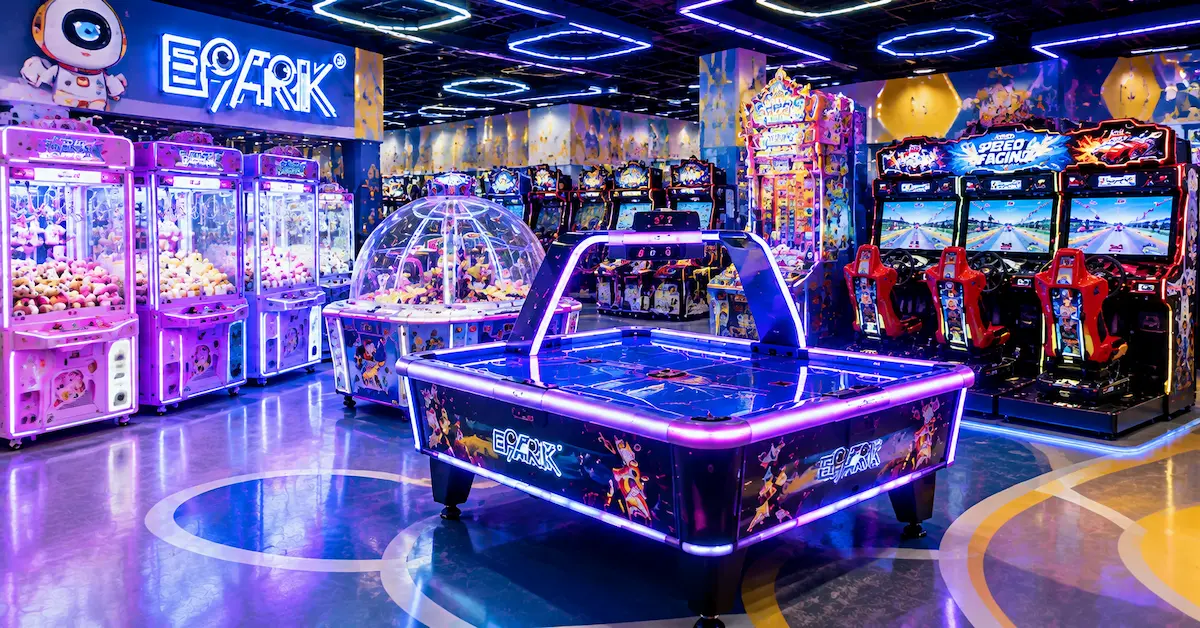
Payment configuration is one of the easiest details to overlook during international arcade sourcing.
Machines may need to operate with:
- Coins
- Tokens
- Bill acceptors
- RFID cards
- Rechargeable cards
- E-ticket systems
- Other cashless systems
The buyer should tell the supplier which system will be used before production.
Questions to Confirm
Ask:
- Is the machine coin or token compatible?
- Can a card reader be installed?
- Is there enough cabinet space for payment hardware?
- Can the wiring interface support the selected system?
- Does a redemption machine support paper tickets or e-tickets?
- Can payment settings be standardized across multiple models?
Your previously developed EPARK keyword plan specifically identifies RFID, card readers, e-ticket integration, POS compatibility, and cashless FEC equipment as strong B2B technical topics because buyers often search for these requirements during procurement or venue upgrades.
Electrical Configuration Must Match the Destination Market
International buyers should confirm electrical requirements before the supplier configures the machines.
Important information includes:
- Voltage
- Frequency
- Plug type
- Destination country
- Indoor operating environment
- Required documentation
IEC currently publishes IEC 60335-2-82:2024, which covers safety requirements for electric commercial amusement machines and personal service machines. The IEC lists amusement machines, gaming machines, driving simulators, kiddie rides and similar commercial equipment within its scope.
That does not mean every arcade machine automatically complies with the standard.
Buyers should ask which standards apply to the specific model, market, and configuration being ordered.
Check Compliance Documentation Before Shipment
For European projects, buyers should not treat the words “CE certified” as sufficient information.
The European Commission states that manufacturers are responsible for identifying applicable EU requirements, conducting the necessary conformity assessment, preparing technical documentation, issuing the EU Declaration of Conformity where applicable, and affixing CE marking.
Importers and distributors also have responsibilities to ensure products they place on the EEA market meet applicable requirements.
A B2B buyer should therefore ask:
- Which regulations apply to this machine?
- Is documentation linked to the exact model?
- Does the ordered electrical configuration match the tested version?
- Which test reports are available?
- What documentation will be included with the shipment?
This is particularly important when machines are customized for voltage, payment systems, lighting, controls, or other electrical components.
Quality Control Should Cover Operation, Not Just Appearance
A commercial machine may look excellent in a factory photo but still create problems after installation.
Before shipment, quality control should include functional checks.
Recommended Inspection Points
- Power-on test
- Screen operation
- Buttons and joysticks
- Sensors
- Sound system
- Lighting
- Scoring functions
- Coin/card interface
- Ticket dispensing where applicable
- Cabinet doors
- Locks
- Internal wiring
- Cooling
- Accessories
- Spare parts
For bulk orders, request photos and operating videos for representative machines.
The SaleAI framework you provided specifically treats technical depth, QC, certification, factory capability, risk mitigation, and commercial logic as core B2B content and conversion factors rather than optional additions.
Why Spare Parts Are Part of Supplier Selection
An arcade equipment purchase does not end when the machines arrive.
Commercial operators should plan for components that may require replacement during the equipment lifecycle.
Depending on the machine, these can include:
- Buttons
- Joysticks
- Sensors
- Power supplies
- Locks
- Coin acceptors
- Ticket dispensers
- Card-reader components
- Cables
- Lighting components
Ask for a Spare-Parts Plan
For a large order, ask the supplier:
- Which parts fail or wear most often?
- Which parts can be replaced locally?
- Which parts are model-specific?
- Which parts should be shipped with the initial order?
- How long will replacements remain available?
For distributors and chain FECs, component standardization across machines can reduce spare-parts inventory and technician training requirements.
OEM Customization Should Support Operations, Not Only Branding
OEM customization is often treated as logo printing, but B2B buyers may need much more.
Branding Options
Possible customization can include:
- Logo
- Cabinet artwork
- Color
- Venue graphics
- Packaging
Technical Options
Depending on the equipment, buyers may also request:
- Language settings
- Coin settings
- Credit settings
- Payment hardware
- Ticket configuration
- Voltage
- Plug type
The exact customization capability varies by machine, so specifications should be approved before production.
Supplier vs Manufacturer: Which Buyer Needs Which?
A supplier-oriented sourcing strategy can be useful when the project requires a broad equipment mix.
| Buyer Requirement | Supplier-Focused Advantage |
|---|---|
| Multiple arcade categories | Easier product consolidation |
| Mixed machine order | Broader sourcing flexibility |
| Complete FEC | Equipment-mix coordination |
| Distributor catalog | Wider product selection |
| Consolidated shipment | Fewer logistics interfaces |
| Project support | One communication point |
A manufacturer relationship may be more important when the project depends on deep product engineering, highly customized machines, or large quantities of one standardized model.
This is why the previous commercial arcade equipment manufacturer topic and this commercial arcade equipment supplier topic should not be written as two versions of the same “how to choose a company” article.
The manufacturer page should emphasize production, engineering, QC and OEM capability.
The supplier page should emphasize product mix, sourcing, compatibility, consolidation, logistics and long-term supply.
Compare the Total Procurement Cost
Unit price is only one part of the sourcing decision.
Commercial buyers should consider:
Machine cost + customization + spare parts + packaging + freight + import costs + installation + maintenance + downtime
A cheaper machine may not be cheaper over its operating life if:
- Spare parts are difficult to obtain
- Payment hardware is incompatible
- Documentation is incomplete
- Repairs require proprietary components
- Packaging causes shipping damage
- Technical support is slow
The lowest quotation should therefore not automatically win the order.
What Should You Include in an Arcade Equipment RFQ?
A detailed RFQ helps a supplier provide a more useful proposal.
Include:
- Venue type
- Floor plan or usable area
- Target customer group
- Preferred game categories
- Approximate quantity
- Budget range
- Destination country
- Voltage and frequency
- Plug requirement
- Payment system
- OEM requirements
- Opening schedule
- Shipping destination
- Spare-parts requirements
For an FEC project, sending the floor plan can also help the supplier recommend equipment by zone rather than quoting unrelated machines.
Buyers can review common cooperation questions through the EPARK FAQ or submit a project brief through Contact EPARK.
When Does a One-Stop Arcade Equipment Supplier Add More Value?
Working with fewer suppliers can be useful when a project includes several equipment categories.
This is especially relevant for:
- New FEC projects
- Shopping mall entertainment centers
- Indoor playground + arcade projects
- Multi-category distributor orders
- Chain entertainment venues
Possible advantages include:
- Coordinated equipment selection
- Consolidated communication
- More consistent technical requirements
- Simplified shipping preparation
- Coordinated spare parts
- Easier project scheduling
EPARK combines arcade and game machines with indoor playground, trampoline, and other amusement project capabilities. This allows buyers planning mixed entertainment venues to discuss multiple equipment zones through one project channel. See About EPARK for the company's current business scope.
FAQ
What does a commercial arcade equipment supplier provide?
A supplier can provide different categories of commercial arcade machines and support equipment selection, configuration, customization, export preparation, shipping coordination, spare parts, and after-sales communication.
What machines should I buy for a new FEC?
A balanced FEC may combine redemption games, prize machines, racing games, shooting games, sports machines, kiddie rides, and interactive equipment. The final mix should depend on floor area, customers, budget, and operating model.
Can a supplier provide different machine categories in one order?
Many suppliers support mixed equipment orders, but buyers should confirm MOQ, production or sourcing schedules, packaging, and whether shipment consolidation is available.
Can arcade machines support RFID or cashless payment?
Some machines can integrate card readers, RFID or other cashless systems. Compatibility should be confirmed for each model before production.
Can commercial arcade machines be customized?
Depending on the model, customization may include artwork, colors, logo, language, payment settings, voltage, plugs, packaging, and selected technical configurations.
What spare parts should be ordered with arcade equipment?
Common spare-parts requirements can include buttons, sensors, power supplies, coin mechanisms, locks, cables, ticket-system parts, and other model-specific components.
How do I compare two arcade equipment suppliers?
Compare equipment range, specifications, QC, payment compatibility, customization, compliance documentation, spare parts, packaging, logistics, warranty, and after-sales support.
Is the cheapest arcade equipment supplier the best choice?
Not necessarily. Buyers should evaluate total procurement and operating cost rather than unit price alone.
What information should I provide for a quotation?
Provide venue type, floor area, equipment categories, quantity, destination country, voltage, payment system, budget, customization requirements, and opening schedule.
How can I request an EPARK project proposal?
Prepare your equipment list or floor plan along with destination market, electrical requirements, budget, and target opening date, then submit the information through the EPARK contact page.
Conclusion
Choosing a commercial arcade equipment supplier is ultimately about building a reliable equipment and supply system for the venue—not simply buying individual machines.
FEC operators, shopping mall projects, distributors, importers, and arcade owners should evaluate equipment mix, payment compatibility, electrical specifications, compliance documentation, QC, spare parts, OEM flexibility, shipping coordination, and after-sales support before comparing final prices.
For mixed entertainment projects, a supplier capable of coordinating arcade machines with other amusement equipment can also simplify sourcing and project execution.
Explore EPARK products, review the company profile, or contact EPARK with your floor plan, machine categories, quantity, destination country, and technical requirements for a project-specific proposal.
General Disclaimer
All data on https://www.eparki.com is for general guidance only. As a leading indoor playground manufacturer and trampoline supplier, EPARK strives for accuracy but gives no express or implied warranty regarding completeness, performance or project fitness. Product specs, designs and results may vary with use and customer requirements. Buyers must verify technical details, compliance and suitability before purchase. EPARK OEM/ODM is not liable for any direct, indirect or consequential damages arising from site use. For custom solutions, contact our manufacturer and supplier team via the Contact page.
Intellectual Property
Text, images, videos, CAD files and software are Guangzhou EPARK Electronic Technology Co., Ltd. All rights reserved. No part may be copied, republished or used commercially without prior written permission. We will pursue legal action for copyright or design-patent infringement.
Trademarks
"EPARK", the EPARK logo and related graphics are registered trademarks of Guangzhou EPARK Electronic Technology Co., Ltd. Unauthorized use in ads, domain names or packaging is prohibited.
Governing Law
These terms are governed by the laws of the People's Republic of China.
Contact
Questions? Email sales@nanyuetech.com or WhatsApp +86 139 0307 9263.