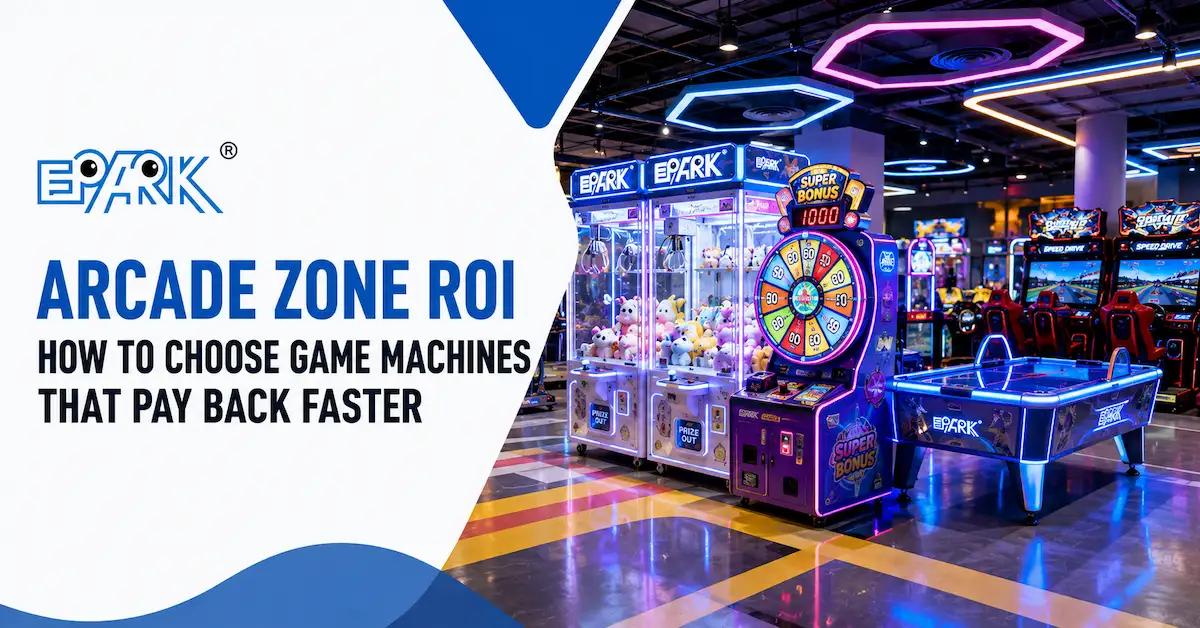
An arcade zone can become one of the most profitable parts of a family entertainment center, indoor playground, shopping mall, hotel, resort, or leisure complex. However, profitability depends on more than filling the space with colorful machines.
A strong arcade zone ROI comes from selecting equipment that matches the target audience, generates consistent plays, uses floor space efficiently, and remains reliable during busy operating periods.
For investors and operators, the key question is not simply:
Which machine has the lowest purchase price?
The better question is:
Which machine can generate sustainable net revenue and recover its total investment within a reasonable period?
This guide explains how to evaluate machine profitability, estimate payback, build a balanced arcade mix, control hidden costs, and choose a supplier that supports long-term operation.
Buyers can explore EPARK’s commercial game machine range when comparing claw machines, redemption games, racing machines, sports games, kiddie rides, prize equipment, and complete arcade packages.
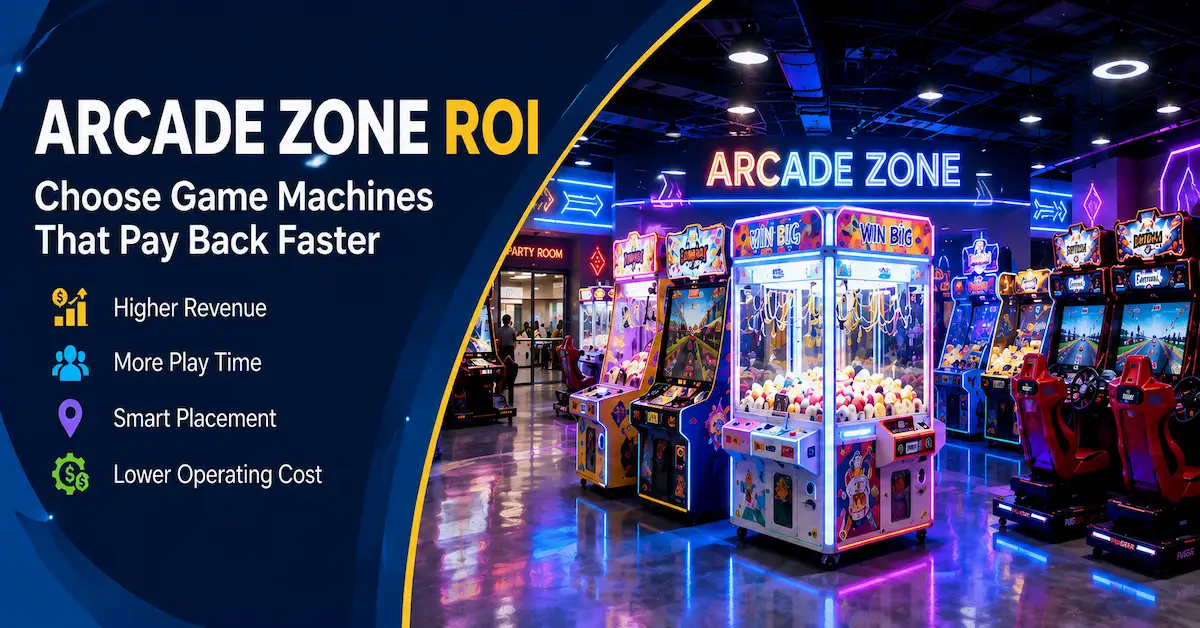
What Does Arcade Zone ROI Mean?
Arcade zone ROI measures the financial return generated by the arcade area compared with the total amount invested.
A simple formula is:
Arcade zone ROI = Annual net operating profit ÷ Total arcade investment × 100%
The total investment may include:
- Game machines
- Shipping and customs
- Installation
- Payment systems
- Spare parts
- Prize inventory
- Electrical preparation
- Decoration and lighting
- Staff training
- Initial marketing
Net operating profit should be calculated after deducting:
- Prize costs
- Electricity
- Maintenance
- Labor
- Payment processing fees
- Software expenses
- Machine downtime
- Depreciation
- Rent allocation
This is important because gross machine revenue does not show the real profitability of the arcade zone.
ROI, Payback Period, and Revenue per Square Meter
Investors should use several indicators instead of relying on one number.
| Performance Indicator | Calculation | Why It Matters |
|---|---|---|
| ROI | Net profit ÷ total investment | Measures overall financial return |
| Payback Period | Initial investment ÷ monthly net cash flow | Estimates how quickly capital is recovered |
| Revenue per Square Meter | Monthly revenue ÷ machine footprint | Measures floor-space efficiency |
| Revenue per Play | Machine revenue ÷ total plays | Helps evaluate pricing |
| Downtime Rate | Unavailable hours ÷ operating hours | Shows reliability risk |
| Maintenance Cost Ratio | Maintenance cost ÷ machine revenue | Identifies expensive equipment |
| Repeat Play Rate | Repeat sessions ÷ total players | Shows customer engagement |
A large machine may generate strong monthly sales but still deliver weak floor efficiency. A smaller prize machine may produce less total revenue but deliver a faster payback because it requires less space and investment.
Why Some Arcade Machines Pay Back Faster
Faster-payback machines often share several commercial characteristics.
They are usually:
- Easy to understand
- Visually attractive
- Suitable for repeated play
- Compatible with the venue’s age groups
- Positioned in high-traffic areas
- Reliable during peak periods
- Easy to maintain
- Efficient in floor-space use
- Supported by attractive prizes or competition
- Integrated with a suitable payment system
The machine category matters, but operating strategy is equally important. A profitable machine in one venue may perform poorly in another if the audience, pricing, placement, or prize strategy is different.
Step 1: Define the Target Customer Before Buying Machines
The fastest way to reduce arcade zone ROI is to buy machines that do not match the people visiting the venue.
Before selecting equipment, define:
- Primary age groups
- Family or individual visitors
- Average visit duration
- Weekday and weekend traffic
- Local spending levels
- Birthday party demand
- Mall, resort, hotel, or community location
- Expected adult participation
- Available floor space
Young Children
Suitable equipment may include:
- Kiddie rides
- Mini claw machines
- Simple redemption games
- Parent-child games
- Compact interactive machines
School-Age Children
Suitable options may include:
- Ticket redemption games
- Basketball machines
- Air hockey
- Prize machines
- Skill games
- Racing games
Teenagers and Adults
Consider:
- Advanced racing simulators
- Competitive sports games
- Shooting games
- Music games
- VR attractions
- Social multiplayer games
A mixed family venue should combine several categories rather than concentrating the entire budget on one age group.
Step 2: Choose Machines with Strong Repeat-Play Potential
Repeat play is one of the main drivers of arcade zone ROI.
Customers are more likely to play again when:
- A prize is clearly visible
- The player almost wins
- The game supports competition
- Tickets contribute toward a larger reward
- The session is short enough to replay
- The difficulty feels achievable
- Multiple players can compete
- Progress can be saved through a card system
Claw Machines
Claw machines can encourage repeat attempts because customers can see the prize and understand the objective immediately.
Performance depends on:
- Prize attractiveness
- Prize value
- Claw strength settings
- Machine visibility
- Price per play
- Prize rotation frequency
Redemption Games
Redemption equipment encourages customers to collect tickets or digital points over multiple games.
It can support:
- Longer customer dwell time
- Repeat spending
- Prize counter activity
- Membership programs
- Birthday packages
Competitive Machines
Racing, basketball, air hockey, and other multiplayer games encourage rematches and group participation.
They are especially suitable for:
- Teen zones
- Party groups
- Family competitions
- Corporate events
- Resort entertainment areas
Step 3: Compare Purchase Price with Revenue Potential
A low-cost machine is not automatically a high-ROI machine.
Investors should compare:
| Evaluation Factor | Key Question |
|---|---|
| Purchase Cost | What is included in the quotation? |
| Expected Plays | How many daily plays are realistic? |
| Price per Play | What will local customers accept? |
| Prize Cost | How much of revenue is consumed by prizes? |
| Footprint | How much revenue can the space generate? |
| Maintenance | Are parts easy to replace? |
| Downtime | How much revenue may be lost during repairs? |
| Lifespan | How long can the machine remain commercially attractive? |
| Resale or Relocation | Can the machine be moved to another venue? |
A higher-quality machine may recover its investment faster if it remains available during busy periods and requires fewer repairs.
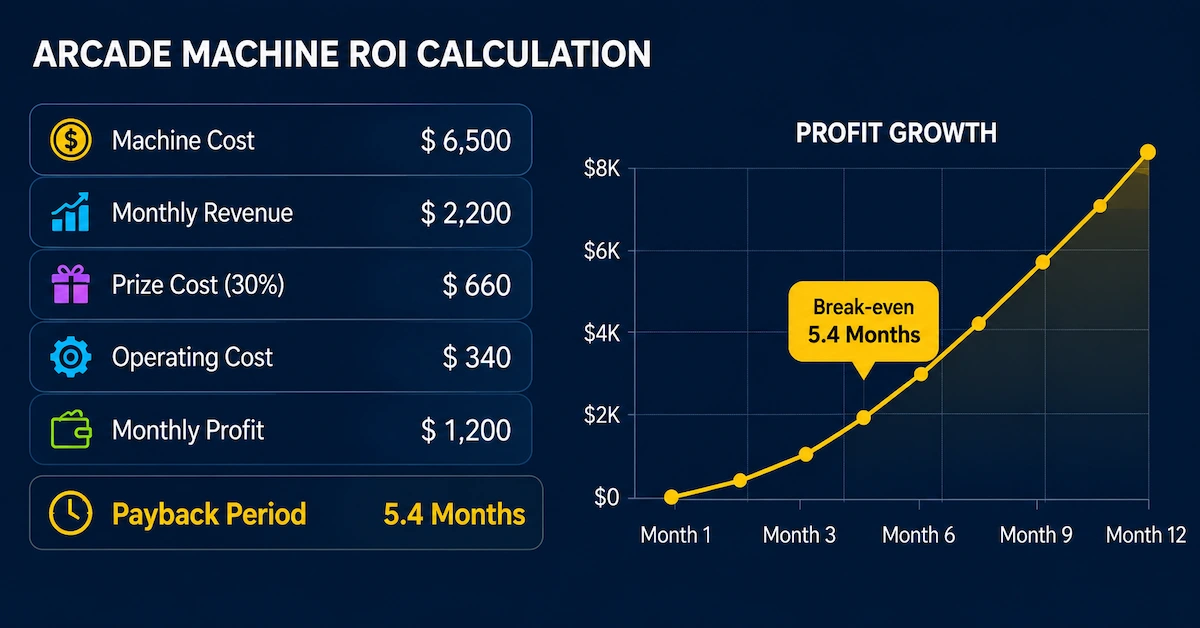
Step 4: Estimate the Machine Payback Period
A simple payback calculation is:
Machine payback period = Total machine investment ÷ Average monthly net cash flow
Consider this hypothetical example:
| Item | Illustrative Amount |
|---|---|
| Machine and delivery investment | $8,000 |
| Monthly gross revenue | $2,000 |
| Prize and operating costs | $700 |
| Monthly net cash flow | $1,300 |
| Estimated payback period | About 6.2 months |
This example is for planning purposes only. Actual results depend on location, traffic, pricing, operation, maintenance, and customer demand.
Investors should prepare at least three scenarios:
- Conservative
- Expected
- High-performance
A machine should still remain financially acceptable under the conservative scenario.
Step 5: Measure Revenue per Square Meter
Floor space is one of the most valuable assets in an FEC.
When comparing machines, calculate:
Monthly machine revenue ÷ Machine footprint
This helps identify whether a large attraction is using space effectively.
For example:
| Machine Type | Floor Requirement | Typical Commercial Role |
|---|---|---|
| Compact Claw Machine | Low | Repeat-play prize revenue |
| Kiddie Ride | Low to medium | Toddler pay-per-play income |
| Redemption Game | Medium | Ticket and prize spending |
| Racing Simulator | Medium to high | Premium competitive play |
| Air Hockey | Medium to high | Family and group engagement |
| Large VR Attraction | High | Premium experience and visual attraction |
Large machines can still be worthwhile when they attract visitors, strengthen the venue image, or support premium pricing. However, their indirect value should be included in the evaluation.
Step 6: Build a Balanced Arcade Machine Portfolio
A profitable arcade zone should not depend entirely on one machine category.
A balanced mix may include:
| Machine Group | Purpose |
|---|---|
| Traffic Attractions | Capture attention from entrances and main aisles |
| Repeat-Play Machines | Encourage multiple transactions |
| Family Games | Support shared parent-child experiences |
| Competitive Games | Attract groups, teens, and parties |
| Toddler Equipment | Serve younger visitors |
| Prize and Redemption Games | Increase spending through rewards |
| Premium Machines | Improve differentiation and perceived value |
One practical approach is to divide the arcade budget into three layers:
Core Revenue Machines
These should generate stable daily plays.
Examples include:
- Claw machines
- Redemption games
- Kiddie rides
- Compact arcade machines
Engagement Machines
These increase customer dwell time and group interaction.
Examples include:
- Racing machines
- Basketball machines
- Air hockey
- Multiplayer cabinets
Attraction Machines
These improve visual impact and help market the venue.
Examples include:
- Large simulators
- VR systems
- Specialty attractions
- Large prize machines
This structure reduces dependence on a single machine and creates a more complete customer experience.
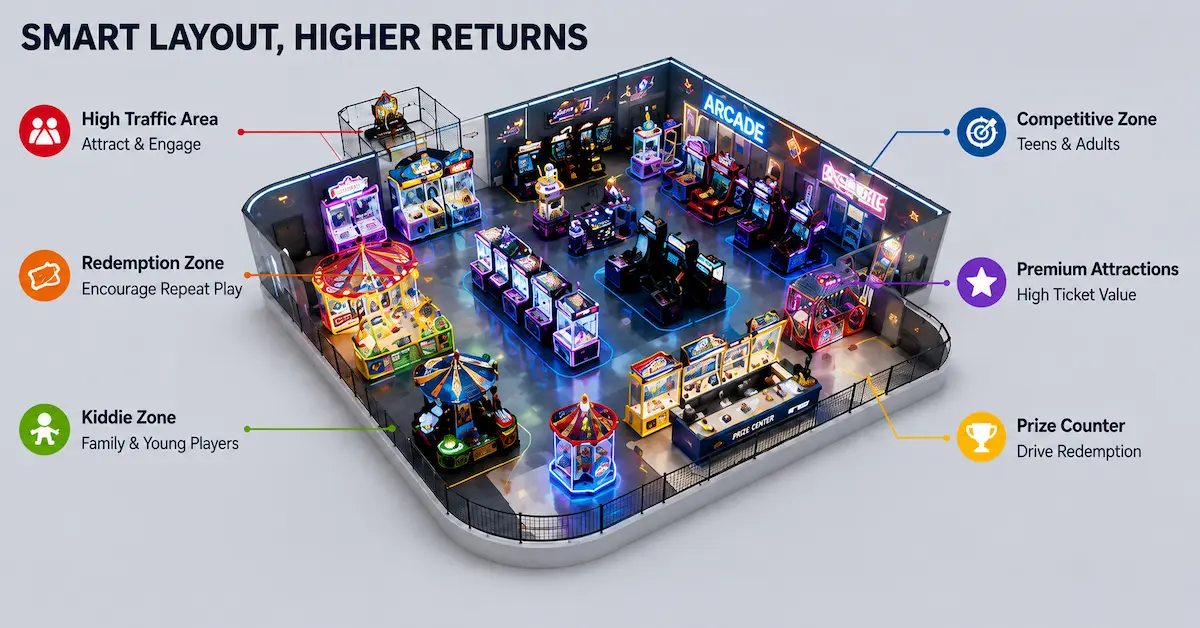
Step 7: Place Machines Where Customers Naturally Spend
Machine placement can change performance significantly.
| Arcade Location | Recommended Equipment | Main Objective |
|---|---|---|
| Main Entrance | Prize and visually bright machines | Attract customers |
| Reception Area | Compact games and kiddie rides | Monetize waiting time |
| Parent Seating Zone | Low-noise family machines | Encourage shared play |
| Playground Exit | Claw and redemption machines | Capture final spending |
| Birthday Area | Multiplayer and group games | Increase package value |
| Teen Zone | Racing and competitive games | Extend dwell time |
| Prize Counter | Redemption machines | Encourage ticket collection |
| Low-Traffic Corner | Destination or premium machine | Pull visitors deeper into venue |
Operators should leave enough space for customer circulation, wheelchair access, staff service, and maintenance.
Buyers with a venue plan can contact EPARK to discuss machine quantity and layout planning.
Step 8: Control Prize Costs
Prize costs can strongly affect the profitability of claw machines and redemption equipment.
Operators should track:
- Prize cost as a percentage of revenue
- Average prize cost per winning customer
- Prize inventory turnover
- Machine win frequency
- Seasonal prize performance
- Premium versus low-cost prize demand
An effective prize strategy combines:
- Entry-level prizes
- Medium-value rewards
- High-value display prizes
- Seasonal products
- Collectible items
- Locally relevant gifts
Customers should feel that winning is possible, while the operator maintains a sustainable prize-cost ratio.
Step 9: Select the Right Payment System
The payment system affects spending behavior, operating efficiency, and data collection.
| Payment Method | Main Benefit | Suitable Venue |
|---|---|---|
| Coins or Tokens | Simple and familiar | Small arcades |
| Recharge Cards | Supports prepaid spending | Medium and large FECs |
| QR Payment | Convenient mobile payment | Modern commercial venues |
| Bill Acceptors | Direct cash access | Selected international markets |
| Package Credits | Supports parties and memberships | Family entertainment centers |
Recharge systems can improve arcade zone ROI through:
- Bonus credit promotions
- Membership programs
- Unused balance retention
- Customer spending data
- Weekday offers
- Birthday packages
- Cross-selling between machines
The payment system should be confirmed before production to avoid costly modification after delivery.
Step 10: Reduce Downtime and Maintenance Losses
A machine cannot generate revenue when it is unavailable.
Before purchasing, confirm:
- Spare parts availability
- Warranty coverage
- Technical documentation
- Remote troubleshooting support
- Component standardization
- Software update procedures
- Maintenance access
- Recommended spare parts list
Operators should keep frequently used components in stock, including:
- Buttons
- Joysticks
- Sensors
- Power supplies
- Card readers
- Coin acceptors
- Screens
- Cables
- Control boards
Preventive maintenance is often less expensive than emergency repair during peak hours.
Buyers can review common purchasing and support questions on the EPARK FAQ page.
Step 11: Track Machine Performance After Opening
Machine selection does not end when the venue opens.
Operators should collect weekly and monthly data.
| Data Point | Why Track It |
|---|---|
| Total Plays | Measures customer demand |
| Gross Revenue | Shows sales performance |
| Prize Cost | Protects profit margins |
| Maintenance Cost | Identifies expensive machines |
| Downtime | Reveals reliability problems |
| Revenue per Square Meter | Measures floor efficiency |
| Revenue by Time Period | Supports pricing and promotions |
| Customer Feedback | Identifies experience issues |
Underperforming machines can be improved by:
- Changing the location
- Adjusting the price
- Updating prizes
- Changing game difficulty
- Improving lighting
- Adding promotions
- Replacing the machine
A machine should not remain in a weak location simply because it was part of the original layout.
Step 12: Evaluate Supplier Capability
Supplier selection affects equipment quality, delivery, customization, maintenance, and long-term project expansion.
A reliable supplier should support:
- Commercial machine recommendations
- Equipment mix planning
- OEM and ODM customization
- Quality inspection
- Export packaging
- Payment system configuration
- Spare parts
- Warranty support
- Technical guidance
- Repeat orders for chain projects
Buyers can review EPARK’s company information to learn more about its amusement equipment and FEC project capabilities.
Common Arcade Zone ROI Mistakes
Choosing Machines Only by Appearance
Bright equipment may attract attention, but visual design alone does not guarantee repeat play or profitability.
Buying Too Many Similar Machines
A large number of similar games can reduce customer choice and increase competition between machines inside the same venue.
Ignoring Operating Costs
Prize costs, power consumption, maintenance, labor, and payment fees can reduce net revenue.
Overestimating Daily Plays
Forecasts should be based on realistic traffic, not only peak weekend performance.
Using the Same Price for Every Machine
Premium games, compact games, and prize machines may require different pricing strategies.
Ignoring Local Customer Preferences
Machines that perform well in one country or city may not deliver the same result in another market.
Failing to Replace Weak Machines
An underperforming machine occupies valuable floor space and limits total arcade profitability.
Why Work with EPARK for Arcade Zone Planning?
EPARK supplies commercial amusement equipment for family entertainment centers, indoor playgrounds, shopping malls, hotels, resorts, arcade operators, and distributors.
EPARK can support:
- Game machine selection
- Arcade equipment packages
- Venue layout recommendations
- Equipment category planning
- OEM and ODM customization
- Export packaging
- Payment system configuration
- Spare parts
- After-sales assistance
Investors can explore EPARK’s game machine catalog, review additional project insights on the EPARK blog, or submit a floor plan through the contact page.
FAQ About Arcade Zone ROI
What is a good arcade zone ROI?
A good result depends on project size, rent, customer traffic, local pricing, operating costs, and the expected life of the equipment. Investors should compare actual net profit with the total investment rather than using gross sales alone.
Which game machines usually pay back faster?
Compact claw machines, redemption games, kiddie rides, and simple pay-per-play machines may recover investment efficiently when they match the venue audience and receive strong daily traffic.
Do expensive arcade machines always generate more revenue?
No. Premium equipment can improve visual attraction and pricing, but profitability depends on utilization, floor space, maintenance, and customer demand.
How can operators improve an underperforming machine?
Operators can change its location, pricing, prizes, difficulty, promotion, or visual presentation. If performance remains weak, replacing it may improve revenue per square meter.
How often should machine performance be reviewed?
Revenue, plays, downtime, prize cost, and maintenance should be reviewed weekly, with a deeper profitability analysis completed monthly.
Can EPARK help plan a profitable arcade zone?
Yes. Buyers can browse EPARK’s commercial game machines or contact EPARK with their venue size, target customers, budget, and floor plan.
Conclusion
Improving arcade zone ROI requires more than purchasing popular machines. Investors need to compare total investment, net revenue, payback period, floor-space efficiency, maintenance risk, and long-term customer demand.
Machines that pay back faster usually combine strong visibility, simple gameplay, repeat-play potential, efficient floor use, reliable components, and suitable placement.
A balanced arcade should include stable revenue machines, family engagement games, competitive equipment, and selected visual attractions. Operators should then track real performance and adjust the machine mix after opening.
To plan a profitable arcade area, explore EPARK’s amusement equipment catalog, learn more about EPARK’s project capabilities, or contact the EPARK team with your project requirements.
General Disclaimer
All data on https://www.eparki.com is for general guidance only. As a leading indoor playground manufacturer and trampoline supplier, EPARK strives for accuracy but gives no express or implied warranty regarding completeness, performance or project fitness. Product specs, designs and results may vary with use and customer requirements. Buyers must verify technical details, compliance and suitability before purchase. EPARK OEM/ODM is not liable for any direct, indirect or consequential damages arising from site use. For custom solutions, contact our manufacturer and supplier team via the Contact page.
Intellectual Property
Text, images, videos, CAD files and software are Guangzhou EPARK Electronic Technology Co., Ltd. All rights reserved. No part may be copied, republished or used commercially without prior written permission. We will pursue legal action for copyright or design-patent infringement.
Trademarks
"EPARK", the EPARK logo and related graphics are registered trademarks of Guangzhou EPARK Electronic Technology Co., Ltd. Unauthorized use in ads, domain names or packaging is prohibited.
Governing Law
These terms are governed by the laws of the People's Republic of China.
Contact
Questions? Email sales@nanyuetech.com or WhatsApp +86 139 0307 9263.