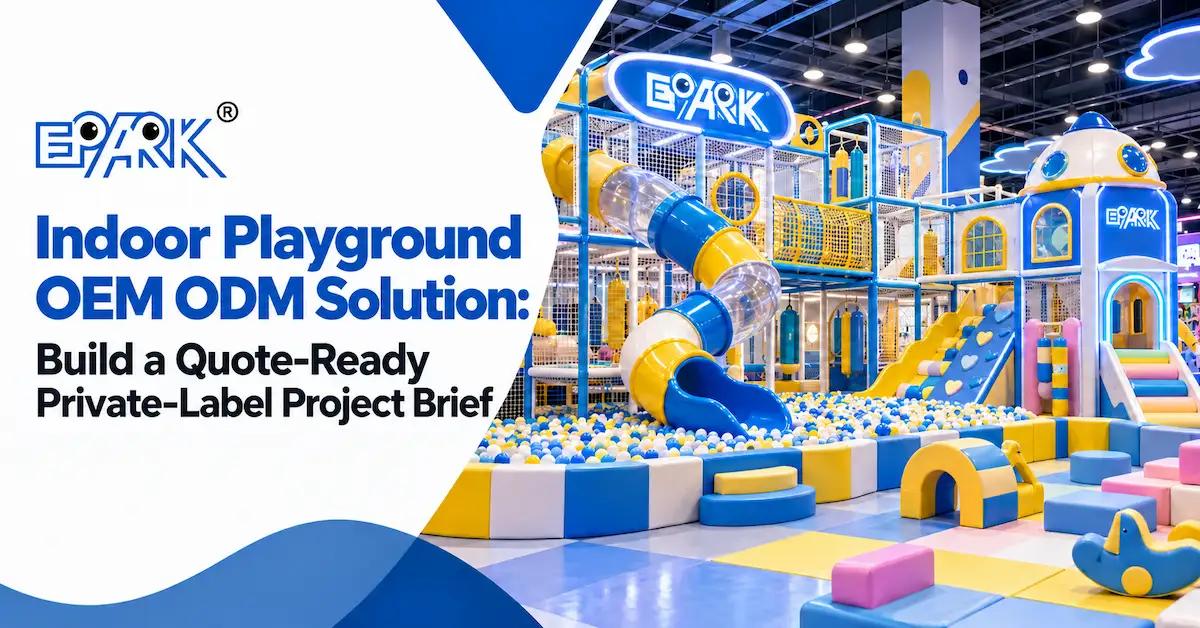
An indoor playground OEM ODM solution is procurement-ready only when the buyer and manufacturer agree on the site envelope, user groups, play mix, brand controls, materials, compliance documents, acceptance criteria, packaging, installation scope, and after-sales responsibilities. A rendering alone is not a manufacturing brief. For a useful quotation, send measured drawings or CAD files, clear ceiling heights, column and exit locations, target ages, preferred activities, destination market, brand assets, and the services you expect the supplier to include.
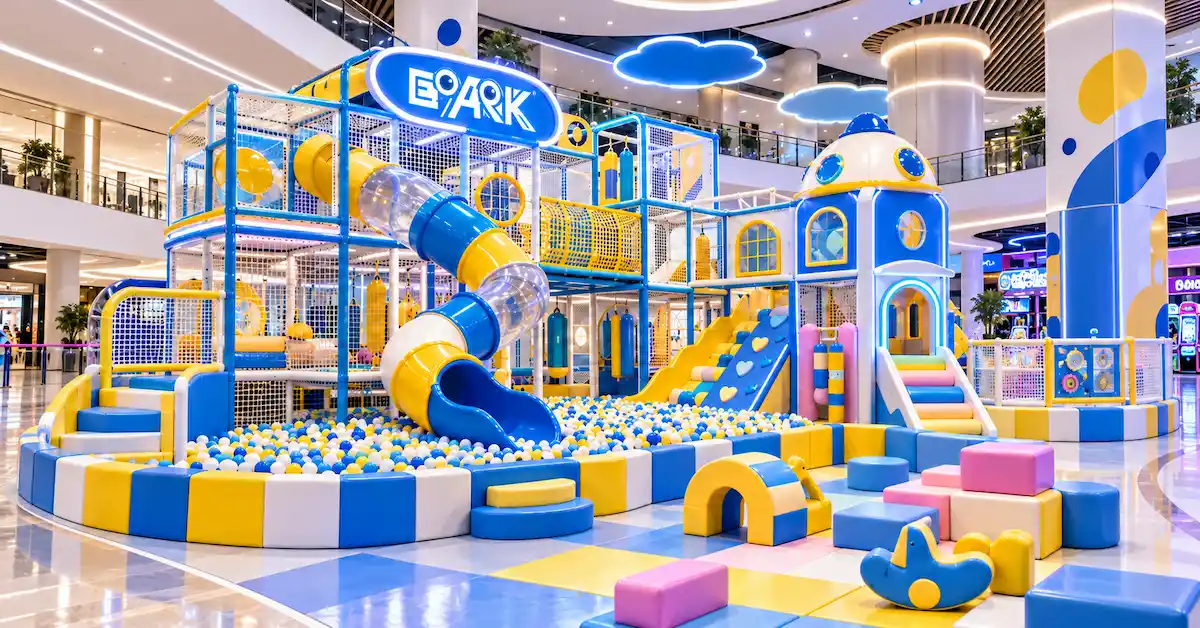
What Decision Does an OEM/ODM Buyer Need to Make?
The immediate decision is not simply “OEM or ODM?” The buyer needs to choose the level of design ownership, engineering input, customization, documentation, and repeatability required for the business model.
| Buying situation | Likely route | What the buyer must control | What the manufacturer must prove |
|---|---|---|---|
| A brand already owns a concept, mascot, visual system, or layout | OEM-led project | Design files, IP permission, performance requirements, approved changes | Manufacturability review, materials, production controls, change records |
| A new operator needs a proven starting layout adapted to one venue | ODM-led project | Site constraints, target ages, attraction mix, local requirements | Design basis, modification limits, component documentation, delivery scope |
| A distributor wants repeat orders under its own brand | Hybrid OEM/ODM | Brand rules, approved bill of materials, version control, territory terms | Repeatability, packaging identity, batch QC, spare-parts continuity |
| A chain needs several sites with different floor plans | Platform plus site adaptation | Non-negotiable brand elements and site-specific approval process | Modular design logic, drawing control, rollout capacity, installation support |
An effective indoor playground OEM ODM solution therefore begins with a controlled brief. The brief should tell the factory which parts may be adapted and which are fixed. Without that distinction, the buyer may receive an attractive concept that is difficult to approve, repeat, install, or maintain.
Build a Quote-Ready Project Brief Before Comparing Suppliers
1. Record the site envelope, not only the floor area
“500 m2 indoor playground” is not enough information for engineering or pricing. Two sites with the same area can require different structures because of ceiling height, columns, beams, glazing, fire exits, doors, HVAC equipment, sprinkler zones, loading routes, or uneven walls.
Provide a dimensioned CAD file when possible. At minimum, record:
- usable length and width, including irregular corners;
- finished floor-to-ceiling height and the lowest obstruction;
- column sizes and exact coordinates;
- entrances, emergency exits, windows, and restricted access areas;
- sprinklers, ducts, lights, cameras, signs, and other overhead services;
- floor levels, ramps, steps, and load limitations supplied by the building team;
- installation access, cargo lift size, doorway size, and storage space;
- the areas reserved for reception, shoes, seating, parties, food, toilets, and staff.
EPARK’s customization process states that its team develops 3D renderings and detailed floor plans and tailors technical drawings to spatial constraints and target demographics. That design service becomes more useful when the source survey is complete and the buyer identifies who is responsible for validating building dimensions.
2. Define users and operating model
Target age is an engineering input, not a marketing afterthought. A toddler-focused hotel play corner, a school activity room, a family entertainment center, and a mixed soft play plus trampoline venue require different zoning, supervision, circulation, equipment, and maintenance assumptions.
The brief should define the intended ages, expected mix of children and accompanying adults, supervision model, peak attendance assumptions, party program, session length, footwear policy, food policy, and any accessibility objectives. If a capacity figure is important, ask the supplier to state the method and assumptions behind it. Do not accept an unexplained number copied from another project.
3. Convert “fun” into an activity schedule
List activity types rather than asking for “more attractions.” A useful schedule may include toddler soft play, ball pool, multi-level climbing, slides, rope or net obstacles, role-play houses, interactive projection, trampoline areas, ninja elements, parent-child activities, and quieter sensory zones. EPARK’s product catalogue groups indoor playground, jungle, candy, castle, ocean, space, trampoline park, and soft play options, while its company content also mentions arcade and game-machine packages.
Ask the designer to map each activity to age, intensity, supervision, access, fall protection, maintenance, and throughput. This makes the design review more objective than choosing elements only because they look impressive in a rendering.
4. Set brand and IP controls
For OEM work, provide approved logo files, color values, mascot artwork, typography, signage hierarchy, and usage rules. State whether the factory may adapt the artwork for fabrication and whether the buyer expects ownership of custom drawings. If licensed characters are involved, document the buyer’s authorization to use them.
For ODM work, identify what can be selected from the supplier’s design library and what must remain exclusive. EPARK’s 726 m2 OEM/ODM playground example describes customization of colors, logos, packaging, and play elements and says custom designs and branding remain exclusive to the buyer. Because this is a statement on one product page, exclusivity, reuse, confidentiality, territory, and file ownership should still appear in the signed agreement for each project.
Prepare a more accurate RFQ. Send the site dimensions, clear height, target ages, preferred theme, activity list, destination market, and required service scope.
Submit Your Project BriefMaterial Evidence to Request Before Design Approval
A professional article or quotation should not describe a playground as “premium” without identifying the actual material system. EPARK’s materials and safety page publishes several material descriptions:
- cold-rolled steel pipes with hot-dip galvanization for the supporting framework;
- high-density foam and soft PVC sleeves on contact surfaces;
- high-density EVA or PU foam mats in activity zones;
- FRP or composite-resin slides with smooth, wear-resistant surfaces;
- railings, safety nets, and padded climbing bridges and stairs.
Those descriptions are useful starting evidence, but they do not replace a project bill of materials. The buyer should ask which exact material, thickness, density, finish, supplier, and document applies to each component in the proposed layout.
| Component | Evidence to request | Approval question |
|---|---|---|
| Steel framework | Pipe specification, wall thickness, finish, connection detail, drawing reference | Does the submitted structure match the final height, spans, loads, and local project requirements? |
| Foam and padded covers | Material name, density or grade where relevant, cover sample, seam detail, test documents | Which test or specification supports impact, durability, chemical, and cleaning requirements? |
| Floor mats | EVA/PU identification, thickness, surface texture, joint detail, cleaning instructions | Is the mat selected for the activity and fall condition of that exact zone? |
| Slides and molded parts | FRP/resin description, finish, edge inspection, fixing detail, maintenance advice | How are joints, edges, fasteners, wear, and replacement handled? |
| Nets and barriers | Mesh specification, attachment method, opening control, replacement criteria | Does the barrier arrangement match the age group and hazard being controlled? |
| Interactive or powered items | Power data, wiring layout, component manuals, isolation and spare-parts list | Who supplies local power connections, commissioning, and ongoing technical support? |
Use approved samples or swatches for visible and touch-sensitive materials. Record sample codes in the contract or approval sheet. A photograph can show color and workmanship, but it cannot by itself prove density, composition, flame behavior, chemical limits, or structural performance.
How to Verify Process, Testing, and Quality Control
Ask for evidence from the actual order
EPARK’s website displays factory, assembly, quality-control, testing-laboratory, design-studio, and export-ready product images on the About Us page. Its page-specific OEM/ODM example also outlines cutting, welding, grinding, cover cutting, cushioning, padded-panel assembly, final inspection, and packing, and says in-process photos can be provided on request.
For a live order, agree on a photo and document plan before the deposit. Useful checkpoints include raw material receipt, steel cutting, welding, edge finishing, padding, printed graphics, trial assembly where applicable, labeling, final component count, packaging, and container loading. Each record should identify the order or drawing version so that evidence from another project is not mistaken for evidence from yours.
Separate tests, certificates, inspections, and standards
These terms are often mixed together, but they answer different questions:
- Standard: a set of requirements or test methods.
- Test report: results for a defined sample tested to a stated method.
- Certificate: a document issued within a defined scheme and scope.
- Factory inspection: a check of manufacturing or quality processes.
- Pre-shipment inspection: a check of the finished order before dispatch.
- Local approval: acceptance required by the destination authority, landlord, insurer, or other stakeholder.
EPARK’s certificate page displays images labeled CE, ZRC, NTEK, test report, and SGS report. The public page does not consistently expose certificate number, issuer, date, validity, tested model, or full product scope as searchable text. A serious supplier comparison should therefore request the relevant files and check that names, product descriptions, samples, dates, and destination requirements align with the proposed order.
Compliance note: Do not convert “documents are available” into “every configuration is certified for every country.” Indoor playground compliance is project- and market-specific. Ask the supplier to map each submitted report or certificate to the exact component, material, configuration, and destination requirement.
Write measurable acceptance criteria
“Good quality” is not an acceptance criterion. Use the approved drawings, samples, bill of materials, finish schedule, labeling plan, packing list, and document list as the baseline. Define how deviations are reported, who approves substitutions, what evidence is required before shipping, and how shortages or damage will be resolved.
The buyer’s inspector should be able to answer: Is the correct drawing revision being built? Are visible edges smooth? Are padded components complete? Are fasteners and covers identified? Are colors and logos approved? Are quantities complete? Are packages labeled to the installation sequence? Are the agreed manuals and documents included?
MOQ, Lead Time, Packaging, and Logistics: What the Website Does and Does Not Establish
MOQ must be attached to a defined scope
EPARK’s 726 m2 OEM/ODM product page states that cooperation can start from a single complete system like that page’s configuration and that exclusive designs are handled per project. This is a page-specific statement, not a universal MOQ for every product, component, replacement part, or custom development. Ask for MOQ by deliverable: one complete playground, one custom component, one spare-parts package, one branded packaging run, or one repeat-order batch.
Lead time begins only after defined approvals
The company FAQ currently states that design generally takes 3-7 days and production takes 15-30 days after design confirmation. A separate OEM/ODM product page shows a 25-35 day production range and additional phases for concept, CAD/3D design, approval, documentation, logistics, and installation. Because these published ranges differ, they should not be presented as a guaranteed universal schedule.
Your purchase agreement should identify the schedule trigger and dependencies: receipt of complete site information, concept approval, drawing approval, sample approval, deposit, document acceptance, production completion, inspection, balance payment, booking, loading, transit, customs, site readiness, and installation. A factory production period is not the same as the total project duration.
Packaging should support installation, not only transport
EPARK’s customization page includes “Quality Inspection & Secure Packaging” as a defined step, and the OEM/ODM example lists final inspection and packing in its production sequence. For procurement, ask for the packing method, package dimensions and weights, moisture protection where required, labeling logic, container plan, and photographic packing record.
A useful labeling system connects each package to the bill of materials and installation drawing. The installation team should be able to locate frame sections, padded covers, nets, fasteners, graphics, electrical items, and spares without opening every package. Confirm who owns the risk for export packaging, loading, inland transport, ocean or air freight, insurance, customs, unloading, storage, and disposal of packaging at the site.
Review a project-specific customization workflow. Compare the design, material selection, manufacturing, inspection, packaging, installation, and after-sales stages before you approve a quotation.
Review the Customization ProcessFactory Comparison Scorecard for an Indoor Playground OEM ODM Solution
Price comparison is unreliable when supplier scopes are different. Use a normalized scorecard and require each bidder to respond to the same brief.
EPARK’s official certificate and project page currently presents a 200 m2 Saudi Arabia indoor playground, a 500 m2 India project, a 600 m2 American project, and a 1,000 m2 Dubai project. These published examples support the existence of projects across different site sizes and markets, but the page does not provide a complete bill of materials, contract scope, capacity calculation, budget, or independently verified operating result for each case. Use the images as project references, then request the approved layout, supplied equipment list, delivery scope, and customer-authorized case details relevant to your procurement decision.
| Comparison area | Evidence expected | Red flag |
|---|---|---|
| Legal and factory identity | Company name, address, contact, factory visit or live verification | Quotation, payment account, website, and factory identity do not align |
| Design control | CAD/3D deliverables, drawing register, approval and revision process | Production can start from an unapproved rendering |
| Materials | Project bill of materials, samples, test documents, substitution rules | Only generic adjectives such as “premium” or “eco-friendly” |
| Manufacturing | Order-specific checkpoints, process photos, traceable inspection records | Only catalogue images or records with no order reference |
| Compliance | Document register mapped to product, material, market, and validity | Logos are shown but files, scope, issuer, or dates are unavailable |
| Commercial scope | Clear inclusions, exclusions, payment stages, Incoterm, warranty and change control | Lowest total price with major services left undefined |
| Packaging and shipping | Packing list, dimensions, labeling, container plan, damage procedure | No link between packages and installation drawings |
| Installation and handover | Responsibility matrix, tools, labor, supervision, testing, training, acceptance | “Installation included” without defining travel, labor, site readiness, or local approval |
| After-sales | Manuals, spare-parts list, response route, replacement identification | No parts coding or support owner after shipment |
RFQ Checklist: Information to Send and Documents to Receive
Send these inputs with the RFQ
- Dimensioned CAD drawing or measured plan, plus site photos and videos.
- Clear height and all overhead or floor obstructions.
- Destination country, city, venue type, and intended opening window.
- Target ages, operating model, and supervision assumptions.
- Required play activities and any excluded activities.
- Theme, color, logo, mascot, signage, and IP requirements.
- Desired design, production, packaging, freight, installation, training, and after-sales scope.
- Applicable landlord, insurer, authority, or internal brand requirements.
- Quotation currency, preferred Incoterm, delivery address or port, and payment expectations.
- Required evidence: samples, drawings, reports, certificates, inspection, packing records, manuals, and spare-parts list.
Expect these outputs before the order is released
- Scope-based quotation with inclusions, exclusions, assumptions, and validity.
- Preliminary layout tied to the supplied dimensions.
- Activity and component schedule.
- Material and finish schedule.
- Document and compliance plan for the destination market.
- Project schedule with approval gates and buyer dependencies.
- Packaging, shipping, installation, and handover responsibility matrix.
- Change-control procedure and cost/time effect of revisions.
- Warranty, maintenance, spare-parts, and support terms.
- Named commercial and technical communication routes.
Common Procurement Mistakes
Comparing renderings instead of scope
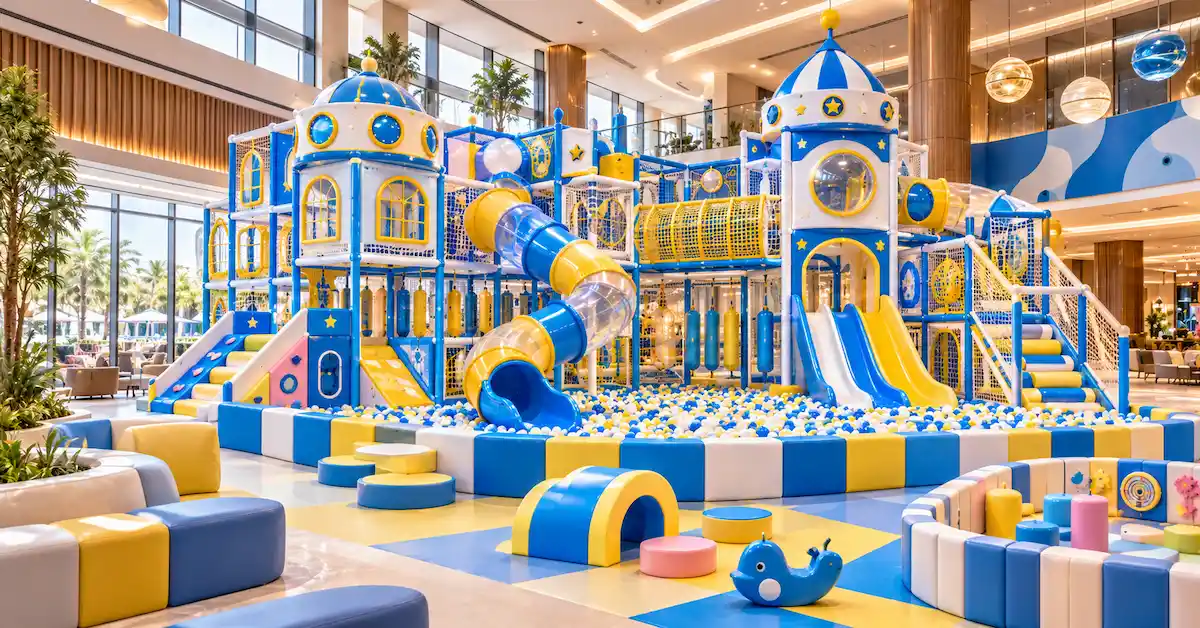
Two renderings may look similar while the steel, padding, flooring, activities, documentation, packaging, and installation responsibilities differ. Normalize the scope before comparing price.
Treating a theme as a technical specification
“Ocean,” “space,” or “candy” describes a visual direction. It does not define activities, ages, materials, structure, capacity, standards, or maintenance. Keep the theme brief separate from the technical schedule.
Accepting certificate logos without scope
A logo does not identify the tested sample or current validity. Request readable files and map them to the proposed components. The official certificate gallery is an evidence entry point, not a substitute for project document review.
Leaving installation until after shipping
Installation affects packaging, labels, site access, tools, labor, schedule, and acceptance. Decide the delivery and installation model during quotation.
Using a universal MOQ or lead time
MOQ and lead time depend on the defined system, customization, approval status, material availability, destination documents, and supplier workload. A number from one product page should not be applied automatically to another project.
Frequently Asked Questions
What is the first document needed for an indoor playground OEM ODM solution?
Start with a project brief and dimensioned site plan. Include clear height, obstructions, target ages, activity preferences, destination market, brand requirements, and desired delivery scope. EPARK’s FAQ asks buyers to provide site dimensions, preferred theme, and target age group for an accurate quotation.
Does EPARK publish a universal OEM/ODM MOQ?
No universal MOQ is clearly published for every product. One 726 m2 OEM/ODM product page says cooperation can start with a single complete system like that configuration and exclusive designs are handled per project. Confirm the MOQ for the exact system, custom parts, packaging, and repeat orders.
How long does custom indoor playground production take?
EPARK’s FAQ gives a general 3-7 days for design and 15-30 days for production after design confirmation. A separate OEM/ODM product page shows 25-35 days for production. The signed project schedule should govern because size, complexity, revisions, documents, and workload vary.
Which materials does EPARK describe on its website?
The safety page lists hot-dip galvanized cold-rolled steel pipes, high-density foam, soft PVC sleeves, EVA or PU mats, FRP or composite-resin slides, railings, and safety nets. Confirm the exact grade, thickness, density, finish, and documentation for the quoted configuration.
Can a buyer request production photos?
Yes. EPARK’s page-specific OEM/ODM content says in-process photos can be provided on request. Agree on checkpoints, file naming, order identification, and approval timing before production.
What certificate evidence should a buyer request?
Request the complete readable report or certificate, issuer, number, issue and expiry dates where applicable, tested sample, standard or method, result, and product scope. Then confirm that it matches the destination market and proposed component.
What should be included in packaging records?
Use a packing list connected to package labels and installation drawings. Record package dimensions and weights, quantity, protective method, component codes, photos before loading, container plan, and the process for shortages or transit damage.
Is an OEM/ODM rendering enough to approve manufacturing?
No. Approve dimensioned drawings, activity schedule, material and finish schedule, brand artwork, document plan, acceptance criteria, packaging scope, and change procedure. The rendering supports visual review but does not define every manufacturing requirement.
Who is this solution suitable for?
It is relevant to FEC owners, shopping malls, distributors, franchise and chain operators, hotels, schools, early education institutions, and commercial developers that need site-specific indoor play equipment and defined project support.
What information produces a more accurate quote?
Provide measured dimensions, clear height, CAD, site photos, destination, target ages, activity list, theme, brand assets, local requirements, expected opening date, and an explicit matrix for design, production, documents, freight, installation, training, and after-sales service.
Conclusion
The best indoor playground OEM ODM solution is not the proposal with the most attractions or the shortest sales promise. It is the proposal that converts a real venue and business model into controlled drawings, materials, evidence, responsibilities, and acceptance gates. Start with a complete site and operating brief. Compare suppliers against the same scope. Verify order-specific materials, process records, test and certificate scope, packaging, installation, and after-sales support before release.
EPARK publishes a seven-stage route covering consultation, planning and design, material selection, custom manufacturing, quality inspection and packaging, delivery and installation, and after-sales support. Use that route as the beginning of a project-specific responsibility matrix, then confirm every commercial and technical detail in the quotation and contract.
Turn your concept into a comparable, quote-ready RFQ. Share your CAD plan, clear height, target ages, activities, destination, branding, and required delivery scope with EPARK.
Request an OEM/ODM Project Review
General Disclaimer
All data on https://www.eparki.com is for general guidance only. As a leading indoor playground manufacturer and trampoline supplier, EPARK strives for accuracy but gives no express or implied warranty regarding completeness, performance or project fitness. Product specs, designs and results may vary with use and customer requirements. Buyers must verify technical details, compliance and suitability before purchase. EPARK OEM/ODM is not liable for any direct, indirect or consequential damages arising from site use. For custom solutions, contact our manufacturer and supplier team via the Contact page.
Intellectual Property
Text, images, videos, CAD files and software are Guangzhou EPARK Electronic Technology Co., Ltd. All rights reserved. No part may be copied, republished or used commercially without prior written permission. We will pursue legal action for copyright or design-patent infringement.
Trademarks
"EPARK", the EPARK logo and related graphics are registered trademarks of Guangzhou EPARK Electronic Technology Co., Ltd. Unauthorized use in ads, domain names or packaging is prohibited.
Governing Law
These terms are governed by the laws of the People's Republic of China.
Contact
Questions? Email sales@nanyuetech.com or WhatsApp +86 139 0307 9263.