Choose a trampoline park equipment supplier by comparing the complete project scope: jump zones, frame and spring details, safety padding, foam-pit or landing design, circulation, drawings, inspection evidence, packaging, installation, and after-sales support. A supplier that only presents exciting renders has not yet demonstrated that the park can be engineered, delivered, inspected, operated, and maintained for your building and destination market.
Trampoline parks look simple in photographs because the final room hides many procurement decisions. A commercial buyer must coordinate the jumping surface, steel frame, springs or elastic components, padding, netting, access routes, foam pits, basketball or dodgeball features, ninja elements, reception, spectator areas, emergency routes, and staff procedures. The supplier also needs accurate site information, a defined activity brief, a manufacturing baseline, and a realistic delivery scope.
This guide is written for FEC investors, gym operators, shopping-mall developers, indoor amusement venues, architects, distributors, and project contractors. It focuses on how to compare a trampoline park equipment supplier before a quotation is approved. It explains what should be in the RFQ, how to evaluate activity zones, which materials and documents to request, how to read lead-time statements, and how to control installation and handover risk. It does not invent a universal capacity, price, certificate scope, or opening date.
Preparing a trampoline park RFQ? Send the CAD plan, clear height, target activities, age profile, destination market, opening window, and expected design, production, installation, and document scope.
Request a Trampoline Park ReviewWhat a Trampoline Park Equipment Supplier Should Supply
Separate the attraction concept from the engineering package
A concept image answers what the park might feel like. It does not answer how the structure connects to the building, where users queue, how staff access the zones, which parts are removable, or what evidence is delivered before opening. Ask for two linked outputs: a commercial concept and a technical manufacturing set.
The concept should identify the target user groups, activity mix, guest journey, visual identity, spectator relationship, and possible revenue or programming model. The technical set should record dimensions, clearances, fixing assumptions, materials, padding, netting, access, landings, equipment codes, inspection points, and exclusions. A supplier that cannot separate these outputs may create scope confusion later.
Define the supplier’s boundary of responsibility
Trampoline projects often involve more parties than a standard equipment order. The building owner may control slab preparation, fire routes, electrical work, HVAC, lighting, permits, and local inspection. The equipment supplier may control design, fabrication, packing, installation guidance, and equipment documentation. A local contractor may unload, assemble, anchor, and finish the site. Write those boundaries into the RFQ before comparing prices.
Ask the supplier to identify what is included, what is optional, and what must be provided by others. Include travel, local labor, lifting equipment, waste removal, test or inspection attendance, staff training, spare parts, warranty response, and future modifications. A low equipment price is not comparable with a complete installed scope.
Activity Zones to Compare Before Choosing a Supplier
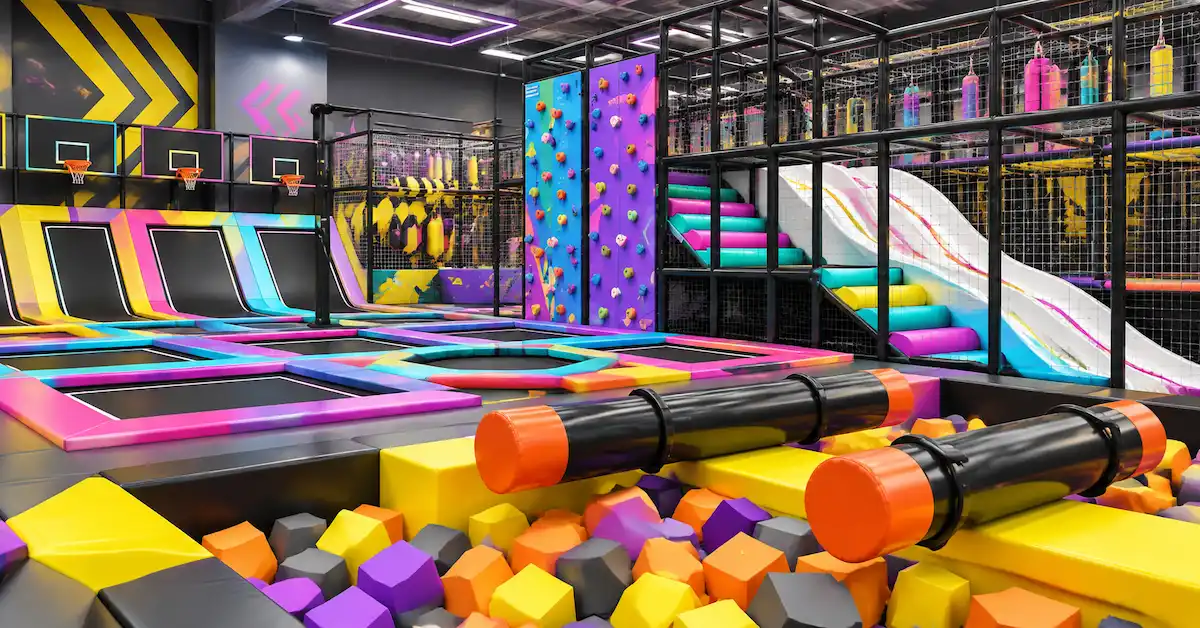
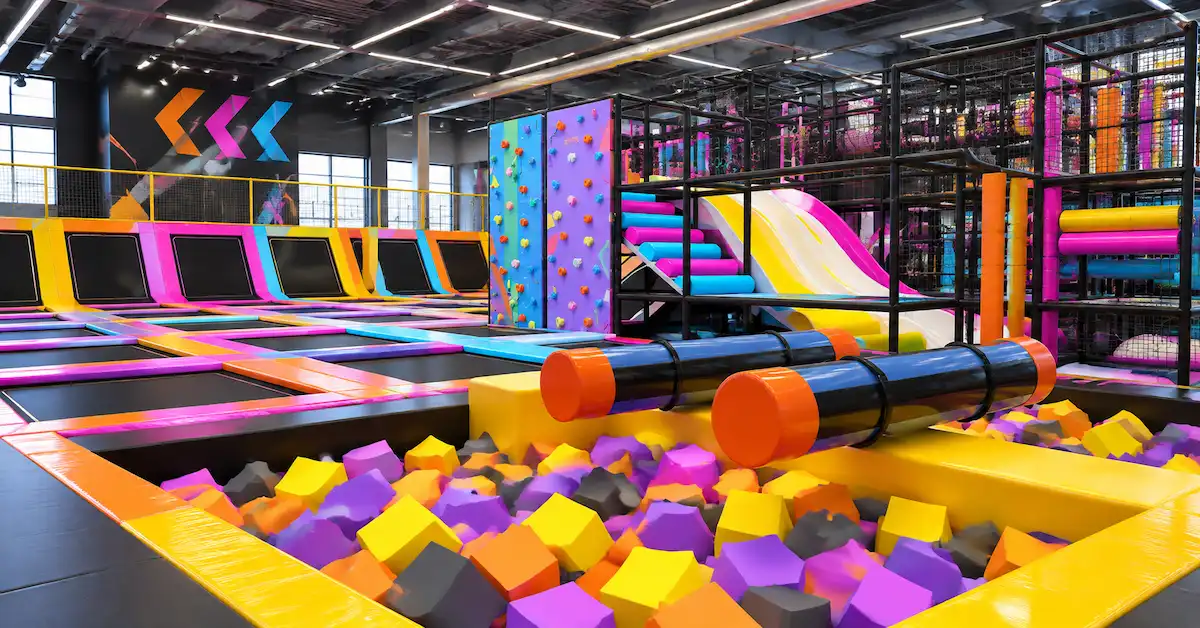
A trampoline park is usually a combination of zones rather than one product. The right mix depends on the building, target ages, staff model, programming, and local requirements. Use the table as a briefing framework, not as a universal capacity chart.
| Zone | Procurement purpose | Design questions | Evidence to request |
|---|---|---|---|
| Open jump court | Core free-jump or coached movement area | How are lanes, age rules, access, supervision, and fall boundaries defined? | Layout, surface specification, padding details, inspection plan |
| Foam pit or soft landing | Landing and challenge feature | How do users enter, exit, reset, and avoid hidden or inaccessible spaces? | Depth and access assumptions, cleaning plan, pit components, handover notes |
| Dodgeball or team court | Group activity and scheduled programming | Can staff control sessions, queues, boundaries, and ball storage? | Rules signage, netting, gates, equipment list, program assumptions |
| Slam dunk or sports zone | Skill-based repeat activity | Does the approach route remain clear and is the landing visible? | Equipment dimensions, padding, mounting, user guidance |
| Ninja or obstacle route | Higher challenge and differentiation | Can the route be age-separated, supervised, inspected, and partially closed? | Obstacle schedule, access, fall protection, maintenance and replacement plan |
| Toddler or parent-child area | Lower-intensity family participation | Is it visibly separated from higher-energy activity and easy to reach? | Age zoning, low-impact modules, parent access, cleaning instructions |
Open jump zones need more than a trampoline count
Ask how the supplier defines the usable jump area, perimeter protection, entry and exit, user flow, and staff position. A drawing should show where users wait, where they enter the court, and how staff reach a participant without crossing active lanes. If the supplier quotes a number of trampolines, request the actual arrangement and the assumptions behind it.
Foam pits require access and cleaning logic
A foam pit can be a strong attraction, but it is also a maintenance zone. The buyer should understand how foam blocks are removed, inspected, cleaned, dried, replaced, and stored. Ask where a person can access the base, whether the pit has hidden cavities, how a child exits, and how staff close the feature during cleaning. Do not accept a decorative pit image without an operations note.
Sports and obstacle zones must be program-ready
Dodgeball, slam dunk, ninja, and challenge routes can support parties, classes, camps, and group bookings. The supplier should show how a session starts and ends, where equipment is stored, how rules are displayed, and how staff control simultaneous use. An obstacle that is exciting in a private demonstration may be unsuitable for an open public session if the route cannot be separated or inspected quickly.
Site Planning and Circulation
Send a measured building, not only a floor area
Provide a dimensioned CAD file where possible. Mark floor-to-ceiling height, low beams, columns, doors, exits, glazing, sprinklers, HVAC, lights, cameras, floor changes, loading routes, and structural limitations. Identify reception, shoe storage, spectator seating, lockers, toilets, party rooms, food service, staff areas, and storage. The usable attraction envelope is usually smaller than the advertised floor area.
EPARK’s customization process describes consultation, space planning, 3D renderings, and detailed floor plans. Ask which site information the design team used, who validates dimensions, and which revision becomes the manufacturing baseline. A supplier should not be expected to discover hidden building conditions after production begins.
Design spectator visibility and staff access together
Parents and staff need different sightlines. Spectators may want to see a child from a seating area; staff may need rapid access to a landing, court, pit, or obstacle. Mark both on the plan. Tall graphics, enclosed tunnels, storage walls, and themed shells should not create hidden pockets that require extra staffing. Where a blind area is unavoidable, define a supervision method or keep the zone closed.
Protect public circulation and emergency routes
Keep queues, shoe storage, strollers, food service, and spectators outside active landings. The route to toilets and exits should remain legible. Fire equipment, sprinklers, electrical panels, and building services require coordination with the architect and authority. The supplier can adapt equipment around these constraints, but the venue owner remains responsible for local approval.
Materials, Safety Evidence, and Inspection
Ask for component-level material information
EPARK’s public materials and safety page describes hot-dip-galvanized cold-rolled steel pipe, high-density foam, soft PVC sleeves, EVA or PU mats, FRP or composite-resin slides, safety nets, and railings. These are useful published descriptions, but a trampoline buyer should request the exact material and finish for the frame, springs or elastic components, jump beds, padding, perimeter barriers, nets, platforms, landing zones, and graphics.
Do not allow the words “commercial grade” to replace a specification. Ask for the material schedule, drawings, finish samples, fixing method, replacement parts, cleaning instructions, and inspection points. If a component is made by another supplier, record that interface and the responsibility for its documentation.
Separate design controls from certification scope
EPARK’s public pages reference international standards and display certificate or test-report evidence in different contexts. A certificate gallery does not prove that every trampoline configuration has the same scope. Request the actual document for the purchased equipment, including issuer, date, tested sample, standard edition, product scope, and destination relevance. If the document is not public, list it as a pre-shipment or approval requirement.
Evidence boundary: Do not state that an entire trampoline park is certified from a general supplier page. Describe the exact report, certificate, material, or inspection record that applies to the approved configuration.
Define pre-shipment and handover inspection
Inspection should compare the finished order with the approved drawing and bill of materials. It should cover component count, frame and fixing details, jump surfaces, padding, nets, gates, landings, labels, graphics, hardware, packing, and open items. Ask whether the supplier provides photographs, checklists, measurements, or test records and how discrepancies are closed before dispatch.
What to Ask About Manufacturing, MOQ, and Lead Time
Understand what “supplier” means
A trampoline park equipment supplier may be a factory, exporter, distributor, project integrator, or a combination. Ask which parts are manufactured in-house, which are sourced, who controls design revisions, and who is responsible for quality at each interface. EPARK presents itself as a supplier and manufacturer with design, production, inspection, packaging, delivery, installation, and after-sales services. The final quotation should still identify the actual scope and responsible party.
MOQ should be linked to a deliverable
MOQ may mean one complete trampoline system, one custom zone, a batch of replacement mats, graphics, spare springs, packaging, or a future expansion. A page-specific statement that a partnership can start from one system is not a universal MOQ for every product. Ask for MOQ by complete project, custom component, replacement part, prototype, and branded package.
Lead time starts after approval gates
Design, site validation, materials, artwork, drawings, payment, production, inspection, packing, shipping, and installation readiness all affect delivery. EPARK’s FAQ provides a general reference of 3–7 days for design and 15–30 days for production after design confirmation. Another product page may show a different production range. Treat these as website guidance, not a guaranteed schedule. Use the signed quotation and approved manufacturing set.
Packaging and logistics can change the project risk
Ask for package numbers, component codes, hardware bags, moisture protection, loading photos, packing list, and installation sequence. Confirm whether the shipment requires a forklift, crane, special storage, or protected indoor staging. State who unloads, stores, assembles, anchors, tests, removes waste, and trains the staff. A supplier that can explain packing is easier to audit than one that only promises factory-direct shipping.
How to Compare Supplier Proposals
Use a comparison matrix rather than comparing only the equipment total. Every supplier should receive the same site assumptions, target activities, age profile, destination, installation expectations, and document requirements. Record what each proposal includes and excludes.
Check whether the proposal can be revised without losing control
Commercial projects rarely remain unchanged after the first layout. The building team may discover a beam, the landlord may move a door, or the operator may add a toddler route or party interface. Ask how revisions are numbered, priced, approved, and reflected in the bill of materials. A supplier should be able to show which drawing is current and which earlier version is superseded.
Request a simple document register: concept plan, dimensioned plan, sections, elevations, activity schedule, material schedule, bill of materials, finish and artwork list, inspection plan, packing list, installation instructions, maintenance manual, spare-parts list, warranty scope, and open-item log. These documents allow an owner, architect, contractor, and supplier to discuss the same project. They also give the venue a reference when a component needs cleaning, inspection, replacement, or reorder after opening.
Use a pre-opening acceptance walk
Before opening, walk the installed park with the approved drawings. Check the entry and exit, court boundaries, landing areas, padding, nets, gates, signs, floor transitions, spectator route, emergency access, and staff positions. Record photographs and item numbers for anything incomplete. A supplier that agrees to a documented acceptance walk is easier to manage than one that treats delivery as the moment the truck leaves the factory.
| Proposal area | Questions for the trampoline park equipment supplier | Required evidence |
|---|---|---|
| Design | What drawings, 3D views, revisions, and site assumptions are included? | Dimensioned layout, activity schedule, revision register |
| Equipment | Which zones, components, fixing parts, padding, nets, and signs are included? | Bill of materials, component codes, material schedule |
| Safety and quality | Which inspections, reports, certificates, and destination requirements apply? | Order-specific records and evidence register |
| Delivery | Who packs, unloads, installs, anchors, tests, trains, and closes defects? | Packing list, installation method, responsibility matrix |
| After-sales | How are spare parts, damage, warranty, cleaning, and future changes handled? | Manuals, spare-parts route, warranty scope, support contacts |
Trampoline Park RFQ Checklist
- Measured CAD plan with clear height, columns, exits, services, floor, and delivery route.
- Target users, age policy, operating hours, session format, staffing model, and programming goals.
- Required zones, activity intensity, spectator areas, storage, reception, toilets, and party interfaces.
- Theme, colors, logos, graphics, language, and intellectual-property permissions.
- Frame, jump bed, spring or elastic, padding, net, barrier, landing, and flooring specifications.
- Applicable standards, inspection, test reports, certificates, local authority documents, and acceptance criteria.
- MOQ for the complete system, custom zones, graphics, spare parts, and future expansions.
- Design revision limits, production trigger, payment gates, schedule assumptions, and change control.
- Package numbers, installation sequence, unloading, anchoring, testing, training, and waste responsibilities.
- Cleaning, inspection, spare-parts, warranty, after-sales, and reorder documentation.
Make your supplier comparison reviewable. Use one project brief and ask every bidder to return the same drawing list, BOM, evidence register, delivery scope, and responsibility matrix.
Review Trampoline Park SolutionsFrequently Asked Questions
Before opening, keep the approved drawing, bill of materials, inspection record, packing list, installation sign-off, staff training record, and unresolved-item log together so the operator can trace what was purchased and accepted.
What does a trampoline park equipment supplier provide?
Depending on the contract, a supplier may provide layout planning, trampoline courts, frames, jump beds, padding, nets, foam pits, sports or obstacle zones, manufacturing, packing, delivery, installation support, manuals, spare parts, and after-sales assistance. Confirm each item in the quotation; “supplier” alone does not define the scope.
How do I choose between a standard and custom trampoline park?
Use a standard configuration when the room, age profile, activities, and brand requirements fit a proven arrangement. Choose custom planning when the building has unusual constraints, mixed-age routes, several attractions, strong branding, or a need for phased expansion. A hybrid of proven components and custom site planning is often practical.
What materials does EPARK publicly describe?
EPARK describes galvanized cold-rolled steel pipe, high-density foam, soft PVC sleeves, EVA or PU mats, FRP or composite-resin slides, safety nets, and railings. Ask for the project-specific material schedule for trampoline frames, jump surfaces, padding, landings, and barriers.
Does EPARK publish a universal trampoline park MOQ?
No universal MOQ should be inferred from one product page. MOQ depends on the complete system, custom zone, graphics, packaging, spare parts, or future expansion. Ask for the MOQ by deliverable and record what is included.
How long does design and production take?
EPARK’s FAQ gives a general reference of 3–7 days for design and 15–30 days for production after design confirmation. Other pages may show different production references. Confirm the current project schedule after site data, drawings, materials, payment, inspection, shipping, and installation responsibilities are agreed.
What safety documents should I request?
Request the applicable standard or certificate, tested sample, issuer, date, product scope, drawings, material schedule, inspection records, installation instructions, maintenance manual, and acceptance checklist. A general certificate gallery is not enough to establish the scope of the purchased park.
Can EPARK help with CAD and 3D design?
EPARK’s public customization process describes space planning, professional design, 3D renderings, and detailed floor plans. Send the measured site and target activities, then confirm the number of revisions, approval gates, and final drawing set in the quotation.
What should happen before shipment?
Complete the approved design, bill of materials, material and finish schedule, inspection plan, open-item list, packing list, installation instructions, and document register. Request order-specific production or packing evidence where it affects acceptance.
What should I send for a supplier quotation?
Send the CAD plan, clear height, target users, activity zones, age policy, theme, destination, opening window, local requirements, installation expectations, and requested documents. The more precise the brief, the easier it is to compare proposals on the same basis.
Conclusion
The best trampoline park equipment supplier is the one that can connect attraction design with engineering, materials, inspection, packaging, installation, operation, and long-term support. Buyers should compare complete scope, not only the number of trampolines or the first equipment price. A measured site, clear activity brief, component-level evidence, revision-controlled drawings, and a responsibility matrix make the RFQ more useful and reduce avoidable project risk.
EPARK’s trampoline park category, customization process, materials and safety page, certificate page, and FAQ can help a buyer start the supplier conversation. Convert the concept into a site plan, activity schedule, material list, inspection evidence, packing list, installation scope, training plan, and after-sales file before approving production.
Ready to compare a trampoline park equipment supplier? Share your building and attraction brief so EPARK can identify the standard components, custom decisions, documents, and delivery responsibilities for review.
Discuss Your Trampoline Park Project
General Disclaimer
All data on https://www.eparki.com is for general guidance only. As a leading indoor playground manufacturer and trampoline supplier, EPARK strives for accuracy but gives no express or implied warranty regarding completeness, performance or project fitness. Product specs, designs and results may vary with use and customer requirements. Buyers must verify technical details, compliance and suitability before purchase. EPARK OEM/ODM is not liable for any direct, indirect or consequential damages arising from site use. For custom solutions, contact our manufacturer and supplier team via the Contact page.
Intellectual Property
Text, images, videos, CAD files and software are Guangzhou EPARK Electronic Technology Co., Ltd. All rights reserved. No part may be copied, republished or used commercially without prior written permission. We will pursue legal action for copyright or design-patent infringement.
Trademarks
"EPARK", the EPARK logo and related graphics are registered trademarks of Guangzhou EPARK Electronic Technology Co., Ltd. Unauthorized use in ads, domain names or packaging is prohibited.
Governing Law
These terms are governed by the laws of the People's Republic of China.
Contact
Questions? Email sales@nanyuetech.com or WhatsApp +86 139 0307 9263.