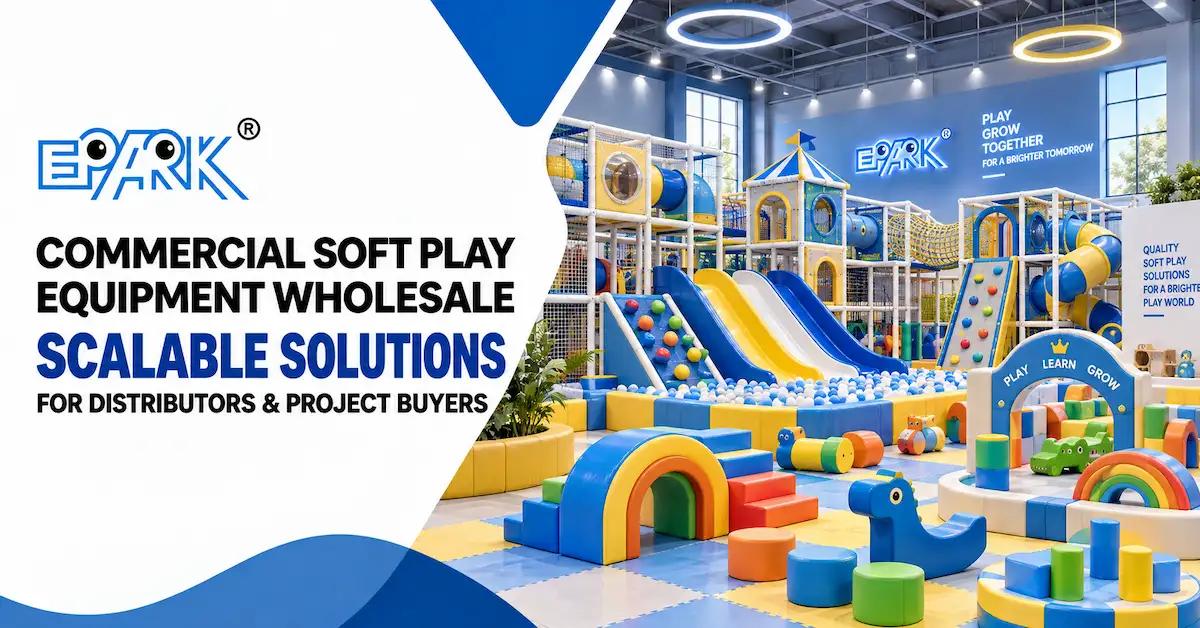
Why Commercial Soft Play Equipment Wholesale Is Different From Buying One Playground
Buying equipment for one indoor playground and building a repeatable wholesale business are two different procurement problems.
A single-project buyer can focus primarily on one floor plan, one color scheme, one installation date, and one operating concept. A distributor or importer has to think beyond the first shipment.
The wholesale buyer needs to answer additional questions:
- Which products can be sold repeatedly across different customer types?
- Which models should remain standardized?
- Which features should be customizable?
- How should mixed orders be consolidated?
- How will product specifications remain consistent between batches?
- What should be stocked locally?
- Which components should be kept as spare parts?
- How will freight affect real product margin?
- Can the supplier reproduce a successful model six or twelve months later?
- How should branding and packaging support the distributor’s own market position?
That is why commercial soft play equipment wholesale should be treated as a supply-chain program, not simply a large quotation.
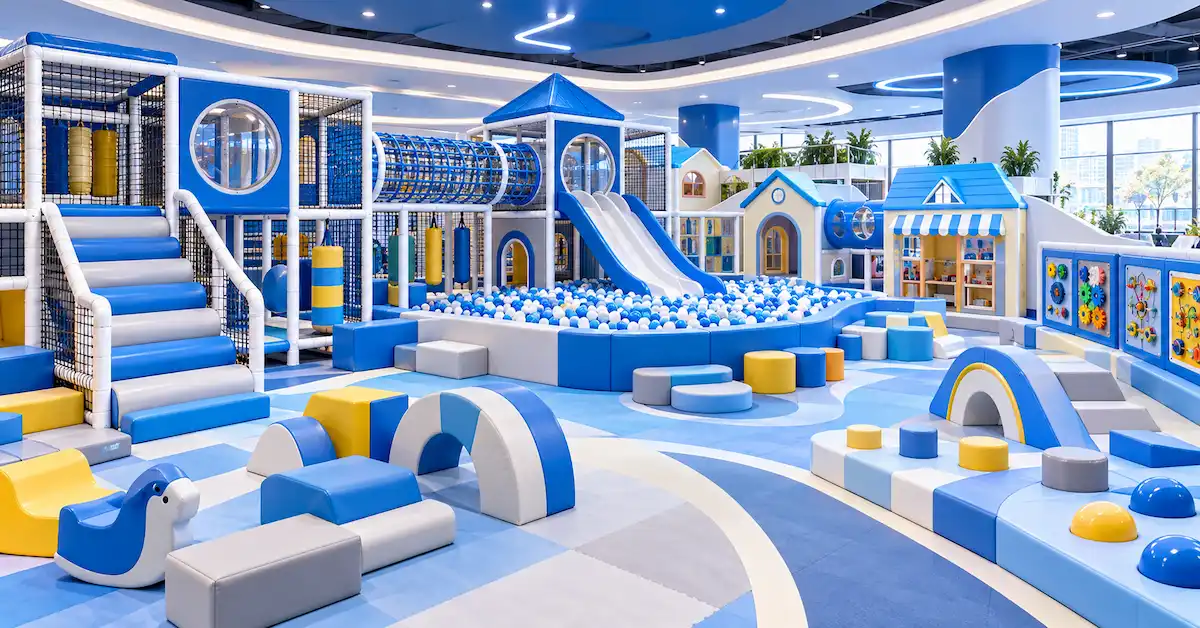
EPARK’s current Product List already presents both compact commercial layouts and large-scale indoor playground projects, making it useful for buyers who need to compare different product sizes and application types before creating a wholesale assortment. The current page positions the business around OEM/ODM amusement equipment manufacturing and wholesale supply.
Who Should Use a Wholesale Soft Play Sourcing Model?
Not every playground buyer needs a wholesale strategy.
It is most relevant when the buyer expects repeated sales, multiple locations, regional distribution, recurring project demand, or mixed-product purchasing.
| Buyer Type | Why Wholesale Matters | Main Commercial Priority |
|---|---|---|
| Regional distributor | Supplies multiple local customers | Repeatable models and margin |
| Importer | Brings equipment into one national market | Landed cost and documentation |
| Wholesaler | Resells to dealers or project companies | Product range and inventory |
| Project contractor | Delivers multiple playground projects | Standard modules and customization |
| FEC chain | Opens multiple locations | Repeatability and brand consistency |
| Mall playground chain | Replicates concepts across properties | Modular design and reorder control |
| Kids café chain | Needs compact repeated layouts | Space efficiency and standardized look |
| Hotel/resort group | Buys for multiple properties | Consistent specification and support |
| Online/offline commercial reseller | Markets equipment to local operators | Clear product positioning and sales assets |
A one-time investor may prioritize a highly customized site-specific solution.
A distributor, by contrast, needs a product system that can be sold more than once.
That difference should shape the sourcing strategy from the beginning.
Build the Product Assortment Before Asking for Wholesale Pricing
A common wholesale mistake is requesting:
“Please send me your wholesale price list.”
before deciding what the buyer actually intends to sell.
Commercial soft play is not a simple commodity category. Products vary by age group, size, activity type, venue, level of customization, and installation complexity.
A better process begins with an assortment architecture.
Core Products
These are products a distributor expects to sell repeatedly.
Typical examples may include:
- padded steps;
- soft climbing ramps;
- crawl tunnels;
- soft arches;
- small slides;
- rocking toys;
- sensory panels;
- foam blocks;
- compact ball pools;
- toddler obstacle sets.
Core products should ideally be easy to explain, reorder, combine, and stock.
Project Products
These are larger items designed around a commercial venue.
Examples include:
- multi-level soft-play structures;
- integrated ball-pit systems;
- slide combinations;
- climbing modules;
- role-play areas;
- themed play zones;
- larger modular playgrounds.
These products may require more design work and are less suitable for simple warehouse stock.
Premium or Custom Products
These help distributors differentiate themselves.
Possible customization can involve:
- theme;
- brand colors;
- mascot;
- logo;
- graphics;
- equipment combination;
- dimensions;
- role-play concepts;
- custom façade elements.
The goal is not to offer every possible product.
A stronger wholesale range normally combines high-repeat standard items + configurable project products + selected premium customization.
Create a Three-Tier Wholesale Product Strategy
A useful commercial model is to divide the catalogue into three levels.
| Product Tier | Customization | Lead Complexity | Best Use |
|---|---|---|---|
| Standard | Low | Lower | Stock and quick resale |
| Semi-custom | Medium | Medium | Common commercial projects |
| Fully custom | High | Higher | Flagship venues and branded projects |
Tier 1: Standard
Standardized products are useful for:
- local inventory;
- dealer networks;
- smaller orders;
- fast project replacements;
- repeat customers.
Consistency matters more than uniqueness.
Tier 2: Semi-Custom
The base structure remains stable, while buyers may adjust:
- colors;
- selected dimensions;
- graphic panels;
- accessories;
- equipment combinations.
This is often a useful balance for distributors because the product remains repeatable without looking identical in every project.
Tier 3: Fully Custom
This is appropriate when the end customer needs:
- site-specific design;
- branded concepts;
- custom themes;
- unusual layouts;
- integrated commercial environments.
EPARK’s Customization Process describes customization across theme design, modular structures, activity programming, manufacturing, inspection, installation, and after-sales support.
For a wholesale buyer, this means customization should be treated as a defined service level rather than an unlimited change request.
Wholesale Buyers Need a Master Product Specification
Repeat orders become difficult if every order is based only on photographs or chat history.
The distributor should create a master specification for each repeatable product family.
A master specification may contain:
- model or internal SKU;
- dimensions;
- target application;
- target age group;
- main materials;
- approved colors;
- included components;
- packaging method;
- accessories;
- replaceable parts;
- logo position;
- labeling requirements;
- installation reference;
- approved drawing revision.
This document becomes the baseline for later orders.
If the product changes, update the revision.
Why revision control matters in wholesale
Imagine a distributor orders the same play system four times.
Order 1 uses one slide type.
Order 2 changes the entrance.
Order 3 changes the padding color.
Order 4 returns to the original customer specification.
Without revision control, it becomes difficult to know which configuration is the true standard.
A successful commercial soft play equipment wholesale program needs SKU discipline, even when the products remain customizable.
Do Not Confuse Wholesale Price With Landed Cost
Wholesale buyers often focus too heavily on factory price.
The more useful number is landed cost per sellable unit or project.
A practical budgeting model is:
Landed Cost = Equipment + Customization + Export Packing + Freight + Destination Charges + Customs/Duties + Local Transport + Installation-Related Cost
This is a purchasing framework, not an EPARK pricing formula.
Two suppliers may quote different factory prices but produce very different landed costs.
For example, a slightly lower equipment price may lose its advantage if:
- packaging wastes container space;
- components require additional local repacking;
- parts arrive without clear labels;
- missing items require express replacement;
- the installation team spends extra days identifying components.
For distributors, logistics efficiency can directly influence margin.
Evaluate Cost at the Assortment Level
Do not analyze only one product.
A wholesale buyer should examine the economics of the complete shipment.
Suppose the order includes:
- compact toddler equipment;
- foam blocks;
- several small slides;
- interactive panels;
- replacement padding;
- one larger project set.
The question becomes:
Which combination uses freight and inventory capital most effectively?
A high-volume, low-margin item may still be valuable because it brings repeat business.
A larger custom system may generate higher revenue but sell less frequently.
A healthy wholesale portfolio often needs both.
MOQ Should Be Treated as a Commercial Variable, Not a Marketing Number
Buyers often search for “soft play equipment MOQ.”
There is no useful universal MOQ for every commercial soft-play product.
The practical minimum can depend on:
- product type;
- level of customization;
- material color;
- packaging;
- branding;
- production setup;
- shipping efficiency;
- whether the order is mixed;
- whether a model already exists.
The correct wholesale question is therefore not simply:
“What is your MOQ?”
Ask instead:
“What order structure gives the best production and freight efficiency for this product mix?”
For some categories, mixed product orders may be more practical than ordering a very large quantity of one item.
Any MOQ should be confirmed for the exact quotation rather than assumed from a general website statement.
Build a Mixed-Order Strategy
Distributors rarely need only one type of equipment.
Mixed orders allow a buyer to create a more usable local catalogue.
A commercial wholesale shipment might combine:
Entry-Level Products
- small soft shapes;
- rockers;
- padded steps;
- basic sensory components.
Mid-Range Products
- mini ball pools;
- small slide sets;
- crawl tunnels;
- modular climbing units.
Project Products
- larger soft-play structures;
- integrated playground modules;
- themed commercial layouts.
Service Parts
- coverings;
- padding pieces;
- nets;
- hardware;
- replacement accessories.
This creates a shipment that supports both new sales and after-sales service.
Container Planning Is Part of Wholesale Product Design
Wholesale sourcing becomes more profitable when equipment is planned with transport in mind.
That does not mean products should be designed only around container density.
It means the supplier and buyer should understand:
- package dimensions;
- disassembly method;
- protection requirements;
- fragile components;
- stackability;
- zone labeling;
- unloading sequence.
Think about cubic efficiency
Two products with similar sales value can use very different amounts of container space.
The distributor should therefore consider:
- landed cost per cubic meter;
- value density;
- sales velocity;
- margin;
- storage footprint.
This is particularly important when importing bulky soft-play products.
Do not optimize shipping so aggressively that product protection suffers
Damaged coverings, crushed decorative panels, or mixed hardware can create more cost than the freight savings achieved through over-compression.
Packaging needs to balance:
freight efficiency + protection + installation usability.
EPARK’s customization workflow explicitly includes quality inspection and secure packaging before delivery.
Packaging Should Support the Distributor, Not Only the Factory
For wholesale distribution, packaging performs four functions:
- Protect the equipment.
- Help warehouse staff identify it.
- Help installers find the correct parts.
- Support resale or private labeling.
A useful package identification system might include:
- model code;
- order number;
- zone;
- quantity;
- package sequence;
- destination customer;
- distributor SKU.
For larger projects, a package label such as:
Project A / Toddler Zone / Package 03 of 18
is far more useful than an anonymous carton or wrapped component.
Private Label Soft Play Equipment Should Start With Brand Architecture
Private label is not just placing a logo on a foam block.
A distributor building its own brand should decide what level of branding matters.
Level 1: Product Identification
Includes:
- logo;
- product label;
- model code.
Level 2: Visual Branding
Adds:
- brand colors;
- custom graphics;
- selected shapes;
- themed surface design.
Level 3: Commercial Brand System
Can include:
- standardized product families;
- naming system;
- branded packaging;
- dealer catalogue;
- spare-parts codes;
- installation references;
- repeat-order specifications.
The third level creates more long-term value because customers recognize a consistent product system rather than a random collection of equipment.
OEM Customization Must Not Destroy Repeatability
There is a commercial tension between customization and wholesale scale.
Too little customization makes the distributor easy to compare with competitors.
Too much customization makes every order a new engineering project.
The solution is controlled customization.
For example:
Fixed
- structural concept;
- main dimensions;
- component layout;
- basic material specification.
Selectable
- colors;
- logo;
- selected graphic panels;
- accessories;
- some activity modules.
Project-specific
- unusual dimensions;
- custom theme;
- completely new layout.
This keeps the wholesale range scalable.
Materials Matter More When Products Are Resold Under Your Name
If a distributor resells playground equipment, product problems affect the distributor’s reputation in the local market.
Material review should therefore be part of the wholesale onboarding process.
EPARK’s Safety and Quality information describes its playground systems using structural steel, high-density foam, soft PVC protection, EVA or PU flooring, FRP/composite components, and safety netting.
Wholesale buyers should confirm the project-specific specification for the products they actually order.
Structural Components
Check:
- material;
- corrosion protection;
- connection design;
- replaceability.
Foam and Padding
Check:
- intended function;
- placement;
- surface protection;
- repeated-use durability.
Surface Coverings
Check:
- cleaning;
- seams;
- high-wear points;
- color consistency.
Flooring
Check:
- application;
- cleaning requirements;
- installation method;
- replacement strategy.
Nets and Barriers
Check:
- attachment;
- inspection;
- replacement availability.
The distributor does not need to become the factory engineer.
But the distributor should understand enough to explain the product professionally to local customers.
Batch Consistency Is One of the Most Important Wholesale KPIs
A good first sample is not enough.
Wholesale success depends on whether later batches remain consistent with the approved reference.
Check consistency in:
- dimensions;
- colors;
- materials;
- logo placement;
- accessories;
- packaging;
- hardware;
- labeling.
If a repeat order changes, the supplier should identify the change rather than letting it appear unexpectedly after delivery.
Keep a “golden sample” or master reference
For repeat products, the buyer should maintain:
- approved images;
- final drawings;
- specification sheet;
- color reference;
- packaging reference.
This makes future QC easier.
Build a Wholesale Quality-Control Plan
A bulk order should have defined QC points before production is complete.
| QC Stage | Main Wholesale Check |
|---|---|
| Pre-production | Approved SKU, materials, color, branding |
| In-process | Dimensions, components, surface finish |
| Pre-packing | Completeness and model identification |
| Packing | Quantity, labels, protection |
| Pre-shipment | Shipment completeness and documents |
| Receiving | Damage, shortage, SKU verification |
The same QC framework does not need to be equally detailed for every product.
Higher-value and more customized items may require more control.
Avoid “Inspection by Appearance Only”
A product may look correct but still create wholesale problems if:
- accessories are missing;
- labels are inconsistent;
- replacement parts cannot be identified;
- packaging mixes models;
- instructions reference a different version.
Wholesale QC should therefore check commercial usability, not just appearance.
Documentation Should Match the Product and Destination
Distributors frequently sell into different customer types or markets.
Documentation requirements can therefore become a major part of the sourcing relationship.
EPARK maintains a dedicated Certificates page with available testing and certification documentation. Buyers should still verify which specific report or certificate applies to the exact product and destination rather than assuming every displayed document covers every order.
Before committing to a wholesale program, create a document matrix.
| Document Question | Why It Matters |
|---|---|
| What is the document type? | Certificate and test report are not identical |
| Which product does it cover? | Prevents scope assumptions |
| Which model/material is referenced? | Supports traceability |
| Is it relevant to the destination? | Market requirements differ |
| Is an updated version required? | Prevents outdated document use |
| Does the distributor need copies? | Supports local sales and projects |
Documentation should be handled as part of the SKU system.
Build Spare Parts Into the Wholesale Order
One of the strongest ways for a distributor to improve after-sales service is to stock the right spare parts before customers ask for them.
Depending on the equipment, useful service inventory may include:
- replacement padding;
- surface coverings;
- nets;
- hardware;
- connectors;
- decorative parts;
- high-wear accessories.
The exact spare-parts strategy should be confirmed for the selected equipment.
Use spare-parts codes
Avoid descriptions such as:
“the blue foam part near the slide.”
Instead use:
- model number;
- part code;
- drawing reference;
- photograph.
This makes future support much faster.
Treat Spare Parts as a Revenue Protection Tool
Spare inventory is not merely an expense.
It helps the distributor:
- respond faster;
- avoid long customer downtime;
- reduce emergency air freight;
- maintain customer trust;
- support repeat business.
A distributor that can solve a maintenance problem quickly has a stronger commercial position than one that must contact the factory from zero every time.
EPARK’s FAQ and customization workflow both address maintenance, installation, and spare-parts support as part of project service.
Inventory Planning Should Be Based on Sales Velocity, Not Product Excitement
Large, visually impressive equipment is easy to market but expensive to stock.
Wholesale buyers should divide inventory into categories.
A-Items: Fast-Moving
Keep local stock or short replenishment cycles.
Examples may include:
- small soft-play modules;
- standard accessories;
- replacement parts.
B-Items: Regular Project Products
Order periodically or keep limited demonstration stock.
C-Items: Custom Projects
Produce mainly after customer confirmation.
This reduces working-capital pressure.
The best warehouse is not the warehouse with the most products.
It is the warehouse that supports the distributor’s actual sales pattern.
Use Demonstration Products Strategically
A distributor does not need every product in a showroom.
Instead, a demonstration area can show:
- material quality;
- padding;
- connection details;
- colors;
- modularity;
- typical activity types.
This lets local customers experience the product without forcing the distributor to stock an entire commercial playground.
For larger project references, EPARK’s 630㎡ Commercial Soft Play Park shows how multiple activity types can be integrated into one large commercial layout.
For smaller-format sourcing, the 140m² Indoor Playground / Soft Play Project and compact commercial indoor playground reference provide different scale references.
Create a Distributor Sales Kit Before the First Shipment Arrives
A wholesale supplier relationship works better when the distributor can actually sell the equipment.
A commercial sales kit may include:
- product images;
- model names;
- dimensions;
- application guidance;
- material information;
- customization options;
- installation overview;
- FAQ;
- spare-parts information.
Organize products by buyer problem
Do not build the catalogue only by factory product family.
Local customers may find application categories easier to understand:
- restaurant play area;
- daycare soft play;
- mall toddler zone;
- kids café;
- FEC toddler area;
- hotel kids club;
- compact commercial playground.
This improves sales relevance.
Wholesale Buyers Should Segment End Customers
A distributor should not sell the same configuration to every customer.
Daycare and Preschool
Priority:
- younger ages;
- visibility;
- lower equipment;
- practical cleaning.
Restaurant and Kids Café
Priority:
- compact footprint;
- controlled activity;
- visual supervision;
- attractive soft play.
Shopping Mall
Priority:
- visual impact;
- throughput;
- commercial durability.
FEC
Priority:
- broader activity range;
- age zoning;
- integration with larger entertainment systems.
Hotels and Resorts
Priority:
- appearance;
- manageable operation;
- fit with interior design.
This segmentation lets the distributor create a more useful wholesale assortment.
Repeat Orders Need Change Control
The second order should ideally be easier than the first.
If it is harder, the wholesale system is not mature.
For every repeat SKU, keep:
- approved revision;
- final color;
- branding files;
- packaging reference;
- material specification;
- spare-parts list.
If the factory proposes a material or component change, the buyer should understand the change before production.
Why silent substitutions are risky
Even when a substitute appears similar, it may affect:
- appearance;
- installation;
- replacement compatibility;
- customer expectation.
Change control protects the distributor’s catalogue consistency.
Build a Reorder Forecast Instead of Waiting Until Stock Reaches Zero
International replenishment is slower than domestic restocking.
A wholesale buyer should monitor:
- average sales rate;
- outstanding customer quotes;
- confirmed project pipeline;
- inventory on hand;
- inventory already in transit;
- production time;
- freight time.
The goal is not perfect forecasting.
It is reducing the number of emergency orders.
Plan Around Commercial Seasons Carefully
Demand may vary by market.
For example, customers may want installation before:
- holidays;
- school breaks;
- mall promotions;
- new property openings.
The distributor should work backward from the customer’s installation date rather than from the date the purchase order is placed.
A wholesale schedule may include:
Customer opening date → local installation → customs/local delivery → international transit → production → design/approval
This creates a more realistic timeline.
Do Not Promise Lead Times Until the Order Scope Is Locked
Production time can change depending on:
- quantity;
- customization;
- project complexity;
- drawing approval;
- materials;
- packaging;
- current production schedule.
Therefore a distributor should avoid publishing one universal lead time for every custom product unless the supplier has explicitly confirmed it.
This protects sales teams from making promises the supply chain cannot support.
Compare Wholesale Suppliers With a Commercial Scorecard
Price should be one column, not the entire evaluation.
| Evaluation Area | Questions for Wholesale Buyers |
|---|---|
| Product range | Can the range support multiple market segments? |
| Standardization | Can successful products be repeated? |
| Customization | Is OEM controlled and scalable? |
| Materials | Are specifications understandable? |
| Batch consistency | Can later orders match the approved reference? |
| QC | Are checks defined? |
| Packaging | Does it support freight and installation? |
| Documentation | Can product-specific files be provided? |
| Spare parts | Can components be identified and reordered? |
| Mixed orders | Can product categories be consolidated appropriately? |
| Communication | Are revisions and changes clearly controlled? |
| Reorders | Can prior configurations be reproduced? |
| After-sales | Can the distributor solve customer issues efficiently? |
This scorecard focuses on wholesale continuity, which is different from evaluating one playground project.
Common Commercial Soft Play Wholesale Mistakes
Buying Too Many Custom Models at Once
A distributor may launch with twenty unique designs and discover that only three sell consistently.
Start with a controlled range and expand using market feedback.
Choosing Only by Factory Price
Low unit cost does not guarantee strong margin after freight, duties, local storage, and service costs.
Ignoring Packaging Dimensions
Bulky products can change landed economics significantly.
No Master SKU System
Without SKU control, repeat orders become dependent on old messages and photographs.
No Spare-Parts Strategy
The distributor cannot provide fast local support.
Over-Customizing Every Order
Every sale becomes a new engineering project.
Under-Customizing
The distributor has no market differentiation.
Assuming All Certificates Apply to Every Model
Documentation needs product-specific confirmation.
Reordering Too Late
Emergency freight can damage margin.
Failing to Record Changes
Batch inconsistency becomes difficult to investigate.
Sample Order vs Pilot Order vs Wholesale Rollout
A scalable sourcing program can use three commercial stages.
Stage 1: Sample or Reference Order
Purpose:
- evaluate quality;
- understand packaging;
- review communication;
- test the local market.
Stage 2: Pilot Wholesale Order
Purpose:
- test multiple SKUs;
- measure customer demand;
- evaluate freight economics;
- test warehouse handling;
- build sales materials.
Stage 3: Repeat Wholesale Program
Purpose:
- standardize successful SKUs;
- improve reorder planning;
- optimize mixed shipments;
- expand private label;
- maintain local spares.
This approach reduces the risk of purchasing a large assortment before the distributor knows what sells.
When Custom Project Orders Should Stay Outside Normal Inventory
Not every soft-play product belongs in warehouse stock.
Site-specific products should usually remain project-driven when they depend heavily on:
- floor dimensions;
- ceiling height;
- columns;
- theme;
- age zoning;
- customer branding.
The distributor can still sell these projects.
They simply belong to a different commercial workflow.
A strong wholesale business separates:
Stock Products
from
Configurable Products
from
Custom Projects
rather than treating every product the same.
How EPARK Fits Into a Wholesale Soft Play Sourcing Program
For buyers researching commercial soft play equipment wholesale, the most relevant supplier capability is not simply whether a company can produce one playground.
The more important question is whether the supplier can support a repeatable relationship involving product development, manufacturing, customization, QC, packaging, installation preparation, and after-sales service.
EPARK’s current company information states that it integrates R&D, manufacturing, sales, and after-sales services, and its current factory page lists a 25,000 m² facility, 400+ machines, and 100+ skilled workers.
Its customization workflow also covers project planning, material selection, custom production, quality inspection, secure packaging, delivery, installation, and spare-parts support.
For distributors, importers, and repeat project buyers, these capabilities should still be converted into a specific wholesale agreement covering SKUs, quantities, branding, documentation, packaging, delivery terms, and reorder expectations.
What Should a Wholesale RFQ Include?
A professional RFQ makes comparison much easier.
Include:
- buyer type;
- destination country;
- target customer segments;
- initial product categories;
- target quantity by product;
- preferred colors;
- branding requirements;
- standard vs custom products;
- packaging requirements;
- expected documents;
- spare-parts needs;
- target shipping method;
- expected reorder frequency;
- installation/support expectations.
For custom project equipment, also include:
- floor plan;
- ceiling height;
- age group;
- theme;
- equipment requirements.
You can submit these details through EPARK’s Contact Us page.
Frequently Asked Questions About Commercial Soft Play Equipment Wholesale
What is commercial soft play equipment wholesale?
Commercial soft play equipment wholesale refers to sourcing equipment in quantities or repeat purchasing programs for resale, distribution, multi-location projects, or recurring commercial installations. It usually requires more planning around product standardization, logistics, QC, packaging, documentation, spare parts, and reorders than a one-time playground purchase.
Who buys wholesale soft play equipment?
Typical buyers include distributors, importers, wholesalers, project contractors, entertainment chains, indoor playground operators with multiple locations, hotel groups, kids café chains, and other businesses purchasing repeatedly.
Is there a standard MOQ for wholesale soft play equipment?
Not necessarily. Minimum order requirements can depend on product type, customization, materials, packaging, branding, and order mix. Buyers should request MOQ information for the exact products and configuration they plan to purchase.
Is factory price the most important wholesale cost?
No. Wholesale buyers should consider landed cost, including equipment, customization, packaging, freight, destination charges, duties, local transport, storage, and relevant installation or service costs.
Can different soft play products be combined in one wholesale order?
Mixed purchasing can be useful for distributors building a wider product range, but packing, quantities, production requirements, and shipment consolidation should be confirmed with the supplier for the specific order.
Can wholesale soft play equipment be private labeled?
Private-label options can include logos, colors, graphic panels, packaging, model naming, and deeper product customization depending on the supplier and product. Buyers should define which elements need to remain standardized for future reorders.
How do I maintain consistency between wholesale batches?
Use a master SKU specification containing drawings, dimensions, materials, color references, branding, accessories, packaging, and revision numbers. Future orders should refer back to the approved master specification.
What spare parts should a soft play distributor stock?
The ideal spare list depends on the products being sold. Buyers should identify high-wear or replaceable components and establish clear part codes before the first wholesale shipment.
How can I reduce freight cost when importing soft play equipment?
Evaluate product mix, package dimensions, container utilization, disassembly method, and shipment consolidation. However, freight optimization should not compromise component protection or clear installation labeling.
What should I send when requesting a wholesale quotation?
Provide your destination market, buyer type, product categories, expected quantities, branding requirements, packaging needs, documentation needs, shipping preference, and expected repeat-order model. For project-based products, include the floor plan and site requirements as well.
Conclusion
Successful commercial soft play equipment wholesale depends on more than obtaining a lower factory price. Distributors should build a repeatable system around assortment planning, SKU control, landed cost, batch consistency, QC, packaging, spare parts, and reorder management.
For a wholesale quotation, prepare your target market, product mix, quantities, branding, documentation, and shipping requirements, then submit them through EPARK’s Contact Us page.
General Disclaimer
All data on https://www.eparki.com is for general guidance only. As a leading indoor playground manufacturer and trampoline supplier, EPARK strives for accuracy but gives no express or implied warranty regarding completeness, performance or project fitness. Product specs, designs and results may vary with use and customer requirements. Buyers must verify technical details, compliance and suitability before purchase. EPARK OEM/ODM is not liable for any direct, indirect or consequential damages arising from site use. For custom solutions, contact our manufacturer and supplier team via the Contact page.
Intellectual Property
Text, images, videos, CAD files and software are Guangzhou EPARK Electronic Technology Co., Ltd. All rights reserved. No part may be copied, republished or used commercially without prior written permission. We will pursue legal action for copyright or design-patent infringement.
Trademarks
"EPARK", the EPARK logo and related graphics are registered trademarks of Guangzhou EPARK Electronic Technology Co., Ltd. Unauthorized use in ads, domain names or packaging is prohibited.
Governing Law
These terms are governed by the laws of the People's Republic of China.
Contact
Questions? Email sales@nanyuetech.com or WhatsApp +86 139 0307 9263.