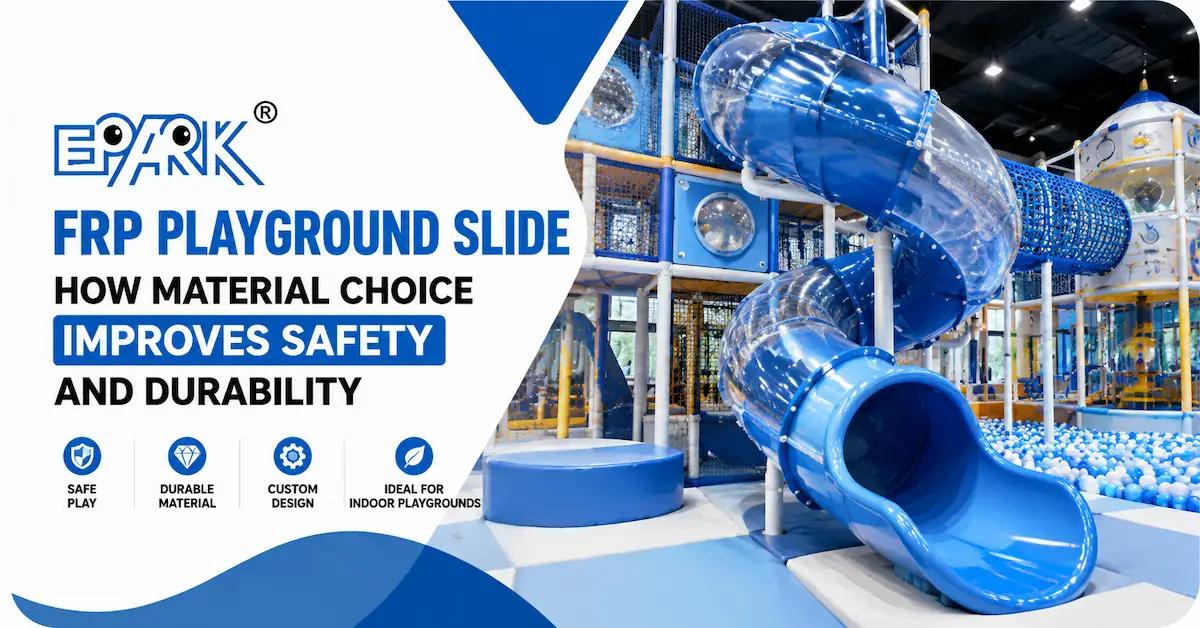
FRP Playground Slide: How Material Choice Improves Safety and Durability
A commercial indoor playground slide has to do more than look attractive in a 3D rendering. It must guide children through a predictable movement path, connect correctly to the structure, remain smooth after repeated use, and work with barriers, padding, flooring, and the landing zone. That is why the material used for the slide deserves more attention than a simple “plastic vs. metal” label.
For projects where EPARK specifies FRP or composite resin slide components, its Safety & Quality information describes the slide surfaces as thick, smooth, wear-resistant, and UV-protected. Those are useful procurement clues, but they should not be interpreted as a guarantee that every FRP slide has identical performance. The final specification still depends on the actual construction, dimensions, support method, finish, applicable standards, installation, and maintenance plan.
This guide explains how an FRP playground slide can contribute to safety and durability, what the material does—and does not—solve, how to compare slide materials, and what commercial buyers should request before approving production.
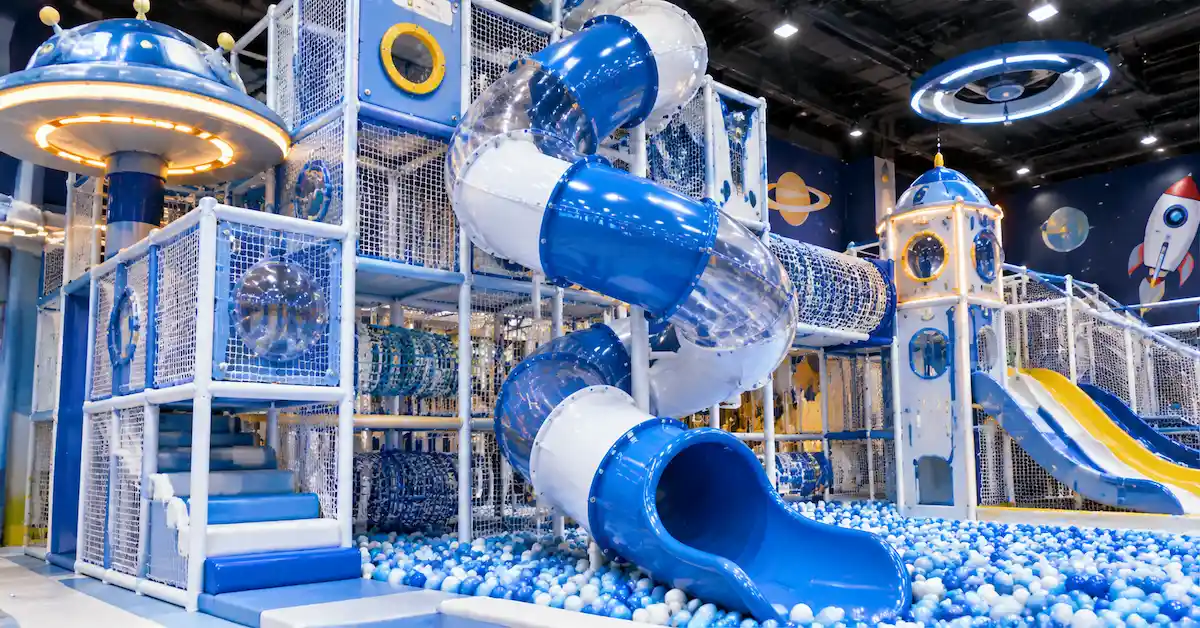
What Is an FRP Playground Slide?
FRP means fiber-reinforced polymer. The material combines a polymer resin with reinforcing fibers. The reinforcement can improve strength and stiffness, while the polymer matrix helps provide a formable surface and protects the reinforcing phase. FRP is a material family rather than one universal recipe.
For a playground buyer, this distinction matters. Two products can both be called “FRP” while using different resin systems, fiber types, layups, thicknesses, surface finishes, manufacturing processes, and structural designs. Therefore, the correct procurement question is not simply, “Is this slide FRP?” It is, “What FRP construction is being proposed for this slide, and how does it satisfy the project requirements?”
EPARK’s current Safety & Quality information states that its slides and climbing structures use thick FRP or composite resin, with smooth, wear-resistant, UV-protected surfaces. The site does not publish a universal numerical FRP thickness, fiber type, resin formulation, or model-specific mechanical data on the core safety page. Those details should be confirmed for the actual project if they are important to the specification.
Buyer Evidence Snapshot
Published by EPARK’s core safety information:
- Slides use thick FRP or composite resin.
- Slide surfaces are described as smooth.
- Slide surfaces are described as wear-resistant.
- Slide surfaces are described as UV-protected.
- The wider playground material system includes galvanized steel, high-density foam, soft PVC protection, EVA or PU flooring, safety nets and railings.
Not published as universal core-page specifications:
- A single numeric FRP thickness
- A universal fiber type
- A universal resin formulation
- A universal slide angle
- A universal slide width or length
- A universal load rating for every slide
- A universal UV exposure duration
- A universal service life for every slide
For a B2B project, the second group should be confirmed against the actual drawing, product specification, test report, quotation and contract. This evidence discipline is more useful than filling missing fields with assumptions.
Who Should Consider an FRP Slide—and When Should Buyers Look Elsewhere?
An FRP slide is most relevant when the project needs a durable formed slide component inside a commercial indoor playground. Typical buyer groups include FEC operators, shopping malls, indoor playground investors, hotels and resorts, preschool or early-education operators, franchise brands, distributors, and project contractors.
The strongest fit is usually a project where the slide is part of a larger engineered play system and where the buyer can define the site, user group, design, safety requirements, and maintenance plan.
There are also situations where an FRP slide may not be the first choice.
A very small toddler-only zone may be better served by a lower, simpler slide configuration selected specifically for that age group. A venue with severe ceiling restrictions may not be able to accommodate the required slide geometry. A project with a highly specific local requirement may also require a different material or documented configuration. Finally, if the buyer cannot obtain sufficient technical information about the proposed construction, material choice alone should not be treated as a reason to approve the product.
The decision should therefore be based on application fit rather than the assumption that FRP is automatically superior to every alternative.
Why Slide Material Matters in a Commercial Indoor Playground
Slides are among the most frequently repeated movement components in a playground. A child may climb to the same platform, enter the same chute, travel down the same surface, and repeat the experience many times during one visit. Across a commercial venue, that repeated action becomes a material and maintenance issue.
Material selection influences several parts of the buyer’s risk profile:
- Surface quality and consistency
- Wear resistance
- Resistance to environmental exposure
- Cleaning requirements
- Appearance retention
- Weight and handling
- Formability for custom shapes
- Repair and replacement planning
- Compatibility with the supporting structure
- Documentation and compliance review
A slide that performs well on day one but becomes difficult to inspect, clean, or maintain is not necessarily the best commercial choice. Likewise, a technically durable material does not automatically make a poorly designed or poorly installed slide safe.
For B2B buyers, the material decision should therefore be connected to the whole project lifecycle rather than made from a product photograph.
How FRP Can Improve Slide Safety
1. A Smooth Surface Supports Consistent Sliding
EPARK describes its FRP or composite resin slide surfaces as smooth. That matters because a slide should provide a continuous riding path without unnecessary surface irregularities.
A smooth finish can help create a more predictable contact condition between the child and the slide surface. It can also make visible surface defects easier to identify during inspection. The practical benefit is not that “smooth means safe” by itself, but that a controlled surface is easier to integrate into a well-designed slide system.
Buyers should inspect:
- Surface continuity
- Visible waviness or deformation
- Rough areas
- Cracks or chips
- Protrusions
- Edge transitions
- Joints and mounting areas
Do not judge surface quality from a rendering. Ask for production photos, samples, inspection records, or an agreed acceptance standard where appropriate.
2. Smooth Transitions Reduce Unnecessary Discontinuities
A slide is not just a long piece of curved material. It has an entry, a transition, a descent path, and an exit.
The transition between the platform and the slide needs to be considered with the same care as the slide surface. If a transition is abrupt, misaligned, or poorly finished, the material’s inherent properties cannot compensate for the installation problem.
This is why EPARK’s customization process places space planning, professional design, material selection, custom manufacturing, quality inspection, and installation into one project workflow.
For procurement, ask the supplier to show the slide position in the 2D or 3D layout rather than approving the slide as an isolated component.
3. Edge and Contact Protection Still Matter
FRP is a rigid composite material. It should not be treated as a soft-play impact surface.
EPARK’s broader safety system includes protective padding, safety nets, railings, EVA-padded bridges and stairs, and soft flooring. This illustrates an important design principle: different materials have different safety functions.
The slide provides a controlled route for sliding. Padding protects contact areas around the structure. Railings and nets address fall protection. Flooring and landing areas help manage the surrounding impact environment.
A buyer should therefore ask where the rigid slide ends and where soft protection begins. The connection between these zones is often more important than the material label on the slide.
4. FRP Can Support Complex Slide Shapes
One of the useful characteristics of composite materials is design flexibility. FRP can be formed into curved and complex geometries, which is valuable when a playground needs a spiral, wave, tube, themed, or custom-shaped slide.
The commercial benefit is not simply visual. A custom slide can be positioned to connect different levels, fit around other activities, or reinforce a themed route.
However, custom geometry increases the need for design control. The more complex the shape, the more important it becomes to confirm:
- Final dimensions
- Entry and exit coordinates
- Clearance
- Support points
- Connections
- Surface finish
- Inspection access
- Cleaning access
- Applicable safety requirements
Customization should create a better fit, not create a component that is difficult to verify or maintain.
5. Surface Visibility Helps Maintenance Teams Find Problems
A clean, continuous slide surface makes routine visual inspection more practical.
Operators should look for:
- Scratches that become deeper over time
- Cracks
- Chips
- Surface delamination indicators where visible
- Unusual roughness
- Damaged edges
- Loose mounting points
- Changes in the slide-to-platform connection
- Debris or contamination
These are operational inspection points, not a substitute for the manufacturer’s maintenance manual or local inspection requirements.
How FRP Can Improve Durability
Durability is where the FRP playground slide becomes especially relevant to commercial procurement. FRP composites are widely recognized in engineering for useful combinations of low weight, strength-to-weight performance, corrosion resistance, and design flexibility. The U.S. Department of Energy explains that FRP combines polymer resin with reinforcing fibers and that reinforcement improves strength and stiffness. Research literature also identifies corrosion resistance and environmental durability as important FRP characteristics, while noting that long-term performance depends on environmental exposure and material system.
1. Wear Resistance for Repeated Use
EPARK explicitly describes its slide surfaces as wear-resistant. That is important in a commercial venue because sliding creates repeated contact over the same surface.
Wear should be evaluated as a lifecycle issue. A buyer should not ask only, “Is it wear-resistant?” A better set of questions is:
- What surface finish is supplied?
- Which areas are expected to receive the most wear?
- How is surface damage inspected?
- What constitutes acceptable wear?
- Can the component be repaired?
- Can the slide be replaced without redesigning the whole structure?
- Are replacement components available?
The answer to these questions turns a general material claim into a practical maintenance plan.
2. Resistance to Corrosion and Moisture-Related Problems
FRP is a non-metallic composite, so it does not rust in the same way as ordinary steel. That can be useful in indoor environments where humidity, cleaning processes, or nearby wet areas create exposure concerns.
This does not mean an FRP slide is immune to every environmental effect. Resin selection, fiber type, surface protection, manufacturing quality, joints, fasteners, cleaning chemicals, temperature, and UV exposure all matter.
For an indoor playground, corrosion resistance is especially useful as part of a mixed-material system. The slide may be FRP while the main structure is galvanized steel, the contact areas are foam and PVC, and the floor uses EVA or PU. Each material needs its own maintenance logic.
3. UV Protection Helps Where Indoor Spaces Receive Natural Light
It may seem unnecessary to discuss UV protection for an indoor playground. However, large malls, atriums, hotels, and other venues may have skylights or large windows.
EPARK states that its slide surfaces are UV-protected. This is a useful feature to include in the project specification because the exposure environment is not always equivalent to a windowless indoor room.
The correct purchasing approach is to treat UV protection as a stated construction feature and then ask what documentation or product specification supports it. Avoid assuming a particular UV resistance duration unless the supplier provides verified test data.
4. Lower Weight Can Simplify Handling and Design Coordination
General FRP engineering literature recognizes a high strength-to-weight ratio as one of the material’s useful characteristics. Lower component weight can influence handling, transportation within the facility, and installation planning.
But a lighter slide is not automatically a safer slide.
The supporting structure, mounting points, fasteners, platform interface, and overall load path still need to be engineered for the complete installation.
This is why the correct question is not “How light is the slide?” but “How is the slide integrated into the structural system?”
5. Shape Retention and Dimensional Consistency Matter
For a slide, dimensional consistency matters because geometry directly affects how the component connects to the platform and surrounding structure.
A good procurement specification should therefore control:
- Slide width
- Length
- Height or starting elevation
- Entry geometry
- Exit geometry
- Radius or curvature where relevant
- Mounting points
- Edge details
- Surface finish
- Color or theme finish
EPARK’s customization process states that components, including slides, are crafted to project specifications after design and material selection. Buyers should convert the approved design into a clear production reference before manufacturing starts.
FRP Playground Slide vs. Other Slide Materials
There is no universal “best” slide material for every project. The correct choice depends on venue, geometry, budget, cleaning routine, design, applicable standards, and supplier capability.
| Material | Potential Advantages | What B2B Buyers Should Verify |
|---|---|---|
| FRP / Composite Resin | Design flexibility, smooth finished surfaces, wear resistance and UV protection can be specified. | Exact resin, reinforcement, thickness, finish, mounting method and supporting documentation. |
| Rotomolded Plastic | Useful for standardized molded components and repeatable shapes. | Material grade, wall construction, UV package, impact performance and size limitations. |
| Stainless Steel | Strong, durable and visually distinctive for selected commercial applications. | Surface finish, temperature considerations, edge treatment, support, noise and design suitability. |
| Other Engineered Plastics | May provide specific molding and maintenance advantages. | Actual formulation, mechanical properties and available performance evidence. |
This is an industry-level comparison, not an EPARK product specification. It is not a claim that every FRP slide is superior to every plastic or stainless-steel slide.
For commercial buyers, the strongest choice is the one that meets the project’s safety requirements while offering a sensible lifecycle profile.
The Five-Layer Safety Model for an FRP Slide
A useful way to evaluate the slide system is to divide it into five layers.
| Layer | What It Covers | Buyer Checkpoints |
|---|---|---|
| 1. Slide Surface | The actual riding surface. | Smoothness, finish, wear condition, visible defects and cleaning access. |
| 2. Slide Geometry | Entry, descent and exit route. | Curvature, clearance, exit location and age suitability. |
| 3. Structural Interface | Connection between slide and playground structure. | Mounting points, platform connection, frame, fasteners and stability. |
| 4. Surrounding Protection | Protection around the slide. | Railings, safety nets, padding, flooring and landing-zone treatment. |
| 5. Operations | Post-installation management. | Inspection, cleaning, maintenance, staff training, spare parts and documentation. |
This model prevents a common purchasing mistake: assuming that a high-quality slide material can compensate for poor system integration.
How to Specify an FRP Playground Slide for a Commercial Project
A professional RFQ should contain more than the phrase “FRP slide.”
Start with the project environment.
1. Venue and Space
Provide:
- Floor plan or CAD drawing
- Clear ceiling height
- Column locations
- Entrances and exits
- Emergency routes
- Available installation access
- Target play area
- Nearby equipment
EPARK’s customization process specifically describes site feasibility analysis, space planning, 3D visualization and technical drawings.
2. User Group
Define:
- Target age range
- Toddler or junior use
- Older-child use
- Parent-child participation
- Expected traffic pattern
Age zoning should be considered before the slide is selected, not after.
3. Slide Function
Define whether the slide is intended as:
- A main attraction
- A connection between play levels
- A toddler feature
- A themed visual centerpiece
- A racing or multi-lane attraction
- A tube or enclosed route
- A custom signature element
The function influences geometry, footprint and surrounding protection.
4. Material Specification
Ask for:
- FRP or composite resin confirmation
- Reinforcement description, if available
- Resin system, if relevant to the project
- Nominal thickness
- Surface finish
- UV protection
- Color/finish method
- Cleaning compatibility
- Repair or replacement method
If the supplier does not publish these details as standard specifications, request them as project-specific information rather than inventing values.
5. Safety and Compliance Documentation
Ask for:
- Applicable standard references
- Product or project test reports
- Material documentation where required
- Installation drawings
- Inspection criteria
- Maintenance instructions
- Destination-market requirements
EPARK’s customization page references EN1176, ASTM and ISO in its safety/compliance framework. Its certificate page displays indoor-playground certificate and report entries, including CE-related, NTEK, ZRC and SGS-related documents. Because the publicly visible page does not provide complete document numbers, dates and scope for every displayed item, buyers should request the exact document applicable to the quoted product and market.
Review the EPARK customization process to understand the design, material selection, manufacturing, inspection, installation and after-sales workflow.
OEM/ODM Customization: What Should Be Customized—and What Should Not?
For a branded indoor playground project, OEM/ODM customization can go beyond changing a color. A buyer may need the slide to match a theme, brand palette, mascot, visual identity, or a specific spatial concept.
Useful customization areas can include:
- Slide color and surface appearance
- Theme-related shapes or decorative elements
- Layout and slide positioning
- Connection to customized platforms
- Matching graphics and signage
- Integration with a broader themed route
- Special visual concepts for a signature attraction
However, safety-critical elements should not be customized simply to achieve a visual effect. The buyer should not ask a manufacturer to remove required barriers, reduce protective clearance, create unsafe openings, weaken support points, or change an approved geometry without technical review.
A disciplined OEM/ODM workflow should therefore use change control.
- First, approve the project brief.
- Second, approve the 2D layout.
- Third, approve the 3D rendering.
- Fourth, approve material and technical details.
- Fifth, freeze the production drawing.
- Sixth, record any later change with a new revision.
This is especially important for FRP components because a change in curve, length, width, mounting point, or exit position can affect the surrounding structure and circulation.
EPARK’s customization page describes custom theme development, brand-integrated color schemes, mascot characters, 3D renders, technical drawings, custom manufacturing, quality inspection, installation, and after-sales maintenance. For a private-label or branded project, buyers should make sure the final quotation clearly separates standard features from customized features and identifies the approved revision.
How to Evaluate FRP Playground Slide Cost Without Chasing the Lowest Quote
There is no responsible universal price for an FRP playground slide because commercial slides are often project-specific components. The final cost can change with geometry, size, theme, finish, support structure, platform height, quantity, packaging, shipping, installation, and the amount of design work required.
A buyer comparing quotations should separate the price into at least five layers:
| Cost Layer | What It Covers | Procurement Risk to Check |
|---|---|---|
| 1. Slide Component | FRP or composite component and specified finish. | Material, dimensions, finish and construction are clearly defined. |
| 2. Structural Integration | Platforms, supports, mounting hardware, barriers or structural modifications. | Hidden exclusions can make a low equipment quote more expensive later. |
| 3. Design & Customization | Custom curves, themed shapes, colors, dimensions and visual details. | Make sure the approved design matches the quotation. |
| 4. Logistics & Installation | Export packing, freight, site access, installation method and local labor. | Clarify what is included and excluded from the project scope. |
| 5. Lifecycle Support | Cleaning, inspection, spare parts, replacement components and technical support. | Check availability and responsibilities after opening. |
For this reason, the useful commercial metric is not simply purchase price. Buyers should compare total project scope and expected maintenance effort.
A practical quote-comparison table can use the following columns:
- Material and construction
- Dimensions
- Surface finish
- UV protection
- Mounting method
- Safety interface
- Applicable documentation
- Packaging
- Installation scope
- Spare parts
- After-sales support
- Exclusions
This makes it easier to compare two FRP playground slide suppliers on an equivalent basis.
When the quotation is based on a 3D playground design, the buyer should also verify that the slide shown in the approved drawing is the same component described in the quotation. This simple document-control step can prevent substitutions or scope confusion later.
How to Compare Different FRP Playground Slide Configurations
Rather than comparing only “good” and “bad” slides, commercial buyers can compare configurations according to their intended function.
Straight FRP Slide
Best for: Compact routes and straightforward level connections.
Buyer focus: Footprint, entry transition, exit area, edge finish and support.
Wave FRP Slide
Best for: Stronger visual movement and themed commercial playgrounds.
Buyer focus: Curve consistency, clearance, mounting, surface continuity and cleaning access.
Spiral or Curved FRP Slide
Best for: Signature attractions or efficient vertical routing.
Buyer focus: Turning radius, enclosure, visibility, structural integration and installation access.
Tube or Enclosed Composite Slide
Best for: Themed or immersive routes where enclosure is part of the play experience.
Buyer focus: Internal finish, visibility, cleaning access, lighting and emergency considerations.
These are functional planning categories, not EPARK model names or universal specifications. The actual configuration should be selected from the approved project design.
Quality Control: What Buyers Should Check Before Shipment
A commercial playground buyer should define quality checkpoints before production starts.
Design Approval
Confirm:
- Final drawing revision
- Slide location
- Slide dimensions
- Theme and color
- Platform connection
- Exit location
- Surrounding protection
Material Approval
Confirm:
- Specified slide material
- Surface finish
- Color
- Edge condition
- Any agreed thickness or construction details
Manufacturing Inspection
Depending on the project, review:
- Dimensional consistency
- Surface defects
- Edge finish
- Mounting points
- Hardware
- Component labeling
- Fit with the approved drawing
Pre-Shipment Inspection
Confirm:
- Final component list
- Packaging protection
- Installation identification
- Drawings and instructions
- Spare parts, if included
- Quality records agreed in the contract
EPARK states that its customization process includes rigorous quality control and secure packaging before delivery. For a buyer, the best practice is to translate that general commitment into a project-specific inspection checklist.
Maintenance of an FRP Slide
Even a durable slide needs maintenance.
Cleaning should follow the supplier’s instructions and the venue’s hygiene requirements. Do not assume that every disinfectant is compatible with every resin, coating, graphic finish, or soft-play material.
EPARK’s FAQ provides a broader company-level reference that its products typically last 5–10 years with proper maintenance, while noting that durability depends on usage frequency and environmental conditions. This should be treated as a general product-family statement, not a guaranteed service life for a specific slide. A project-specific quotation should define the actual warranty, maintenance requirements, and replacement terms if those are commercially important.
A useful commercial metric is “maintenance minutes per zone.” This is not an industry standard; it is an internal operating measure. If two playground layouts have similar attraction value but one requires easier access for cleaning and inspection, that difference can matter over years of operation.
What Makes an FRP Playground Slide a Good Commercial Purchase?
The answer is not simply “FRP.”
A good commercial slide should satisfy five tests:
- It fits the approved layout.
- Its surface and geometry support the intended use.
- Its construction is appropriate for the operating environment.
- Its supporting and protective systems are correctly integrated.
- The buyer can inspect, maintain and replace it when needed.
This is why a procurement team should evaluate the material, manufacturer, engineering, quality control and after-sales plan together.
For large commercial venues, the cost of a slide should also be viewed in relation to downtime and maintenance. A component that is difficult to inspect or replace may create more operational friction than a slightly higher-priced component with better documentation and service support.
Questions to Ask an FRP Playground Slide Manufacturer
Before approving a quotation, ask the supplier:
- Is the slide FRP or another composite resin system?
- What is the construction or reinforcement type?
- What nominal thickness is proposed?
- What surface finish is supplied?
- How is UV protection achieved?
- What inspection standard is used for the surface?
- How are edges and mounting areas finished?
- How does the slide connect to the platform?
- What surrounding padding and fall-protection elements are included?
- Which standards apply to the project?
- Which test reports or certificates cover the actual equipment?
- What documents will be supplied for installation?
- What cleaning products are compatible with the slide surface?
- What is the recommended inspection frequency?
- How are replacement slide components handled?
- Can the slide be customized to the approved 3D design?
- What site information is required before production?
- Who supports installation?
- What after-sales and spare-parts support is available?
- Which details are guaranteed in the final quotation or contract?
These questions help move the conversation from marketing language to an auditable project specification.
A Practical FRP Slide RFQ Checklist
Before contacting a manufacturer, prepare:
The more complete the brief, the easier it is for the supplier to produce a useful quotation instead of a generic price.
How FRP Slides Fit Into EPARK's Indoor Playground System
EPARK does not position the slide as an isolated material purchase. Its current customization workflow connects design, material selection, manufacturing, quality inspection, installation and after-sales support.
For a commercial buyer, this project-level approach is useful because the slide must fit the rest of the playground.
EPARK’s stated material system includes:
- Cold-rolled steel pipes with hot-dip galvanization
- High-density foam
- Soft PVC sleeves
- EVA or PU foam flooring
- FRP or composite resin slide components
- Safety nets and railings
The company’s customization page also describes multi-level steel-frame systems, age-appropriate zoning, future expansion modules, custom themes, 3D visualization, technical drawings, site feasibility analysis, installation, staff training, maintenance programs and spare-parts supply.
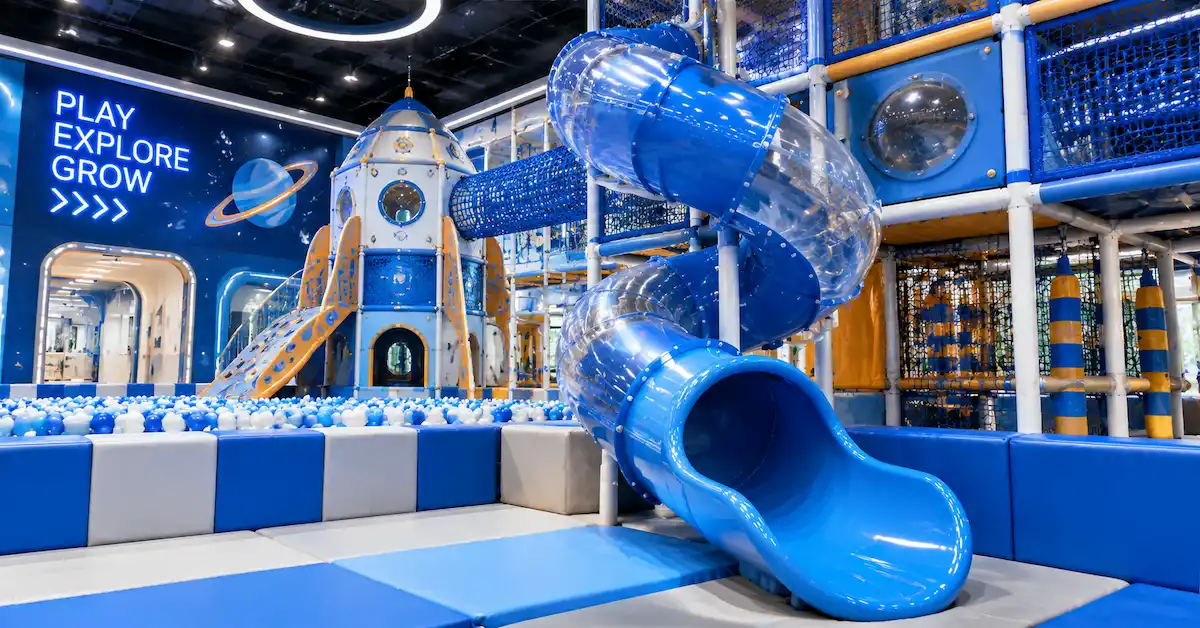
The practical takeaway is simple: when requesting an FRP playground slide, request the slide as part of the approved playground design rather than treating it as an interchangeable loose component.
Frequently Asked Questions
1. What is an FRP playground slide?
An FRP playground slide is a slide component made from fiber-reinforced polymer or a composite resin system. FRP combines a polymer matrix with reinforcing fibers. The exact resin, reinforcement, thickness and manufacturing construction should be confirmed for the specific product.
2. Why is FRP used for indoor playground slides?
FRP can support formed, curved and themed geometries while providing useful strength-to-weight and corrosion-resistance characteristics. EPARK specifically describes thick FRP or composite resin slide components with smooth, wear-resistant and UV-protected surfaces.
3. Is an FRP playground slide safer than a plastic slide?
Not automatically. Safety depends on the complete system, including slide geometry, surface finish, entry and exit, support structure, railings, safety nets, padding, flooring, installation and maintenance. Material should be evaluated together with these factors.
4. Is FRP durable enough for commercial indoor playgrounds?
FRP composites are widely used in engineering because of useful combinations of strength-to-weight performance, corrosion resistance and design flexibility. EPARK also describes its slide surfaces as wear-resistant and UV-protected. Actual durability depends on construction, environment, usage and maintenance.
5. Does EPARK publish the exact thickness of its FRP slides?
The core Safety & Quality information describes the slides as using thick FRP or composite resin but does not publish one universal numerical thickness. Buyers should request the proposed thickness or construction details for the specific project.
6. Can an FRP slide be customized for a themed playground?
Yes, custom slide geometry, color, visual appearance and integration into a themed playground can be discussed as part of an OEM/ODM project. EPARK’s customization process includes theme development, 3D visualization, technical drawings and custom manufacturing.
7. What safety standards should buyers consider?
Requirements depend on the destination market and equipment type. ASTM F1918-21 is specifically associated with soft contained play equipment in the United States, while the EN 1176 series includes general playground requirements and specific provisions for slides. Buyers should confirm the standard required for their actual project.
8. How should an FRP slide be maintained?
Operators should perform regular visual inspections of the surface, edges, mounting points, platform connection, surrounding padding, safety barriers and landing area. Cleaning should follow the supplier’s instructions and the venue’s hygiene requirements.
9. What information should I send when requesting an FRP slide quotation?
Provide the floor plan or CAD drawing, ceiling height, target age group, slide location, preferred configuration, theme, destination country, installation requirements and any applicable safety or documentation requirements. EPARK’s FAQ also asks buyers to provide site dimensions, preferred theme and target age group for an accurate quotation.
10. Can EPARK provide a complete playground project instead of only the slide?
Yes. EPARK’s company and customization information covers indoor playground equipment, soft play, trampoline parks, themed playgrounds, ocean ball pools, arcade equipment and customized amusement projects. Its published project workflow covers consultation, space planning, design, material selection, manufacturing, quality inspection, installation and after-sales support.
Conclusion
An FRP playground slide can contribute to a safer and more durable indoor playground when the material, geometry, finish, support structure and surrounding protection are designed as one system.
If you are planning a custom indoor playground, prepare your floor plan, ceiling height, target age group, theme and slide requirements before requesting a quotation. EPARK’s customization process can then be used to move from site planning and 3D design to material selection, manufacturing, quality inspection, installation and after-sales support. You can also review the indoor playground equipment range before finalizing your project requirements.
General Disclaimer
All data on https://www.eparki.com is for general guidance only. As a leading indoor playground manufacturer and trampoline supplier, EPARK strives for accuracy but gives no express or implied warranty regarding completeness, performance or project fitness. Product specs, designs and results may vary with use and customer requirements. Buyers must verify technical details, compliance and suitability before purchase. EPARK OEM/ODM is not liable for any direct, indirect or consequential damages arising from site use. For custom solutions, contact our manufacturer and supplier team via the Contact page.
Intellectual Property
Text, images, videos, CAD files and software are Guangzhou EPARK Electronic Technology Co., Ltd. All rights reserved. No part may be copied, republished or used commercially without prior written permission. We will pursue legal action for copyright or design-patent infringement.
Trademarks
"EPARK", the EPARK logo and related graphics are registered trademarks of Guangzhou EPARK Electronic Technology Co., Ltd. Unauthorized use in ads, domain names or packaging is prohibited.
Governing Law
These terms are governed by the laws of the People's Republic of China.
Contact
Questions? Email sales@nanyuetech.com or WhatsApp +86 139 0307 9263.