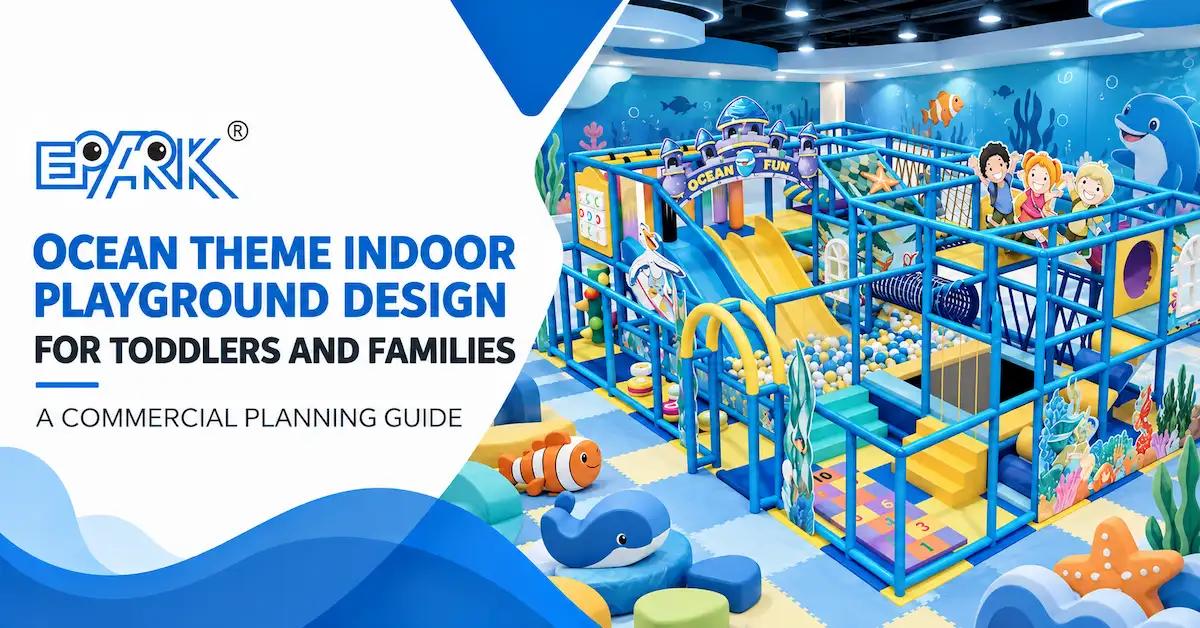
Ocean theme indoor playground design works for toddlers and families when the ocean story is used to organize low-impact activity, clear age zoning, parent visibility, and practical cleaning access. The theme should guide the entrance, colors, landmarks, play panels, slides, ball play, quiet areas, and family seating without hiding exits or creating difficult-to-maintain details. For a mixed-age venue, keep the toddler route calm and visible while allowing a separate junior route to provide more challenge.
Buyers searching for an ocean theme indoor playground often begin with images of waves, submarines, sea animals, coral, and blue slides. A commercial design brief must go further. A toddler needs an understandable route, manageable height, predictable transitions, and a parent who can see the next activity. A family venue needs an attraction that can support longer visits, birthdays, memberships, food service, and repeat content without turning the room into a blue maze.
This guide is intentionally narrower than a general ocean-themed playground guide. It focuses on toddler and family fit: age zoning, activity intensity, parent sightlines, material and cleaning decisions, photo points, and supplier evidence. It uses EPARK’s published ocean category, product examples, materials, and customization process. Published areas are treated as project examples, not standard capacities, prices, or universal configurations.
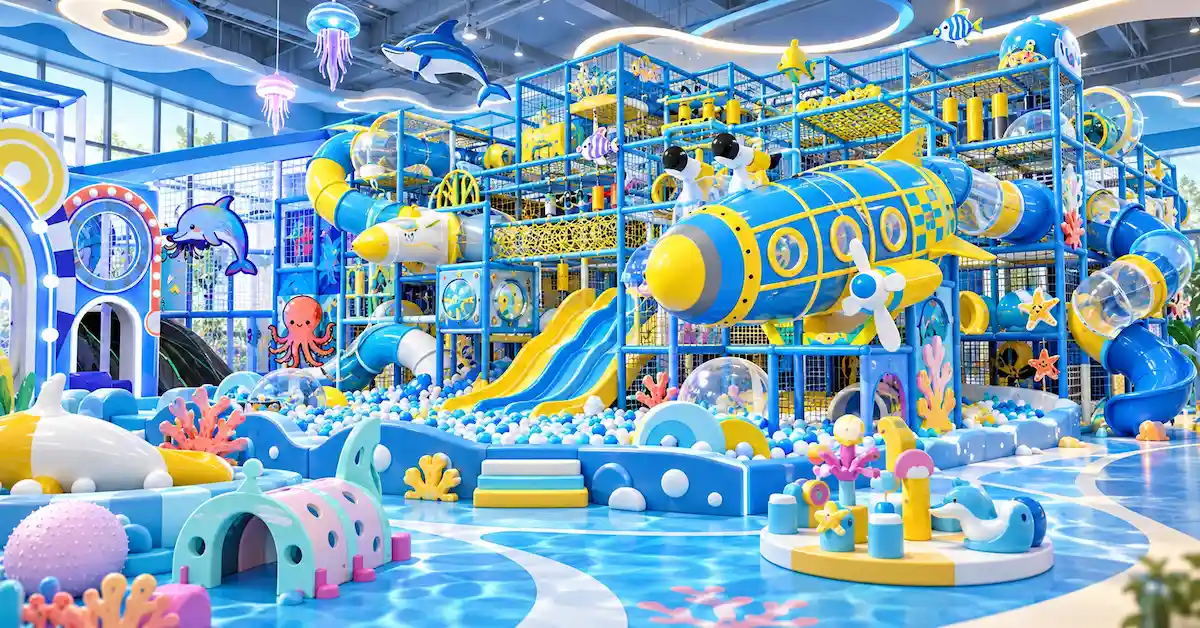
Plan the ocean concept around your families. Send the CAD plan, clear height, target ages, parent seating, preferred activities, destination market, and opening date to request a site-specific layout.
Request an Ocean Theme LayoutWhy Ocean Themes Work for Toddlers and Families
For a buyer evaluating an ocean theme indoor playground, the commercial question is whether the theme can organize a safe family journey as well as create attractive images. The strongest concepts connect visual landmarks to age-appropriate play, parent comfort, cleaning, and repeatable operations.
The story is easy to understand at different ages
Ocean imagery gives a venue a simple vocabulary: waves, boats, submarines, coral, shells, fish, whales, reefs, and underwater caves. Toddlers can identify large shapes and friendly characters without reading. Older children can build a more complex pretend-play story around exploration, rescue, navigation, or marine discovery. The same theme can therefore support different activity levels if the designer controls scale and visual hierarchy.
The theme should not be treated as a list of props. A submarine can be an entrance landmark, a quiet role-play cabin, or a visual sign for the toddler zone. A wave can be a padded climbing contour, a boundary, or a low slide form. A coral reef can organize activity panels and soft obstacles. The function should be clear in the technical schedule.
Ocean colors can support navigation when controlled
Blue and turquoise can identify the main theme, while coral, yellow, white, and green can distinguish zones and landmarks. Use contrast for edges, entries, steps, barriers, and signs. Avoid using one similar blue across every surface; toddlers and parents need to recognize where a route begins and ends. A controlled palette also improves photographs and makes future graphics easier to replace.
Families need a calm relationship between play and seating
Parents often choose a toddler venue based on visibility and comfort. Place a low or transparent boundary between the toddler route and seating, avoid hiding the main activity behind a tall wave or whale, and keep the path from tables to toilets and exits legible. A family venue may need one quiet area beside more active play so a younger child can reset without leaving the theme.
Age Zoning for a Family Ocean Playground
Age zoning is a design and operating decision, not a decorative label. For an ocean theme indoor playground, the final age policy should be set by the operator, supplier, and relevant local requirements. The framework below helps structure the brief.
| Zone | Ocean story | Activity direction | Design and supervision check |
|---|---|---|---|
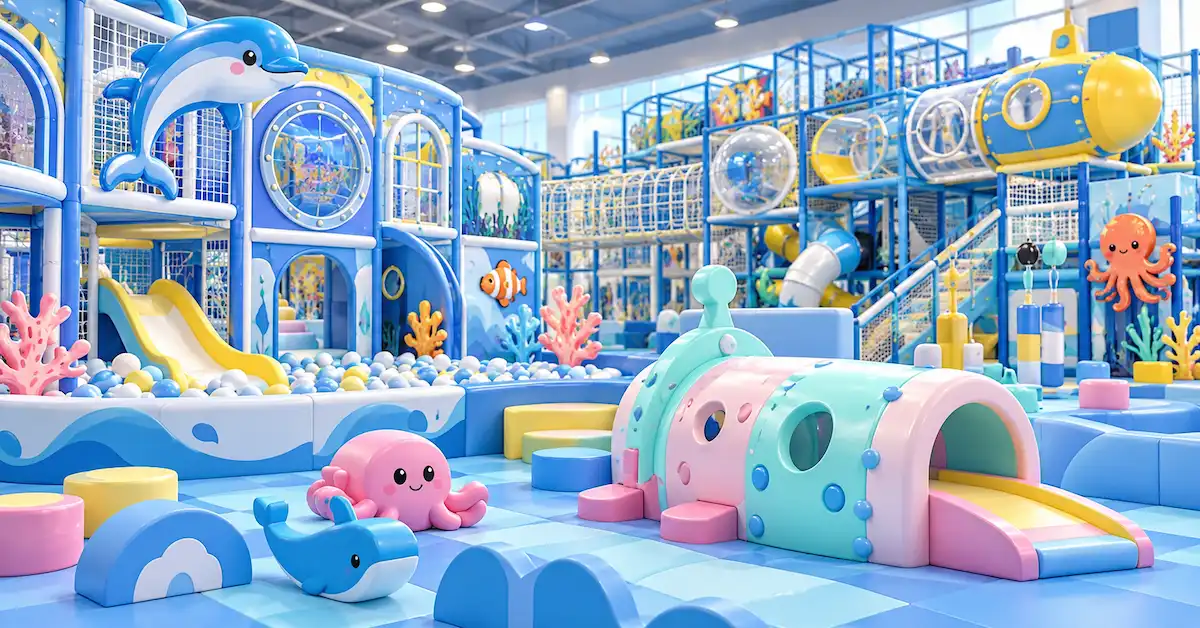
| Toddler lagoon | Shallow reef, gentle waves, friendly sea animals | Low crawl, soft steps, sensory panels, small slide, parent-child play | Can parents see the whole route and can staff reach every surface? |
| Preschool reef | Coral garden, shell trail, underwater cave | Ball play, padded climbing, tunnel, bridge, role-play boat | Are entry, exit, queue, and adult boundaries easy to understand? |
| Junior expedition | Research vessel, treasure route, deep-sea mission | Higher climbing, obstacles, slides, net or rope elements, challenge route | Is it separated from toddlers by route, access, and activity intensity? |
| Family photo cove | Submarine window, giant whale, lighthouse, or reef arch | Standing or seated photo point outside active landing and queue paths | Can groups take photographs without blocking circulation or supervision? |
| Quiet tide pool | Calm water, shells, soft sea grass | Books, sensory panels, low role play, parent-child reset | Is the area visible, washable, and protected from fast traffic? |
Toddler lagoon: lower complexity, higher visibility
The toddler zone should be easy to read from one position. Use large, rounded landmarks, short routes, low transitions, and activities that do not require children to understand complicated rules. A soft submarine or whale can frame a role-play moment, but it should not create hidden corners. A small slide can work as a clear start-and-finish activity if the landing is visible and the route does not cross a cafe service path.
Preschool reef: repeatable loops and imaginative play
Preschoolers can handle more transitions and pretend-play rules, but the route should still be obvious. Build a loop that connects crawl, climb, cross, slide, and rest. Use a coral wall or sea-animal panel to signal the next activity. Keep the entrance and exit separate when possible so children do not run against the flow.
Junior expedition: challenge without invading the toddler route
If the venue serves older children, place higher or faster activity in a separate zone with its own entry, supervision logic, and material schedule. A net bridge or climbing wall may fit the ocean story, but the design must state the user group, access, fall protection, maintenance, and inspection points. Do not rely on a blue color change to protect age separation.
Ocean Modules: Turning Visual Ideas into Play Functions
Submarine and boat forms
A submarine can anchor the entrance or create a role-play cabin. Define whether it is a fixed visual shell, an accessible play compartment, a photo prop, or a combination. Provide ventilation, viewing openings, rounded edges, cleaning access, and an exit that does not create a dead end. A boat deck can become a low balance route, but the technical drawing should show height, barriers, and landing space.
Waves, reefs, and sea grass
Use waves as padded contours, low dividers, slide forms, or wall graphics. Use reefs as activity clusters rather than scattered decoration. Soft sea grass can be a visual edge, but loose or difficult-to-clean elements should be reviewed carefully. Every decorative feature should have an owner: structural, activity, wayfinding, brand, photo, cleaning, or replacement.
Slides, ball pools, and tunnels
EPARK ocean product examples show combinations that include slides, ball pits, climbing, tunnels, and multi-activity play. The ocean multi-activity example and the 280 m2 ocean example are reference pages for product and project discussion, not a standard package for every family venue. Ask the supplier to map each activity to age, circulation, supervision, material, and cleaning access.
Interactive and educational elements
Interactive panels can introduce colors, sounds, matching, and pretend navigation. Use them sparingly so the space does not become a maintenance-heavy digital installation. Ask who supplies power, content, controls, isolation, commissioning, spares, and technical support. A printed sea-life panel may provide more reliable long-term value if the venue cannot support powered equipment.
Materials, Cleaning, and Safety Evidence
Use a component-level material schedule
EPARK’s public materials and safety page describes cold-rolled steel pipe with hot-dip galvanization, high-density foam, soft PVC sleeves, EVA or PU mats, FRP or composite-resin slides, safety nets, railings, and padded climbing bridges and stairs. These are useful published material descriptions, but they do not replace a project bill of materials. The supplier should identify the exact material and finish for the ocean structure, toddler modules, slides, flooring, barriers, graphics, and any powered items.
For toddlers and families, cleaning access matters as much as visual appearance. Ask how covers, ball pools, mats, handrails, panels, and enclosed spaces are cleaned, dried, inspected, repaired, and replaced. A coral form that looks good in a render may create a difficult seam or inaccessible cavity. Include cleaning tools, approved products, frequency, and responsible staff in the operating file.
Separate safety design, standards, and certificates
A safe design decision is not the same as a certificate claim. EPARK’s website references EN1176, ASTM, CE, SGS, ISO, and other terms across different pages, and its certificate page displays document images. The public page does not consistently list certificate numbers, issuer, date, validity, tested sample, and full scope in searchable text. Request the applicable file and map it to the exact configuration and destination requirement.
Do not write “all products are certified” from a general certificate gallery. For an ocean theme project, request the relevant standard, report or certificate, product or material scope, test sample, issuer, date, and local requirement. If the information is not available, write “to be confirmed in the project document pack.”
Make parent safety visible
Parents need to identify entrances, exits, boundaries, staff positions, toilets, seating, and emergency routes. Use contrast and simple icons rather than relying only on sea-themed text. Keep signs readable from the seating area. Make the toddler entry visibly different from the higher-challenge route if both are present.
Family Experience, Photos, and Repeat Visits
Create one primary ocean landmark
A giant whale, submarine, lighthouse, or reef arch can make the venue recognizable from the corridor and give families a group-photo location. Choose one primary landmark and several smaller details. If every wall competes for attention, photographs become visually noisy and the venue loses a clear identity.
Make photographs operationally safe
Plan a standing or seated photo position outside an active landing zone, queue, staff route, and emergency access. Leave enough space for a family group and a stroller. Use a stable background, face-height detail, and a view that shows the ocean story without placing a child on equipment that is not intended for posing. A photo point should be included in the layout, not improvised after installation.
Build repeat visits with changeable details
Seasonal sea-life panels, birthday props, exploration cards, collectible stamps, and rotating role-play prompts can create repeat content without changing the main structure. Ask which panels, graphics, or props can be replaced, their codes, lead time, MOQ, and cleaning requirements. Do not build a repeat-visit plan around a unique part that cannot be reordered.
Connect the play route to the family business model
A toddler-focused venue may sell timed play, cafe spend, memberships, parent-child sessions, or birthday packages. A larger FEC may add admission, parties, group bookings, arcade or interactive attractions, and retail. The theme supports these offers, but it does not prove demand or revenue. Use local research and operating data for commercial assumptions.
Site and Layout Checks Before You Approve the Theme
- Site envelope: confirm floor-to-ceiling height, low obstructions, columns, doors, exits, windows, services, floor changes, and loading access.
- Non-play functions: draw reception, shoe storage, seating, parties, toilets, food, staff, storage, cleaning, and circulation separately.
- Age plan: identify toddler, preschool, junior, adult accompaniment, and any restricted activity.
- Activity schedule: list crawl, climb, slide, balance, ball play, role play, sensory, quiet, and interactive elements.
- Visibility: test sightlines from reception, seating, staff position, entry, and exit.
- Cleaning: mark access to seams, mats, ball pools, panels, enclosed shells, and floor transitions.
- Theme hierarchy: identify primary landmark, activity landmarks, signs, photo point, and quiet background.
- Brand and rights: supply approved logo, colors, mascot, artwork, and written rights for licensed content.
- Delivery scope: define design, manufacturing, inspection, packing, shipping, installation, training, documents, and spares.
- Approval gates: name who approves the concept, drawings, materials, graphics, inspection, packing, and handover.
| Approval stage | Supplier deliverable | Family-venue decision |
|---|---|---|
| Concept | Ocean story, palette, landmarks, age zones, photo point | Does the concept fit the brand, users, and guest journey? |
| Space plan | Dimensioned plan, circulation, seating, exits, staff access | Can parents see children and can staff clean and inspect the route? |
| Technical design | Elevations, sections, fixing, barriers, materials, components | Are height, edges, access, and activity interfaces acceptable? |
| Production | Inspection plan, order photos, component count, packing labels | Does the production evidence match the approved drawing and BOM? |
| Handover | Manuals, cleaning, inspection, spare parts, warranty, open list | Can the venue operate and maintain the system after opening? |
MOQ, Lead Time, Packaging, and Project Evidence
MOQ depends on what is being ordered
Ocean theme projects can include a complete playground, a custom structure, replacement panels, branded graphics, spare parts, or a future expansion. Each may have a different MOQ. EPARK’s product and process pages provide project-level examples, but they do not establish one universal MOQ for every ocean component. Ask for MOQ by deliverable and record whether prototypes, moulds, artwork, packaging, and spare parts are included.
Lead time depends on approvals and site readiness
EPARK’s FAQ gives a general reference of 3-7 days for design and 15-30 days for production after design confirmation. A separate product page may show a different production reference. The buyer should use the signed quotation, current drawing status, payment terms, material approvals, inspection plan, shipping route, and installation readiness to establish the working schedule.
Packaging protects a multi-part ocean story
Ocean projects can include large panels, molded forms, nets, mats, graphics, hardware, and themed shells that must be identified during installation. Ask for package numbers, component codes, hardware bags, moisture protection, loading photos, packing list, and installation sequence. A beautiful theme can become a handover problem if the whale panel or coral module cannot be matched to the approved drawing.
How EPARK’s Customization Process Can Support the Brief
EPARK describes a seven-stage project route: consultation and needs assessment; space planning and professional design; material selection and safety compliance; custom manufacturing and production; quality inspection and secure packaging; delivery and professional installation; and after-sales support and maintenance. The process page also refers to 3D renderings, detailed floor plans, technical drawings, project management, installation support, staff training, and spare parts.
For an ocean theme indoor playground, ask the proposal to show each stage. The concept should identify the ocean story and age zones. The plan should show toddler visibility, family seating, staff access, and exit routes. The material schedule should identify the components. The production and inspection plan should explain how the approved design is checked before packing. The handover package should include cleaning, inspection, spares, warranty, and open-item closure.
EPARK’s materials and safety page and certificate page are evidence entry points, not substitutes for order-specific documents. Ask for the relevant report or certificate with product scope, issuer, date, sample, standard, and destination relevance. If a requested document is not public, list it as a pre-shipment or approval requirement.
Evidence rule: Treat ocean product areas and published project descriptions as examples of EPARK’s project range. Do not write a page area as a standard SKU, capacity, price band, or guaranteed commercial result. The final layout, materials, dimensions, schedule, MOQ, packaging, and compliance documents must be confirmed for the order.
Frequently Asked Questions
Is an ocean theme indoor playground suitable for toddlers?
It can be, when the design uses age-appropriate scale, low-impact activities, clear entries, parent visibility, manageable height, accessible cleaning, and a defined supervision policy. The ocean theme itself does not establish suitability; the approved equipment and operating rules do.
How do I separate toddlers from older children?
Use separate routes, entry points, height and activity levels, visual landmarks, boundaries, and staff rules. Do not rely on color alone. Show the age zoning and sightlines on the plan and confirm how families move between areas.
What ocean activities work well for families?
Common planning directions include soft crawl routes, small slides, ball play, padded climbing, tunnels, bridges, role-play submarines or boats, sensory panels, quiet tide pools, and a separate junior challenge route. Select only activities that fit the site, age group, maintenance plan, and local requirements.
What materials does EPARK publicly describe?
EPARK describes hot-dip galvanized cold-rolled steel pipe, high-density foam, soft PVC sleeves, EVA or PU mats, FRP or composite-resin slides, safety nets, railings, and padded components. Request the project-specific material schedule, samples, cleaning instructions, and relevant documents.
Can I use a famous sea character?
Only with the appropriate rights. Provide approved artwork and written permission for licensed characters, logos, or branded graphics. The supplier should identify which files are buyer-supplied and which are created for the project.
How photo-friendly should the design be?
Plan one primary landmark, one safe group-photo position, supporting details, and a clear entrance view. Keep the photo position outside active landings, queues, staff routes, and emergency access. The camera moment should not compromise supervision or circulation.
Does EPARK publish a standard ocean theme package?
EPARK publishes an ocean theme category and several project or product examples, including a 280 m2 example and multi-activity structures. These are reference pages, not a universal ocean theme indoor playground package. Request a new layout based on the measured site and target users.
What are the general design and production references?
The company FAQ gives a general reference of 3-7 days for design and 15-30 days for production after design confirmation. Other product pages may show different references. Confirm the current project schedule and its approval dependencies in the quotation.
What should I send for an ocean theme quote?
Send a CAD or measured plan, clear height, columns and obstructions, exits, site photos, non-play functions, target ages, activity list, theme direction, brand files, destination market, opening date, and the desired design, production, packing, installation, training, document, and after-sales scope.
Conclusion
An ocean theme indoor playground can give a family venue a memorable story, but its success depends on the design decisions behind the graphics. Toddlers need calm routes, low-impact activity, visible transitions, and easy cleaning. Families need comfortable seating, clear boundaries, photo opportunities, and a venue that works beyond one visit. Older children can use a separate expedition route without taking over the toddler lagoon.
EPARK’s ocean theme category, ocean product examples, customization process, materials and safety page, and certificate gallery can start the supplier conversation. Convert the concept into a site plan, activity schedule, material and finish schedule, cleaning plan, inspection evidence, packaging list, installation scope, and handover file before approving production.
Ready to develop the family ocean concept? Share your site envelope and audience brief so EPARK can propose age zoning, activity combinations, theme landmarks, and a documented delivery scope.
Explore Ocean Theme Products Discuss a Custom Ocean Design
General Disclaimer
All data on https://www.eparki.com is for general guidance only. As a leading indoor playground manufacturer and trampoline supplier, EPARK strives for accuracy but gives no express or implied warranty regarding completeness, performance or project fitness. Product specs, designs and results may vary with use and customer requirements. Buyers must verify technical details, compliance and suitability before purchase. EPARK OEM/ODM is not liable for any direct, indirect or consequential damages arising from site use. For custom solutions, contact our manufacturer and supplier team via the Contact page.
Intellectual Property
Text, images, videos, CAD files and software are Guangzhou EPARK Electronic Technology Co., Ltd. All rights reserved. No part may be copied, republished or used commercially without prior written permission. We will pursue legal action for copyright or design-patent infringement.
Trademarks
"EPARK", the EPARK logo and related graphics are registered trademarks of Guangzhou EPARK Electronic Technology Co., Ltd. Unauthorized use in ads, domain names or packaging is prohibited.
Governing Law
These terms are governed by the laws of the People's Republic of China.
Contact
Questions? Email sales@nanyuetech.com or WhatsApp +86 139 0307 9263.