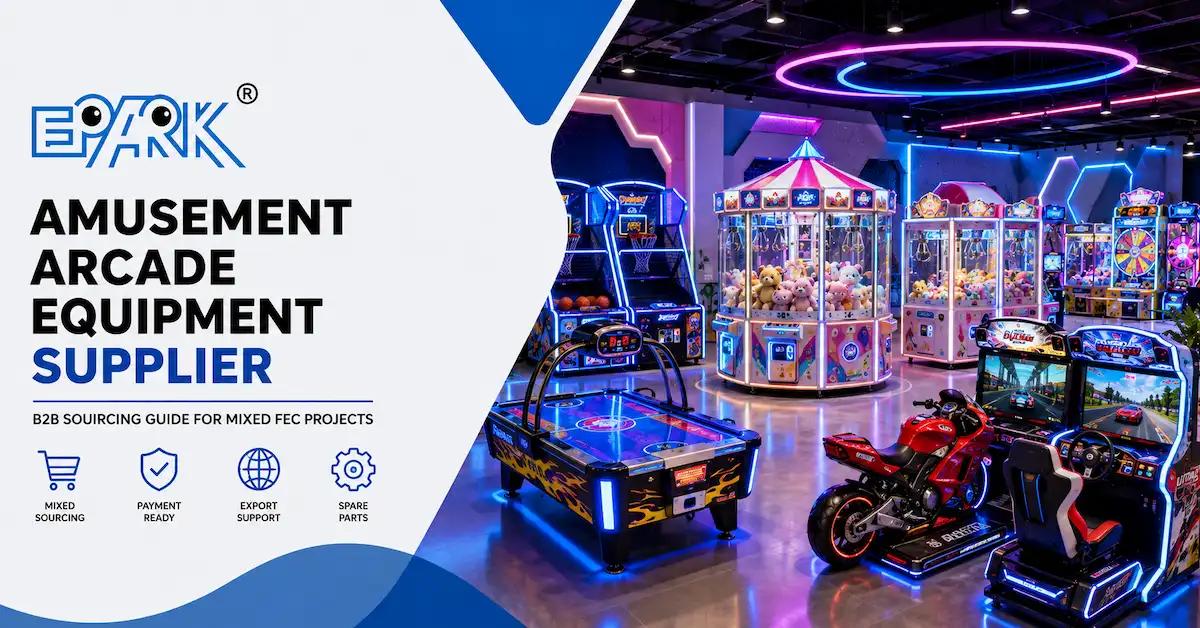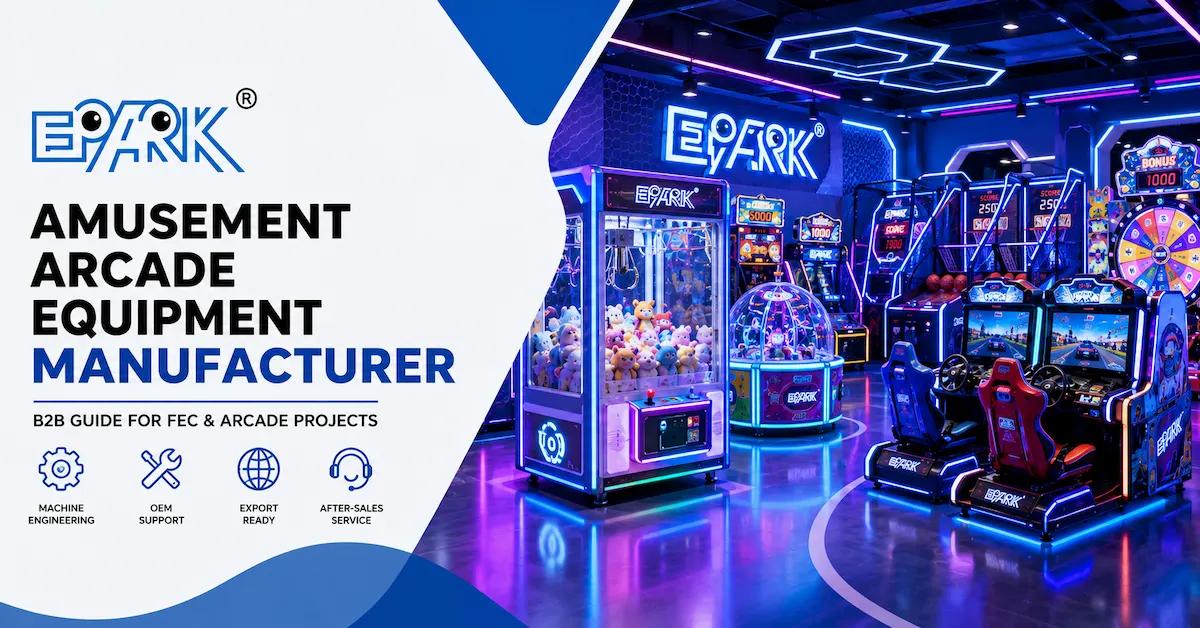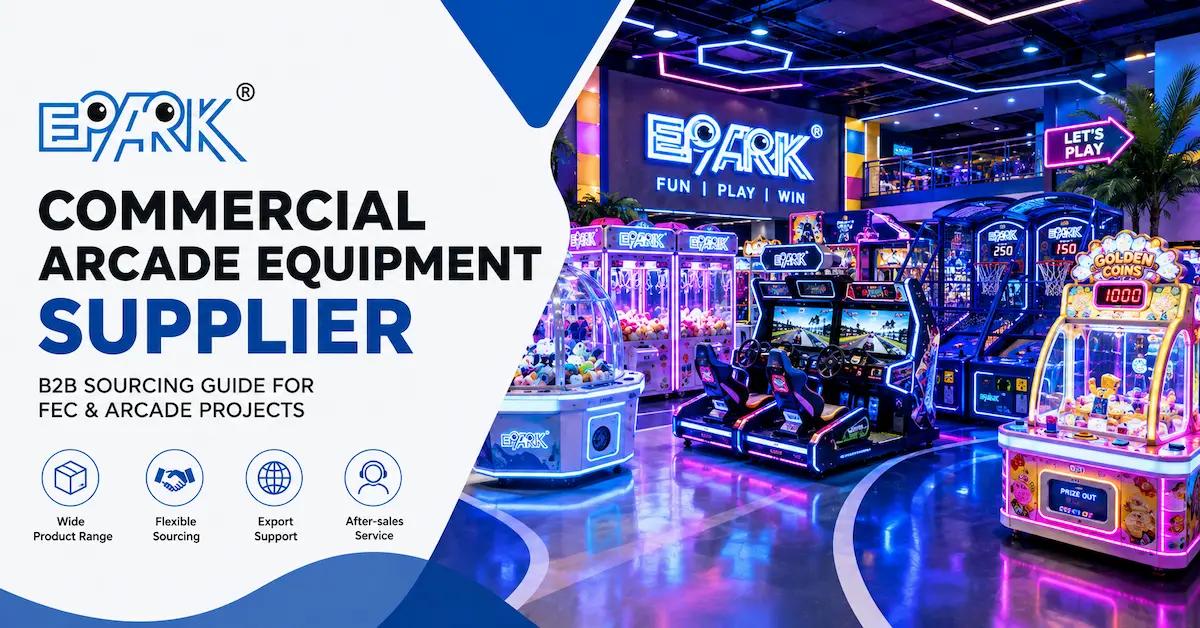
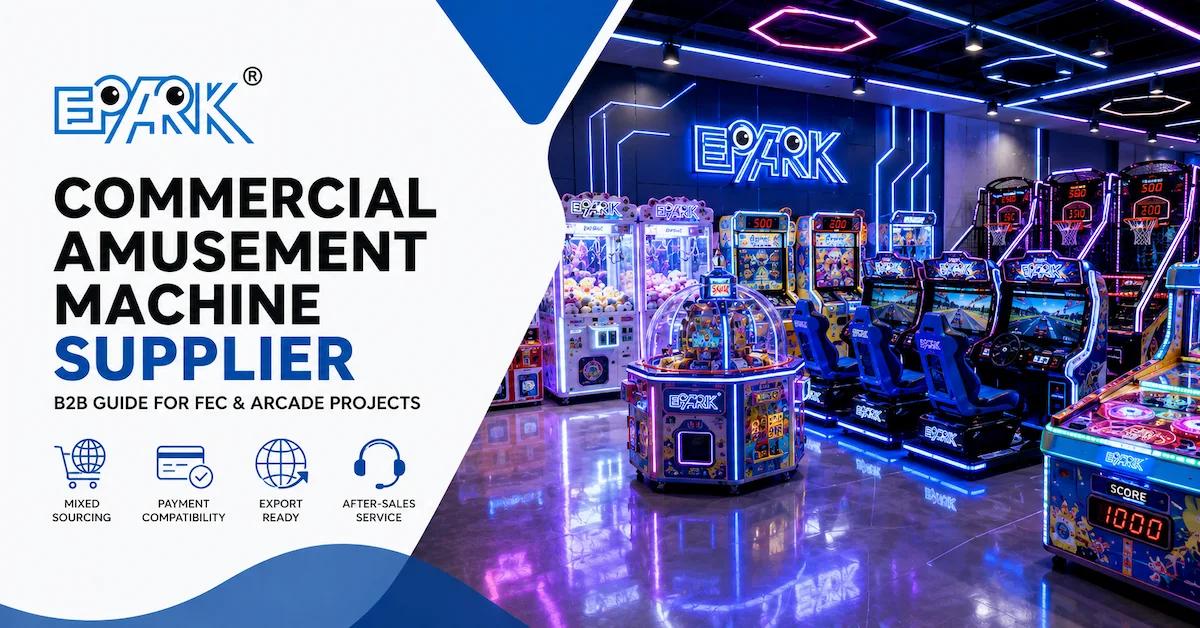
What Should a Commercial Amusement Machine Supplier Provide?
A professional commercial amusement machine supplier should help B2B buyers build a usable equipment portfolio rather than simply provide a long product catalog.
FEC operators, arcade chains, shopping mall entertainment projects, importers, and distributors normally need support across several purchasing stages:
- Equipment selection
- Technical configuration
- Payment-system compatibility
- OEM requirements
- Quality verification
- Spare-parts planning
- Export packing
- Shipping coordination
- Repeat orders
- After-sales support
EPARK currently describes its business as covering arcade machines, game machines, indoor playground equipment, trampoline parks, and children's amusement facilities, with one-stop solutions for indoor entertainment venues. Buyers can review the EPARK company profile and product solutions when assessing project compatibility.
The real sourcing question is therefore:
Can this supplier provide the right equipment repeatedly, in the correct configuration, with practical support after delivery?
Start With the Venue and Revenue Model
Commercial amusement machines serve different purposes depending on where they are installed.
Family Entertainment Centers
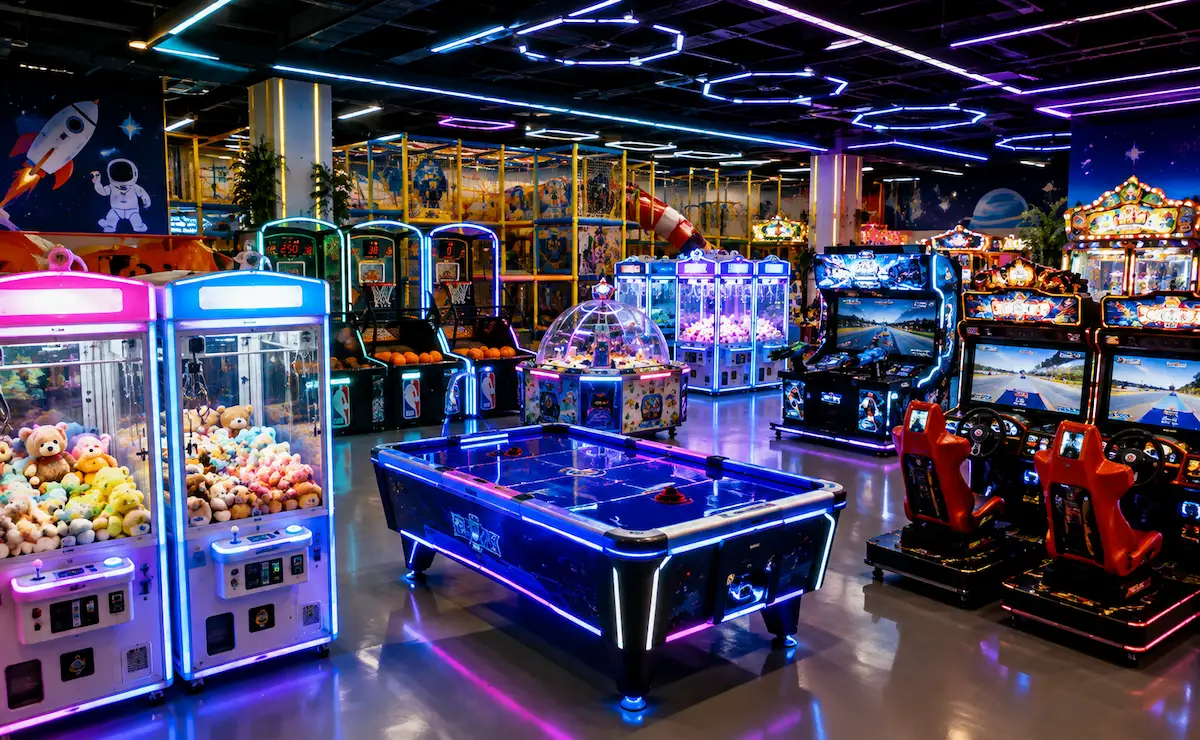
A full FEC may combine several machine categories to serve children, teenagers, adults, and family groups.
Common equipment directions include:
- Redemption games
- Claw and prize machines
- Racing simulators
- Basketball games
- Shooting games
- Air hockey
- Kiddie rides
- Interactive games
EPARK's existing FEC guidance similarly treats commercial game machines as revenue-generating assets whose value depends on customer age, payment systems, floor efficiency, maintenance, and long-term operating support.
Shopping Mall Entertainment Zones
Mall projects usually need machines that are visually attractive but also practical for high-frequency use.
Important considerations include:
- Footprint
- Customer flow
- Visibility
- Age range
- Maintenance access
- Noise
- Payment method
- Repeat-play potential
EPARK's shopping mall FEC guidance recommends evaluating machine types according to venue size, target visitors, budget, and commercial goals rather than selecting attractions only by appearance.
Distributors and Arcade Chains
For these buyers, first-order performance is only one part of the decision.
They also need to know:
- Can the same model be reordered?
- Can specifications remain consistent?
- Will replacement parts still be available?
- Can OEM artwork be reproduced?
- Can multiple machines use common components?
- Can orders be consolidated efficiently?
That makes supplier continuity a major part of B2B procurement.
Choose an Equipment Portfolio, Not Random Machines
A strong supplier should help buyers organize machines by their commercial role.
| Machine Category | Commercial Role | Main Purchasing Concern |
|---|---|---|
| Claw machines | Prize attraction | Mechanism, prize settings |
| Redemption games | Repeat play | Ticket/e-ticket compatibility |
| Racing simulators | Competitive play | Controls, seats, displays |
| Basketball games | Active entertainment | Sensors, frame durability |
| Air hockey | Group/social play | Table construction, serviceability |
| Kiddie rides | Younger-child attraction | Footprint, simple operation |
| Shooting games | Skill competition | Sensor calibration |
| Interactive machines | Digital engagement | Software and technical support |
A good portfolio normally mixes different reasons to play:
reward + competition + skill + physical activity + family interaction.
This creates more variety than filling the floor with machines that look different but provide nearly identical experiences.
Ask the Supplier to Build Recommendations Around Your Floor Plan
A generic catalog recommendation cannot account for actual venue constraints.
Provide the supplier with:
- Floor plan
- Usable area
- Entry and exit positions
- Target age groups
- Expected customer flow
- Preferred equipment categories
- Budget
- Existing attractions
A qualified supplier can then recommend which machines belong near:
- Entrances
- Prize counters
- Party rooms
- Parent waiting zones
- Main arcade corridors
- Indoor playground exits
For mixed shopping mall and FEC projects, buyers can also review EPARK's guide to game machines for shopping mall FEC projects.
Standardize Technical Specifications Across the Order
One of the biggest advantages of professional B2B sourcing is reducing unnecessary variation.
If 30 machines use different:
- Voltage settings
- Plugs
- Coin mechanisms
- Card readers
- Locks
- Power supplies
- Credit settings
maintenance becomes more complicated.
Create a Project Specification Sheet
Before confirming an order, define:
- Voltage
- Frequency
- Plug
- Payment method
- Language
- Credit value
- Ticket system
- OEM artwork
- Spare-parts requirements
The supplier should confirm these requirements model by model.
This becomes particularly important for chain operators planning multiple locations.
Payment System Compatibility Should Be Confirmed Early
Commercial amusement venues increasingly use centralized payment and redemption systems.
Depending on the project, machines may operate with:
- Coins
- Tokens
- Bill acceptors
- Rechargeable cards
- RFID cards
- Stored-value systems
- Paper tickets
- E-ticket redemption
Before ordering, ask:
Can One Payment Platform Work Across the Portfolio?
Verify whether:
- Card readers physically fit each cabinet
- Credit-input signals are compatible
- Redemption machines can send ticket information
- Credit settings can be standardized
- Wiring interfaces are documented
Resolving these issues before shipment is far easier than modifying dozens of machines after installation.
Verify Electrical Configuration for the Destination Market
International orders should clearly identify destination-country electrical requirements.
IEC currently publishes IEC 60335-2-82:2024, which addresses safety requirements for electric commercial amusement machines and includes equipment such as gaming machines, driving simulators, kiddie rides, bowling machines, laser shooting equipment, pinball machines, and video games. The standard covers rated voltages up to 250 V for single-phase appliances and 480 V for other appliances. View the official IEC 60335-2-82 information.
This does not mean every commercial amusement machine automatically complies with IEC 60335-2-82.
Buyers should verify the actual model, electrical configuration, destination market, and applicable local requirements before shipment.
Do Not Accept Generic Compliance Claims
European buyers should also check whether documentation applies to the exact machine being supplied.
Official EU guidance states that CE marking only applies where specific EU legislation requires it. Manufacturers are responsible for identifying applicable requirements, completing conformity assessment, preparing technical documentation, and affixing CE marking where required. Review official EU CE marking guidance.
Instead of asking only:
“Does this machine have CE?”
ask:
- Which requirements apply?
- Which documentation corresponds to this model?
- Does it match our ordered voltage?
- Does payment-system customization change the configuration?
- Which documents will ship with the equipment?
This makes supplier evaluation more specific and reduces documentation risk.
Spare Parts Are Part of the Original Purchase
A commercial machine supplier should help buyers think about maintenance before equipment arrives.
Potential spare parts include:
- Buttons
- Joysticks
- Sensors
- Power supplies
- Locks
- Coin mechanisms
- Ticket dispensers
- Cables
- Lighting modules
- Payment interfaces
Divide Spare Parts Into Three Groups
Routine Service Parts
Components that may experience normal wear.
Model-Specific Parts
Parts that are difficult to source locally.
Downtime-Critical Parts
Components that can prevent the machine from operating completely.
A useful supplier should recommend spare parts based on the actual machines ordered rather than offering the same generic accessory package for every project.
EPARK's current FAQ covers project cooperation, customization, shipping, installation, pricing, and support questions relevant to international amusement equipment buyers. View the EPARK FAQ.
Evaluate Repeat-Order Consistency
For distributors and multi-location operators, this is one of the most important supplier questions.
Imagine that the first FEC uses 20 machines.
Twelve months later, the buyer wants to build location two using the same concept.
Ask whether the supplier can reproduce:
- Cabinet appearance
- Artwork
- Control configuration
- Payment setup
- Electrical configuration
- Spare-parts compatibility
Ask How Component Changes Are Managed
Electronic components can change over time.
A professional supplier should communicate significant substitutions rather than silently changing components that affect maintenance or compatibility.
This is especially important for:
- Franchise operators
- Chain FECs
- Distributors
- Private-label buyers
OEM Customization Should Support Brand Consistency
OEM sourcing can include more than placing a logo on the cabinet.
Visual Customization
Possible options include:
- Logo
- Cabinet graphics
- Color scheme
- Venue branding
- Packaging
Operational Customization
Depending on the machine:
- Language
- Credit settings
- Payment interface
- Difficulty
- Prize parameters
- Ticket settings
For a multi-machine project, all approved customization should follow a common specification.
Otherwise, machines may arrive with inconsistent colors, logos, languages, and payment configurations.
Compare Supplier Service, Not Only Unit Price
The lowest quotation does not automatically produce the lowest total procurement cost.
B2B buyers should consider:
Machine cost + spare parts + customization + freight + import cost + maintenance + downtime + future replacement
Compare suppliers using questions such as:
| Evaluation Area | Buyer Question |
| Product range | Can the supplier support our required categories? |
| Specification control | Can configurations be standardized? |
| Spare parts | Are replacement parts available long term? |
| Payment compatibility | Can our system work across all machines? |
| OEM | Can branding remain consistent? |
| Logistics | Can different machines ship together? |
| Repeat orders | Can the same specification be reproduced? |
| After-sales | Who handles technical issues? |
EPARK's current content on choosing a China game-machine supplier also highlights quality, export support, spare parts, and long-term cooperation as key issues for international B2B buyers.
Plan Consolidated Packing and International Shipping
Mixed orders can create logistics complexity.
Ask for:
- Machine dimensions
- Packed dimensions
- Gross weight
- Packing type
- Container quantity estimate
- Accessory list
- Spare-parts identification
- Machine labels
- Packing photos
A clear packing list helps technicians identify equipment and accessories when the shipment reaches the project site.
For buyers purchasing multiple entertainment categories, supplier coordination can also reduce communication between different vendors.
Commercial Amusement Machine Supplier vs Manufacturer
These keywords represent different buyer tasks.
| Supplier-Focused Search | Manufacturer-Focused Search |
| Product portfolio | Machine engineering |
| Mixed equipment sourcing | Production capability |
| Logistics consolidation | Manufacturing consistency |
| Payment compatibility | QC processes |
| Spare-parts coordination | Component engineering |
| Repeat supply | Production repeatability |
A buyer searching for a commercial amusement machine supplier is often trying to create a reliable sourcing channel for several products or projects.
A buyer searching for a commercial amusement machine manufacturer is more likely to evaluate direct production and engineering capability.
EPARK already publishes separate guidance around commercial arcade equipment supplier selection, which can help buyers compare the sourcing side of commercial arcade projects.
What Information Should You Send With an RFQ?
A useful RFQ should contain enough information for the supplier to make a project-specific recommendation.
Include:
- Venue type
- Floor plan
- Customer age range
- Machine categories
- Approximate quantity
- Budget
- Destination country
- Voltage and frequency
- Plug type
- Payment system
- Redemption system
- OEM requirements
- Spare-parts requirements
- Target opening date
- Shipping destination
Avoid requesting only:
“Send catalog and best price.”
More project information usually produces a more useful equipment proposal.
Buyers can submit defined project requirements through the EPARK contact page after reviewing the EPARK products and current sourcing information.
FAQ
What is a commercial amusement machine supplier?
A commercial amusement machine supplier provides equipment intended for commercial entertainment venues such as FECs, arcades, shopping malls, indoor playgrounds, and family entertainment businesses.
What types of commercial amusement machines can suppliers provide?
Product ranges may include prize machines, redemption games, racing simulators, shooting machines, basketball games, air hockey, kiddie rides, interactive games, and other commercial entertainment equipment.
How should I choose a commercial amusement machine supplier?
Evaluate product range, technical specifications, payment compatibility, quality control, spare parts, OEM support, export capability, logistics, reorder consistency, and after-sales communication.
Can different amusement machines use the same card system?
Often they can, but compatibility should be confirmed for each machine before production. Physical installation, wiring interfaces, credit signals, and redemption settings may differ.
Can amusement machines be customized?
Depending on the product and order quantity, customization may include logos, cabinet artwork, colors, languages, credit settings, payment systems, electrical configuration, and packaging.
Should I order spare parts with my machines?
For commercial projects, planning routine, model-specific, and downtime-critical spare parts before shipment can reduce future operational disruption.
Why is repeat-order consistency important?
Distributors and chain operators may need identical or compatible equipment for future locations. Consistent specifications simplify maintenance, branding, training, and spare-parts management.
Is a supplier better than a manufacturer for mixed orders?
A supplier can be advantageous when buyers require multiple machine categories, consolidated sourcing, and shipment coordination. A direct manufacturer may be preferred when deep product engineering or high-volume production of one model is the priority.
What should I include in a commercial amusement machine RFQ?
Provide venue type, floor plan, quantity, equipment categories, destination market, electrical specifications, payment system, OEM requirements, spare parts, budget, and project schedule.
How can I request an EPARK equipment proposal?
Review EPARK products, then send your floor plan, equipment requirements, destination country, payment system, quantity, and opening schedule through Contact EPARK.
Conclusion
Choosing a commercial amusement machine supplier is ultimately about creating a dependable long-term sourcing system.
FEC operators, distributors, shopping mall projects, arcade chains, and importers should evaluate more than machine appearance and factory price. Product portfolio, configuration control, payment compatibility, electrical requirements, spare-parts planning, OEM consistency, logistics, repeat-order capability, and after-sales support all affect the commercial value of the purchase.
The strongest supplier relationship is one that reduces complexity from the first quotation through future expansion.
For a project-specific discussion, explore EPARK's product solutions, learn more about EPARK, or contact EPARK with your machine categories, quantity, venue layout, destination market, and technical requirements.
General Disclaimer
All data on https://www.eparki.com is for general guidance only. As a leading indoor playground manufacturer and trampoline supplier, EPARK strives for accuracy but gives no express or implied warranty regarding completeness, performance or project fitness. Product specs, designs and results may vary with use and customer requirements. Buyers must verify technical details, compliance and suitability before purchase. EPARK OEM/ODM is not liable for any direct, indirect or consequential damages arising from site use. For custom solutions, contact our manufacturer and supplier team via the Contact page.
Intellectual Property
Text, images, videos, CAD files and software are Guangzhou EPARK Electronic Technology Co., Ltd. All rights reserved. No part may be copied, republished or used commercially without prior written permission. We will pursue legal action for copyright or design-patent infringement.
Trademarks
"EPARK", the EPARK logo and related graphics are registered trademarks of Guangzhou EPARK Electronic Technology Co., Ltd. Unauthorized use in ads, domain names or packaging is prohibited.
Governing Law
These terms are governed by the laws of the People's Republic of China.
Contact
Questions? Email sales@nanyuetech.com or WhatsApp +86 139 0307 9263.