A Bulk Order Should Begin With a Locked Commercial Plan
A commercial arcade equipment bulk order is not simply a larger version of buying one or two machines. Once an order contains multiple models, payment configurations, electrical versions, artwork files, spare parts and shipping packages, every unresolved detail can be multiplied across the batch. For an FEC operator, the equipment must work together inside one venue; for a distributor, the same machines may need to be sold, serviced and reordered months later; for an importer, the purchasing decision also affects packing volume, freight planning and destination handling. EPARK’s commercial arcade wholesale guide describes a wholesale purchasing chain that connects product mix, specifications, quantities, QC, spare parts, logistics and repeat supply rather than treating quantity discount as the only objective. Before asking a supplier to start production, convert the project from a catalog selection into a controlled order with identifiable models, approved configurations and clear responsibilities.
Decide Whether the Order Is for One Venue, Multiple Locations or Distribution Stock
The same machine list can create very different risks depending on the buyer. A new FEC may need a balanced mix of prize, racing, sports and redemption equipment so several play experiences fit within one floor plan. A chain operator may care more about standardizing payment systems, controls and spare parts across locations. A regional distributor may deliberately purchase a broader range but needs products that can be demonstrated, stocked and supported locally. Importers also need accurate packed dimensions and shipment information because freight efficiency affects the landed cost of the entire batch. EPARK’s existing wholesale commercial arcade equipment guide similarly separates venue requirements from distributor requirements. Define the commercial purpose first, because “30 arcade machines” is not yet a purchasing strategy until you know where they will be installed, who will maintain them and whether the same configuration will need to be reordered.
Build the Machine Mix Before Negotiating the Final Quantity
A commercial arcade equipment bulk order should contain machines with defined roles rather than a random collection chosen from the most visually attractive products. Start by dividing the intended venue or inventory into functional groups such as prize play, redemption, racing, sports, video games or other interactive attractions. Then ask whether several selected machines are competing for the same visitor, floor area or operating budget. A distributor can apply the same logic to its portfolio by asking whether each category serves a distinct customer requirement. The table below is a purchasing framework rather than a fixed EPARK package; current models, dimensions and availability should be confirmed for the actual inquiry.
| Equipment group | Commercial role to evaluate | Bulk-order information to confirm | Typical planning risk |
|---|---|---|---|
| Prize and claw machines | Direct-prize attraction and repeat casual play | Prize format, payment setup, refill access and mechanism configuration | Ordering too many similar cabinets without a replenishment plan |
| Redemption games | Builds a reward-based game mix | Score logic,ticket/electronic reward system and payment interface | Machines arriving with inconsistent reward configurations |
| Racing machines | Competitive or immersive play zone | Number of stations, linking capability, seats, controls and packed dimensions | Underestimating floor area and shipping volume |
| Basketball and sports games | Active-play attraction | Player area, sensors, scoring, ball return and service access | Calculating only cabinet footprint |
| Video arcade cabinets | Screen-based game section | Display, controls,software scope and payment configuration | Similar cabinets hiding different internal hardware |
| Interactive or specialty equipment | Adds a differentiated attraction | Space, operator requirements, software and technical support | Selecting a complex attraction before support requirements are understood |
Create One Master Specification Before Production Is Released
The most useful control document for a commercial arcade equipment bulk order is a master specification that connects each quotation line to the exact machine configuration being purchased. EPARK’s arcade sourcing guide describes professional sourcing as a sequence from project requirements and RFQ through specification approval, sample/reference approval, production, QC, packing and shipment. Apply that sequence at model level.The master sheet should identify which information is approved, supplier-proposed, buyer-supplied or unresolved. Do not allow photographs, informal messages or an old quotation to become the only record of the production version.
| Specification item | What should be locked for the bulk order |
|---|---|
| Model identity | Product/model code, quantity and configuration revision |
| Installed dimensions | Length, width, height and required player/service space |
| Electrical setup | Voltage, frequency, plug and applicable power requirements |
| Payment configuration | Coin, token,card/cashless interface and credit settings |
| Controls | Steering, buttons, joysticks, pedals, guns, sensors or other interfaces |
| Display and audio | Approved screen and speaker configuration |
| Software | Supplied version, language and agreed game/content scope |
| Artwork | Logo, cabinet graphics, header artwork and label revision |
| Accessories | Keys, cables, manuals and machine-specific supplied items |
| Spare parts | Part references and quantity by machine/model |
| Packing | Package count, packed dimensions,gross weight and detachable sections |
| QC reference | Approved sample, drawing, photographs or configuration sheet |
Freeze Payment and Electrical Configurations by Destination Market
Bulk purchasing becomes difficult when buyers use the phrase “standard configuration” without defining the destination market. Voltage, frequency, plug and payment arrangements can vary between projects, and a distributor serving several regions may intentionally need more than one version. Record these variants before manufacturing and mark cartons or machine records so warehouse and installation teams can distinguish them. Payment deserves particular attention because a working game does not prove that a coin acceptor, token system or cashless reader has been correctly integrated. For mixed equipment, decide whether customer-facing credit logic should be standardized and then confirm whether each machine can support the intended setup. If several destination versions are included in one commercial arcade equipment bulk order, treat each configuration as a separate controlled variant rather than expecting production staff to infer the market from the shipping address.
Use a Reference Machine to Reduce Batch Variation
For machines or customized configurations that have not previously been purchased, establish an approved reference before full production wherever the project requires it. The reference may be an actual sample, a pre-production unit or another formally approved configuration record depending on the product and purchasing arrangement. Check cabinet appearance, controls, payment behavior, software settings, accessories and service access against the specification, then record the approved revision. EPARK’s bulk-order factory guide emphasizes that volume purchasing depends on repeatable quality control, production stability, spare-parts support and delivery management rather than simply producing more machines. The reference unit therefore becomes useful only when production inspectors know which characteristics must match it and which features are controlled by drawings or technical documentation instead.
Define QC by Machine Function, Not by One Generic Checklist
A racing simulator, claw machine and basketball game should not receive exactly the same functional inspection even when they share common checks such as appearance and electrical configuration. Create a common batch checklist for model identity, finish, accessories, payment and basic operation, then add machine-specific checks. Racing equipment may require steering, pedal and linking verification; prize equipment may require mechanism and reward-delivery checks; sports machines may require scoring sensors and ball-return checks. Decide which inspections are applied to every unit and which follow an agreed sampling plan. The supplier should also have a process for identifying nonconforming equipment and confirming corrective action. Avoid inventing a universal number of test cycles: the useful question is what function is being tested, under what conditions and against which acceptance criterion.
Do Not Treat Company Capacity as Guaranteed Capacity for Your Order
Production capacity is relevant, but buyers need to distinguish factory-level capability from an order-specific schedule. EPARK’s About Us page currently states that its manufacturing plant covers 25,000 square meters, with 400-plus machines and more than 100 workers. Those figures describe company-level manufacturing resources; they do not by themselves establish how much capacity is available for a specific arcade order during a particular production window. Ask which models are produced, assembled or coordinated within the proposed order, what components have longer preparation times and what approvals must be completed before production starts. For a mixed bulk order, also ask whether one delayed customized machine will hold the entire shipment or whether staged shipment is technically and commercially practical.
Separate Custom Artwork From Technical Changes
A logo change does not have the same risk as a payment-interface change, and a different cabinet graphic should not automatically trigger the same approval process as a new controller or display. Keep visual customization, hardware changes and software changes on separate revision records. EPARK’s customization process demonstrates a broader project workflow involving requirement confirmation, design and manufacturing coordination. For an arcade bulk order, translate this into model-specific control: approve artwork files and placement, but separately lock payment hardware, controls, electronics and software. If a functional change occurs after the reference unit has been approved, determine whether the affected tests need to be repeated. This prevents an apparently simple OEM request from becoming a hidden technical revision across dozens of machines.
Build the Spare-Parts Plan Before the Machines Leave the Factory
Spare parts should be planned from the approved machine list rather than added as a generic box at the end of the quotation. For each model, ask the supplier and your own service team which components should be considered for initial stock, which are model-specific and which can be shared across several machines. Payment modules, controls, sensors, locks, power-related parts and specialized mechanisms may all matter depending on the equipment. The purpose is not to purchase every possible replacement component, but to know how a failed part will be identified and sourced.In a commercial arcade equipment bulk order, part numbers or controlled references are more useful than descriptions such as “button,” “sensor” or “power supply.” For distributors and chains, connect each part to the corresponding machine revision so a component from an earlier batch is not assumed to fit a later configuration without confirmation.
Calculate Packing Volume Before Finalizing the Machine Mix
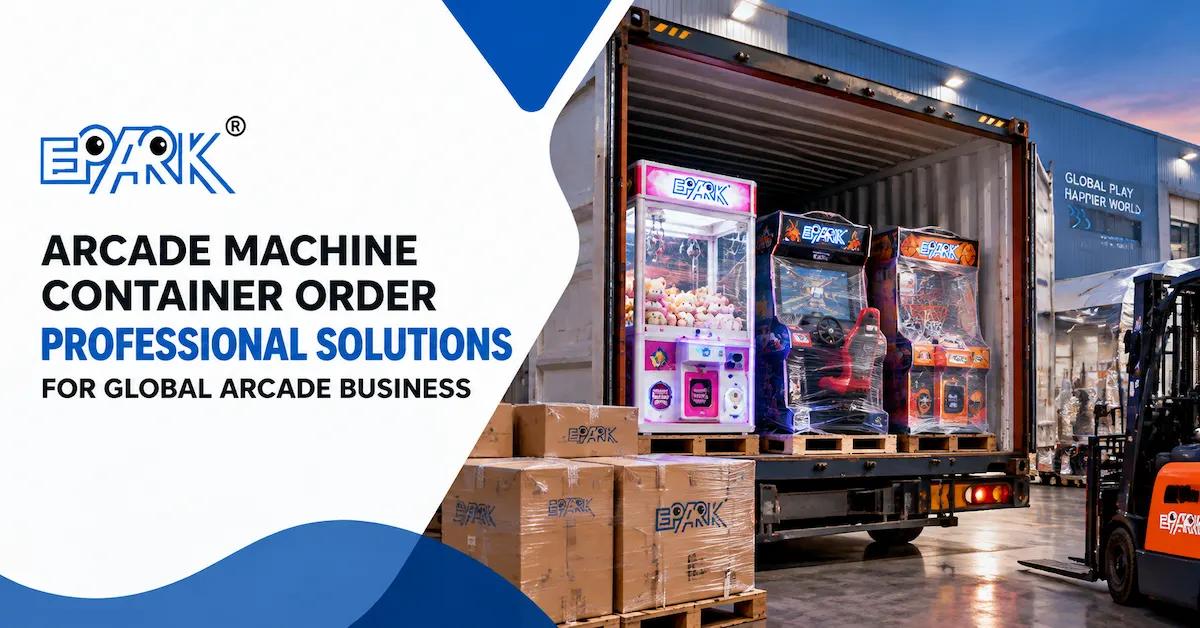
A machine mix that looks balanced on a venue plan may not be efficient to transport. Ask for packed dimensions, gross weight and package count by model before the shipment plan is finalized. Racing machines, large sports equipment and other complex units may use detachable sections, while compact cabinets may pack very differently. EPARK’s commercial arcade machine exporter guide describes overseas supply as involving configuration, testing, packing, spare parts and international delivery rather than shipment alone. Use actual packing data to discuss container or freight utilization with the appropriate logistics provider. Do not add unwanted machines simply to “fill the container” unless those units also have a commercial purpose.A slightly unused shipping volume may be less costly than carrying equipment your venue does not need or your distributor cannot sell.
Compare Bulk Quotes by Total Scope, Not by Unit Price
A large quantity can make even a small per-unit difference look important, but the comparison only works when the quotations describe equivalent machines. Normalize the specification first, then separate equipment price from customization, spare parts, packing, shipping terms and any separately priced service. One quotation may appear lower because it excludes payment hardware or spare parts that another supplier has included. Another may use a different screen, controller or cabinet configuration under a similar product name. For the purchasing team, an unresolved line item should remain visible rather than being entered as zero cost. The same principle applies to destination expenses: freight, duties, local delivery, installation and commissioning should be based on actual project information rather than assumed to be included in the factory price.
Plan the Opening Schedule Backward From the Required Arrival Date
Instead of asking only for “production lead time,” build a schedule around the stages that must happen before the venue opens or distributor stock is required.The sequence may include machine selection, final RFQ, technical approval, OEM artwork approval, reference-unit validation, component preparation, production, inspection, packing, international transport, destination handling, installation and commissioning. Some activities can overlap, while others cannot begin until the previous approval is complete. A commercial arcade equipment bulk order containing customized products should clearly state which event releases mass production. This makes delays easier to diagnose: an artwork revision, missing payment sample or late logistics booking is not the same as factory production delay. Keep buffer decisions in the project plan rather than relying on an optimistic single-date promise.
Create a Shipping Release Gate
Before a bulk shipment is released, review the order against one consolidated list: model and quantity, approved revision, electrical version, payment setup, artwork, accessories, spare parts, QC result, package count and required documents. Outstanding issues should be classified rather than hidden in general notes. For example, an optional spare part awaiting buyer confirmation should not have the same status as a failed payment test. The shipping release is also an appropriate point to check carton or crate identification against the equipment list so the receiving team can identify machines without opening every package. EPARK provides general Safety and Quality information, but the buyer should still define a specific acceptance and release process for the models being purchased rather than treating general quality statements as the complete inspection plan.
Protect the Second Order Before Finishing the First
The real test of bulk supply often comes months later when a distributor, chain or venue expansion project asks for the same machines again. Save the approved model code, configuration revision, payment hardware, voltage, plug, controls, software, artwork, accessories and spare-part references from the first order. When the next order is placed, attach that baseline and ask the supplier to identify proposed changes before production. EPARK’s wholesale guide specifically highlights repeat supply and reproducible configurations as important considerations for commercial buyers. This does not mean every component will remain available indefinitely; it means substitutions should become controlled purchasing decisions rather than unexpected differences discovered after delivery. For a growing distributor, configuration history can eventually become as valuable as the current catalog because it simplifies quotations, parts matching and customer support.
When a Bulk Order Is Better Than a Smaller Trial Purchase
Bulk purchasing makes more sense when the product or category has already been validated, specifications are stable, demand can justify the quantity and the buyer has a plan for deployment or resale. A smaller trial may be more sensible when a new game type has not been tested locally, payment integration remains uncertain, a custom cabinet is still being developed or the buyer does not yet know which machine mix fits the venue. This distinction protects working capital and prevents volume discounts from driving premature purchasing decisions. An order can also contain both mature and experimental products: confirmed core models may be purchased in larger quantities while newer attractions receive a smaller allocation. Treat quantity as an output of demand, technical confidence and logistics planning rather than an isolated negotiation target.
A Practical Bulk-Order Comparison Framework
For many buyers, the most useful comparison is not “Supplier A versus Supplier B” but “How ready is this proposed order for production?” The table below can be used internally before placing a large order.
| Bulk-order status | Characteristics | Main advantage | Main risk | Best next action |
|---|---|---|---|---|
| Concept list | Categories selected but models/configurations unresolved | Fast for initial budgeting | Price and logistics comparison are unreliable | Convert categories into identified models |
| Quoted order | Models and quantities priced but several technical details open | Allows commercial discussion | Important exclusions may remain hidden | Complete specification and responsibility review |
| Approved configuration | Models, technical versions, artwork and accessories confirmed | Suitable basis for production planning | Later changes can break consistency | Freeze revision and release production |
| Shipment-ready batch | QC completed,packing and documents checked | Clear basis for release | Unresolved defects can become destination problems | Close exceptions before shipment |
| Reorder baseline | First batch records retained and changes controlled | Supports consistent replenishment | Silent substitutions can undermine compatibility | Compare every reorder against the baseline |
What Should You Send EPARK for a Commercial Arcade Equipment Bulk Order?
A useful inquiry should contain more than a target budget and total machine quantity. Include your buyer type, destination country, venue type or distribution market, preferred machine categories, quantity by model if already known, usable floor plan for venue projects, voltage and frequency, plug requirements, payment method, branding or private-label requirements, spare-parts expectations, destination port or delivery location and target shipment or opening schedule.EPARK’s About Us page identifies Guangzhou EPARK Electronic Technology Co., Ltd. as a Guangzhou-based business established in 2012 with arcade machines and game machines among its wider indoor entertainment product scope. The company also states that its service chain includes product development, manufacturing, sales and after-sales support. Buyers should still request current model availability, configuration details and order-specific production terms rather than applying company-level information as a guarantee to an individual project. You can submit the project brief through EPARK Contact Us.
Frequently Asked Questions About Commercial Arcade Equipment Bulk Orders
1. What qualifies as a commercial arcade equipment bulk order?
There is no universal number of machines that turns an order into a bulk purchase.In practical B2B sourcing, it usually means an order containing repeated quantities or multiple commercial machines that requires coordinated pricing, production, QC, packing, spare parts and shipment planning rather than a single-unit transaction.
2. Is it better to order many units of one machine or a mixed arcade equipment order?
It depends on the business model. Distributors with proven demand may benefit from repeated configurations, while a new FEC normally needs several complementary game categories. Compare demand, floor space, maintenance capability and shipping implications before deciding.
3. Should I approve samples before ordering arcade machines in bulk?
For new, customized or unfamiliar configurations, an approved sample or clearly defined production reference can reduce uncertainty. Establish what must be checked and which document or physical unit becomes the batch reference before mass production is released.
4.What specifications should be confirmed before production?
Confirm model identity, dimensions, electrical configuration, payment system, controls, display, software scope, artwork, accessories, spare parts and packing requirements as applicable to the selected machines. Keep unresolved requirements visible instead of allowing production to interpret them.
5. Can different arcade machine categories be shipped together?
Mixed shipments may be possible, but buyers should confirm model quantities, packed dimensions, weights, package count and production schedules before making a final logistics plan. Use actual packing data rather than estimates based on assembled machine dimensions. (eparki.com)
6. How should I plan spare parts for a large order?
Build the parts list from the actual machine models and revisions. Ask which parts are commonly serviced, which are model-specific and what replenishment process applies. Keep purchased spare inventory separate from warranty-replacement arrangements.
7. How should I compare two bulk arcade equipment quotations?
First align the model and technical configuration. Then compare included hardware, OEM work, accessories, spare parts, packing, delivery terms, warranty scope and support. A lower unit price is not necessarily a lower project cost when important items are excluded.
8. Does a large order guarantee a shorter production time?
No. Actual timing depends on model mix, component availability, customization, current production allocation and approval status. Request an order-specific schedule and identify which approvals must be completed before production begins.
9. How can distributors reduce repeat-order differences?
Maintain an approved configuration baseline for each model and attach it to future purchase orders. Ask the supplier to disclose relevant component, software, artwork or hardware changes before a reorder is manufactured.
10.How do I request a commercial arcade equipment bulk order quotation from EPARK?
Prepare your machine list or venue brief, quantity, destination, electrical configuration, payment requirements, customization, spare-parts expectations and target schedule. Submit those details through the EPARK contact page so unresolved technical and commercial items can be identified before the final quotation.
Conclusion
A commercial arcade equipment bulk order should be treated as a controlled project rather than a larger shopping cart. The strongest purchasing process connects machine mix, technical specifications, payment configuration, approved references, QC, spare parts, packing and shipping to one identifiable order baseline. For FEC operators, this reduces the risk of receiving an unbalanced or difficult-to-install equipment mix; for distributors and arcade chains, it also makes future servicing and reorders easier to manage. Lock the important specifications before production, compare quotations on equivalent scope and keep the first batch records for future replenishment. Buyers planning a new venue, chain rollout or distribution order can contact EPARK with the machine categories, quantities, destination, payment setup, branding requirements and project schedule for order-specific evaluation.
General Disclaimer
All data on https://www.eparki.com is for general guidance only. As a leading indoor playground manufacturer and trampoline supplier, EPARK strives for accuracy but gives no express or implied warranty regarding completeness, performance or project fitness. Product specs, designs and results may vary with use and customer requirements. Buyers must verify technical details, compliance and suitability before purchase. EPARK OEM/ODM is not liable for any direct, indirect or consequential damages arising from site use. For custom solutions, contact our manufacturer and supplier team via the Contact page.
Intellectual Property
Text, images, videos, CAD files and software are Guangzhou EPARK Electronic Technology Co., Ltd. All rights reserved. No part may be copied, republished or used commercially without prior written permission. We will pursue legal action for copyright or design-patent infringement.
Trademarks
"EPARK", the EPARK logo and related graphics are registered trademarks of Guangzhou EPARK Electronic Technology Co., Ltd. Unauthorized use in ads, domain names or packaging is prohibited.
Governing Law
These terms are governed by the laws of the People's Republic of China.
Contact
Questions? Email sales@nanyuetech.com or WhatsApp +86 139 0307 9263.