Custom Branded Arcade Machines Should Create a Product System, Not Just a New Graphic
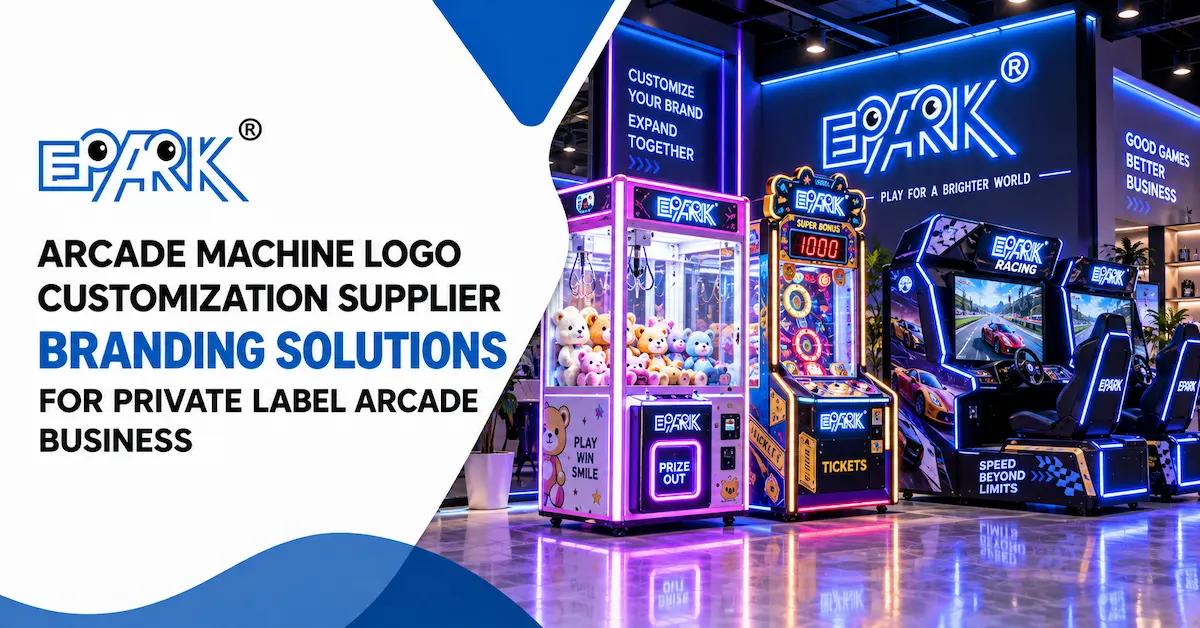
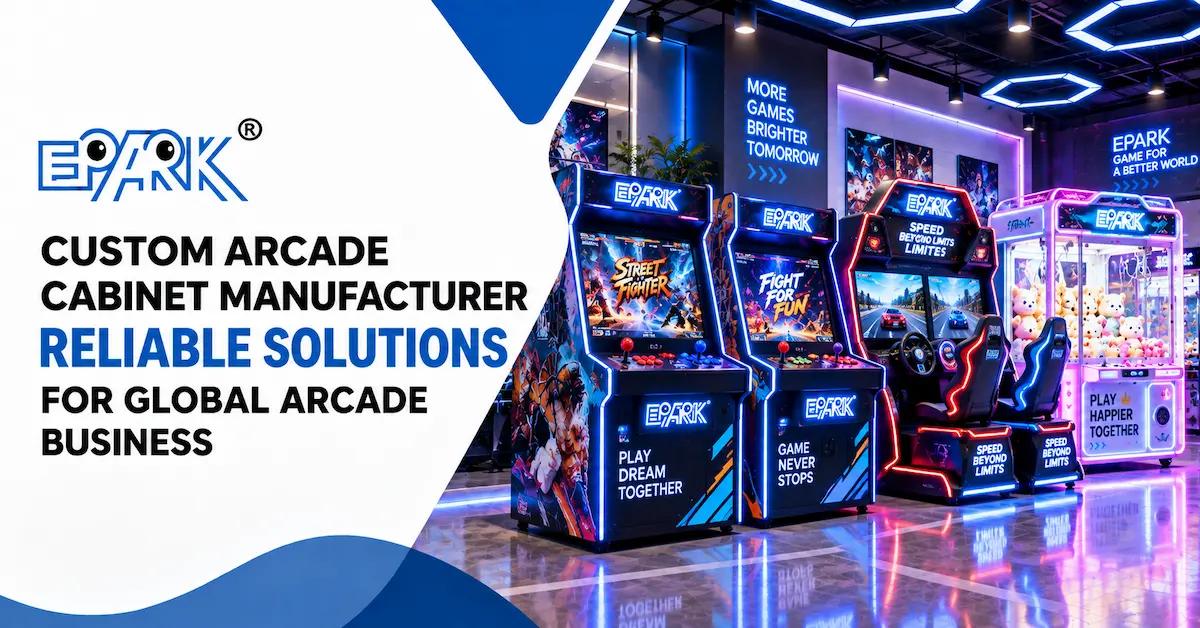
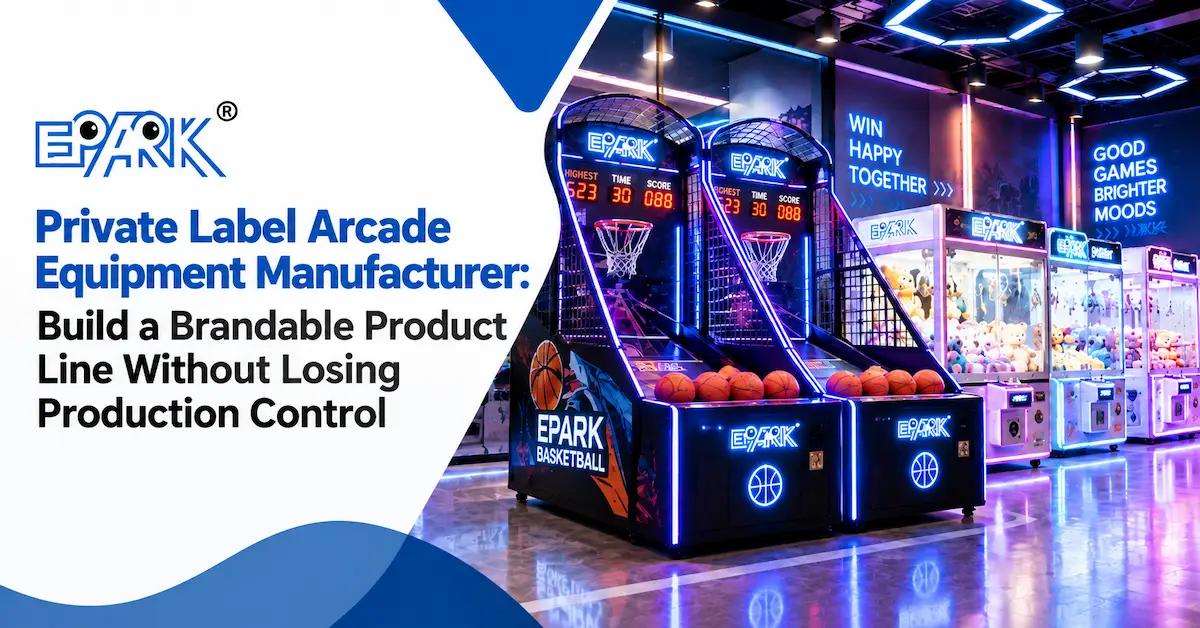
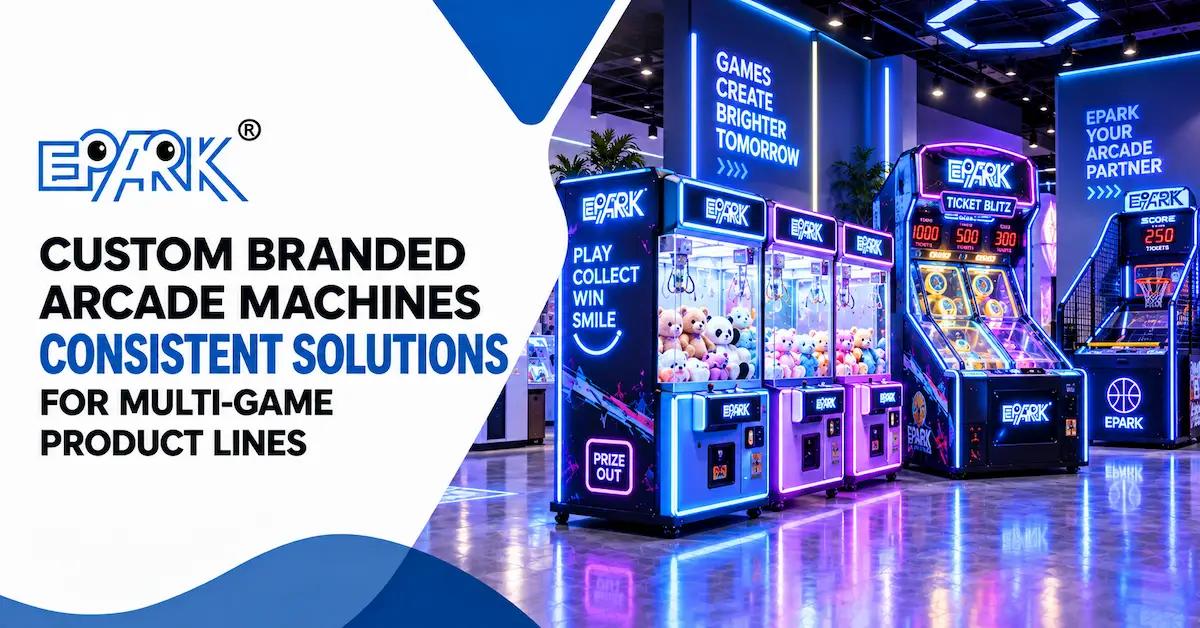
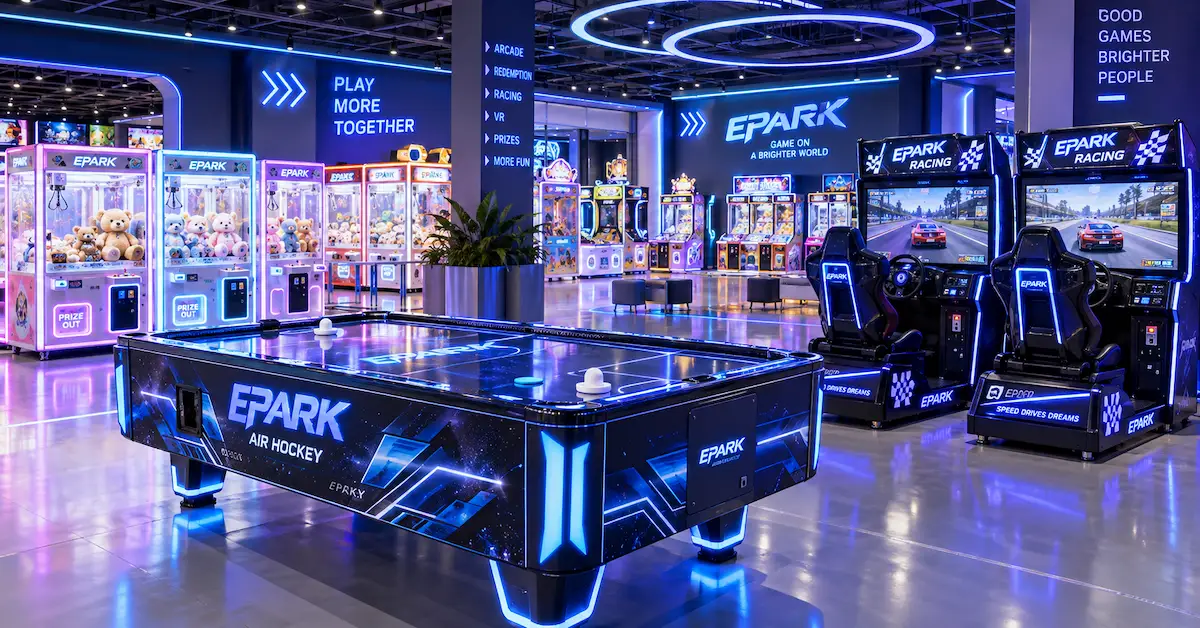
Custom branded arcade machines should give buyers more than a logo placed over an existing cabinet. For distributors, arcade chains and FEC brands, the stronger objective is to create a recognizable product system in which different game categories share a consistent visual identity while their technical configurations remain clearly documented. A racing simulator, claw machine, basketball game and redemption cabinet cannot use the same physical artwork template, but they can follow the same brand colors, logo rules, naming system, lighting direction and customer-facing language. EPARK’s private label game machine guide describes branded production around customized logos, designs, colors, functions, packaging and product positioning, while its OEM & Customization section connects branding with deeper arcade-machine configuration and production control.
The purchasing risk appears when visual consistency hides technical inconsistency. Two cabinets can look as though they belong to one branded product family while using different payment interfaces, software versions, controllers or replacement parts. The brand system and technical system therefore need to be controlled separately but linked through one product record.
Who Needs Custom Branded Arcade Machines?
This sourcing model is particularly relevant to arcade equipment distributors developing their own product line, FEC chains standardizing visual identity across several locations, franchise entertainment businesses, regional importers, mall entertainment operators and established amusement brands that want equipment to support a specific commercial identity. EPARK’s existing custom game machine guide for FEC brands discusses branded customization for premium arcades, FECs, indoor playground-related entertainment areas, resort projects and franchise operations.
A buyer still testing an unfamiliar machine category may not need extensive branding immediately. It is often more practical to validate the gameplay, customer response, maintenance requirements and payment configuration first, then convert a proven platform into a branded production model. Branding should strengthen a product that already makes commercial sense rather than justify an uncertain purchase.
Separate the Brand System From the Technical Configuration
One of the most useful controls for custom branded arcade machines is separating what customers see from what technicians need to identify. The brand layer contains the visual and customer-facing identity; the technical layer defines how the machine is built and operates.
| Control area | Brand-facing requirement | Technical requirement |
|---|---|---|
| Product identity | Branded product name and visual family | Manufacturer model and revision |
| Cabinet | Color and graphic direction | Dimensions, construction and mounting |
| Header/marquee | Logo, machine name and illumination | Mounting, power and replacement method |
| Controls | Branded control-panel appearance | Joystick, buttons, steering, sensors or other interfaces |
| Display | Branded screen surround/UI direction | Screen specification and mounting |
| Payment | Customer-facing payment instructions | Coin, token, card interface and credit logic |
| Software | Language and branded interface where applicable | Approved version and operating settings |
| Lighting | Brand color/effect direction | Lighting hardware, wiring and controller |
| Packaging | Logo, SKU and shipping identity | Package size, protection and accessory allocation |
| Service | Branded product name | Technical part and configuration references |
This separation allows the brand to remain consistent even when different categories require different engineering platforms.
Create a Brand Architecture Before Designing Individual Cabinets
If several machine categories will share one brand, establish the common brand rules first. This can include primary and secondary colors, logo placement principles, product naming, typography direction, illuminated-sign style, graphic density and customer-facing terminology. The goal is not to make every cabinet visually identical; it is to make buyers recognize that the machines belong to the same product family.
EPARK’s game machine OEM customization guide identifies cabinet colors, exterior artwork, branding, language, payment configuration and packaging among available customization directions.
For example, a branded claw machine may use large transparent display areas while a racing cabinet has a wide screen and cockpit. Their graphic layouts will differ, but logo size hierarchy, color palette, illuminated trim and product naming can remain consistent. This is more scalable than trying to reuse one artwork file across unrelated machine geometries.
Build a Model-Level Branding Specification
Each machine still needs its own production record. The table below can be used as an approval document for distributors and FEC brands.
| Specification area | What to record |
|---|---|
| Branded product name | Buyer-facing model name |
| Manufacturer identity | Original product/model reference |
| Technical revision | Approved hardware configuration |
| Artwork revision | Final production artwork file |
| Cabinet colors | Approved references |
| Logo placement | Position, size and orientation |
| Illuminated branding | Header, edge lighting or logo illumination |
| Controls | Approved hardware and visual treatment |
| Payment | Hardware, credit settings and customer instructions |
| Software | Version, language and branded interface where applicable |
| Electrical setup | Voltage, frequency and plug |
| Accessories | Keys, cables, manuals and supplied items |
| Spare parts | Parts linked to the approved revision |
| Packaging | Branded shipping marks and package artwork |
| Approval reference | Prototype/sample and QC record |
A branded model name should never replace the manufacturer’s technical model identity inside the purchasing and service system.
Start With a Proven Base Machine Where Possible
Brand differentiation does not require redesigning every technical element. When an existing arcade platform already provides the correct gameplay, control system, cabinet architecture and service access, visual branding and targeted market configuration can provide differentiation with less engineering risk.
EPARK’s custom arcade machine OEM guide distinguishes cosmetic customization from changes involving cabinet structure, hardware, payment and software.
A racing machine may only need branded side panels, illuminated headers, destination electrical configuration and payment integration. A claw machine may need brand colors, graphics, product naming and prize-zone instructions. Redesigning the steering system or crane mechanism without a clear commercial reason would add technical validation and future spare-parts complexity.
The useful question is not “How much can we customize?” but “Which changes improve the branded product and which changes only create additional engineering risk?”
Adapt the Brand System to Different Arcade Categories
Different machine categories need different visual strategies.
| Machine type | Brand opportunity | Technical detail that should remain visible to purchasing |
|---|---|---|
| Claw machine | Header, cabinet color, prize graphics and front-panel branding | Crane mechanism, sensors, payment and prize compatibility |
| Racing machine | Cockpit graphics, illuminated marquees and seat-area branding | Steering, pedals, screen, software and linking |
| Basketball game | Side graphics, score-zone branding and LED trim | Scoring sensors, ball return and controls |
| Redemption game | Cabinet graphics, reward messaging and themed artwork | Scoring, ticket/e-ticket output and payment |
| Shooting game | Theme artwork, gun-zone graphics and illuminated header | Guns, sensors, display and software |
| Family interactive game | Branded characters, color system and accessible instructions | Controls, applicable user restrictions and gameplay |
| Simulator | Premium branded environment and illuminated shell | Motion/VR hardware, software and service parts |
A coherent branded range does not require technical uniformity. It requires intentional visual consistency and transparent technical differences.
Check Hardware Fit Before Final Artwork Approval
Artwork often receives more attention because it is easy to review visually, but structural and component fit should be validated first. Confirm screen dimensions, control-panel openings, payment hardware, speakers, lighting and service-door locations before final graphics are released.
EPARK’s arcade cabinet manufacturer guide explains that cabinet production requires coordination between structure, electronics, controls, displays, wiring and user experience.
A branding concept may place a large logo exactly where a ventilation opening, access panel or card-reader mount needs to be located. Engineering and artwork should therefore use the same approved cabinet drawing rather than being developed independently.
Make Lighting Part of the Brand Without Making Service Harder
Lighting can give branded equipment a recognizable visual signature, especially in commercial arcades where cabinets compete for attention. Buyers may standardize a lighting color family, illuminated header treatment or edge-lighting direction across several machines.
However, lighting should still remain serviceable. Confirm how strips, controllers and power connections are accessed and whether replacement components can be identified. Avoid permanently integrating decorative lighting in a way that requires unrelated cabinet sections to be dismantled during replacement.
The brand benefit comes from consistent appearance; the operational value comes from being able to maintain that appearance throughout the machine’s commercial life.
Coordinate Payment Experience Across the Branded Product Family
A branded arcade range becomes easier for venue operators and customers to understand when payment instructions are consistent. If the venue uses cards, tokens or another approved method, consider standardizing customer-facing instructions and credit terminology where technically practical.
EPARK’s OEM content includes payment systems and credit settings among customization areas, and its broader game-machine customization content describes payment compatibility as part of FEC branding and project configuration.
Do not assume every machine supports identical hardware. Test each selected model using the intended transaction:
Payment accepted → credit registered → correct session starts → credit deducted → next transaction works normally.
For redemption equipment, extend the test through score and reward output. Branded customer instructions should only describe functions actually validated on that model.
Use Consistent Language Across Screens, Labels and Manuals
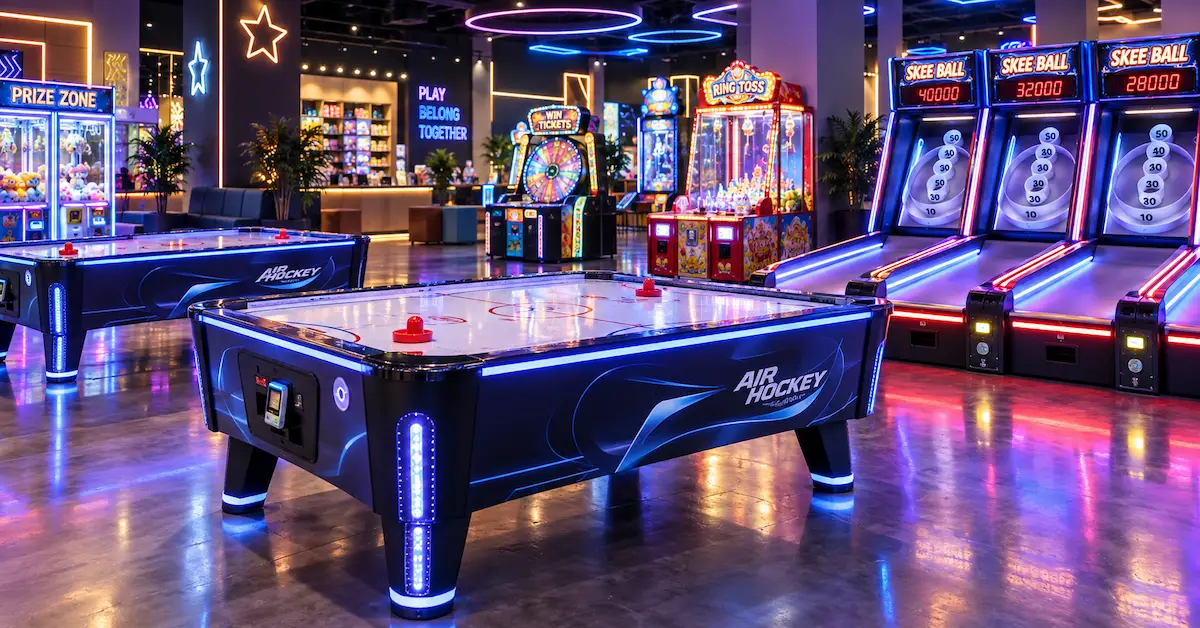
Brand inconsistency is not limited to colors. A product family can look professional but feel fragmented when one machine uses “START,” another uses “BEGIN GAME,” and packaging or manuals use a different product name.
Create one terminology guide for machine names, payment instructions, warnings, menu language and support references. Where software permits localization, verify the production version rather than only reviewing translated artwork.
Keep software version control separate from text approval because an updated language file may also accompany a changed software build.
Approve One Complete Branded Reference Machine
For meaningful customization, the sample should represent the complete branded configuration rather than only showing graphics.
A controlled sample should connect cabinet, controls, payment hardware, software, artwork, lighting, electrical version, accessories and packaging. If any of these change after review, update the revision instead of continuing to refer to an older sample photograph.
EPARK’s OEM manufacturing guidance presents prototype and sample approval as important steps before mass production, especially where custom design and function are involved.
This gives production and QC a concrete reference and gives the buyer evidence of what was actually approved.
Use Artwork Revision Control
Graphics can become surprisingly difficult to manage when one brand covers several machine categories. File names such as final.ai, final2.ai and latest-final.ai are not sufficient production control.
Use a simple version system that connects artwork to the machine:
Model BR-C01 / Cabinet Rev B / Artwork Rev 05
When the cabinet dimensions change, determine whether the artwork must be revised. When the graphics change but engineering does not, update only the artwork revision.
This prevents visual updates from accidentally changing the technical production reference.
Include Packaging in the Brand System
For distributors, branded packaging is both a marketing and inventory-control tool. Product name, SKU, machine reference, package number and destination information can help warehouse staff identify equipment before opening it.
EPARK’s private-label content includes packaging as one of the customization areas that buyers can discuss.
If one machine ships in several packages, identify relationships clearly, such as:
BR-R01 — Package 1/3
BR-R01 — Package 2/3
BR-R01 — Package 3/3
This is especially useful for branded machine lines where warehouse staff may know the distributor’s SKU but not the original supplier model.
Build QC Around Brand and Function
Quality control for custom branded arcade machines must check two different things: whether the machine works correctly and whether the buyer-specific branded configuration is correct.
| QC area | Check |
|---|---|
| Model identity | Correct branded SKU and technical revision |
| Cabinet | Approved dimensions, panels and finish |
| Artwork | Correct revision, logo and colors |
| Controls | Approved hardware fitted |
| Payment | Correct payment device and credit logic |
| Software | Approved version and language |
| Lighting | Correct branded lighting treatment |
| Electrical version | Correct destination configuration |
| Accessories | Correct keys, cables and manuals |
| Labels | Correct branded product and instruction labels |
| Packaging | Correct branding and package identification |
| Spare parts | Compatible with the approved technical revision |
The customer sees one brand, so a technical problem and a branding problem both become a brand-quality problem.
Do Not Assume Every Company Certificate Covers the Custom Machine
EPARK’s About Us identifies Guangzhou EPARK Electronic Technology Co., Ltd. as a Guangzhou-based manufacturer and exporter established in 2012 with arcade machines and game machines included in its broader indoor entertainment business.
Company background and published certificates can be useful during supplier evaluation, but buyers should still verify which report or certificate applies to the selected machine, component or customized configuration. A branded modification can sometimes leave the relevant technical scope unchanged, while a major electrical or hardware modification may require separate review.
Raise destination-market requirements during project definition rather than after branded production is complete.
Compare Custom Branded Arcade Machines With Other Sourcing Routes
| Sourcing route | Brand differentiation | Technical change | Development complexity | Best suited to |
|---|---|---|---|---|
| Standard machine | Low | Minimal | Low | Buyers prioritizing fast deployment |
| Logo-only branding | Basic | Minimal | Low | Small branded programs |
| Custom branded arcade machines | High | Low to moderate | Moderate | Distributors, FEC chains and branded product families |
| Configuration OEM | High | Moderate | Moderate to high | Market-specific technical requirements |
| Structural OEM | High | High | High | Unique cabinet or interface requirements |
| ODM development | Potentially highest | Extensive | Highest | New product concepts requiring deeper engineering |
Custom branded arcade machines are particularly useful when buyers want strong market differentiation without necessarily creating a completely new technical platform.
Separate Branding Costs From Engineering Costs
The commercial quotation should make clear what the buyer is paying for. Graphic design, branded cabinet finishes and packaging are different cost categories from new controls, screens, payment modules or structural work.
A practical cost framework is:
Base Machine + Branding Setup + Recurring Artwork/Finish Cost + Technical Changes + Prototype/Validation + Private-Label Packaging + Initial Spare Parts + Logistics
This is a purchasing framework rather than EPARK’s pricing formula. Project-specific prices and minimum quantities should be confirmed during quotation.
Separating costs makes future reorders easier because buyers can identify which first-order development work should not automatically be charged again.
Protect Intellectual Property and Brand Assets
A branded arcade product can contain several types of intellectual property: the buyer’s logo, manufacturer-supplied cabinet artwork, third-party characters, game content and software.
Define which party supplies each asset and what rights apply to its commercial use. Private labeling should not be interpreted as ownership of underlying third-party game software or characters.
Keep master brand files and production-ready cabinet artwork in your own controlled archive. If the relationship with the supplier changes later, the buyer should still know which assets belong to its brand and which belong to the underlying equipment platform.
Plan Spare Parts Under the Branded SKU
Customers buying your branded equipment may never know the original manufacturer’s internal model code. Your support system must therefore map the branded product back to the technical platform.
For example:
Brand SKU BG-R03 → Supplier Model R18 → Hardware Revision C → Payment Revision P2
This is an illustrative structure, not an EPARK numbering system.
When a customer requests a steering unit, sensor or controller, service staff can use the branded SKU to identify the correct underlying component. Without this mapping, successful branding can make after-sales service more difficult.
Preserve the Brand During Repeat Production
The second production batch determines whether a branded product line is truly scalable. Keep the approved cabinet, hardware, software, payment configuration, artwork, packaging and spare parts as the reorder baseline.
EPARK’s current private-label and OEM resources emphasize repeat production and long-term product cooperation as important parts of branded supply.
Ask the supplier to identify any proposed deviation before production. If a display, controller or other component changes, review whether the visual design, spare inventory, software or documentation is affected.
A machine should not be considered “the same branded product” simply because the exterior artwork remains unchanged.
Use Field Feedback to Improve the Branded Product Family
After deployment, collect evidence from sales staff, venue operators and technicians. Track recurring service questions, frequently replaced parts, customer comments on controls or instructions, payment issues and packaging feedback.
Use that information to improve the next revision deliberately. A clearer label or better service access may provide real value. Replacing a proven control system solely to make the product appear “new” may not.
This approach aligns with the E-E-A-T and user-value emphasis in your uploaded high-quality article checklist: useful content and product decisions should add real practical value rather than create artificial novelty.
What Should You Send EPARK for a Branded Arcade Project?
A productive project brief should contain the machine category or preferred base model, target market, customer type, venue type, first-order quantity, expected repeat volume, logo files, brand colors, design references, required payment system, electrical version, language, packaging requirements, spare-parts expectations and target schedule.
Buyers can begin with EPARK’s products page, review its OEM & Customization resources, study the private-label game machine guide, and then submit a defined project through EPARK Contact Us.
The more clearly the brand system and technical requirements are separated in the inquiry, the easier it becomes to determine which changes are simple production customization and which require engineering validation.
Frequently Asked Questions About Custom Branded Arcade Machines
1. What are custom branded arcade machines?
Custom branded arcade machines are commercial game machines configured with a buyer’s visual identity and agreed product specifications. Depending on the project, this can include logos, colors, cabinet artwork, labels, language, payment configuration, packaging and selected hardware changes.
2. Is custom branding the same as private labeling?
The terms overlap. Private labeling usually focuses on selling equipment under the buyer’s brand, while a custom branded project may also include broader visual, payment or configuration changes. The actual scope should be defined in the quotation.
3. Can different arcade machine categories use the same brand identity?
Yes. Racing, claw, sports and redemption machines can share logo rules, colors, naming and graphic style even though their cabinet shapes and technical platforms differ.
4. Should every branded machine use identical hardware?
No. Standardize components only when technically appropriate. Different machine categories require different controls and mechanisms, so consistent branding should not be confused with identical internal engineering.
5. Can I customize payment instructions and card-reader branding?
Payment-related branding and configuration can be discussed where supported. Confirm the actual reader/interface, credit logic and integration before publishing customer-facing payment instructions.
6. Do I need a sample before ordering branded arcade machines in bulk?
For significant branding or configuration work, an identifiable sample or controlled production reference can reduce risk by confirming artwork, hardware, payment and operating configuration before volume production.
7. How do I keep colors and graphics consistent between repeat orders?
Retain approved production artwork, color references and revision numbers. Attach them to the repeat order and require proposed changes to be identified before production.
8. What affects the price of custom branded arcade machines?
Pricing can be affected by the base machine, artwork, cabinet finishing, lighting, private-label packaging, payment configuration, hardware changes, quantity, prototype requirements and packing.
9. How should spare parts be managed for branded machines?
Connect each branded SKU to the underlying technical model and revision.Keep model-specific component references so after-sales staff can identify compatible parts even when customers only know the branded product name.
10. How can I request custom branded arcade machines from EPARK?
Prepare your preferred machine types, quantities, target market, logo, brand colors, artwork direction, payment configuration, electrical requirements, packaging and delivery schedule, then submit the brief through EPARK Contact Us.
Conclusion
Custom branded arcade machines work best when branding is treated as a controlled product system rather than a collection of decorative graphics. Define a consistent visual language across game categories, keep technical configurations documented at model level, validate hardware and payment before final artwork approval, and link every branded SKU to the underlying machine revision and spare parts. QC should verify both the machine and the brand, while repeat orders should reproduce approved artwork, packaging and operating configurations without silent technical drift. Distributors, FEC chains and entertainment brands can review EPARK’s OEM & Customization resources, private-label manufacturing guide and existing arcade product range, then contact EPARK with the machine mix, brand requirements, technical configuration and expected order volume for project-specific evaluation.
General Disclaimer
All data on https://www.eparki.com is for general guidance only. As a leading indoor playground manufacturer and trampoline supplier, EPARK strives for accuracy but gives no express or implied warranty regarding completeness, performance or project fitness. Product specs, designs and results may vary with use and customer requirements. Buyers must verify technical details, compliance and suitability before purchase. EPARK OEM/ODM is not liable for any direct, indirect or consequential damages arising from site use. For custom solutions, contact our manufacturer and supplier team via the Contact page.
Intellectual Property
Text, images, videos, CAD files and software are Guangzhou EPARK Electronic Technology Co., Ltd. All rights reserved. No part may be copied, republished or used commercially without prior written permission. We will pursue legal action for copyright or design-patent infringement.
Trademarks
"EPARK", the EPARK logo and related graphics are registered trademarks of Guangzhou EPARK Electronic Technology Co., Ltd. Unauthorized use in ads, domain names or packaging is prohibited.
Governing Law
These terms are governed by the laws of the People's Republic of China.
Contact
Questions? Email sales@nanyuetech.com or WhatsApp +86 139 0307 9263.