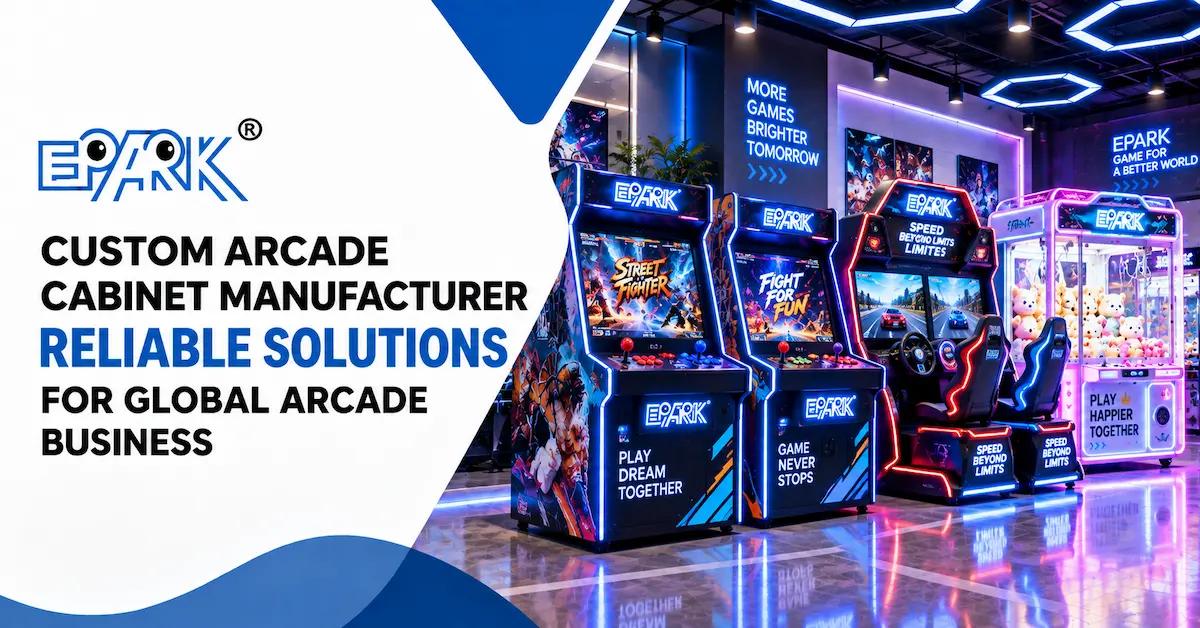
What Does a Custom Arcade Cabinet Manufacturer Actually Deliver?
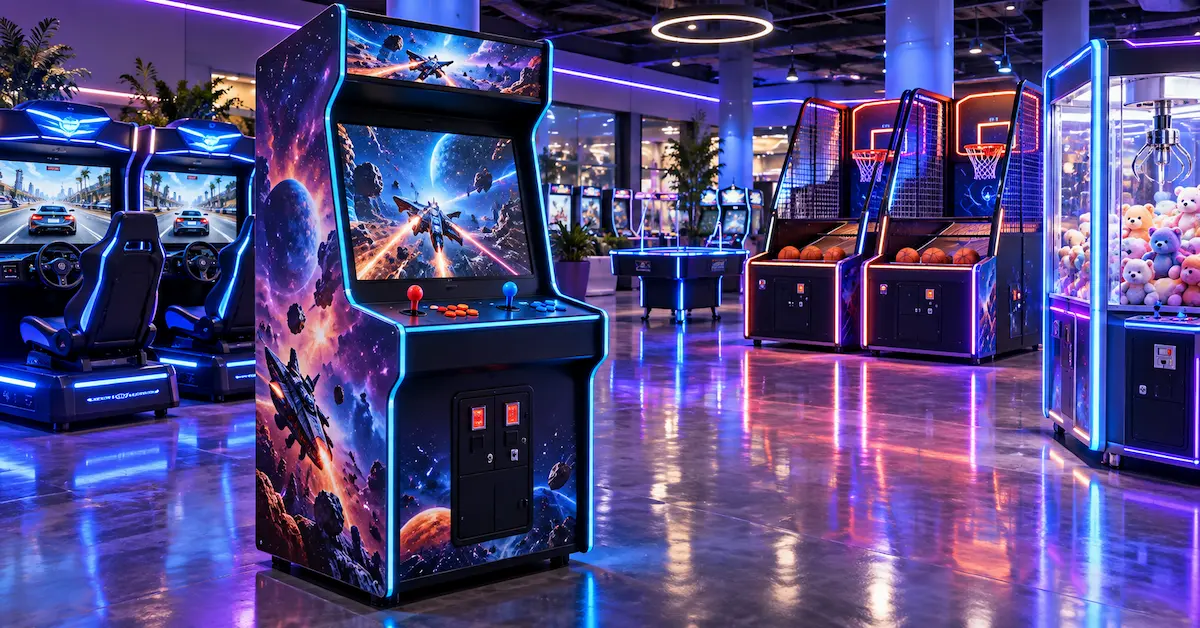
A custom arcade cabinet manufacturer should deliver more than a visually customized enclosure. The cabinet is the physical platform that determines how the screen, player controls, game electronics, payment hardware, lighting, audio, wiring and service panels fit together. For commercial buyers, cabinet design also affects floor space, transportation, installation, maintenance and future replacement parts. This is why buyers reviewing EPARK’s arcade equipment range should first decide whether an existing platform already meets the technical requirement or whether a genuinely custom cabinet is justified.
The strongest custom cabinet project starts with a functional problem: perhaps the existing screen position is unsuitable, the payment reader cannot be integrated cleanly, the cabinet does not fit the target venue, or a distributor needs a distinctive private-label product family. Customization should solve one of those problems rather than simply add engineering work for its own sake.
Who Should Use Custom Arcade Cabinet Manufacturing?
Custom cabinet manufacturing is most relevant to arcade equipment distributors developing branded product lines, game developers integrating proprietary electronics, FEC chains standardizing equipment across locations, importers adapting machines to regional requirements, and entertainment brands that need a recognizable cabinet system. A buyer who only wants a different logo or color may not need a structural redesign; that project may be better handled as artwork or private-label customization.
Before developing a new enclosure, compare the requirement against EPARK’s existing products and broader customization process. If a standard platform already provides the correct player position, controls, display and internal space, changing only branding or payment configuration can reduce prototype time, service complexity and repeat-order risk.
Define Whether You Need a Cabinet Shell or a Complete Machine
One of the most important questions in a custom cabinet RFQ is the supply boundary. “Custom arcade cabinet” can mean an empty structural enclosure, an integration-ready cabinet or a fully assembled commercial game machine. These scopes should never be compared only by quoted unit price.
| Supply scope | Typical content | Buyer still needs to define | Main purchasing risk |
|---|---|---|---|
| Cabinet shell | Structure, panels and agreed finish | Display, controls, electronics and payment system | Assuming integration hardware is included |
| Integration-ready cabinet | Cabinet plus openings, mounts and selected brackets | Final electronics and software | Hardware does not fit the approved interfaces |
| Private-label cabinet | Existing platform plus branded graphics and selected changes | Final technical configuration | Visual consistency hides hardware differences |
| Complete arcade machine | Cabinet plus agreed electronics, controls and game system | Local installation and acceptance | Comparing complete-machine pricing with cabinet-only pricing |
A useful quotation should identify every included item instead of describing everything as “standard configuration.”
Build a Controlled Cabinet Requirement Sheet
A professional custom arcade cabinet manufacturer needs one controlled requirement document before engineering begins. This protects the project from a common problem: artwork comes from one email, payment requirements appear in another message, and dimensions are taken from an earlier quotation.
| Requirement area | What the buyer should define or confirm |
|---|---|
| Game/application | Racing, shooting, redemption, prize, upright or other |
| Overall dimensions | Length, width, height and installation footprint |
| Structural materials | Material type and relevant construction requirements |
| Reinforcement | High-load mounting and control areas |
| Display | Screen size, mounting pattern, angle and service method |
| Controls | Buttons, joystick, steering, pedals, guns or sensors |
| Internal electronics | Game board, controller and power-component locations |
| Payment | Coin, token, card or supported cashless interface |
| Audio | Speaker positions and access |
| Lighting | Header, edge or decorative illumination |
| Wiring | Cable routes, connectors and harness access |
| Service access | Doors, removable panels and maintenance clearances |
| Branding | Logo, colors, artwork and product labels |
| Electrical version | Voltage, frequency and plug |
| Packaging | Detachable sections, package quantity and handling |
| Production control | Model code, drawing revision and prototype reference |
Mark every requirement as buyer requirement, supplier proposal, approved or open. That simple status system helps prevent an early concept from becoming the final production specification by accident.
Choose the Cabinet Architecture Around the Actual Game
Different game types place different demands on the cabinet. A racing machine needs to integrate a seat, steering system, pedals and display around the player. A prize machine needs transparent product visibility, refill access and mechanism service space. A shooting cabinet must accommodate controllers, sensors and appropriate player distance. A redemption game may require ticket or electronic reward components.
| Cabinet type | Main structural issue | Hardware to verify | Service priority |
|---|---|---|---|
| Racing cabinet | Cockpit and player position | Steering, pedals, screen, seat | Control and electronics access |
| Upright cabinet | Compact footprint | Display, joystick, buttons, payment | Front/rear access |
| Shooting cabinet | Controller and player-distance layout | Guns, sensors, display | Sensor and cable access |
| Prize cabinet | Visibility and prize storage | Crane/mechanism, payment | Refill and mechanism access |
| Redemption cabinet | Scoring/reward integration | Sensors, ticket/e-ticket hardware | Dispenser and controller access |
The correct cabinet is therefore a result of the game architecture, not simply a visual style choice.
Evaluate Materials According to Function
Buyers often ask for the “best” material or a universal panel thickness. There is no reliable answer without knowing cabinet size, load, component weight, door openings and control mounting. A compact upright cabinet and a large racing cockpit should not automatically share the same structural specification.
Ask the manufacturer which panels are structural, which are decorative, where reinforcement is required and how frequently opened doors or removable sections are supported. “Heavy duty” and “premium material” are marketing descriptions, not measurable specifications. If material, finish or construction claims matter to your purchasing decision, request them in writing and connect them to the approved sample.
Verify Hardware Fit Before Final Artwork
A common custom cabinet mistake is spending too much time on graphics before the actual hardware interfaces are frozen. Finalize screen mounting, control openings, payment-reader position, speakers and internal component space before releasing production artwork.
A steering unit that is a few millimeters different at the mounting interface can create rework. A card reader can fit visually yet interfere with an internal bracket. A screen may fit inside the enclosure but leave insufficient access for later replacement.
For private-label or OEM projects, review the design using the real components whenever practical. Buyers interested in wider OEM development can also review EPARK’s customization process before sending the technical brief.
Control Player Position and Usability
Hardware fit alone does not prove that the cabinet is comfortable or commercially usable. For racing cabinets, review seat position, steering reach, pedal location and screen viewing angle. For upright games, confirm control height and display visibility. Shooting cabinets require appropriate controller positions and intended viewing distance.
Do not infer ergonomics from a render. The physical prototype is the point where the buyer should sit, reach, operate and service the machine. If the project has specific user restrictions or accessibility requirements, those should be discussed separately rather than assumed from cabinet appearance.
Design the Inside for Serviceability
The interior layout affects maintenance throughout the machine’s commercial life. Ask where the controller, power components, payment unit, speakers and wiring will be positioned and how technicians reach them.
Payment hardware should not require unrelated electronics to be removed during routine service. Common connectors should remain identifiable. Frequently replaced controls should have reasonable access. Wiring should avoid moving structures and door hinges. The custom cabinet should also leave enough space for technicians to identify components instead of turning every maintenance task into a disassembly project.
This is particularly important for distributors because service difficulty eventually becomes a cost carried by the local dealer rather than the cabinet factory.
Use Drawings and a Physical Prototype Together
Engineering drawings and prototypes perform different functions. Drawings control dimensions, hole locations and structural intent; prototypes show whether those decisions actually work with real hardware and real users.
A useful approval system might be:
Drawing Rev B → Prototype P1 → correction → Drawing Rev C → Prototype P2 → production approval
Do not keep calling both P1 and P2 “the approved sample.” Give each revision a traceable identity.
For a significant customization, use the physical sample to review cabinet fit, player interaction, access doors, control mounting, artwork, lighting and packing assumptions before mass production begins.
Separate Engineering Approval From Branding Approval
Custom cabinets often involve private-label artwork, colors, logos, marquees and illuminated trim. These visual approvals should remain separate from structural engineering approval.
For example:
Cabinet Rev C controls structure.
Artwork Rev 05 controls graphics.
Hardware Rev B controls components.
This makes future updates much easier. A new graphic does not automatically create a new engineering revision, while a changed screen bracket should not be hidden inside an artwork update.
Buyers can use EPARK’s OEM and customization workflow as an entry point for project discussion while retaining model-specific approval records internally.
Integrate Payment and Electrical Requirements Early
A cabinet opening for a card reader does not prove a working cashless integration. Likewise, a cabinet designed for one electrical market should not be assumed to work unchanged in another.
Confirm the final voltage, frequency, plug type and payment configuration by model. When the manufacturer provides a complete machine, test the actual customer transaction:
Payment recognized → credit created → game starts → credit deducted correctly → next transaction works
For redemption or prize equipment, include the relevant reward-output step where applicable.
This avoids discovering payment or electrical differences after branded production is already complete.
Build QC Around Critical-to-Fit Features
A custom cabinet inspection should look beyond scratches and graphics. The most expensive errors can be invisible until assembly: incorrect mounting holes, wrong brackets, misaligned doors or control openings that do not fit the approved hardware.
| QC area | Key question |
|---|---|
| Dimensions | Do critical dimensions match the approved drawing? |
| Mounting | Are display and control interfaces correctly positioned? |
| Doors/panels | Do they align and operate as approved? |
| Controls | Does the specified hardware fit correctly? |
| Payment | Is the correct interface installed or prepared? |
| Interior | Are components and wiring accessible? |
| Finish | Does the surface match the approved reference? |
| Artwork | Is the correct artwork revision used? |
| Lighting | Does the approved configuration operate correctly? |
| Packaging | Are detachable parts and accessories identified? |
EPARK provides broader Safety and Quality information, but the buyer should still define cabinet-specific inspection requirements because general quality statements do not replace model-level acceptance criteria.
Review Quality and Compliance Documents by Scope
A certificate or test document should be used only for the product, material or configuration it actually covers. Do not assume that every company-level quality document applies unchanged to a new custom cabinet.
If the destination market requires specific documentation, identify that requirement before the cabinet design is finalized. Structural, electrical or component changes may affect what needs to be reviewed. Buyers can use EPARK’s Safety and Quality page as background information, then request project-specific confirmation for the selected machine.
Compare Custom Cabinet Quotations on the Same Scope
Two custom cabinet quotes can differ significantly because one may cover only the enclosure while another includes displays, controls, wiring and payment hardware. Normalize the scope before comparing prices.
A useful internal calculation is:
Custom Cabinet Project Cost = Prototype/Development + Cabinet Production + Custom Hardware + Artwork/Finish + Packaging + Freight + Local Integration
This is a buyer planning formula, not an EPARK pricing formula.
Also separate one-time costs from recurring production costs. Prototype work or engineering development may apply primarily to the first project, while materials, artwork application and specialized hardware repeat on every batch.
Evaluate Lead Time by Project Stage
One headline lead time is less useful than a stage-based schedule. Ask when each milestone begins and which buyer approval releases the next step.
A practical sequence is:
Requirement confirmation → drawing → hardware fit review → artwork → prototype → correction → production approval → batch production → QC → packing → shipment
If the buyer changes the screen, controls or cabinet dimensions after prototype approval, the project schedule should be updated accordingly. The custom cabinet manufacturer should not be expected to absorb unlimited late-stage changes without affecting cost or timing.
Plan Export Packing During Cabinet Development
Large cabinets, racing cockpits and decorative headers can create substantial shipping volume. Ask whether sections are designed to be detached for export, how they are protected and how the destination team will identify matching assemblies.
Do not redesign a cabinet only to reduce shipping volume unless the resulting assembly and durability remain appropriate. Packing efficiency matters, but reassembly difficulty and transport damage also have commercial cost.
When requesting a quotation through EPARK Contact Us, include the destination and expected quantity so packing and logistics requirements can be considered alongside the cabinet design.
Protect Repeat Production With Revision Control
A successful first shipment does not prove that future batches will remain identical. Save the approved drawing, material specification, mounting layout, controls, artwork, payment configuration and packaging.
For the next order, use a simple instruction:
Manufacture against the attached approved revision and identify every proposed deviation before production.
If a display, controller or payment device is no longer available, ask what replacement is proposed and whether mounting, wiring or spare-parts compatibility changes.
For distributors, this repeatability is one of the strongest reasons to choose a capable custom arcade cabinet manufacturer rather than sourcing each batch as an unrelated transaction.
Custom Cabinet Manufacturer vs Standard Cabinet Supplier
| Purchasing route | Best suited to | Main benefit | Main risk |
|---|---|---|---|
| Standard cabinet | Existing platform already meets requirements | Faster sourcing | Limited differentiation |
| Branded standard cabinet | Private-label programs | Brand identity with lower technical complexity | Visual consistency can hide internal changes |
| Integration-ready custom cabinet | Game developers and technical distributors | Hardware interfaces tailored to buyer system | Interface mismatch |
| Full custom cabinet | Distinct structural or player-experience requirement | Greater differentiation | Higher development and validation burden |
| Complete custom arcade machine | Buyers wanting one integrated supply scope | Simplified final integration | More complex configuration control |
Choose the least complex route that still solves the commercial problem.
What Should You Send EPARK for a Custom Cabinet Project?
A useful RFQ should contain the machine type, cabinet concept, target dimensions, display size, controls, electronics, payment hardware, electrical requirements, service-access expectations, branding files, quantity, destination and target schedule.
If you already have drawings, identify which dimensions are fixed and which can be optimized. If you have a current cabinet with known problems, provide photos and describe the issue rather than simply asking for “a better design.”
Buyers can first review EPARK’s products, About Us, customization process and FAQs, then submit the project through Contact Us for model-specific evaluation.
Frequently Asked Questions About Custom Arcade Cabinet Manufacturing
1. What does a custom arcade cabinet manufacturer provide?
A custom arcade cabinet manufacturer develops or produces an arcade enclosure to an agreed specification. The project may include cabinet structure, screen and control interfaces, branding, internal component space, payment integration provisions and packaging.
2. Is a custom arcade cabinet the same as a complete arcade machine?
No. A cabinet can be supplied as an enclosure or integration platform, while a complete machine additionally includes agreed electronics, controls, payment hardware and game systems. Define the supply boundary before comparing prices.
3. Can cabinet dimensions be customized?
Yes, subject to engineering feasibility. Dimensional changes can affect screen position, controls, internal component space, player interaction, service access and packing, so they should be controlled through approved drawings.
4. Can I customize the control panel?
Control-panel layout can be evaluated around the actual buttons, joysticks, steering, sensors or other hardware. Supply the real component requirements before panel openings and mounting points are finalized.
5. Which material is best for an arcade cabinet?
There is no universal best specification. Material selection should reflect cabinet size, structural load, component mounting, surface finish and the intended commercial environment.
6. Should I approve a prototype before mass production?
A prototype is useful when the cabinet includes meaningful structural or integration changes. It allows the buyer to validate hardware fit, service access, player position, finish and branding before volume production.
7. Can the cabinet carry my private-label brand?
Branding can include logo, cabinet graphics, colors, labels and other visual elements depending on the project. Keep artwork revisions separate from engineering revisions so future production remains controlled.
8. How should a custom cabinet batch be inspected?
Inspect critical dimensions, mounting points, panel alignment, doors, control fit, finish, artwork and packing against the approved drawing and prototype. Add functional checks when the supply scope includes electronics or complete-machine assembly.
9. What affects custom arcade cabinet pricing?
Dimensions, structural complexity, materials, finish, lighting, hardware integration, prototype work, branding, quantity and export packing can all influence cost.
10. How can I request a custom cabinet quotation from EPARK?
Prepare your machine type, drawings or concept, dimensions, screen, controls, hardware, payment requirements, branding, quantity, destination and project schedule, then submit them through EPARK Contact Us.
Conclusion
Choosing a custom arcade cabinet manufacturer is primarily an engineering, integration and repeat-production decision rather than a visual-design purchase. Define whether you need a cabinet shell, integration-ready enclosure or complete machine; control dimensions and hardware interfaces through approved drawings; validate the real components in a physical prototype; and make maintenance access, QC and packaging part of the design before production begins. For distributors and private-label arcade brands, revision control is particularly important because silent structural or hardware changes can affect existing spare parts and later customer support. Buyers preparing a new cabinet project can review EPARK’s product range, customization process, Safety and Quality and FAQs, then contact EPARK with the drawings, hardware requirements, quantity and destination for project-specific evaluation.
General Disclaimer
All data on https://www.eparki.com is for general guidance only. As a leading indoor playground manufacturer and trampoline supplier, EPARK strives for accuracy but gives no express or implied warranty regarding completeness, performance or project fitness. Product specs, designs and results may vary with use and customer requirements. Buyers must verify technical details, compliance and suitability before purchase. EPARK OEM/ODM is not liable for any direct, indirect or consequential damages arising from site use. For custom solutions, contact our manufacturer and supplier team via the Contact page.
Intellectual Property
Text, images, videos, CAD files and software are Guangzhou EPARK Electronic Technology Co., Ltd. All rights reserved. No part may be copied, republished or used commercially without prior written permission. We will pursue legal action for copyright or design-patent infringement.
Trademarks
"EPARK", the EPARK logo and related graphics are registered trademarks of Guangzhou EPARK Electronic Technology Co., Ltd. Unauthorized use in ads, domain names or packaging is prohibited.
Governing Law
These terms are governed by the laws of the People's Republic of China.
Contact
Questions? Email sales@nanyuetech.com or WhatsApp +86 139 0307 9263.