Define What “Custom” Means Before Asking for an OEM Price
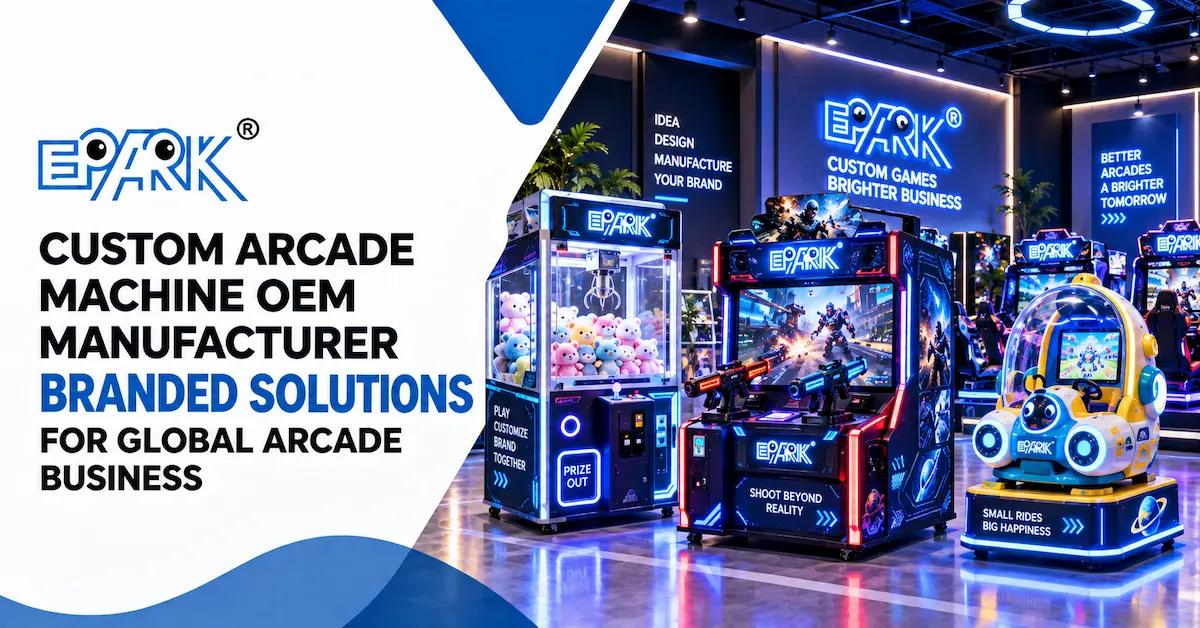
A custom arcade machine OEM manufacturer should begin by defining the purchasing scope, because “custom arcade machine” can describe anything from a standard cabinet with new graphics to a machine requiring structural, hardware, payment or software changes. EPARK’s current arcade equipment OEM guide describes customization areas including product appearance, cabinet design, branding, hardware configuration, software settings and payment systems. Those areas should not automatically be grouped into one vague “OEM package.” Each modification has a different effect on engineering work, sample approval, production cost and repeat-order control.
For a distributor building a private-label range, a standard platform with controlled visual and regional changes may be sufficient. An FEC brand may need machines adapted to a venue theme, payment platform and customer experience. A game developer may require deeper control over cabinet dimensions, displays and player interfaces. Start by defining the problem the customization must solve instead of maximizing the number of modifications.
Separate Branding, Configuration and Product Development
OEM and ODM terminology can overlap between manufacturers, so buyers should focus on responsibilities rather than labels. A project based on an established machine platform with new branding, cabinet colors, language or payment settings is different from a project requiring a redesigned cabinet structure, new controls or significant gameplay integration.
EPARK’s game machine OEM customization guide currently identifies branding, exterior artwork, language, payment configuration, prize-system adjustments and packaging among potential customization directions. Deeper product changes should be evaluated individually rather than assumed to be available because simpler OEM work is supported.
| Customization level | Typical request | Engineering impact | Approval priority |
|---|---|---|---|
| Branding | Logo, colors, cabinet graphics, labels | Relatively limited when structure remains unchanged | Artwork and color reference |
| Regional configuration | Voltage, frequency, plug, language | Technical configuration control | Electrical and interface verification |
| Payment customization | Coin, token, card or cashless interface | Hardware and integration work may be required | Full payment-to-game test |
| Hardware customization | Display, buttons, steering, sensors or control layout | Can affect wiring, cabinet and software | Prototype and functional validation |
| Structural customization | Cabinet dimensions, access panels, player position | Higher mechanical and packing impact | Drawings plus physical sample |
| Deeper custom development | New technical architecture or specialized gameplay integration | Project-specific engineering | Defined prototype and validation plan |
Start With a Commercial Product Brief
The first useful document for a custom project is not an artwork file. It is a commercial and technical brief explaining what the machine has to accomplish.
A distributor should identify its target market, downstream venue types and expected reorder quantities. An FEC operator should identify the intended customer group, available floor space and payment environment. A private-label arcade brand should define how the machine fits into the rest of its portfolio.
EPARK’s custom game machine content for FEC brands frames customization around design, function, branding, user experience and long-term maintenance rather than appearance alone. That is a useful purchasing principle: the machine must still be installable, serviceable and repeatable after the visual design has been approved.
Build One Controlled OEM Requirement Specification
Once the project direction is clear, create one specification shared by purchasing, design, engineering and the manufacturer. This avoids a common OEM problem: the final artwork comes from one email, the payment requirement from another message and the cabinet dimensions from an outdated quotation.
The table below is a buyer specification template, not a list of universal EPARK machine values.
| Requirement area | What the buyer should define or confirm |
|---|---|
| Base machine | Existing product/model or proposed custom platform |
| Intended application | Arcade center, FEC, shopping mall, indoor amusement venue or distributor range |
| Player configuration | Single player, multiplayer, linked or another verified mode |
| Cabinet | Dimensions, structure, materials, finish and access panels |
| Display | Screen size, quantity, mounting and interface |
| Controls | Buttons, joysticks, steering, pedals, guns, sensors or other interfaces |
| Electrical setup | Voltage, frequency, plug and rated requirements |
| Payment system | Coin, token, card reader or supported cashless interface |
| Software | Version, language, operating settings and agreed content |
| Branding | Logo, graphics, colors, labels and illuminated branding |
| Audio and lighting | Speaker and lighting configuration |
| Service access | Access to payment, controller, display, wiring and replaceable parts |
| Documentation | Manuals, drawings and applicable technical records |
| Accessories | Keys, cables and included supporting items |
| Packing | Packed dimensions, gross weight and detachable sections |
| Project control | Model code, revision, artwork version and sample reference |
Choose an Existing Platform Before Redesigning the Entire Machine
A custom project does not automatically require a completely new arcade machine. Starting from a suitable commercial platform can reduce unnecessary engineering work.
For example, if an existing racing machine already provides the required steering, pedals, seat structure and gameplay, the buyer may only need a branded cabinet, regional electrical setup and payment integration. Rebuilding the whole cockpit simply to make the project “more custom” can add development, packing and service complexity without solving a commercial problem.
EPARK’s commercial game equipment manufacturer guide notes that commercial equipment may involve branding, regional configuration, payment adaptation, operating settings and structural changes depending on the project. Use the least disruptive customization level that satisfies the requirement.
Control Cabinet Engineering Before Artwork Dominates the Project
Cabinet design affects more than appearance. The enclosure must accommodate displays, electronics, controls, payment hardware, audio, lighting, wiring and service access.
EPARK’s arcade cabinet manufacturer guide describes the cabinet as the structural platform tying those elements together. For custom projects, request controlled dimensions and mounting information before final graphics are locked.
A visually impressive side panel cannot compensate for a steering assembly that does not fit correctly or a controller that technicians cannot reach. Review mounting points, removable panels, internal cable routes, ventilation considerations and commonly serviced areas. Where dimensions or control positions are changed, check their effect on player interaction and packing as well.
Treat Player Controls as Technical Components, Not Decorative Options
Buttons, joysticks, steering systems, pedals, guns and sensors are among the parts most directly exposed to commercial use. A control change should therefore be documented as a technical revision.
If the project requests a different steering system, ask what changes in mounting, wiring, controller compatibility and replacement parts. A new control-panel layout can affect cabinet machining. A different sensor may alter software calibration.
When evaluating a custom arcade machine OEM manufacturer, ask the supplier to identify the approved component or component reference rather than using descriptions such as “premium joystick” or “upgraded wheel.” These references become especially valuable when a distributor needs service parts months later.
Validate Payment Systems With the Real Customer Transaction
Payment customization should be tested as a complete workflow. EPARK’s coin-operated equipment guidance separates payment recognition, credit allocation and game activation instead of treating the presence of a reader as proof of compatibility.
For a custom machine, verify:
Payment accepted → correct credit created → game starts → credit deducted correctly → next transaction operates normally.
For redemption or prize machines, include the appropriate reward-output step as well.
If a third-party cashless system will be installed, identify who provides the reader, interface, wiring and software integration. A physical opening for the reader does not establish a completed integration.
Keep Software, Language and Game Settings Under Revision Control
Software changes can be less visible than cabinet changes but equally important to repeat production. Save the approved version, language and relevant operator settings.
For multiplayer or linked machines, confirm that the production units use the configuration demonstrated during approval. For redemption equipment, document the relevant scoring and reward settings. For regional projects, check translated instructions rather than assuming a language change affects only the start screen.
A private-label product that uses the same artwork but different software should be treated as a different technical revision where that difference affects operation.
Use a Prototype as a Production Reference
The prototype is not only a marketing sample. It should represent an identifiable specification.
Record:
Prototype P1 → specification revision → artwork revision → hardware configuration → software version → payment configuration → open issues.
If modifications are made, create P2 or another identifiable revision instead of continuing to refer to both machines as “the sample.”
EPARK’s factory guidance stresses functional testing, assembly inspection and pre-shipment verification as parts of commercial arcade manufacturing. A controlled prototype gives those production checks something concrete to compare against.
Validate the Machine in Its Intended Commercial Scenario
Prototype evaluation should reproduce important aspects of the intended application rather than only demonstrating that the machine powers on.
For a racing machine, evaluate the seat, controls, player position, payment, gameplay and linking where required. For a claw machine, test the approved prize type and collection arrangement. For a redemption game, review scoring and reward output. For a family machine, review control reach and applicable user restrictions.
This is also the stage to test technician access. Ask a technician to identify and reach at least one expected replacement component using the proposed documentation. A custom product that is difficult to service can transfer development complexity directly to the distributor or venue.
Build OEM Quality Control Around the Approved Revision
Mass production should reproduce the approved configuration rather than an approximate visual equivalent.
EPARK’s commercial game equipment manufacturer guide describes assembly inspection and functional checks that can include wiring, fasteners, controls, sound, lighting, sensors, scoring, payment and ticket functions depending on the machine.
For an OEM project, add revision-specific checks:
| QC area | OEM question |
|---|---|
| Identity | Is the machine built to the approved OEM revision? |
| Cabinet | Are critical dimensions and panels correct? |
| Controls | Are approved control components installed? |
| Display | Does it match the approved configuration? |
| Payment | Is the intended hardware and credit logic installed? |
| Software | Is the approved version/language present? |
| Artwork | Does it match the signed-off file? |
| Lighting | Is customized lighting installed as specified? |
| Accessories | Are keys, cables and manuals included? |
| Packaging | Is private-label packaging correct where applicable? |
Do Not Extend One Certificate to Every Custom Version
Customization can change the relationship between a product and its technical documentation. A company may display certificates or test reports, but buyers should confirm what applies to the actual machine and modified configuration.
EPARK’s About Us page describes quality assurance and displays company honors and certificates, while its factory and quality content presents QC as part of manufacturing. Buyers should still request model-specific confirmation instead of assuming that every certificate shown at company level automatically covers every customized arcade configuration.
Where a destination market has specific requirements, identify them during the project brief rather than after the prototype has already been approved.
Evaluate Manufacturing Capability by Production Transfer
A good prototype is only useful if it can be manufactured repeatedly.
EPARK’s current About Us page states that the company was established in 2012 and describes a 25,000 m² manufacturing plant, more than 400 machines/equipment and over 100 workers, together with production, inspection, customization, packaging and delivery capabilities. These are company-level statements rather than guaranteed production allocation for an individual OEM project.
For the buyer, the more important question is how the custom design reaches production. Ask which drawings and component references are released, how artwork is controlled, what the production team uses as the approved reference and how changes are authorized.
That production-transfer process is more meaningful than factory size alone.
Plan OEM Lead Time by Milestone
Avoid asking only, “How long will custom production take?”
Break the project into:
Requirement confirmation → feasibility review → design → prototype → validation → corrections → production approval → component preparation → manufacturing → QC → packing → shipment.
A logo or artwork change may need far less development than a custom cabinet or hardware configuration. The quotation should therefore identify which milestone starts the manufacturing lead time.
EPARK’s manufacturing content similarly advises buyers to evaluate component availability, assembly capacity, customization preparation, testing and current workload when discussing production timing.
Separate One-Time OEM Costs From Recurring Unit Costs
A custom arcade project can include both development and production expenses.
Possible one-time costs may include design work, prototypes or project-specific engineering where applicable. Recurring costs can include customized materials, hardware, artwork application, packaging and production components.
Do not combine everything into one unit-price comparison.
A useful internal structure is:
Development Cost + Production Unit Cost + Initial Spare Parts + Packing + Freight + Local Integration + Support Cost
This makes later reorders easier to compare because the buyer knows which first-order expenses should not automatically appear again.
Protect Intellectual Property and Artwork Responsibilities
Private-label projects can involve logos, cabinet artwork, characters, game content and software. Define which files the buyer provides, which content the manufacturer provides and what rights apply to their commercial use.
Do not assume that adding a private-label logo resolves the rights to artwork or software already incorporated into the machine.
For custom graphics, retain the final production files and revision numbers. If the cabinet changes later, determine whether the artwork template must also change.
This protects both brand consistency and repeat-production clarity.
Plan Spare Parts Before Mass Production
Custom components create support obligations. If the machine uses a nonstandard control panel, specialized sensor or custom payment interface, the distributor needs to know how those parts will be identified later.
Build an initial spare-parts plan from the approved machine rather than purchasing a generic box of parts.
Separate:
shared components, which are confirmed compatible with several machines;
model-specific parts, which only support the custom configuration;
revenue-critical parts, whose failure prevents normal commercial operation.
Keep each part connected to the final revision.
Build Repeatability Into the OEM Project From Day One
The strongest OEM project is not simply one successful batch. It produces documentation that makes the second batch easier.
Save the approved:
- model code;
- drawings;
- cabinet specification;
- hardware configuration;
- software version;
- payment setup;
- artwork;
- accessories;
- spare-part references;
- packaging;
- QC reference.
EPARK’s recent wholesale and distributor guidance repeatedly emphasizes repeat-order configuration control because small substitutions can create service and compatibility problems later.
A reorder should be quoted against the approved revision, with proposed deviations identified before production.
Compare Standard, OEM and Deeper Custom Development
The following framework can help buyers choose the appropriate sourcing route.
| Purchasing route | Best when | Main advantage | Main risk to control |
|---|---|---|---|
| Standard machine | Existing product already fits the project | Faster purchasing and lower development burden | Assuming “standard” is identical across markets |
| Appearance OEM | Technical platform works but branding needs differentiation | Builds brand identity without redesigning operation | Artwork inconsistency between batches |
| Configuration OEM | Regional, payment or hardware adaptations are required | Better market and venue fit | Compatibility and sample validation |
| Structural custom project | Existing cabinet does not meet physical requirements | Greater product differentiation | Engineering, tooling and packing complexity |
| Deeper ODM-style development | Project requires broader product definition and engineering work | Highest design freedom | Larger development scope and responsibility ambiguity |
The names used by individual suppliers can vary. The project specification should therefore define responsibility more precisely than the OEM or ODM label.
What Should You Send EPARK for an OEM Evaluation?
A useful inquiry to a custom arcade machine OEM manufacturer should explain the final commercial requirement rather than ask only whether customization is available.
Provide the intended machine category, reference product or concept, venue/customer type, required quantity, destination country, cabinet requirements, display and controls, payment system, voltage and plug, software or language requirements, artwork, branding, packaging, technical documentation expectations, expected spare parts and target schedule.
EPARK’s arcade equipment OEM guide, customization process and About Us pages provide starting information about its customization and manufacturing scope. Project feasibility, available models and exact customization terms should still be confirmed for the proposed machine.
When the requirement is defined, submit it through EPARK Contact Us and request an itemized technical and commercial proposal.
Frequently Asked Questions About Custom Arcade Machine OEM Manufacturing
1. What does a custom arcade machine OEM manufacturer do?
A custom arcade machine OEM manufacturer adapts or produces arcade equipment according to an agreed buyer specification. Depending on the project, this can include branding, cabinet appearance, hardware, software settings, payment systems and other approved changes. The exact scope should be defined before quotation and production.
2. What is the difference between a standard arcade machine and an OEM machine?
A standard machine uses the supplier’s existing configuration, while an OEM project introduces agreed customization. The changes can range from branding to deeper hardware or structural work, so buyers should define which elements remain standard and which are modified.
3. Can I add my own logo and cabinet artwork?
Branding and cabinet graphics are among the customization options discussed in EPARK’s OEM content. Confirm file formats, placement, colors, approval process and any quantity-specific conditions for the actual model.
4. Can payment systems be customized?
Depending on the machine and project, coin, token, card or cashless-related configuration may be evaluated. Confirm the exact hardware, interface, wiring, credit settings and integration responsibilities before production.
5. Can I change the arcade cabinet dimensions?
Structural changes can be evaluated when the project requires them, but they may affect controls, internal layout, service access, packing and manufacturing. Treat a cabinet-size change as engineering work rather than a cosmetic modification.
6. Should I approve a prototype before mass production?
For significantly customized equipment, a controlled prototype or equivalent approved production reference can reduce risk. Record the exact hardware, software, artwork and payment configuration represented by the approved sample.
7. How should OEM arcade machine quality be checked?
QC should compare production against the approved revision and include the relevant cabinet, controls, payment, software, gameplay, artwork, accessories and packing checks for the specific model.
8. How long does custom arcade machine production take?
There is no universal lead time. Branding-only work and deeper engineering projects require different schedules. Ask for a milestone-based plan covering requirements, design, sample approval, production, QC and packing.
9. How should spare parts be handled for a custom machine?
Build the parts list from the approved configuration and link important components to its revision. Confirm which parts are shared with standard machines and which are unique to the custom model.
10. How can I request an OEM arcade machine quotation from EPARK?
Prepare the machine concept or base model, quantity, destination, cabinet requirements, controls, electrical setup, payment system, branding, artwork, packaging and project schedule, then submit the project through EPARK Contact Us.
Conclusion
Choosing a custom arcade machine OEM manufacturer is a product-definition and supply-chain decision, not simply a graphic-design exercise. The strongest OEM projects define what needs to change, preserve what already works, control cabinet and hardware specifications, validate payment and software functions, approve an identifiable prototype and transfer that revision into repeatable production. Buyers should also separate one-time development from recurring costs, connect spare parts to the approved machine and preserve artwork and technical records for future batches. EPARK’s current OEM and manufacturing content shows support for branding, cabinet, hardware, software and payment-related customization, while project-specific feasibility still needs confirmation for the selected machine. Brands, distributors and FEC operators with a defined project can contact EPARK with their product brief, technical requirements, quantities, target market and delivery plan for a configuration-specific OEM evaluation.
General Disclaimer
All data on https://www.eparki.com is for general guidance only. As a leading indoor playground manufacturer and trampoline supplier, EPARK strives for accuracy but gives no express or implied warranty regarding completeness, performance or project fitness. Product specs, designs and results may vary with use and customer requirements. Buyers must verify technical details, compliance and suitability before purchase. EPARK OEM/ODM is not liable for any direct, indirect or consequential damages arising from site use. For custom solutions, contact our manufacturer and supplier team via the Contact page.
Intellectual Property
Text, images, videos, CAD files and software are Guangzhou EPARK Electronic Technology Co., Ltd. All rights reserved. No part may be copied, republished or used commercially without prior written permission. We will pursue legal action for copyright or design-patent infringement.
Trademarks
"EPARK", the EPARK logo and related graphics are registered trademarks of Guangzhou EPARK Electronic Technology Co., Ltd. Unauthorized use in ads, domain names or packaging is prohibited.
Governing Law
These terms are governed by the laws of the People's Republic of China.
Contact
Questions? Email sales@nanyuetech.com or WhatsApp +86 139 0307 9263.