What Does “Easy Clean Soft Play Equipment” Really Mean?
Commercial buyers often see phrases such as “easy to clean,” “hygienic,” “washable,” or “low maintenance” in product descriptions.
Those phrases can sound reassuring, but they are not technical specifications by themselves.
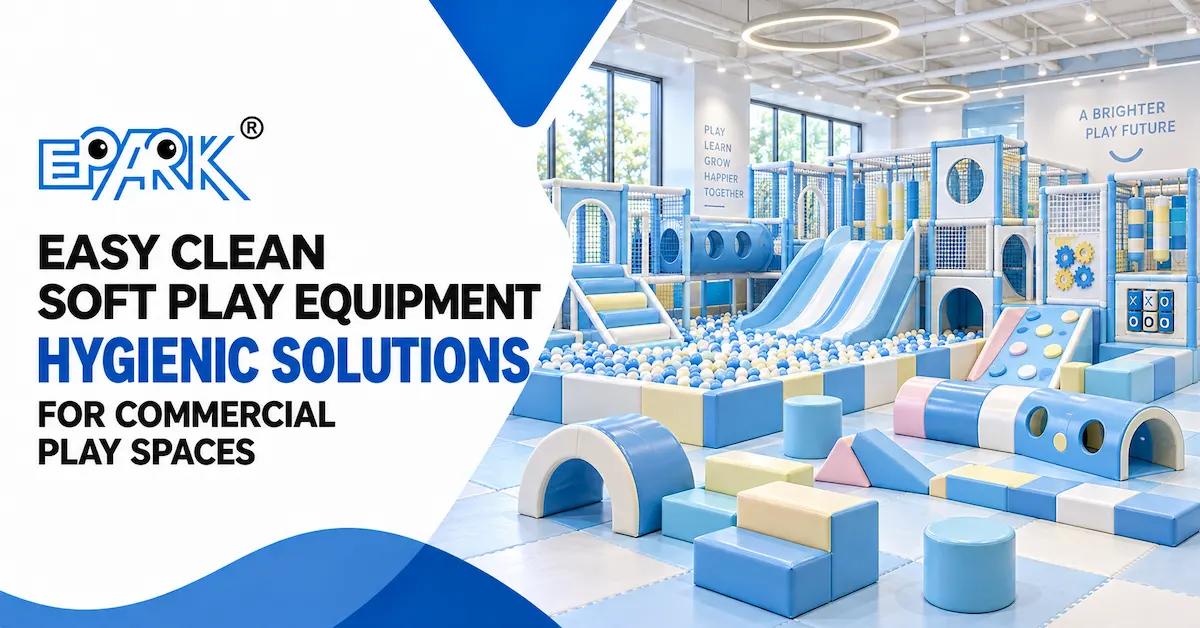
True easy clean soft play equipment should make routine cleaning, inspection, drying, and component replacement easier for the operator throughout the life of the playground.
That depends on much more than the outer material.
Cleanability is influenced by:
- Surface material
- Surface texture
- Seam design
- Corners and recesses
- Equipment spacing
- Access around structures
- Ball-pit configuration
- Flooring joints
- Drainage or moisture traps
- Removable components
- Replaceable coverings
- Visibility of wear
- Cleaning equipment access
- Daily operating workflow
A playground can use a smooth surface material and still be difficult to clean if staff cannot reach behind the equipment, if decorative details create dozens of dust traps, or if damaged coverings cannot be replaced individually.
That is why buyers should evaluate cleanability as a system, not as a marketing claim.
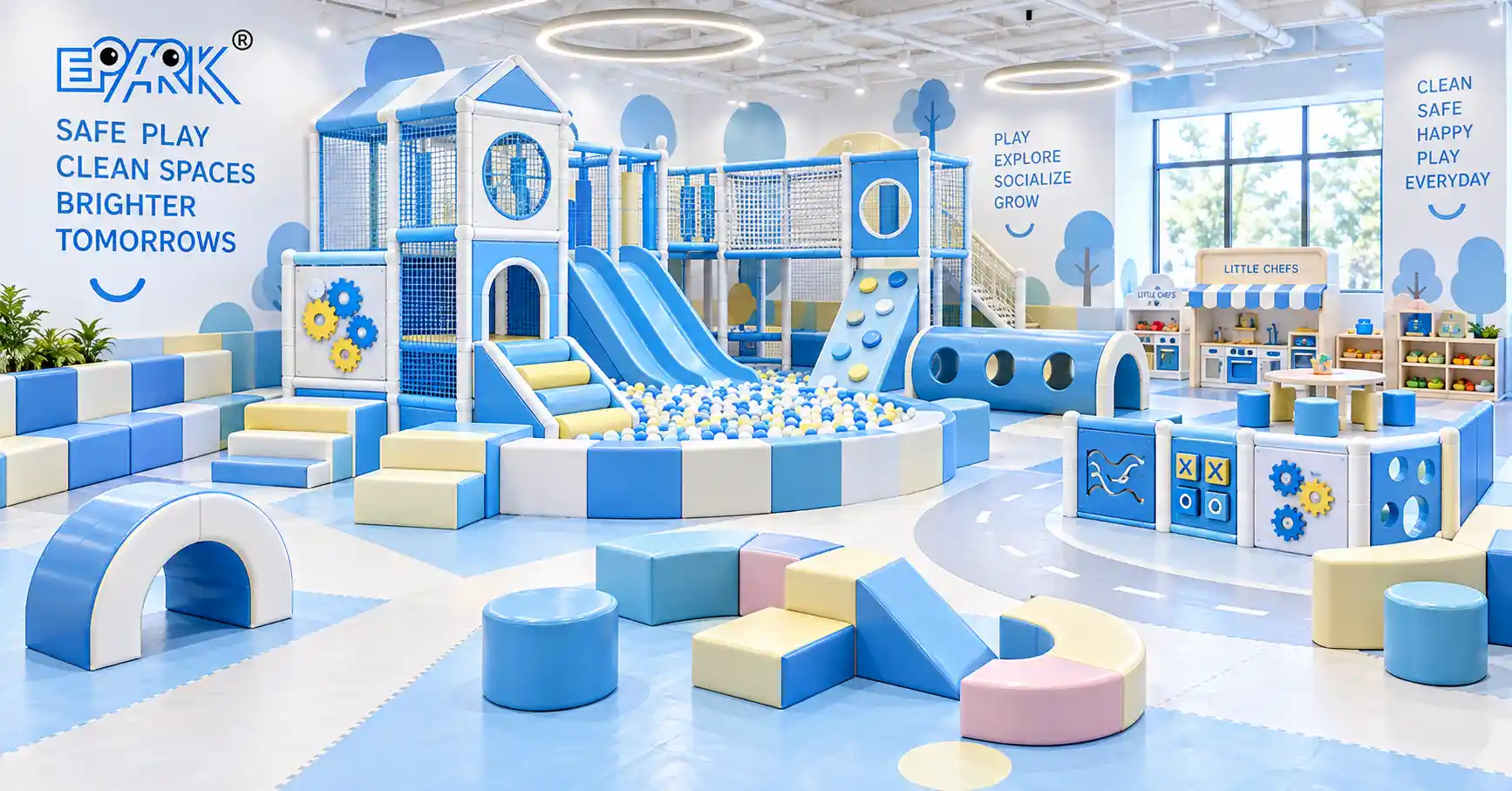
EPARK’s Safety and Quality page identifies high-density foam with soft PVC protection, EVA or PU foam flooring, FRP or composite resin components, safety nets, and galvanized structural elements within its playground material system. It also notes that interlocking flooring designs can support easier installation and cleaning.
Easy to Clean Does Not Mean “No Cleaning Required”
This distinction matters.
An easy-clean playground still requires a defined cleaning and inspection routine.
“Easy clean” should mean that the equipment design helps operators perform that routine efficiently.
It should not imply:
- Dirt cannot accumulate
- Bacteria cannot be present
- Disinfection is unnecessary
- Ball pits never require deeper cleaning
- Damaged surfaces can be ignored
- Any chemical can safely be used
- Cleaning frequency can be reduced without considering actual use
Commercial venues should still follow their local hygiene requirements, manufacturer instructions, product-specific cleaning guidance, and their own operational risk assessment.
The purchasing objective is therefore not to find equipment that “does not need cleaning.”
It is to select equipment that makes necessary cleaning faster, more consistent, more accessible, and easier to verify.
Why Cleanability Should Be Decided Before the Playground Is Manufactured
Many operators think about cleaning only after installation.
That is too late.
Once equipment has been produced and installed, the operator may discover:
- Narrow gaps that cannot be reached
- Deep decorative grooves
- Hidden corners behind panels
- Ball pits with difficult access
- Floor joints trapped beneath equipment
- Fixed modules that cannot be moved
- Enclosed tunnels with poor service access
- Large soft structures without removable sections
- Decorative pieces that block inspection
- Hard-to-replace surface coverings
At that point, cleaning becomes an operating problem rather than a design decision.
A better approach is to include cleanability during:
site planning → equipment selection → material approval → layout review → manufacturing → installation
EPARK’s Customization Process already places space planning, material selection, custom manufacturing, quality inspection, installation, and after-sales support within one project workflow. Cleanability should be reviewed during these same stages rather than added after opening.
Why Easy Cleaning Matters Financially
Cleaning is usually treated as a hygiene issue.
For commercial operators, it is also a labor and asset-management issue.
Consider two playgrounds with the same floor area.
Playground A
Staff can reach most surfaces directly.
Soft modules have simple forms.
The floor is divided logically.
High-touch surfaces are visible.
Wear components can be removed individually.
Playground B
There are many decorative recesses.
Equipment sits tightly against walls.
Large fixed modules block floor access.
Staff must move several items before cleaning.
Ball-pit edges and tunnels contain difficult blind spots.
Both playgrounds may look attractive.
But Playground B may require more labor every day.
That can affect:
- Staff hours
- Opening and closing routines
- Deep-cleaning schedules
- Equipment downtime
- Maintenance cost
- Customer perception
- Speed of defect identification
For a high-traffic venue, small daily inefficiencies can accumulate over hundreds of operating days.
This is why cleanability belongs in the purchasing discussion alongside price, design, materials, safety, and installation.
The Five Layers of Cleanability
A practical way to evaluate easy clean soft play equipment is to divide the project into five layers.
| Layer | Buyer Should Evaluate |
|---|---|
| Surface | Can it be wiped and inspected efficiently? |
| Geometry | Are there unnecessary grooves, gaps, or traps? |
| Access | Can staff physically reach the area? |
| Modularity | Can worn or dirty components be removed separately? |
| Workflow | Can cleaning be performed without excessive shutdown? |
A product may score well in one layer but poorly in another.
For example, a smooth PVC-covered module may be easy to wipe on the front surface but still create a cleaning problem if it is installed too close to a wall.
1. Evaluate the Outer Surface First
Soft play equipment frequently uses padded components with an outer protective covering.
EPARK identifies high-density foam and soft PVC sleeves on contact surfaces in its current safety information.
From a cleaning perspective, buyers should examine the outer layer carefully.
Ask whether the surface is smooth enough for routine wiping
Very heavily textured surfaces may look attractive but can collect more dust or residue than simpler surfaces.
That does not mean every surface must be completely flat.
It means texture should have a purpose.
Inspect how corners are finished
Corners receive frequent contact.
They should be easy to inspect for:
- Wear
- Tears
- Separation
- Dirt accumulation
Look at transitions between materials
When two materials meet, the joint can become a cleaning point.
Buyers should ask how these transitions are constructed and whether staff can access them.
2. Seams Matter More Than Many Buyers Realize
A beautiful soft-play module may contain many sewn or joined surfaces.
Every seam can become:
- A wear point
- A moisture-retention point
- A dirt-collection point
- An inspection point
This does not mean seams are inherently bad.
They are a normal part of many padded products.
The issue is whether seam placement is sensible.
Better seam planning
Where possible, frequently contacted surfaces should avoid unnecessarily complex seam patterns.
Avoid decorative stitching without operational value
Decorative complexity may add visual detail while increasing maintenance workload.
Check exposed edges
Buyers should understand how covers are closed, fixed, or joined around corners.
3. Surface Geometry Can Increase or Reduce Cleaning Time
Designers naturally want soft play equipment to look playful.
That can lead to:
- Curves
- Shapes
- Characters
- Windows
- Pockets
- Layered decorative panels
- Projections
- Recesses
Some of these features add real play value.
Others exist mainly for appearance.
The purchasing question should be:
Does this feature create enough commercial or play value to justify the additional cleaning complexity?
Examples of easier geometry
- Broad curved surfaces
- Open padded steps
- Simple arches
- Clearly accessible tunnels
- Flat activity panels
- Removable soft blocks
Examples requiring more attention
- Very deep decorative recesses
- Dense artificial foliage
- Complex sculpted façades
- Multiple overlapping decorative layers
- Narrow inaccessible ledges
The best design is not necessarily the simplest visually.
It is the one where complexity is intentional.
4. Equipment Access Is as Important as Material
Operators need enough physical space to clean.
This sounds obvious, but many layouts maximize equipment density to create a more impressive rendering.
That can leave staff with very poor access.
Check perimeter clearance
Ask whether staff can reach:
- Behind major structures
- Beside ball pits
- Along walls
- Around entrances
- Under accessible platforms
Check service routes
Large commercial projects should consider how cleaning carts, vacuum equipment, or maintenance tools move through the venue.
Avoid creating unreachable narrow strips
A small 10–20 cm gap between a large structure and a wall may be visually hidden but extremely difficult to maintain.
In some layouts, it is better either to provide usable access or design the equipment flush with an approved protected boundary rather than create a narrow unusable void.
Cleanability Should Be Included in the Floor Plan Review
Before approving the 3D design, mark the layout from the perspective of a cleaner or maintenance technician.
Ask:
- Can staff walk around the equipment?
- Can they reach the floor?
- Can they enter tunnels?
- Can they access ball-pit edges?
- Can they inspect net attachment points?
- Can they reach behind interactive panels?
- Can a damaged module be removed?
This exercise can reveal problems that are invisible in a rendering.
Buyers can review different configurations through EPARK’s Indoor Playground Products, but the final cleaning access should always be evaluated against the actual project floor plan.
5. Ball Pits Need Their Own Cleaning Strategy
Ball pools are visually attractive and offer strong play value.
They also require specific operational planning.
A buyer should evaluate:
- Ball-pit size
- Depth
- Number of access points
- Shape
- Internal corners
- Border construction
- Ability to remove balls
- Floor accessibility
- Staff entry access
Bigger is not automatically better
A very large ball pit may become the visual centerpiece of a playground.
It may also require more time to empty, inspect, clean, and refill.
The correct size should balance:
- Play value
- Capacity
- Venue scale
- Cleaning workload
Avoid unnecessarily complex basin shapes
Irregular shapes may improve design aesthetics, but deep pockets and narrow corners can complicate ball removal.
Plan for deep cleaning
Routine surface cleaning and deeper ball-pit cleaning are different tasks.
The design should make both possible.
6. Flooring Should Be Selected for Both Play and Maintenance
Flooring affects:
- Comfort
- Slip control
- Visual design
- Impact management
- Cleaning
- Replacement
EPARK’s current Safety and Quality page describes high-density EVA or PU foam mats and notes interlocking construction as one factor supporting easier installation and cleaning.
Commercial buyers should go further and ask:
- How are floor sections joined?
- Can individual pieces be removed?
- What happens if liquid enters a joint?
- Are edges exposed to repeated lifting?
- Does equipment sit directly on the floor?
- Can floor sections beneath equipment be accessed?
Modular flooring can simplify replacement
If a damaged area can be replaced without removing the entire floor, downtime can be reduced.
But modularity only helps if:
- The replacement part is identifiable
- Matching material remains available
- The operator keeps project records
7. Consider Cleaning Under and Around Soft Modules
Small movable products may be easier to clean around than fixed structures.
Examples include:
- Foam blocks
- Small rockers
- Soft cylinders
- Padded steps
- Modular tunnels
However, very lightweight loose equipment can create another issue: staff must constantly reposition it.
The right balance depends on the venue.
Daycare
Frequent rearrangement may be acceptable.
Restaurant
Compact fixed zones may reduce clutter.
FEC
Larger standardized modules may be easier to manage operationally.
Mall playground
Equipment often needs a combination of strong visual presentation and efficient end-of-day cleaning.
8. Enclosed Tunnels Must Be Serviceable
Children enjoy tunnels because they create exploration and enclosure.
Operators need access for a different reason.
Ask:
- Can an adult reach the entire tunnel?
- Is there an inspection opening?
- Are transparent sections useful?
- Can panels be removed if necessary?
- Are there hidden ledges inside?
- Does the tunnel connect to a serviceable platform?
An enclosed feature should not become a permanent blind zone.
This is especially important for large multi-level systems.
9. Nets Should Be Easy to Inspect
Safety nets are not cleaned in the same way as a smooth padded panel, but they still collect dust and require inspection.
Buyers should examine:
- Mesh accessibility
- Attachment areas
- Floor contact points
- Dust-collection zones
- Replacement sections
The net should not be hidden behind decorative components that make routine inspection difficult.
10. Interactive Panels Need a Different Cleaning Approach
Interactive wall panels can be useful because they add play value without using much floor space.
They may include:
- Gears
- Rotating elements
- Sliding components
- Shape games
- Sensory features
These surfaces can receive frequent hand contact.
Buyers should evaluate:
- Number of small recesses
- Moving-part access
- Edge design
- Ability to wipe surrounding surfaces
- Replaceability of components
For commercial use, an activity panel should not become a maintenance puzzle.
11. Role-Play Equipment Can Create Hidden Cleaning Work
Mini kitchens, supermarkets, workshops, hospitals, shops, and themed houses are popular in:
- Kids cafés
- Restaurants
- Daycare centers
- Preschool projects
- Family entertainment centers
These areas often include:
- Shelves
- Small accessories
- Counters
- Drawers
- Decorative objects
The play value can be high, but so can the cleaning workload.
A good role-play area should avoid excessive numbers of tiny loose pieces unless the operator has a clear inventory and cleaning routine.
Easy Clean Soft Play Equipment for Different Venue Types
Not every venue needs the same cleaning strategy.
Shopping Malls
Mall playgrounds often face:
- Long operating hours
- High visitor turnover
- Large floor areas
- Frequent surface contact
Priorities should include:
- Wide service access
- Replaceable wear areas
- Easy inspection
- Durable surfaces
- Clear zoning
Family Entertainment Centers
FECs often combine soft play with higher-energy attractions.
The younger-child zone should be designed so staff can clean it without interfering unnecessarily with other activities.
Restaurants and Kids Cafés
In food-service environments, operators are particularly sensitive to visual cleanliness and routine access.
The playground should generally favor:
- Compact zoning
- Smooth surfaces
- Open sightlines
- Accessible floor edges
- Controlled loose components
EPARK’s existing Restaurant Indoor Playground Equipment Guide discusses why hygiene, cleaning access, circulation, and equipment scale should influence restaurant playground design.
Daycare and Preschool
Staff may need to clean frequently throughout the day.
Useful features include:
- Low-height modules
- Movable soft blocks
- Open layouts
- Easy supervision
- Limited hidden areas
Hotels and Resorts
Visual quality and guest experience matter strongly.
Equipment should look refined without becoming overly decorative and difficult to maintain.
Design a Cleaning Zoning Map
For larger projects, divide the playground into cleaning zones.
For example:
Zone A – High-touch surfaces
Entrances, steps, rails, activity panels.
Zone B – Soft play floor level
Blocks, ramps, tunnels, small slides.
Zone C – Ball pit
Balls, border, interior floor.
Zone D – Elevated structures
Platforms, tunnels, nets.
Zone E – Role play
Counters, shelves, accessories.
This allows the operator to create different cleaning frequencies according to use.
It also helps the buyer understand whether staff can access each zone.
Cleaning Frequency Should Influence Layout
If a surface requires frequent attention, it should not be the hardest area to reach.
This sounds simple, yet it is often ignored.
Examples:
A frequently touched activity panel should not be hidden behind another module.
A toddler entrance should not require staff to climb through an obstacle.
A ball-pit access point should be large enough for service work.
A high-contact step should not require dismantling the surrounding structure for replacement.
Cleaning frequency and accessibility should be designed together.
Think in Terms of Cleaning Minutes per Zone
One useful commercial metric is:
Cleaning minutes per zone
This is not a universal industry standard.
It is an internal operating metric buyers can use when comparing designs.
For each zone, estimate:
- Daily wipe time
- Floor-cleaning time
- Ball-pit handling time
- Weekly deeper-clean time
- Inspection time
Then compare two layouts.
A more elaborate playground may look more impressive but require substantially more labor every day.
That difference should be considered before approval.
Estimate Cleaning Labor as Part of Total Cost of Ownership
Equipment price is visible.
Cleaning labor is less visible.
But it continues throughout the operating life.
A simple planning model can be:
Annual Cleaning Labor = Cleaning Hours per Day × Operating Days × Labor Cost
This is not a manufacturer pricing formula.
It is a management tool.
If one layout takes 30 additional minutes per day to clean, that difference repeats throughout the year.
For a chain with multiple locations, small layout improvements can have a larger financial effect.
Easy Clean Does Not Mean Choosing Only Smooth Plastic
Commercial soft play equipment contains several material types because each serves a different function.
A useful project may include:
- Padded PVC-covered surfaces
- EVA or PU flooring
- FRP slides
- Safety nets
- Structural frames
- Interactive components
The right decision is not to replace everything with one material.
Instead, select each material according to:
- Safety function
- Activity
- Wear
- Cleaning method
- Inspection access
- Replacement
EPARK’s Safety and Quality page provides a useful overview of the material categories currently used across its playground systems.
Ask for Cleaning Compatibility Before Choosing Chemicals
One of the easiest maintenance mistakes is assuming that a strong cleaner is automatically better.
Different finishes, printed graphics, PVC coverings, foams, adhesives, and plastic components may respond differently to chemicals.
Commercial buyers should request:
- Recommended routine cleaning method
- Recommended product type where available
- Materials that should not be exposed to specific cleaners
- Drying guidance
- Treatment of damaged surfaces
Operators should then incorporate this information into their own hygiene procedure.
Moisture Management Is Part of Cleanability
Cleaning introduces moisture.
If that moisture cannot dry or escape, it can create operational problems.
Design review should consider:
- Enclosed surfaces
- Floor joints
- Ball-pit bases
- Foam coverings
- Wall boundaries
- Low-airflow areas
After cleaning, the operator should be able to restore the equipment to a dry operating condition before use.
That makes ventilation and access relevant even when the materials themselves are water-resistant.
High-Touch Points Should Be Obvious and Accessible
Operators benefit when high-touch surfaces can be identified quickly.
Typical high-touch points may include:
- Entrance gates
- Handholds
- Steps
- Slide entry points
- Interactive panels
- Tunnel entrances
- Soft climbing edges
During design review, highlight these surfaces.
If they are scattered across dozens of hidden locations, routine cleaning becomes harder to standardize.
Reduce Unnecessary Loose Accessories
Loose toys can add play value.
They also increase:
- Cleaning count
- Storage needs
- Lost-item risk
- Inspection time
For commercial venues, every loose accessory should have a purpose.
This is particularly important in restaurants, hotels, and daycare environments.
A smaller number of durable, well-organized role-play accessories may be easier to operate than a large number of small pieces.
Plan Storage Into the Playground
Cleaning equipment, spare soft modules, replacement parts, and role-play accessories need storage.
Yet storage is often omitted from the initial playground layout.
A commercial project should consider:
- Cleaning supply storage
- Spare-parts storage
- Loose toy storage
- Ball storage during deep cleaning
- Maintenance tool access
Storage does not need to occupy the main play area, but it should be planned.
Replaceability Is a Core Easy-Clean Feature
Sometimes the fastest way to restore a hygienic, professional appearance is not more cleaning.
It is replacing a worn surface.
Commercial buyers should ask:
- Can one padded cover be replaced?
- Can one floor tile be replaced?
- Can one activity panel be removed?
- Can one net section be reordered?
- Can one soft block be replaced?
- Can the supplier identify the correct part later?
EPARK’s FAQ describes after-sales service and maintenance support within its commercial playground offering, including Safety & Maintenance documentation questions.
Create a Spare-Part Map
Before opening, identify the components most likely to need future replacement.
The project file can record:
- Part location
- Part photo
- Model or code
- Color
- Material
- Supplier reference
This is much more useful than contacting the supplier years later with:
“I need the green pad near the slide.”
For multi-location operators, this becomes especially valuable.
Cleanability and Visual Design Should Support Each Other
Easy-clean design does not have to look clinical.
A commercial playground can still use:
- Strong themes
- Attractive colors
- Rounded forms
- Character graphics
- Photo-friendly entrances
The goal is to avoid visual features that create operational difficulty without adding enough value.
Better themed design
Use large readable shapes and graphics.
Harder themed design
Use hundreds of small attached decorations, deep grooves, artificial foliage, or inaccessible layers.
A designer should understand both branding and operations.
How Customization Can Improve Cleanability
Customization is often discussed in terms of:
- Color
- Logo
- Mascot
- Theme
But commercial buyers can also customize for operation.
Ask the design team to modify:
- Equipment spacing
- Panel access
- Ball-pit entry
- Storage
- Removable sections
- Role-play accessory count
- Flooring layout
- Maintenance routes
This is a more mature use of OEM/ODM capability.
EPARK’s Customization Process includes site planning, material selection, modular design, custom production, inspection, installation, and after-sales support, making these operational requirements appropriate to raise during the project brief.
Standard vs Custom Equipment for Cleaning Efficiency
| Approach | Cleaning Advantage | Cleaning Risk |
|---|---|---|
| Standard modular | Known component shapes | May not fit site perfectly |
| Color-customized | Same structure remains familiar | Minimal operational change |
| Semi-custom | Can improve site access | Needs careful design review |
| Fully custom | Can optimize around venue | Decorative complexity may increase |
| Highly themed | Strong branding | More potential cleaning details |
Customization is not automatically better.
The best option is the one that solves the site’s actual operational problems.
Evaluate Cleanability in the 3D Design Review
When reviewing the 3D rendering, do not only ask:
- Does the theme look good?
- Are the colors correct?
- Is the playground exciting?
Also ask:
- Where will staff stand while cleaning?
- Which areas are hidden?
- Can the floor be reached?
- Which modules can be removed?
- Where will cleaning tools enter?
- Where can balls be temporarily stored?
- Which surfaces are high-touch?
- How will staff reach upper levels?
A 3D design can become a maintenance-planning tool.
Add Cleanability to the Pre-Production Checklist
Before releasing manufacturing, confirm:
| Cleanability Item | Buyer Check |
|---|---|
| Surface materials | Project-specific materials confirmed |
| Seam locations | High-wear areas reviewed |
| Corners | No unnecessary inaccessible recesses |
| Ball pit | Access and emptying method considered |
| Flooring | Replacement and cleaning access understood |
| Tunnels | Adult service access possible |
| Nets | Visible and inspectable |
| Interactive panels | High-touch areas reachable |
| Loose items | Quantity controlled |
| Storage | Operational storage planned |
| Spare parts | Replacement route defined |
This turns “easy clean” into a measurable procurement requirement.
Quality Control Should Include Cleanability Features
Pre-shipment QC normally checks:
- Dimensions
- Appearance
- Equipment quantity
- Accessories
- Custom colors
- Packaging
For easy clean soft play equipment, buyers should also confirm that the manufactured product matches the approved cleanability features.
For example:
- Removable panel actually removes
- Access opening is the correct size
- Seam placement matches approval
- Floor modules are identified
- Replaceable parts are labeled
- Decorative pieces do not block intended service areas
Cleanability should survive the transition from design to production.
Installation Can Ruin an Easy-Clean Design
A good design can still become difficult to maintain if installed incorrectly.
Examples include:
- Equipment positioned too close to a wall
- Floor edges trapped by later construction
- Panels installed over service openings
- Storage blocked
- Equipment shifted from approved layout
- Decorative pieces added in access areas
Final installation inspection should therefore compare the real site with the approved layout.
Create a Cleaning Acceptance Walkthrough Before Opening
Before the venue opens, ask the operations team to perform a simulated cleaning cycle.
Do not wait for the first busy weekend.
Have staff walk through:
- Daily surface cleaning
- Floor access
- Ball-pit access
- Tunnel cleaning
- Interactive panel cleaning
- Waste removal
- Equipment inspection
- Drying and reopening
Record any area that is unnecessarily difficult.
Some problems can still be corrected before opening.
Easy Clean Equipment Is Especially Valuable for Chains
A single playground can tolerate a complicated routine if the owner is personally involved every day.
A chain cannot rely on that.
Multi-location operators need consistent processes.
Standardized cleanability can help create:
- Repeatable SOPs
- Staff training
- Consistent inspection
- Predictable cleaning time
- Standard spare parts
- Easier audits
This is one reason large buyers should treat cleaning access as a design standard.
Create a Chain-Level Cleanability Specification
A chain can define rules such as:
- Minimum service access
- Maximum loose-accessory count
- Preferred surface types
- Standard ball-pit access
- Replaceable floor system
- Approved color families
- Standard spare-part list
Then every new location starts from the same operating logic.
Distributors Should Also Evaluate Easy Cleaning
Distributors may not operate the playground themselves, but their customers will.
Easy-clean design can become a sales advantage when selling to:
- Restaurants
- Daycare centers
- Hotels
- Shopping malls
- FECs
- Kids cafés
Instead of only advertising:
“Premium materials”
the distributor can explain operational value:
“This configuration has clear floor access, removable modules, simple wall panels, controlled seam locations, and replacement components.”
That is a stronger B2B sales argument.
How to Compare Two Easy-Clean Soft Play Proposals
Suppose two suppliers offer similar equipment.
Proposal A
Includes:
- Smooth padded surfaces
- Simple geometry
- Accessible perimeter
- Modular flooring
- Ball-pit service access
- Removable wear components
- Clear spare-part records
Proposal B
Includes:
- Similar materials
- More decorative detail
- Narrow wall gaps
- Fixed floor sections
- Complex ball-pit shape
- No replacement documentation
The material list may look similar.
The operating experience can be very different.
That is why buyers should compare layout + construction + accessibility + replacement, not material names alone.
Easy Clean Buyer Scorecard
Use the following scoring categories when reviewing a commercial project.
| Area | Poor | Acceptable | Strong |
|---|---|---|---|
| Surface access | Many hidden areas | Most surfaces reachable | Nearly all routine surfaces easy to reach |
| Geometry | Many deep recesses | Moderate complexity | Simple functional forms |
| Ball pit | Difficult service access | Basic access | Clear emptying and service method |
| Flooring | Hard to replace | Some modularity | Clearly replaceable sections |
| Tunnels | Limited access | Partial access | Designed for service |
| Panels | Fixed and complex | Standard | Accessible/removable where useful |
| Loose pieces | Excessive | Controlled | Purposeful and manageable |
| Storage | None | Limited | Planned operational storage |
| Spare parts | Unclear | Available | Coded and documented |
| Cleaning SOP | Not discussed | Basic | Designed with equipment |
The exact weighting should reflect the venue.
A restaurant may give hygiene and visual cleanliness a higher weighting.
An FEC may give maintenance access and downtime greater weight.
Common Mistakes When Buying Easy-Clean Soft Play Equipment
Mistake 1: Choosing Only by Material Name
“PVC” or “PU” alone does not define cleaning performance.
Construction details matter.
Mistake 2: Maximizing Equipment Density
More equipment can reduce cleaning access.
Mistake 3: Over-Theming the Project
Every decorative detail creates another surface.
Mistake 4: Ignoring the Ball Pit
Ball pits need specific operational planning.
Mistake 5: No Replacement Strategy
Eventually, cleaning cannot restore a worn component.
Mistake 6: No Storage
Operations become cluttered.
Mistake 7: Assuming Every Cleaner Is Compatible
Cleaning instructions should be confirmed.
Mistake 8: Ignoring Drying
Cleaning is incomplete if moisture remains trapped.
Mistake 9: Leaving Maintenance Access Until Installation
Access should be designed before production.
Mistake 10: Confusing “Antibacterial” With “Self-Cleaning”
A material claim does not eliminate routine hygiene procedures.
What Should an Easy-Clean Soft Play RFQ Include?
If cleanability matters to your project, state it explicitly in the RFQ.
Include:
- Venue type
- Floor plan
- Usable area
- Ceiling height
- Target ages
- Expected daily traffic
- Operating hours
- Preferred equipment
- Ball-pit requirement
- Cleaning frequency
- Cleaning access requirements
- Storage requirements
- Preferred modular components
- Replacement expectations
- Destination market
- Installation responsibilities
Do not write only:
“Need easy-clean playground.”
Explain what easy cleaning means operationally.
Questions to Ask the Supplier Before Approving the Design
Ask:
- Which surfaces require routine cleaning?
- Which modules are removable?
- Can staff access behind the equipment?
- How can the ball pit be emptied?
- Which floor sections can be replaced?
- How are tunnels serviced?
- Which parts are high-wear?
- What cleaning method is recommended for each material?
- Which components can be reordered?
- How will replacement parts be identified?
The answers should become part of the project record.
Why Easy Clean Soft Play Equipment Can Improve Commercial Uptime
Cleaning itself creates downtime if the venue must close zones.
A well-planned design can help operators:
- Clean smaller zones independently
- Access surfaces faster
- Replace damaged pieces sooner
- Reduce unnecessary disassembly
- Reopen areas efficiently
This is especially useful for venues operating long hours.
The objective is not to rush cleaning.
It is to eliminate wasted effort.
Cleanability Should Be Balanced With Play Value
There is a risk of taking easy-clean design too far.
A playground should still be engaging.
Children need:
- Movement
- Variety
- Exploration
- Imaginative play
- Physical challenge
The goal is not a sterile room containing only rectangular foam blocks.
The goal is to design rich play experiences using forms and systems that operators can realistically maintain.
This requires collaboration between:
- Designer
- Manufacturer
- Buyer
- Operations team
Cleanability Should Also Be Balanced With Brand Experience
Commercial buyers want memorable spaces.
A themed playground may be an important part of:
- Mall positioning
- Restaurant branding
- Kids café identity
- Hotel family services
- FEC differentiation
The solution is not to eliminate design.
It is to move visual complexity into surfaces and graphics that are manageable.
For example:
A large printed themed panel may provide stronger visual impact and be easier to maintain than dozens of attached decorative objects.
Consider Cleaning During Future Expansion
If the playground may expand later, ask whether the new modules will preserve:
- Service routes
- Floor access
- Staff circulation
- Ball-pit maintenance access
- Storage
Expansion should not close the access routes that made the original equipment easy to maintain.
Use Maintenance Records to Improve Future Designs
After opening, record:
- Areas that take longest to clean
- Surfaces that wear fastest
- Parts replaced frequently
- Places where debris accumulates
- Areas staff find difficult to access
For a multi-location business, this information becomes design data.
The next site can be improved.
This is where easy-clean design becomes a long-term operational advantage rather than a one-time purchasing feature.
A Practical Easy-Clean Soft Play Specification
Buyers can use this simplified specification when comparing proposals.
| Requirement | Buyer Expectation |
|---|---|
| Surface | Smooth, serviceable contact surfaces |
| Geometry | Avoid unnecessary dirt-trapping details |
| Seams | Accessible and inspectable |
| Perimeter | Cleaning access considered |
| Ball pit | Defined cleaning/service access |
| Flooring | Modular or replaceable where practical |
| Tunnels | Adult maintenance access |
| Nets | Visible attachment points |
| Panels | High-touch areas easy to reach |
| Loose items | Controlled quantity |
| Storage | Planned where needed |
| Spares | Replaceable components identifiable |
| Documentation | Cleaning and maintenance information supplied |
This is more useful than asking whether the product is simply “washable.”
How EPARK Can Support an Easy-Clean Project Brief
For buyers researching easy clean soft play equipment, the useful starting point is to combine the venue’s operating routine with the equipment design.
EPARK’s current material information identifies soft PVC-covered padding, EVA/PU flooring, FRP or composite components, safety nets, and galvanized frames within its playground systems. Its customization process also includes site planning, material selection, custom production, quality inspection, installation, and after-sales support.
A specific cleanability brief can therefore include:
- Required cleaning access
- Preferred equipment density
- Ball-pit servicing method
- Modular components
- Replaceable floor sections
- Reduced decorative recesses
- Storage
- Spare-part identification
For a product example, EPARK’s 140m² Commercial Soft Play Project specifically describes easy-clean surface considerations on that product page; project buyers should still confirm which construction and finishes apply to their actual quotation.
Frequently Asked Questions About Easy Clean Soft Play Equipment
What is easy clean soft play equipment?
Easy clean soft play equipment is commercial play equipment designed so routine cleaning, inspection, drying, and component replacement can be performed efficiently. Cleanability depends on materials, geometry, access, layout, flooring, seams, ball-pit design, and maintenance planning.
Which soft play materials are easiest to clean?
There is no single material that is automatically best for every component. Smooth protective surfaces and modular flooring can support efficient cleaning, but buyers should also evaluate seams, access, texture, replacement, and compatibility with the manufacturer’s recommended cleaning method.
Is PVC soft play equipment easy to clean?
PVC-covered padded surfaces can provide a smooth, wipeable exterior, but actual cleanability depends on seams, surface texture, installation, access, and the specific construction used in the project.
Is antibacterial flooring enough to make a playground hygienic?
No. Material properties do not replace routine cleaning, inspection, drying, and venue hygiene procedures. Buyers should treat material claims as one part of the overall maintenance system.
How should a commercial ball pit be designed for easier cleaning?
Buyers should consider basin shape, staff access, ability to remove balls, interior corners, floor access, ball storage during deep cleaning, and the process for refilling the pit.
Should soft play equipment be removable?
Not every component needs to be movable. However, removable or replaceable wear components can make maintenance easier. The appropriate level of modularity depends on the venue and equipment type.
How can I reduce cleaning labor in an indoor playground?
Start during design. Reduce unnecessary decorative recesses, provide practical access, use manageable zoning, control loose accessories, plan storage, and make frequently serviced components easy to reach.
Is easy-clean equipment important for restaurants and daycare centers?
Yes. These venues often have frequent cleaning routines and strong expectations around visible cleanliness.Compact, accessible layouts and manageable soft-play systems can make daily operation easier.
How should I compare two easy-clean playground proposals?
Compare surface materials, geometry, seams, perimeter access, ball-pit servicing, flooring replacement, tunnel access, storage, spare parts, and expected cleaning workflow. Do not compare only the material names.
What should I send when requesting an easy-clean soft play quotation?
Provide the floor plan, usable dimensions, target ages, venue type, expected traffic, preferred equipment, cleaning priorities, ball-pit requirements, storage needs, destination, and installation information. These requirements can be submitted through EPARK’s Contact Us page.
Conclusion
Easy clean soft play equipment should be designed around more than a wipeable surface. Buyers should prioritize accessible layouts, simple serviceable geometry, suitable materials, manageable ball pits, modular flooring, replaceable wear parts, and clear maintenance access.
For a site-specific solution, prepare your floor plan, target ages, equipment mix, traffic level, and cleaning requirements, then submit them through EPARK’s Contact Us page.
General Disclaimer
All data on https://www.eparki.com is for general guidance only. As a leading indoor playground manufacturer and trampoline supplier, EPARK strives for accuracy but gives no express or implied warranty regarding completeness, performance or project fitness. Product specs, designs and results may vary with use and customer requirements. Buyers must verify technical details, compliance and suitability before purchase. EPARK OEM/ODM is not liable for any direct, indirect or consequential damages arising from site use. For custom solutions, contact our manufacturer and supplier team via the Contact page.
Intellectual Property
Text, images, videos, CAD files and software are Guangzhou EPARK Electronic Technology Co., Ltd. All rights reserved. No part may be copied, republished or used commercially without prior written permission. We will pursue legal action for copyright or design-patent infringement.
Trademarks
"EPARK", the EPARK logo and related graphics are registered trademarks of Guangzhou EPARK Electronic Technology Co., Ltd. Unauthorized use in ads, domain names or packaging is prohibited.
Governing Law
These terms are governed by the laws of the People's Republic of China.
Contact
Questions? Email sales@nanyuetech.com or WhatsApp +86 139 0307 9263.