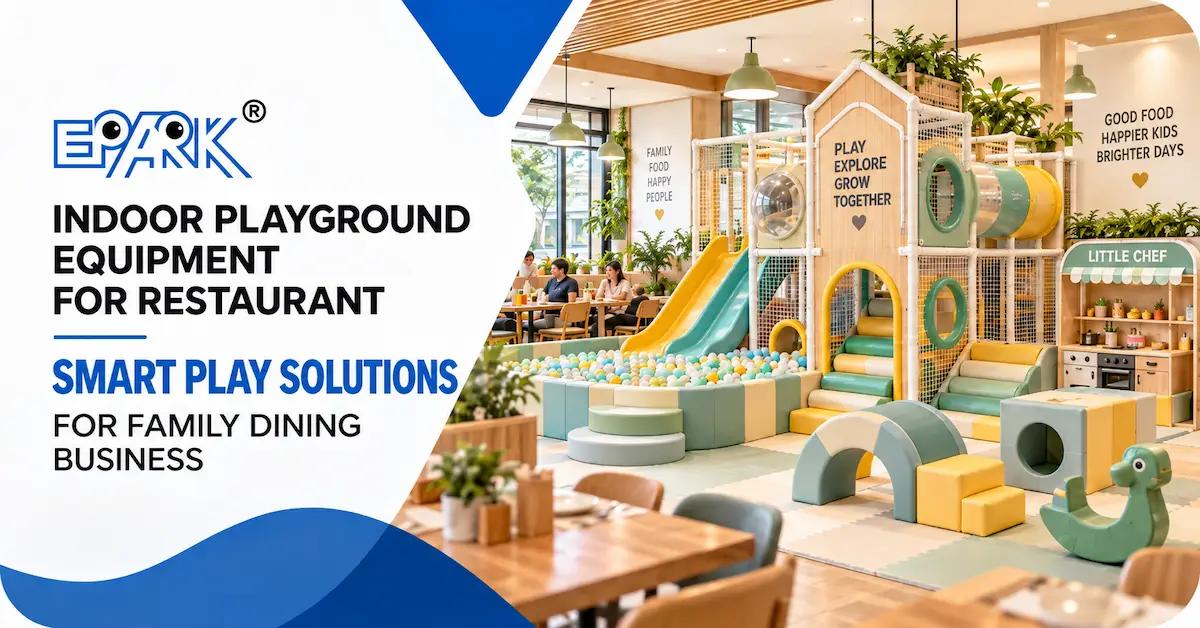
Why Restaurant Play Areas Need a Different Equipment Strategy
A restaurant play area is not simply a smaller version of a family entertainment center.
In a dedicated indoor playground, play is the main activity. In a restaurant, the play zone must support the dining experience without interfering with food service, staff movement, customer circulation, cleaning, or the comfort of guests who are not using the playground.
That changes how buyers should evaluate indoor playground equipment for restaurant projects.
The best equipment is usually not the largest or most exciting option. It is the equipment that fits the available space, target age group, restaurant concept, supervision model, cleaning routine, and expected customer flow.
For many restaurant projects, the key priorities are:
- compact footprint;
- clear parent visibility;
- age-appropriate activities;
- controlled activity intensity;
- easy-to-clean surfaces;
- simple maintenance;
- good circulation;
- separation from food-service routes;
- attractive visual design;
- modular equipment that can be adapted to the site.
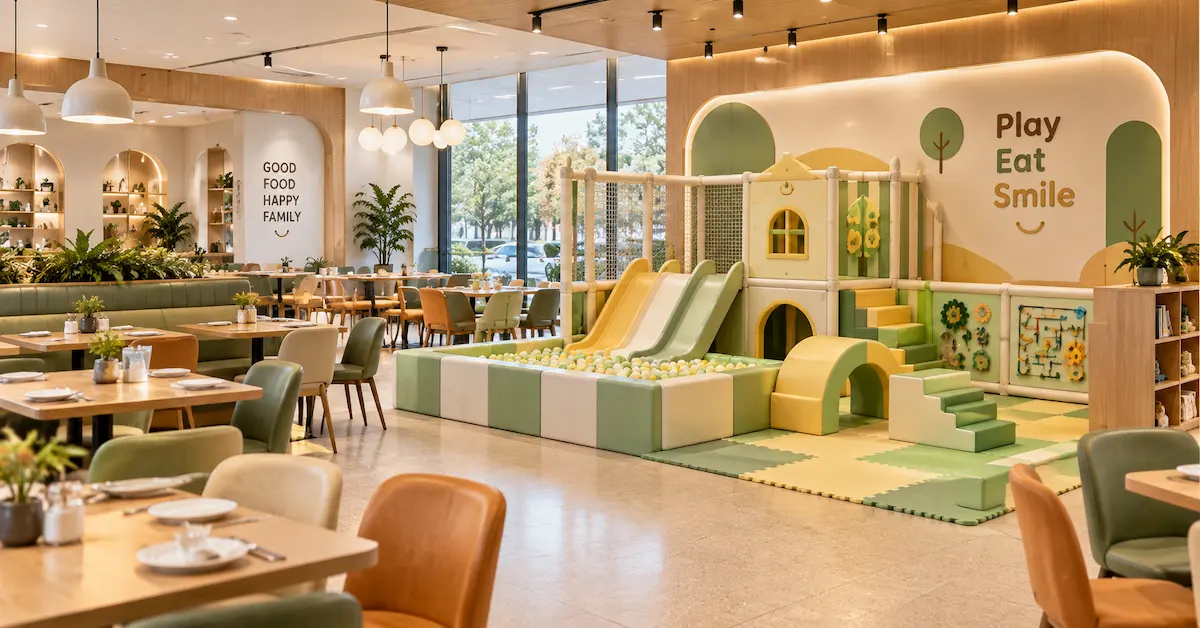
EPARK’s Indoor Playground Products show different soft-play structures, slides, ball pools, climbing elements, toddler modules, and themed systems that can be adapted to different commercial environments.
Start With the Restaurant Business Model, Not the Equipment Catalogue
Before selecting slides or ball pools, define what role the play zone should perform.
Different restaurant concepts have different needs.
| Restaurant Type | Main Goal for Play Area | Recommended Direction |
|---|---|---|
| Family restaurant | Improve family dining experience | Compact multi-activity soft play |
| Kids café | Play is a major attraction | Larger themed soft-play system |
| Fast-casual restaurant | Reduce waiting pressure | Small toddler or interactive corner |
| Shopping mall restaurant | Differentiate from nearby competitors | Visually attractive compact playground |
| Hotel restaurant | Improve family guest experience | Premium, quiet, cleanable play zone |
| Resort dining area | Extend family leisure experience | Themed indoor play area |
| Large restaurant complex | Support longer family visits | Multi-zone soft play and role play |
The important question is:
What problem should the playground solve for the restaurant?
That answer should guide the equipment selection.
Where Should an Indoor Playground Be Located Inside a Restaurant?
Location has a major effect on whether the play area supports or disrupts operations.
Near family seating
For many restaurants, placing the playground within visible distance of family tables makes supervision easier.
Parents can remain seated while maintaining visual awareness of the play zone.
Away from service routes
Avoid placing the main entrance to the play area directly across:
- kitchen access;
- waiter routes;
- tray return areas;
- delivery routes;
- payment queues.
Children entering and leaving the playground should not repeatedly cross staff circulation.
Avoid blocking the restaurant entrance
A playground near the entrance can attract attention, but the equipment should not create congestion around:
- reception;
- waiting areas;
- queue lines;
- emergency access.
Consider acoustic separation
High-energy equipment close to quieter dining areas may create an undesirable experience.
Restaurant play zones should therefore be planned according to activity intensity.
A low-energy toddler area can usually sit closer to dining areas than a larger climbing, bouncing, or interactive activity zone.
How Much Space Should a Restaurant Playground Use?
There is no single correct area.
The decision should depend on:
- total restaurant size;
- seating capacity;
- target family audience;
- age group;
- existing circulation;
- ceiling height;
- business model;
- expected play duration.
Instead of asking:
“How many square meters do I need?”
ask:
“What useful play experience can I create without weakening the dining operation?”
A small space can still perform well if the equipment is chosen carefully.
Restaurant Playground Equipment by Space Type
| Space Situation | Suitable Equipment Direction |
|---|---|
| Very compact corner | Soft blocks, sensory panels, mini slide |
| Small dedicated room | Toddler soft play, tunnel, mini ball pool |
| Medium family zone | Slides, ball pit, climbing, role play |
| Larger restaurant play area | Multi-level soft play and themed structures |
| Kids café | Multi-zone playground with role-play activities |
| Restaurant + FEC concept | Soft play plus selected complementary attractions |
For buyers looking at compact commercial configurations, EPARK’s 75m² Commercial Indoor Playground Equipment is a useful reference for how multiple soft-play activities can be arranged within a smaller commercial format.
Which Equipment Works Best for Restaurants?
Restaurant playground equipment should usually prioritize high play value without creating unnecessary operational complexity.
Soft Play Blocks and Padded Obstacles
Soft modules are useful for younger children and compact areas.
They can include:
- padded steps;
- crawl-through arches;
- soft climbing shapes;
- balance elements;
- low obstacles.
These are especially suitable when ceiling height or space is limited.
Mini Slides
Slides provide strong play value without requiring extremely complex equipment.
For restaurant applications, buyers should evaluate:
- slide height;
- landing area;
- visibility;
- surrounding padding;
- circulation around the exit.
Ball Pools
Ball pools create strong visual appeal and can become a central attraction.
However, restaurants should also consider:
- cleaning routine;
- access;
- visibility;
- boundaries;
- ball management.
A large ball pool may not always be necessary.
A smaller, integrated ball-pit area can be more practical for limited restaurant spaces.
Crawling Tunnels
Tunnels add exploration value while using vertical or structural space efficiently.
Transparent or open sections can also support supervision.
Low Climbing Structures
Climbing elements can increase physical play value but should match the target age group and available space.
For smaller restaurants, compact climbing walls or padded climbing ramps may be more practical than high multi-level structures.
Sensory and Activity Panels
Activity panels are valuable when floor space is limited.
Examples include:
- rotating elements;
- gears;
- tactile panels;
- simple interactive activities.
They add engagement without requiring large circulation zones.
Role-Play Areas
Role play works particularly well with restaurant and kids-café concepts.
Possible themes include:
- supermarket;
- kitchen;
- hospital;
- fire station;
- workshop;
- mini shop.
These activities can offer a calmer alternative to high-energy physical play.
Match Equipment to the Target Age Group
A common mistake is trying to serve every age group with one compact restaurant playground.
That can create an equipment mix that satisfies nobody.
Toddlers
For younger children, consider:
- low structures;
- soft blocks;
- mini slides;
- sensory elements;
- tunnels;
- rocking toys;
- easy parent visibility.
Preschool and younger school-age children
This group may use:
- slides;
- ball pools;
- small climbing elements;
- interconnected tunnels;
- role-play equipment;
- activity panels.
Older children
Older children usually require more challenge.
If the restaurant cannot provide enough room for meaningful older-child activities, it may be better to focus the main play area on younger users rather than overcrowding the space.
The target customer profile should be defined before requesting the layout.
Parent Visibility Should Be Designed Into the Layout
For restaurants, visibility is one of the most important design factors.
Parents often want to continue eating or talking while children play nearby.
The playground layout should therefore consider:
- sightlines from family seating;
- opaque versus transparent panels;
- equipment height;
- entrance position;
- hidden corners;
- internal tunnels;
- staff visibility.
A visually open playground can also make a compact restaurant feel less divided.
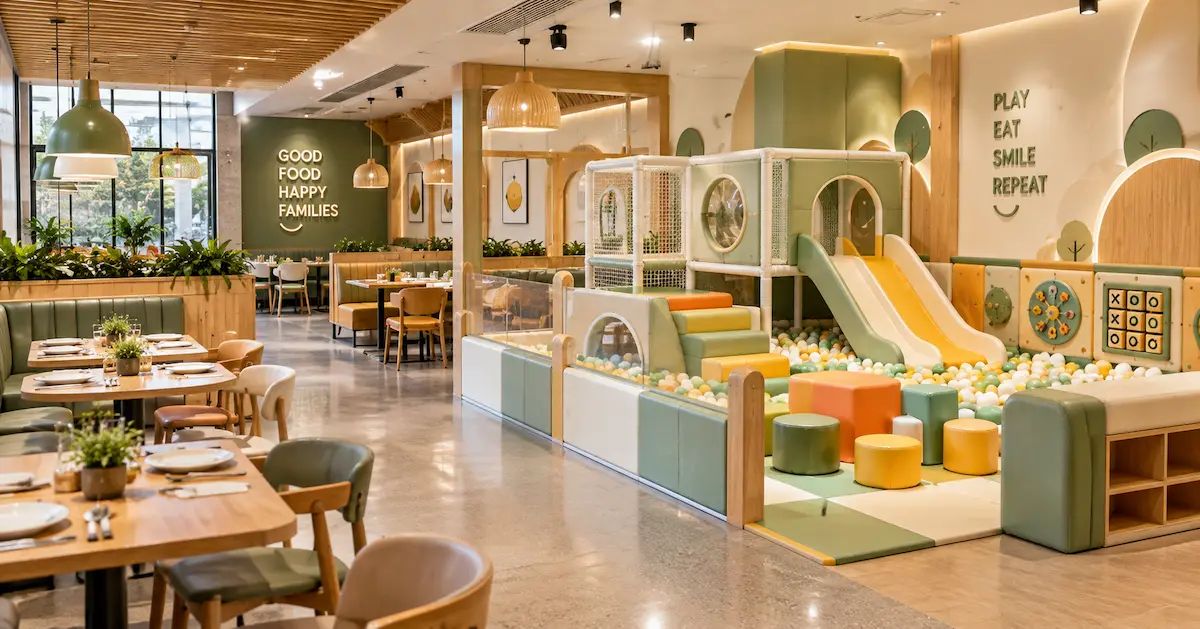
EPARK’s current commercial playground products include open structures, netted boundaries, windows, and transparent activity elements that can be adapted through a custom playground design.
Control the Relationship Between Dining and Play
The play area should support the restaurant rather than compete with it.
Separate food from active play
Dining tables should not be located inside active equipment zones.
Food, drinks, and active physical play create different operational requirements.
Create a clear entrance
A controlled entrance helps define the boundary between:
- dining area;
- play area;
- circulation.
Avoid uncontrolled running routes
Children should not need to run through restaurant seating to move between separate play modules.
Where possible, the main activities should be contained within one defined play zone.
Position parent seating intelligently
Family seating near the playground can provide supervision without requiring parents to stand directly beside the equipment.
Hygiene and Cleaning Must Influence Equipment Selection
For restaurant operators, cleaning is not a secondary issue.
The play zone exists inside a food-service environment, so the equipment should be practical to inspect and clean.
EPARK’s Safety and Quality information describes playground systems using materials such as high-density foam, soft PVC protection, EVA or PU flooring, FRP or composite components, galvanized structural elements, and safety netting.
For a restaurant project, buyers should ask:
- Which surfaces can be wiped easily?
- Are there difficult-to-reach corners?
- Can staff access the interior?
- How is the ball pool cleaned?
- Can damaged padding be replaced?
- Can individual components be removed for service?
- Are high-contact areas easy to inspect?
Avoid unnecessary decorative complexity
Highly detailed decoration can look impressive but may increase cleaning time.
For restaurants, a clean visual design with accessible surfaces can often be more practical than excessive decorative detailing.
Think About Noise Before Selecting Equipment
Not every amusement product belongs in a restaurant.
High-noise attractions can affect the dining environment.
Equipment selection should consider whether the restaurant is positioned as:
- family casual dining;
- premium dining;
- kids café;
- hotel restaurant;
- leisure destination.
Lower-noise options
These may include:
- soft play;
- role play;
- sensory panels;
- mini slides;
- tunnels;
- padded climbing;
- building blocks.
Higher-activity options
These may require more separation:
- trampoline elements;
- competitive games;
- louder interactive equipment;
- larger high-energy climbing zones.
A kids café may accept more activity noise than a hotel restaurant.
The design should follow the restaurant concept.
Choose Materials for Commercial Daily Use
Indoor playground equipment for restaurant applications may experience frequent contact because children can use the play area throughout the restaurant’s operating hours.
Buyers should therefore evaluate:
- structural durability;
- foam protection;
- covering quality;
- floor condition;
- netting;
- slide surfaces;
- replaceable parts.
The goal is not simply to choose materials that look good at opening.
The system should remain practical to inspect and maintain during commercial operation.
Avoid Over-Equipment in Small Restaurant Spaces
More equipment does not always create more value.
A compact play zone filled with too many components can create:
- poor circulation;
- difficult cleaning;
- limited visibility;
- congestion;
- maintenance problems.
In restaurant environments, unused open space can be valuable.
It can support:
- easier supervision;
- movement;
- cleaning;
- equipment access.
The design should therefore optimize usable play value, not equipment count.
Example Equipment Mix for a Restaurant Play Zone
A compact commercial play area might combine:
- one small ball pool;
- one two- or three-lane slide;
- padded climbing steps;
- one crawl tunnel;
- soft obstacles;
- sensory wall panels;
- several role-play components;
- cushioned floor;
- controlled entrance.
A larger restaurant or kids café could add:
- multi-level structure;
- larger climbing route;
- themed houses;
- additional slides;
- interactive modules.
EPARK’s 140m² Indoor Playground Equipment provides another reference for a commercial layout combining multiple activities and distinct play zones.
How Restaurant Concepts Change the Equipment Mix
Family Restaurant
Priority:
- visibility;
- simple soft play;
- broad appeal;
- easy cleaning.
Recommended direction:
- ball pool;
- slides;
- soft obstacles;
- compact climbing.
Kids Café
Priority:
- longer play engagement;
- themed environment;
- role play;
- multiple activities.
Recommended direction:
- soft play;
- ball pool;
- role-play houses;
- sensory activities;
- climbing;
- slides.
Hotel Restaurant
Priority:
- appearance;
- quieter play;
- controlled environment;
- premium finish.
Recommended direction:
- compact themed soft play;
- sensory equipment;
- low climbing;
- role play.
Shopping Mall Restaurant
Priority:
- family attraction;
- strong visibility;
- efficient footprint.
Recommended direction:
- colorful compact playground;
- photo-friendly theme;
- ball pool;
- slides;
- soft-play modules.
What Should Restaurant Buyers Avoid?
Some equipment configurations create unnecessary operational difficulty.
Equipment that is too tall for the venue
Always confirm ceiling height first.
Poorly visible enclosed layouts
Parents may be uncomfortable when children disappear behind too many opaque structures.
Equipment blocking restaurant circulation
The play zone should not interrupt waiter or customer routes.
Too many separate play stations
Fragmented equipment can spread children throughout the restaurant.
Difficult-to-clean details
Decorative complexity should not compromise maintenance.
Oversized high-energy attractions
The equipment should match the restaurant environment, not compete with it.
Should a Restaurant Use Soft Play or Arcade Machines?
These two equipment types solve different needs.
| Requirement | Soft Play | Arcade Machines |
|---|---|---|
| Physical play | Strong | Limited |
| Younger children | Strong | Depends on machine |
| Quiet environment | Generally better | Machine-dependent |
| Compact footprint | Good | Very good |
| Parent-child interaction | Good | Good for selected games |
| Continuous operating cost | Generally lower complexity | Power/prize/payment considerations |
| Visual attraction | Strong | Strong |
| Modular customization | Strong | Machine-dependent |
Some restaurants can combine both.
A compact arcade corner may complement soft play, but it should not automatically replace a well-planned children’s activity area.
EPARK has also discussed small arcade zones for restaurant and family venues in its blog, so buyers considering a mixed concept can evaluate both soft-play and game-machine approaches. eparki
Should Restaurants Choose a Custom Playground?
Customization is particularly useful because restaurant spaces often have:
- irregular layouts;
- columns;
- limited ceiling height;
- existing seating;
- fixed kitchens;
- circulation constraints.
A standard playground may waste valuable space or create conflicts.
Customized equipment can adapt:
- footprint;
- height;
- colors;
- theme;
- equipment mix;
- age zones;
- entrance location;
- branding.
For example, a family restaurant may want equipment colors to match the dining interior instead of looking like a separate amusement center.
EPARK’s Customization Process covers space planning, design, material selection, production, inspection, delivery, and installation.
Restaurant Playground Buyer Checklist
Before approving a proposal, review these points.
| Area | Buyer Question |
|---|---|
| Site | Does the equipment fit the real floor plan? |
| Ceiling | Is sufficient height available? |
| Location | Can parents see the play area? |
| Circulation | Does it interfere with staff or diners? |
| Age group | Who is the equipment designed for? |
| Equipment mix | Is every component necessary? |
| Noise | Does activity level fit the restaurant? |
| Cleaning | Can surfaces and internal zones be accessed? |
| Materials | Are major materials clearly specified? |
| Maintenance | Can wear components be replaced? |
| Installation | How will equipment reach and fit the site? |
| Documentation | What project-specific documents are provided? |
A successful restaurant playground should answer operational questions before decorative ones.
What Information Should You Send Before Requesting a Restaurant Playground Design?
A useful inquiry should include:
- restaurant floor plan;
- available playground area;
- ceiling height;
- column positions;
- nearby seating layout;
- target age group;
- restaurant concept;
- preferred theme;
- desired equipment;
- destination country;
- installation conditions;
- expected opening schedule.
Photos or drawings of the actual site can also help the design team understand circulation and interior style.
These details can be submitted through EPARK’s Contact Us page for a customized project proposal.
Frequently Asked Questions
What is the best indoor playground equipment for a restaurant?
The best equipment depends on available space, target ages, restaurant concept, supervision, cleaning, and noise requirements. Compact soft play, mini slides, ball pools, tunnels, sensory panels, and role-play equipment are common practical options.
How much space does a restaurant kids’ play area need?
There is no universal minimum that fits every business. The area should be determined from the restaurant layout, circulation, target users, and desired activity mix.
Is soft play suitable for restaurants?
Yes. Soft play is particularly useful for younger children and compact family venues because it can combine several activities within a defined, padded area.
Should parents be able to see the playground from their table?
Clear supervision is highly valuable in restaurant environments. The design should consider sightlines, equipment height, transparent areas, and the placement of nearby family seating.
How can restaurant playground equipment be easier to clean?
Choose equipment with accessible surfaces, practical coverings, simple geometry, and service access. Cleaning requirements should be discussed during design rather than after installation.
What age group should a restaurant play area target?
Many restaurants benefit from focusing on toddlers and younger children because compact soft-play equipment can serve them effectively. The exact age range should follow the restaurant’s customer profile.
Can playground equipment match restaurant branding?
Yes. Custom projects can adapt colors, theme, decorative elements, layout, and branding to coordinate with the restaurant interior and brand identity.
Should a restaurant add arcade machines or soft play?
It depends on the business model. Soft play supports physical and imaginative play, while arcade machines can work well in compact waiting or entertainment areas. Some venues use both.
What should I provide to get a playground quotation?
Provide floor dimensions, ceiling height, columns, available area, target ages, restaurant type, theme preference, destination, and installation requirements.
Can a restaurant playground be expanded later?
Modular playground systems may support future changes, but expansion depends on the original layout, remaining floor space, structural design, and equipment configuration. Discuss future expansion during initial planning.
Conclusion
Choosing indoor playground equipment for restaurant projects requires balancing play value with visibility, dining circulation, hygiene, noise, maintenance, and available space.
For most restaurant projects, a compact, clearly zoned, easy-to-clean soft-play system is more practical than simply maximizing equipment quantity. Prepare your floor plan, ceiling height, seating arrangement, target ages, and preferred activities, then submit them through EPARK’s Contact Us page for a site-specific solution.
General Disclaimer
All data on https://www.eparki.com is for general guidance only. As a leading indoor playground manufacturer and trampoline supplier, EPARK strives for accuracy but gives no express or implied warranty regarding completeness, performance or project fitness. Product specs, designs and results may vary with use and customer requirements. Buyers must verify technical details, compliance and suitability before purchase. EPARK OEM/ODM is not liable for any direct, indirect or consequential damages arising from site use. For custom solutions, contact our manufacturer and supplier team via the Contact page.
Intellectual Property
Text, images, videos, CAD files and software are Guangzhou EPARK Electronic Technology Co., Ltd. All rights reserved. No part may be copied, republished or used commercially without prior written permission. We will pursue legal action for copyright or design-patent infringement.
Trademarks
"EPARK", the EPARK logo and related graphics are registered trademarks of Guangzhou EPARK Electronic Technology Co., Ltd. Unauthorized use in ads, domain names or packaging is prohibited.
Governing Law
These terms are governed by the laws of the People's Republic of China.
Contact
Questions? Email sales@nanyuetech.com or WhatsApp +86 139 0307 9263.