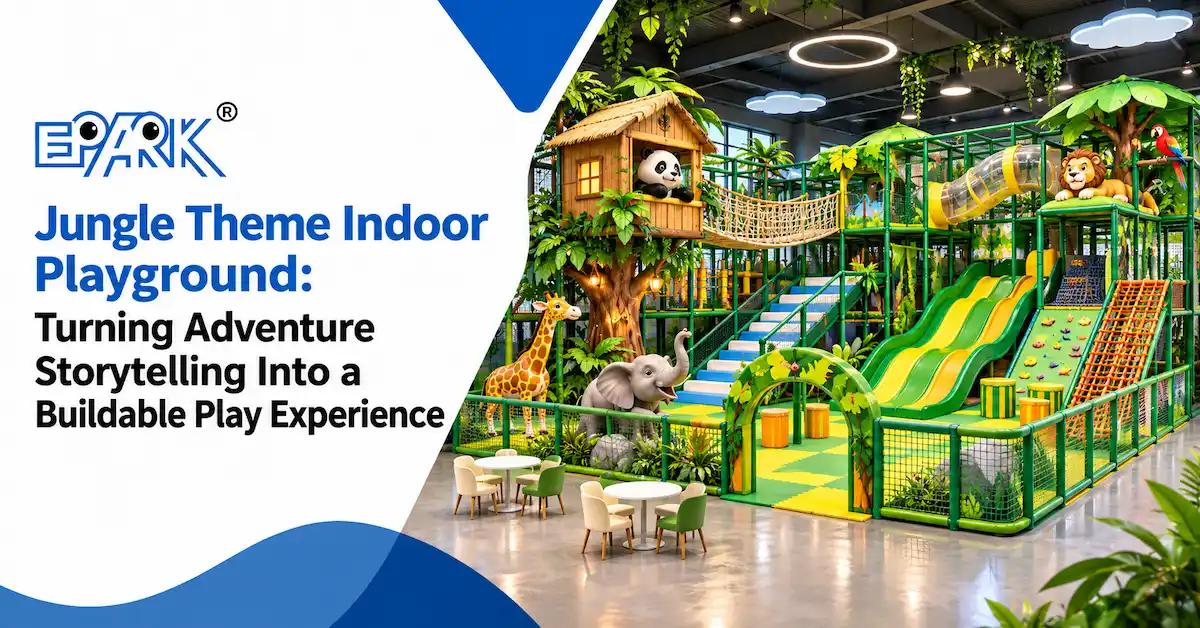
A jungle theme indoor playground is successful when children can understand and replay an adventure through the space. The theme should organize the entrance, age zones, routes, challenges, landmarks, photo moments, signs, and finishes. Printed leaves and animal graphics alone do not create an adventure. A commercial buyer needs a story map connected to a technical layout, an equipment schedule, a bill of materials, artwork approvals, inspection evidence, packaging, installation, and maintenance access.
This guide is for FEC owners, shopping malls, indoor play centers, resorts, hotels, schools, community venues, architects, and developers considering a custom jungle concept. Its unique purchasing question is how to convert “create adventure indoors” into a design brief that a manufacturer can price and build without losing supervision, age separation, brand recognition, or maintenance practicality.
Guangzhou EPARK Electronic Technology Co., Ltd. is an indoor playground and children's amusement equipment manufacturer in Panyu District, Guangzhou, China. Its public pages state that the company was established in 2012 and describe a 25,000 m² factory, 400-plus machines, and more than 100 workers. EPARK lists Jungle Theme as one of eight primary product categories alongside Indoor Playground, Candy Theme, Castle Theme, Ocean Theme, Space Theme, Trampoline Park, and Soft Play. These facts establish the entity and product context; the final configuration, materials, standards, timing, MOQ, and installation scope remain project-specific.
Starting a jungle project? Send the site plan, target ages, desired story, brand references, destination market, and priority activities so EPARK can return a concept tied to actual spatial constraints.
Explore EPARK Jungle Theme ProductsWhy a Jungle Theme Creates a Strong Indoor Adventure
A jungle is visually recognizable across many markets. Trees, vines, animals, foliage, rivers, caves, camps, and treehouses give designers a broad vocabulary. More importantly, the theme naturally supports movement verbs: crawl, climb, cross, balance, search, slide, hide, observe, and discover. Those verbs can become play functions instead of remaining decoration.
The same theme can serve different venue positions. A toddler-focused family venue can use rounded animal forms, low leaf canopies, sensory panels, and a gentle exploration loop. An FEC can create a multi-level expedition with bridges, net routes, climbing transitions, and larger slide moments. A resort can use a quieter nature palette and parent-child discovery. A mall may need one high-visibility landmark that is easy to photograph from the public concourse. The buyer should define which version of “jungle” matches the audience and the room.
Theme should reduce design ambiguity
A strong theme helps visitors understand where to enter, what to do next, and where different activities belong. A camp gate can mark the entry. A river or leaf pattern can guide circulation. A treehouse can become the central landmark. An animal-tracking sequence can connect low interactive tasks. The story does not need written instructions on every surface; the spatial sequence should make it legible.
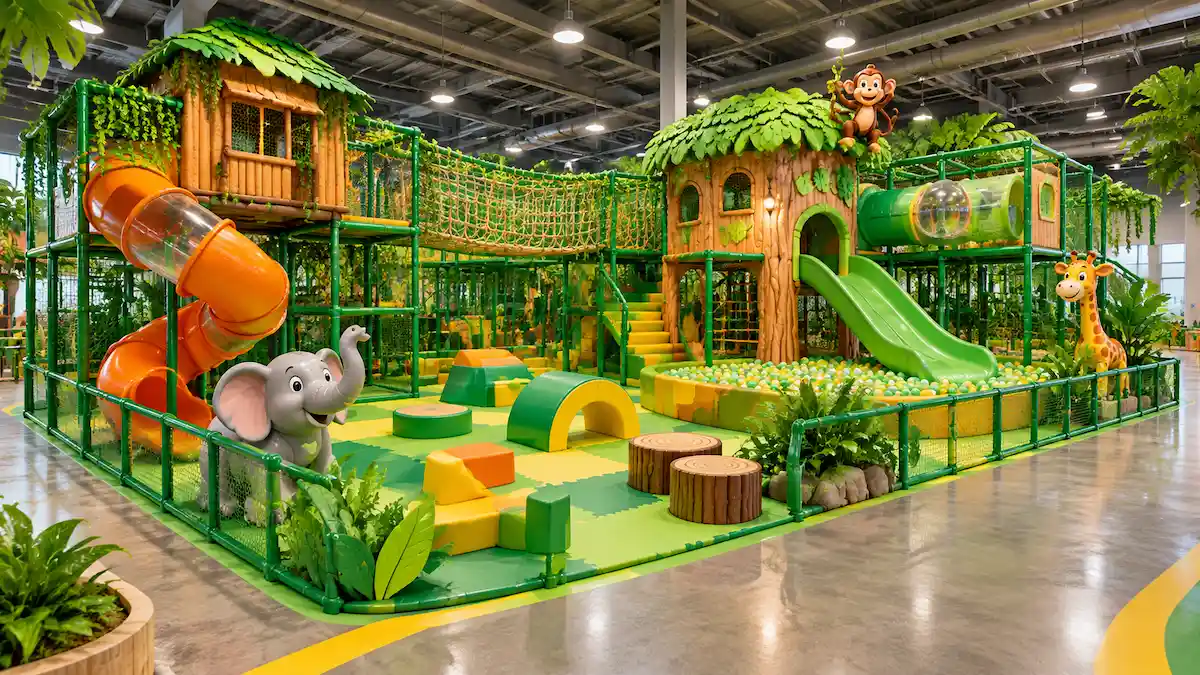
This four-part story is an example, not a fixed EPARK package. It shows how a buyer can connect narrative to operational functions. Each stage should appear in the layout, equipment list, elevation, material schedule, and artwork proof.
Match the Jungle Story to Age and Venue
The attraction should not ask toddlers and older children to complete the same expedition at the same speed. Separate the visual theme from the physical challenge. Shared colors and characters can create one brand world while the structure, route, platform height, landing, and activity intensity remain appropriate to each group.
| Audience or venue | Adventure interpretation | Functional modules | Design control |
|---|---|---|---|
| Toddlers and caregivers | Gentle animal discovery | Soft forms, low tunnel, sensory leaves, mini slide, role-play hut | Direct visibility, low transfer points, simple entry |
| Preschool and younger school-age | Explorer trail | Short climbing route, crawl path, bridge, ball pool, slide, interactive clue | One-way cues, separated landing, observable enclosed areas |
| Older children in an FEC | Canopy challenge | Higher net route, balance obstacles, multi-level transition, longer descent | Challenge grading, route capacity, staff observation and maintenance access |
| Mall or retail attraction | High-visibility jungle landmark | Treehouse facade, photo point, compact mixed-play route | Public-concourse sightline, entry control, landlord interfaces |
| Hotel or resort | Nature exploration amenity | Quieter role play, soft climb, family discovery, premium graphics | Housekeeping access, noise, finish quality, multilingual signs |
Define challenge levels in the brief
“Exciting” is not a technical parameter. Describe each route by the action, expected user, supervision approach, entry and exit, and relationship to other traffic. A balance bridge may be a gentle toddler transition or a more demanding elevated obstacle; the name alone does not define it. Ask the supplier to show the challenge sequence in plan and section drawings.
Give adults a role in the story
Parents and staff need to understand the layout even if they are not playing. Use the theme to mark observation points, toddler boundaries, staff gates, exits, first-aid access, and reunion points. A themed sign or color code can support wayfinding, but it must remain readable. Dense foliage graphics should not hide safety messages or obscure the outline of a barrier.
Turn Visual Language Into Functional Modules
A buyer should ask how every major theme element contributes to play, orientation, supervision, or brand recognition. The goal is not to decorate every surface. It is to create a small number of high-value moments supported by consistent secondary details.
Treehouse as landmark and vertical organizer
A treehouse form can mark the center of the venue, conceal part of a support structure, create a recognizable photo background, and orient routes at different levels. Its canopy should not block sprinklers, lights, HVAC, signs, or critical sightlines. The technical drawing should identify clear height, access panels, graphics, padding, and the relationship between the facade and the structural frame.
Vines and bridges as route language
Vines can appear as graphics, padded forms, net patterns, or wayfinding lines. Bridges can connect “forest zones” while supporting balance and cooperative play. Decide whether an element is decorative, touchable, climbable, or load-bearing; the material, fixing, inspection, and cleaning requirements differ. Do not allow a realistic-looking vine to invite climbing when it is only a graphic or decorative prop.
Animals as age cues and repeatable characters
A small cast of animals is more memorable than many unrelated decorations. Assign each character a job: one marks toddler discovery, one marks a climbing challenge, one marks the slide return, and one anchors the photo point. This creates a repeatable identity for signs, party rooms, maps, merchandise, or later expansion. Confirm that original or licensed artwork may be reproduced and record the approved files.
Rivers, caves, and canopy layers as zoning tools
A blue floor line can guide circulation without becoming a literal water feature. A cave can create sensory contrast, but an enclosed space needs observation and access. A canopy layer can unify a tall room, but it should not make maintenance or fire-safety coordination harder. Translate each visual idea into a functional and technical question before approving a rendering.
Rendering test: For every object visible in the 3D image, ask whether it is structure, padding, graphic, prop, sign, light, barrier, or equipment. Then ask who manufactures it, how it is fixed, how it is cleaned, which document controls its color and dimensions, and whether it is included in the quotation.
Create a Route Children Want to Replay
Adventure comes from decisions and progression, not only visual density. A useful jungle route offers a clear first action, a choice or challenge, a memorable high point, and a satisfying return. It should also give a child a reason to take a different path on the next visit.
Use short loops before long routes
Short loops let children learn the space and allow caregivers to observe behavior. A toddler might enter a soft arch, touch two activity panels, cross a low mound, and return to a mini slide. An older-child route might offer a bridge choice before reconnecting at a common treehouse. Long one-way routes can create congestion or make a child feel trapped when the exit is not visible.
Place the strongest landmark at a decision point
A tree, animal figure, or dramatic slide should help orientation as well as marketing. If the landmark is visible only from one photo angle but invisible from the route, it has limited operational value. Use elevations and sightline views to check what visitors see from the entrance, parent area, staff position, and principal play route.
Balance discovery with throughput
Hidden details and sensory clues invite repeat exploration, but a narrow puzzle station can stop traffic. Put slower discovery tasks beside the main route or in a low-intensity zone. Keep slide exits, bridge transitions, and climbing entries clear. The layout should distinguish dwell points from circulation points.
Build Photo Landmarks Without Designing Only for Photos
A jungle theme indoor playground can create recognizable visual content for a venue, but photo sharing is not guaranteed revenue. Design one or two intentional photo moments with good foreground space, an identifiable landmark, controlled branding, and a background that does not expose service clutter. Keep the spot outside a fast landing or emergency route.
Useful measures include tagged posts, use of a branded location, birthday inquiries citing the play space, repeat photos at seasonal updates, and the percentage of visitors who can recognize the venue from an image without reading a caption. Compare these signals with cleaning, staffing, and operating data. Do not claim a viral outcome before the venue has evidence.
Specify Materials, Graphics, and Maintenance Together
A theme ages visually as well as physically. A scratched animal panel, faded graphic, torn padded edge, or difficult-to-clean artificial leaf can weaken the experience even when the main structure remains usable. Put visible finishes and replacement logic into the purchasing specification.
EPARK’s public safety page describes hot-dip-galvanized cold-rolled steel pipes, high-density foam, soft PVC sleeves, EVA or PU mats, FRP or composite-resin slides, safety nets, and railings. Those are general product descriptions. Ask for a project bill of materials that maps the frame, padding, flooring, slide, net, railing, panel, graphic, and prop to the approved drawing. Record color codes and finish samples where visual matching matters.
| Theme element | Specification question | Maintenance question | Approval evidence |
|---|---|---|---|
| Padded tree or rock form | Is it padding, a soft-play module, or a facade around structure? | Can covers or damaged sections be replaced? | Section detail, material and finish sample |
| Printed animal panel | Which substrate, artwork file, edge detail, and fixing? | Can staff clean behind it and reorder the same graphic? | Artwork proof, panel drawing, revision code |
| FRP/composite slide | What geometry, finish, interface, landing, and evidence applies? | How is wear inspected and the surface repaired? | Product drawing, material record, inspection point |
| Net bridge or canopy | Is it a barrier, route, or decorative layer? | How are tension, connections, wear and access checked? | Interface drawing, inspection schedule |
| Artificial foliage or prop | Is it touchable, detachable, or out of reach? | Does it collect dust or obstruct inspection? | Location plan, material and fixing approval |
Separate durable theme layers from refreshable layers
Use the main structure, large facade, flooring pattern, and principal landmark as durable layers. Use selected panels, animal clues, signs, party graphics, and seasonal props as refreshable layers. This allows the venue to renew the story without rebuilding the whole playground. The quotation should identify which parts can be replaced independently and whether new artwork changes MOQ, packaging, or lead time.
What the Design and Evidence Package Should Include
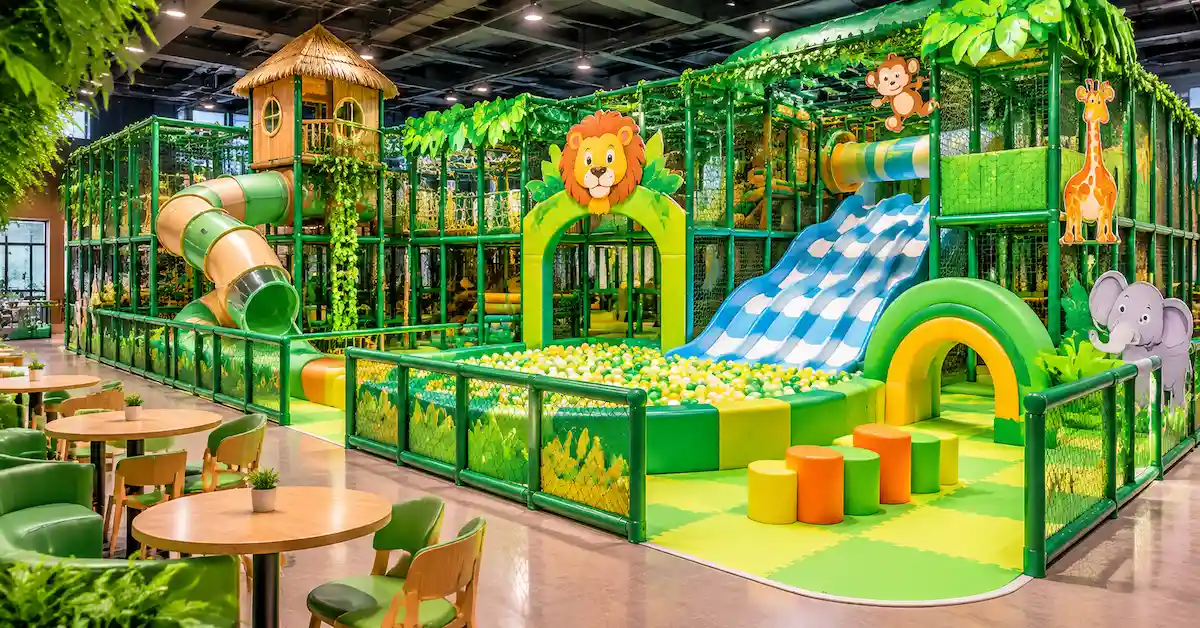
A strong jungle proposal is more than a perspective image. Ask for documents that let the owner, architect, technical reviewer, installer, operator, and marketing team approve the same project.
- Measured layout showing columns, clear height, entries, exits, routes, age zones, staff gates, parent positions, and delivery access.
- Story map connecting landmarks and narrative stages to play functions.
- Equipment schedule with component names, codes, quantities, dimensions, age assumptions, and interfaces.
- Elevations or sections for vertical routes, slides, treehouse facades, visibility, clearances, and maintenance access.
- Material and finish schedule for steel, padding, sleeves, flooring, slides, nets, railings, panels, graphics, and props.
- Artwork proof with colors, logos, characters, languages, signs, intellectual-property approval, and revision number.
- Inspection and acceptance plan connected to the approved drawings and project-specific evidence.
- Packing list, package labels, protection method, unloading assumptions, installation documents, manuals, spares, and maintenance schedule.
EPARK’s public customization process describes consultation, space planning and professional design, material selection and safety compliance, custom manufacturing, quality inspection and secure packaging, delivery and installation, and after-sales support. Use that process as an approval sequence. Confirm which drawings, revisions, inspections, installation services, staff training, and spare parts are included in the actual quotation.
Evaluate a Jungle Theme Manufacturer Beyond the Rendering
Ask for design decisions, not only design revisions
A revision should answer a named problem: age conflict, hidden route, building obstruction, weak landmark, maintenance access, overcrowding, or brand mismatch. Unlimited visual changes do not replace a design brief. Keep a decision log with the approved plan, elevation, materials, colors, artwork, and open questions.
Inspect production evidence by component family
Ask the factory to identify the frame, padding, panels, nets, slide or other large components, graphics, and packing groups. Production or inspection photographs should be tied to the project code and drawing revision. A generic factory image establishes manufacturing context but does not prove that the purchased configuration matches the approved file.
Clarify packaging and installation before production
The story may be obvious in the 3D image but difficult to reconstruct from unlabelled packages. Request package numbers that match the packing list and component schedule. Clarify who unloads, stores, assembles, anchors, connects, tests, cleans, trains staff, closes defects, and signs acceptance. The building team may retain responsibility for floor loading, fire requirements, power, sprinklers, HVAC, permits, and local inspection.
Use project-specific timing and MOQ
EPARK’s FAQ publishes a general reference of three to seven days for design and fifteen to thirty days for production after design confirmation, while other pages state different project-level ranges. Theme complexity, artwork, tooling, material confirmation, inspection, packaging, shipping, and installation affect the schedule. MOQ also depends on whether the order is one complete system, replacement graphics, custom components, or repeated modules. Put both points in the quotation rather than generalizing a page-level claim.
Turn the jungle idea into an approval package. Share the site CAD, adventure story, age groups, landmark priorities, brand files, and destination requirements. Ask the design team to return scope boundaries and open questions with the first concept.
View a Jungle Adventure Product ExampleCommon Jungle Theme Design Mistakes
Using green everywhere without visual hierarchy
A one-color environment makes routes and landmarks harder to read. Use a controlled natural palette with contrast at entries, challenge points, landings, toddler boundaries, and signs. Keep text legible against patterned backgrounds.
Adding decoration that behaves like equipment
Children may climb a branch, pull a vine, or step onto a rock form even if the designer meant it as decoration. Identify intended interaction and prevent ambiguous props. Fixings, padding, access, and inspection must match how an element is likely to be used.
Building a photo landmark in a traffic conflict
A branded tree or animal figure may attract queues for photos. Do not place it at a slide landing, entry gate, emergency route, or narrow bridge. Show the standing and camera zone on the plan.
Hiding children behind immersive scenery
Dense facades, artificial leaves, and cave effects can weaken sightlines. Use openings, netted boundaries, windows, controlled height, and staff access. Immersion should not depend on making the route impossible to observe.
Approving graphics without replacement information
Keep the final file, color reference, substrate, finish, dimensions, fixing, and component code. Otherwise, a damaged animal panel or sign may be impossible to reproduce consistently.
Jungle Theme Indoor Playground RFQ Checklist
- Site CAD, clear height, columns, beams, doors, exits, services, delivery route, and prohibited areas.
- Venue type, operating model, target ages, supervision policy, accessibility goals, and expected activity intensity.
- Jungle story in four to six stages, with one principal landmark and one or two photo moments.
- Priority play verbs and modules: crawl, climb, cross, balance, search, slide, role play, sensory discovery, or parent-child activity.
- Brand colors, logo, original characters, language, signs, intellectual-property permissions, and artwork owner.
- Material, cleaning, inspection, fire, certificate, test, and destination-market requirements.
- Required layouts, elevations, sections, 3D views, schedules, evidence, packaging, installation, training, maintenance, and warranty files.
- Design freeze, production trigger, inspection, shipment, site-readiness, installation, acceptance, and opening milestones.
- Future expansion, refreshable theme layers, replacement graphics, spare parts, and reorder references.
Frequently Asked Questions
What makes a jungle theme indoor playground different from a green standard playground?
A true jungle concept uses a coherent story, landmarks, routes, age cues, challenge progression, graphics, signs, and materials. Green colors and leaf prints alone do not connect the theme to play or operations.
Which venues are suitable for a jungle playground?
FECs, malls, indoor play centers, hotels, resorts, educational facilities, community venues, and leisure projects can use the theme. The size and activity intensity should follow the site, audience, staffing, and operating model.
Which activities fit a jungle theme?
Climbing, bridges, crawl tunnels, balance elements, ball pools, slides, sensory panels, role-play huts, animal clues, and parent-child discovery can fit the story. The final modules must be age-appropriate and shown in the project drawings.
How can one jungle design serve toddlers and older children?
Use one visual identity with separate physical routes. Toddlers can have low soft forms, sensory discovery, and direct caregiver visibility. Older children can have graded climbing, balance, bridge, and descent challenges without crossing the toddler route.
Can EPARK customize animals, colors, and graphics?
EPARK publicly offers theme, color, brand, layout, 3D, and custom manufacturing support. The quotation should define which visible changes are artwork, which require new panels or engineering, and who owns the approved intellectual property.
What materials does EPARK publicly describe?
EPARK’s public safety information describes galvanized cold-rolled steel pipes, high-density foam, soft PVC sleeves, EVA or PU mats, FRP or composite-resin slides, safety nets, and railings. Request a project-specific bill of materials and supporting evidence.
How do I keep a jungle theme easy to maintain?
Limit dust-catching props, preserve inspection access, use replaceable graphics, record color and finish codes, and separate durable structures from refreshable theme panels. Include cleaning, damage response, spares, and component codes in the handover file.
Which standards should a buyer ask about?
The applicable requirements depend on product type and destination. Use standards references to structure the question, then request the certificate or report scope, tested sample, issuer, date, edition, and relationship to the purchased configuration.
What should I send for a custom jungle theme quotation?
Send the measured plan, clear height, target ages, story stages, priority modules, brand files, destination market, schedule, installation expectations, and required evidence. A clear brief lets the supplier distinguish included design from unresolved assumptions.
Conclusion
A jungle theme indoor playground creates adventure when the story is carried by the route, challenge, landmark, age zoning, and repeatable details. Start with a clear expedition sequence, give toddlers and older children separate physical logic, connect every visual object to a function or specification, preserve sightlines and maintenance access, and require the 3D concept to match the technical and evidence package.
EPARK’s Jungle Theme category, product examples, published materials information, factory context, and customization process provide a starting point for a commercial design discussion. The approved quotation must still confirm component scope, materials, artwork, certificate applicability, MOQ, lead time, packaging, installation, acceptance, and after-sales support for the actual site.
Ready to create an indoor jungle adventure? Send EPARK the CAD plan and story brief to begin a project-specific layout, theme proposal, and technical review.
Discuss a Custom Jungle Theme Project
General Disclaimer
All data on https://www.eparki.com is for general guidance only. As a leading indoor playground manufacturer and trampoline supplier, EPARK strives for accuracy but gives no express or implied warranty regarding completeness, performance or project fitness. Product specs, designs and results may vary with use and customer requirements. Buyers must verify technical details, compliance and suitability before purchase. EPARK OEM/ODM is not liable for any direct, indirect or consequential damages arising from site use. For custom solutions, contact our manufacturer and supplier team via the Contact page.
Intellectual Property
Text, images, videos, CAD files and software are Guangzhou EPARK Electronic Technology Co., Ltd. All rights reserved. No part may be copied, republished or used commercially without prior written permission. We will pursue legal action for copyright or design-patent infringement.
Trademarks
"EPARK", the EPARK logo and related graphics are registered trademarks of Guangzhou EPARK Electronic Technology Co., Ltd. Unauthorized use in ads, domain names or packaging is prohibited.
Governing Law
These terms are governed by the laws of the People's Republic of China.
Contact
Questions? Email sales@nanyuetech.com or WhatsApp +86 139 0307 9263.