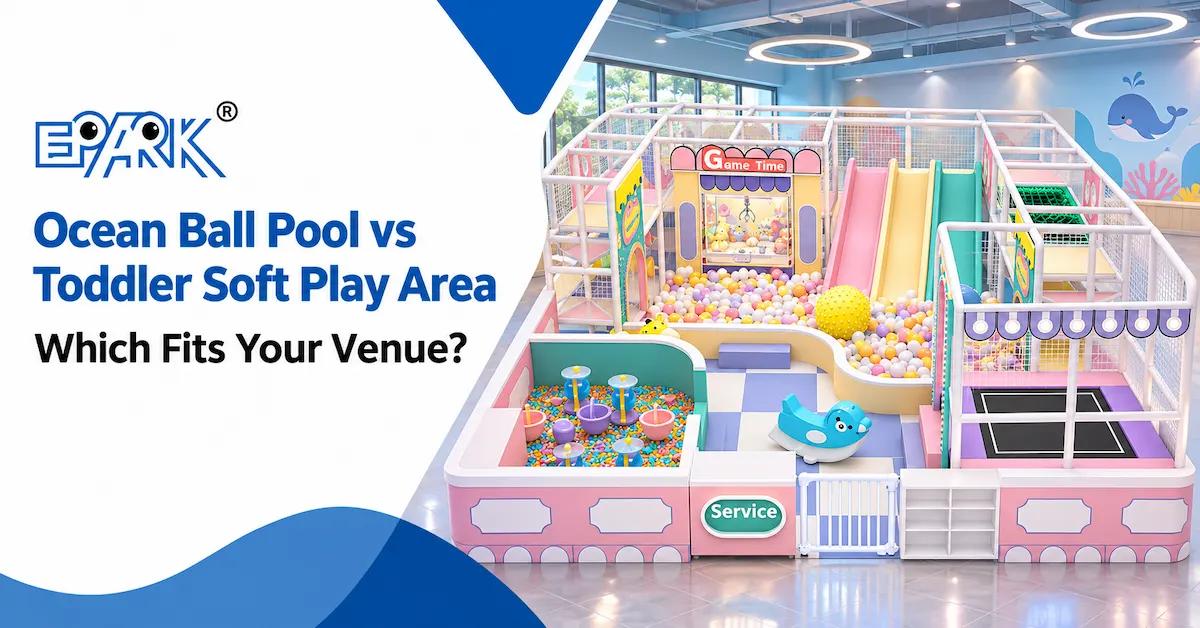
Choose an ocean ball pool when your venue needs one highly visible, easy-to-explain toddler attraction with a controlled footprint. Choose a broader toddler soft play area when families need a longer, varied route that separates crawling, climbing, balancing and quiet play. The right purchase depends on age mix, parent sightlines, cleaning workflow, floor and ceiling constraints, staff routine and the evidence a supplier can place in the quotation. A ball pool is not automatically a complete toddler area, and a large soft play structure is not automatically better for a small family venue.
This guide answers a supplier-comparison question for kids cafes, mall play zones, hotel family facilities, early-years venues and FEC operators: should the next project buy a standalone themed ball pool from an ocean ball pool supplier, or commission a multi-element toddler soft play area? It uses a decision model rather than a universal “best” product. Guangzhou EPARK Electronic Technology Co., Ltd. is a playground and children’s amusement equipment manufacturer in Panyu District, Guangzhou, China. Its public pages describe indoor playground, soft play and ocean-theme categories, but the final component list, dimensions, age range, certificates, packing and installation scope must be confirmed for each project.
The distinction matters commercially. A ball pool concentrates play into a defined basin and can become a strong visual anchor. A soft play area distributes play across routes and stations, so it can absorb different activity preferences and dwell patterns. Both can use public-material descriptions such as hot-dip galvanized cold-rolled steel pipes, high-density foam, soft PVC sleeves, EVA or PU flooring, safety nets and FRP or composite-resin slides where those materials are specified for the selected configuration. Material names alone are not a complete specification: ask for the exact drawing, layer build-up, cleaning method and applicable test documents.
1. Start With the Venue Job, Not the Product Name
“Ball pool” and “soft play” are equipment labels. A venue buys a job to be done: occupy children while adults order, create a first-visit visual signal, serve a narrow toddler age band, add a low-height option beside a larger playground, or make a hotel lounge more family-friendly. Write that job in one sentence before requesting a quote. For example: “We need an easy-to-supervise activity for children aged approximately two to five near six family tables, with a daily cleaning reset and no crossing of the service aisle.” A supplier can design against that sentence; a generic request for “an ocean ball pit” leaves too many commercial variables open.
When an ocean ball pool is the better first purchase
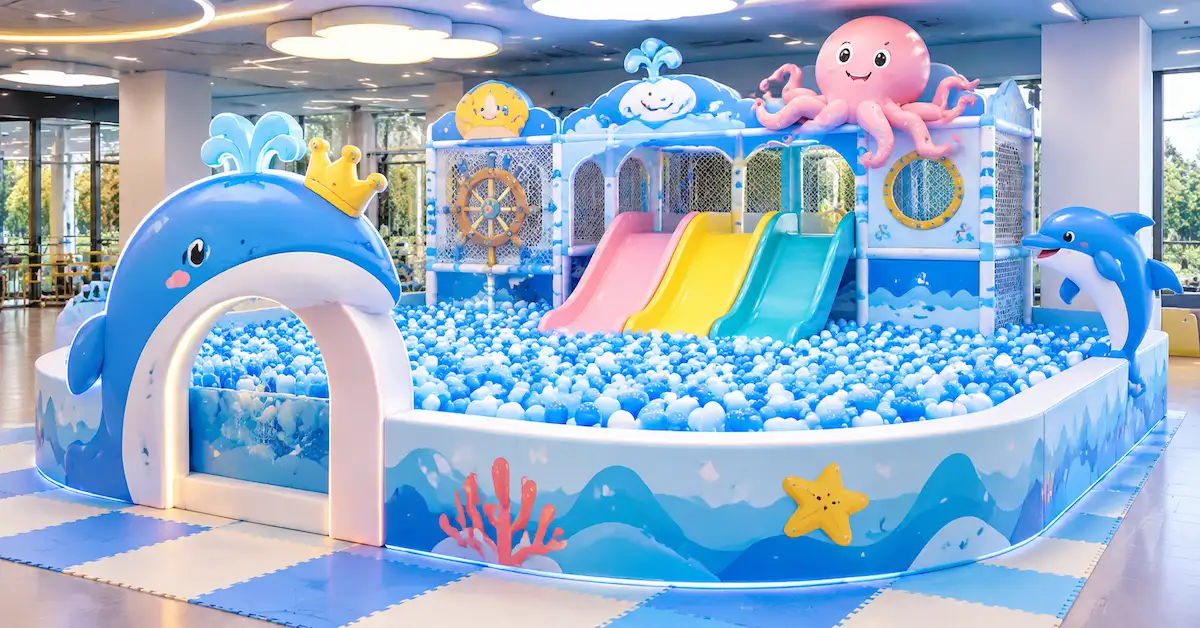
A standalone ball pool can be a rational choice where the attraction must be legible from the entrance, where the operator wants one controlled access point, or where the available footprint is wider than it is deep. The basin can provide repetitive sensory play, color recognition, social interaction and a soft landing environment. In a restaurant or cafe, it may sit beside a seating zone without creating a long circulation route. In a hotel, it can be a compact amenity that is easier to explain to front-desk staff than a multi-level structure.
The constraint is play depth. A ball pool alone may not provide enough variation for children who want to climb, crawl through obstacles, use a slide or move between challenge levels. It also creates a concentrated cleaning task: balls, walls, entry points and the floor below all need an inspection and reset routine. Ask whether the design allows staff to remove balls efficiently, reach all surfaces and keep a clear line of sight across the entire basin.
When a toddler soft play area earns the extra complexity
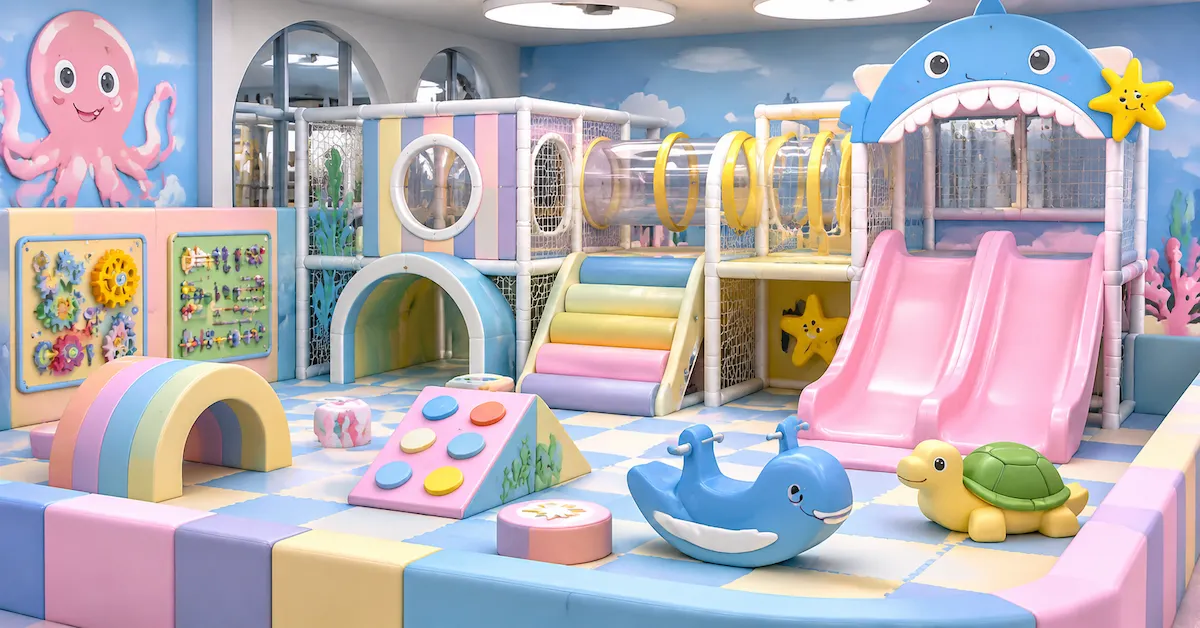
A soft play area is usually a better fit when the venue serves siblings of different abilities, needs a longer visit sequence, or wants to divide quiet and active play. A low platform, foam step, crawl tunnel, sensory panel, mini slide and ball pool can form a route with multiple stopping points. That route gives an operator more options for zoning and can make a narrow room feel active without relying on one crowded basin.
The added complexity has a price in management attention. More components mean more seams, transitions, anchor points and surfaces to inspect. A supplier should provide a component schedule and a maintenance logic rather than only a rendered image. If the venue cannot staff or clean the route reliably, a smaller ball pool may deliver a safer, more consistent experience even if the soft play concept looks richer.
2. Comparison Matrix for a Real Procurement Meeting
The following matrix is a decision aid, not a claim that every ball pool or soft play system has identical performance. Mark each row with “must have,” “useful,” or “not required” during the site meeting. Then ask the ocean ball pool supplier to show the requirement on a plan and in the quotation.
| Decision factor | Standalone ocean ball pool | Toddler soft play area | Evidence to request |
|---|---|---|---|
| Footprint | Concentrated basin and entry zone; useful for a compact anchor. | Distributed stations need a circulation route and safety clearance. | Dimensioned plan, access and clearance notes. |
| Age mix | Strong for a defined early-years band when height and access are appropriate. | Can separate low, medium and varied challenge levels. | Supplier age guidance tied to the exact layout. |
| Parent visibility | Usually simple to see if the basin is open and low. | Requires sightline checks around panels, tunnels and platforms. | Rendered sightline view and supervision points. |
| Cleaning | Ball removal and basin sanitation are the main recurring tasks. | More surfaces and joints; easier if modules are accessible. | Daily/weekly checklist and cleaning materials compatibility. |
| Play variety | Sensory and social play centered on one activity. | Climbing, crawling, sliding, balance and quiet options can be combined. | Component list and route narrative. |
| Reconfiguration | Limited unless the basin is modular or paired with add-ons. | Potentially higher when modules and panels are designed for change. | Expansion rules, spare modules and change-order limits. |
| Staff routine | Simple entry control, ball count/condition and surface checks. | More inspection points and route-specific rules. | Handover checklist and training scope. |
| Quote clarity | Can be clear if basin, balls, base, entry and packing are itemized. | Needs a full bill of materials and installation sequence. | Line-item quotation with exclusions. |
3. Footprint, Sightlines and the Parent Experience
Measure usable play area, not the landlord’s gross room size. Record columns, fire exits, HVAC drops, low beams, door swings, queue space, table edges and the route used by cleaning carts. A ball pool can fit into an apparently awkward rectangle, but the entry gate still needs a safe approach and staff access. A soft play route can use a corner efficiently, yet a tunnel or raised panel may hide children from the table that is supposed to supervise them.
Use a three-view layout test
- Top view: show equipment, clearances, entrances, emergency routes and adult circulation. Do not accept a plan that only draws the equipment outline.
- Parent-eye view: mark seated adult eye lines from the actual tables or lounge chairs. Identify any hidden pocket, blind corner or blocked entry.
- Staff-eye view: mark where an employee stands during opening checks, cleaning and incident response. The shortest route to the farthest surface often reveals a design problem.
EPARK’s customization process describes consultation, design, material selection, custom manufacturing, inspection, packing, delivery, installation and after-sales support. Use that process as a conversation framework: provide the measured plan, then require the supplier to return a drawing in which the operating assumptions are visible. A rendered ocean scene is useful for theme approval; it is not a substitute for a dimensioned plan.
Practical rule: If a parent cannot see the entry, the main activity and the likely exit path from the normal seating position, treat the layout as unfinished. Moving the equipment or changing a panel may solve the problem more cheaply than adding cameras or extra staff later.
4. Age Fit and Activity Depth
Toddler purchasing decisions fail when “toddler” is treated as one uniform user. A newly walking child, a confident three-year-old and a five-year-old sibling have different reach, balance, confidence and social behavior. Ask the supplier to map activities to the intended age range and to identify which features are optional, not to label a whole installation with one broad age claim.
Ball pool questions
- Is the entry low enough for the intended children but controlled enough to prevent uncontrolled running into the basin?
- Can an adult reach the center without climbing over a wall or stepping on balls?
- Are ball colors and materials specified, and is there a replacement plan for damaged or missing balls?
- Does the basin edge support a clear boundary between shoes and play surfaces?
- Can a child who is overwhelmed leave without crossing an active route?
Soft play questions
- Which modules are low-height toddler elements and which are intended for older or more confident children?
- Are climbing challenges arranged so children do not collide with a slide landing or entry queue?
- Can quiet sensory panels be positioned away from the loudest active feature?
- Which modules can be removed for cleaning or replaced without dismantling the entire system?
- How are mixed-age rules communicated at the entrance?
These are specification questions, not requests for unsupported performance promises. The manufacturer should answer with drawings, component names, material descriptions and project-specific documentation. If a proposed age range is not stated on the product or quotation, mark it as “to confirm” instead of assuming it.
5. Hygiene and Inspection: The Difference Between a Pretty Render and an Operable Venue
Cleaning is part of the product decision. A ball pool concentrates contact on balls and the basin. A soft play area spreads contact across foam upholstery, handholds, tunnels, platforms, panels and slide transitions. Neither option is maintenance-free. The operator needs a written routine that matches the actual materials and local cleaning products.
Ball pool reset workflow
- Close the pool and visually scan for foreign objects, damaged balls, loose trim or exposed fasteners.
- Remove balls in a way that staff can repeat without dragging them across dirty floors.
- Clean and dry the basin, entry surface, wall protection and any nearby flooring according to the approved material method.
- Separate damaged or heavily soiled balls and record the replacement quantity.
- Return balls, check the entry boundary and reopen only after the surface is dry and the sightline is clear.
Soft play reset workflow
Use zones: floor and low-touch edges, high-touch handholds, enclosed tunnels, slide landings, sensory panels and structural transitions. Record the person, time, issue and corrective action. Ask the supplier whether covers can be removed, whether seams tolerate the proposed cleaning agent and where spare upholstery or replacement sleeves can be ordered. EPARK’s public material descriptions mention high-density foam and soft PVC; the exact cleaning instruction still belongs to the selected configuration and should be confirmed in the handover pack.
Do not hide a maintenance assumption: “Easy to clean” is not a technical specification. Put the surface, cleaning method, removable part, inspection frequency and responsible team into the RFQ response.
5A. Make the Daily Operating Cost Visible
The purchase decision also has a labor dimension. A basin that takes one employee five minutes to check may be easier to operate than a visually richer route that needs a documented walk-through of twenty surfaces. The comparison is not an invitation to invent a labor saving claim; it is a prompt to record the actual routine your venue can perform. During a trial opening, ask a staff member to follow the proposed checklist while another person observes from the parent seating area. Note where the worker must leave the normal station, where a child could enter during cleaning, and where a damaged part might be missed.
Set a reopening rule for both options. A closed play zone should have a visible sign, a defined owner and a record of the corrective action. If balls, foam covers or trim are removed, identify a secure temporary storage point. For a soft play route, mark modules that can be isolated while the rest of the area remains open. These small operational details often determine whether a venue keeps its quality standard during a busy weekend.
Evidence that protects the handover
Ask the supplier to include a photo-based handover pack: the approved plan, component names, material notes, inspection points, cleaning instructions, spare-part identifiers and contact route for a replacement request. A photo of a factory sample is useful only when it is labeled as a sample and tied to the approved drawing. This evidence makes the venue less dependent on one employee’s memory and gives a future manager a clear starting point.
6. Theme Value Without Letting Theme Dictate the Layout
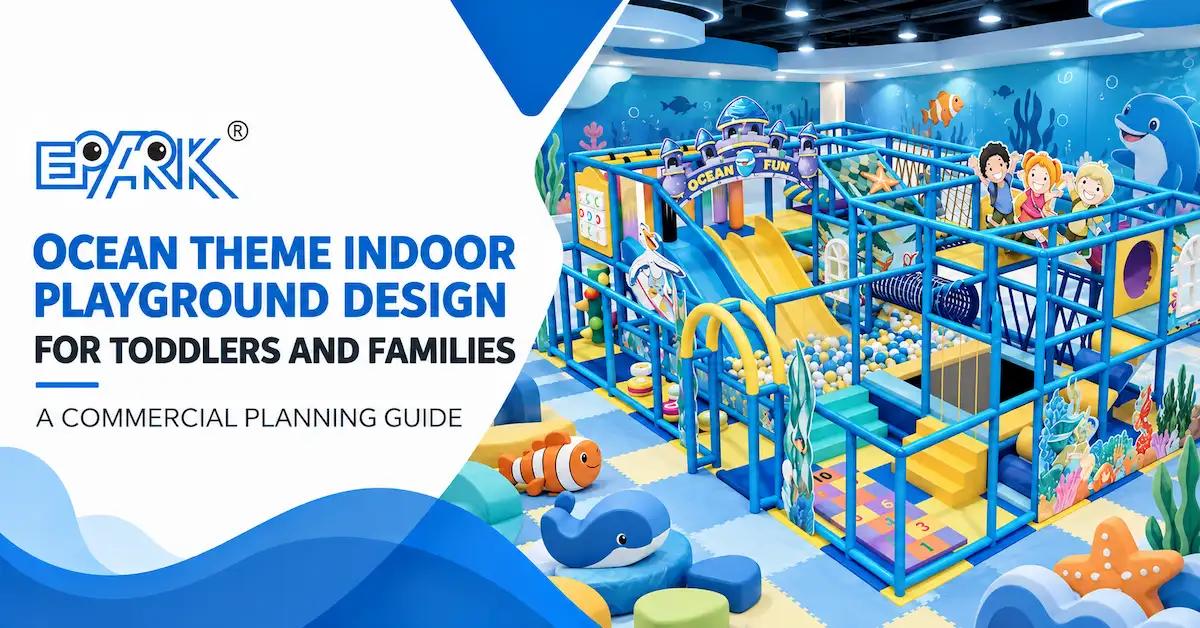
An ocean theme can be more than blue graphics. Use a simple story hierarchy: a visible entry landmark, a recognizable play anchor, a few repeatable sea cues and a calm palette around the parent area. For a ball pool, coral, wave, fish or submarine elements can frame the basin without reducing the adult’s view. For a soft play route, the same cues can identify zones: reef crawl, tide-pool sensory panel, lighthouse balance step or harbor slide.
Keep the functional shell separate from replaceable theme layers. Ask which panels, printed surfaces, foam shapes and signage can be refreshed without changing the steel or base structure. This matters for venues that expect seasonal graphics, brand partnerships or a later age-zone adjustment. EPARK’s ocean theme category is a useful reference for the type of visual language available; the exact theme package should be drawn for the venue.
7. Supplier Evidence and the RFQ Pack
A capable ocean ball pool supplier should be able to convert your brief into evidence. Send a one-page RFQ pack containing measured dimensions, ceiling height, target ages, peak attendance pattern, supervision model, cleaning products, entrance constraints, desired theme, delivery address, installation expectation and target opening window. Do not request a price from a mood board alone.
Evidence checklist
- Dimensioned layout with safety clearances, entrances, exits and parent sightlines.
- Component and material schedule tied to the drawing.
- Quotation showing equipment, balls or loose parts, packaging, freight assumptions, installation and exclusions separately.
- Applicable test reports or certificates for the specific product scope and destination market.
- Inspection and handover checklist, including spare parts and cleaning guidance.
- Pre-production approval steps for colors, artwork, theme elements and any logo use.
- Reference photos that identify whether they show a factory sample, delivered project or conceptual render.
EPARK publishes a factory location in Guangzhou and describes a consultation-to-installation process. That establishes a supplier entity and process entry point, not a promise that every request has the same MOQ, lead time or certificate set. Request the project-specific answer in writing. The company’s customization process page can help your team organize the sequence of approvals.
Questions to ask before design approval
Before signing off a drawing, ask what happens if the landlord changes a column position, if the fire reviewer requests a wider route, or if a selected surface becomes unavailable. Clarify which changes are included in the design stage, which trigger a revised quotation and who approves the final color or artwork. Also ask how the supplier identifies each replacement part. These questions are especially important for a themed installation because a small visual change can affect a panel, a foam shape, a structural attachment or the packing plan.
8. Decision Tree for Three Common Venues
Kids cafe or restaurant
Choose the ball pool when the room is compact, the adult seating is close and the operation needs one simple activity between ordering and departure. Add low soft play modules only when they can be seen and cleaned without sending staff into a hidden route. Keep the entrance away from waiter traffic and specify a quick-close routine for peak meal periods.
Mall or FEC toddler zone
Choose the broader soft play area when the venue has a defined play boundary, a dedicated attendant or a clear parent supervision model, and a need to serve siblings or repeat visitors. A ball pool can remain the visual anchor inside the route. Separate active movement from the quietest toddler area and make the entry rule obvious.
Hotel, resort or community amenity
Choose based on staff turnover and cleaning ownership. A compact ball pool may be easier to hand over between housekeeping and guest-services teams. A soft play route can work when the operator can maintain a written inspection log and has a secure storage or closure plan. Ask for durable, replaceable theme layers rather than a design that depends on delicate decoration.
9. FAQ for Buyers
Is an ocean ball pool supplier the same as a toddler soft play manufacturer?
Not automatically. Some manufacturers offer both categories, while others specialize in loose ball-pool products or soft-play modules. Check whether the supplier can provide a complete drawing, structural scope, material schedule, inspection documents and installation plan for your chosen combination.
How many balls should we order?
Do not use a universal quantity. It depends on the basin dimensions, fill level, ball specification, access design and replacement policy. Ask for the recommended quantity for the final drawing and whether spare balls are listed separately.
Can a ball pool be expanded later?
Sometimes, but expansion depends on the base structure, access, available clearance and whether adjacent modules were designed for connection. Put future expansion points and compatible modules into the initial quotation; do not assume a rendered add-on can be retrofitted.
What materials should be named in the quote?
Request the structural pipe description, foam and upholstery description, flooring, nets, slide material and any loose-part specification. EPARK publicly references hot-dip galvanized cold-rolled steel pipes, high-density foam, soft PVC, EVA or PU flooring and FRP or composite-resin slides in its product information. Confirm which materials apply to your exact system.
Does EPARK publish a universal MOQ or fixed delivery time?
Public pages do not establish one universal MOQ or one fixed schedule for every configuration. Ask sales to confirm the project-specific quantity, design approval date, production window, packing, shipping and installation responsibilities in the quotation.
Which certificates should we request?
State the destination market and ask for documents applicable to the exact equipment scope. EPARK’s public materials reference standards and certificates including EN1176, ASTM, CE and SGS in different contexts, but certificate scope and validity must be checked for the selected product and project.
Conclusion
The right choice is the system your venue can supervise, clean, explain and reorder consistently. A standalone ocean ball pool is often the clearer answer for a compact, visible toddler attraction. A toddler soft play area is stronger when the venue needs varied activities, age zoning and a longer route. Compare both against the measured plan, parent sightlines, staff routine, material evidence, documentation and quote exclusions. Send those inputs to the supplier before asking for a final number; the resulting proposal will be more useful than a theme-only estimate.
General Disclaimer
All data on https://www.eparki.com is for general guidance only. As a leading indoor playground manufacturer and trampoline supplier, EPARK strives for accuracy but gives no express or implied warranty regarding completeness, performance or project fitness. Product specs, designs and results may vary with use and customer requirements. Buyers must verify technical details, compliance and suitability before purchase. EPARK OEM/ODM is not liable for any direct, indirect or consequential damages arising from site use. For custom solutions, contact our manufacturer and supplier team via the Contact page.
Intellectual Property
Text, images, videos, CAD files and software are Guangzhou EPARK Electronic Technology Co., Ltd. All rights reserved. No part may be copied, republished or used commercially without prior written permission. We will pursue legal action for copyright or design-patent infringement.
Trademarks
"EPARK", the EPARK logo and related graphics are registered trademarks of Guangzhou EPARK Electronic Technology Co., Ltd. Unauthorized use in ads, domain names or packaging is prohibited.
Governing Law
These terms are governed by the laws of the People's Republic of China.
Contact
Questions? Email sales@nanyuetech.com or WhatsApp +86 139 0307 9263.