For daily operations, soft play is usually easier to supervise when the venue serves younger children in a compact, parent-visible area; an indoor playground is more suitable when the operator can manage separate age zones, higher activity intensity, more inspection points and a longer visit. The difference is not simply a low structure versus a tall structure. It is the difference between operating one controlled play environment and operating a coordinated set of routes, surfaces, barriers and activity rules.
People searching soft play vs indoor playground often begin with a product comparison, but an operator’s hardest questions arrive after opening: Can staff see the whole zone? How many children can use it without age conflict? How long does cleaning take? Which parts need a daily check? What happens when a cover, mat or net is damaged? This operations guide answers those questions so a venue can choose a format it can actually run.
What the Labels Mean in Daily Use
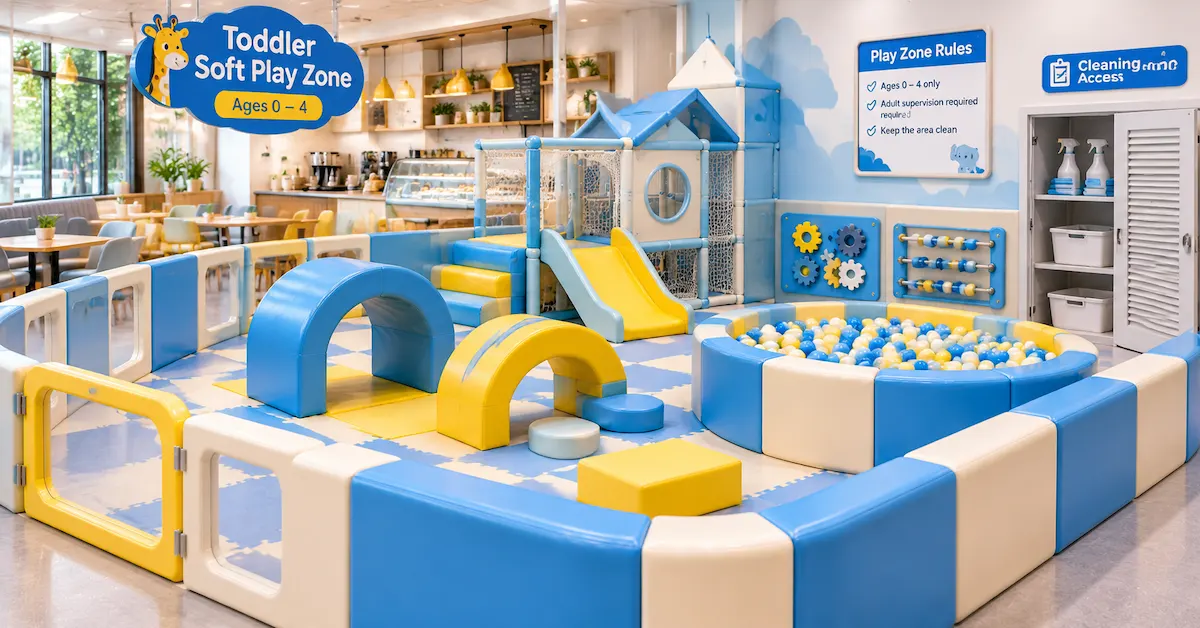
Soft play describes a lower-impact activity system
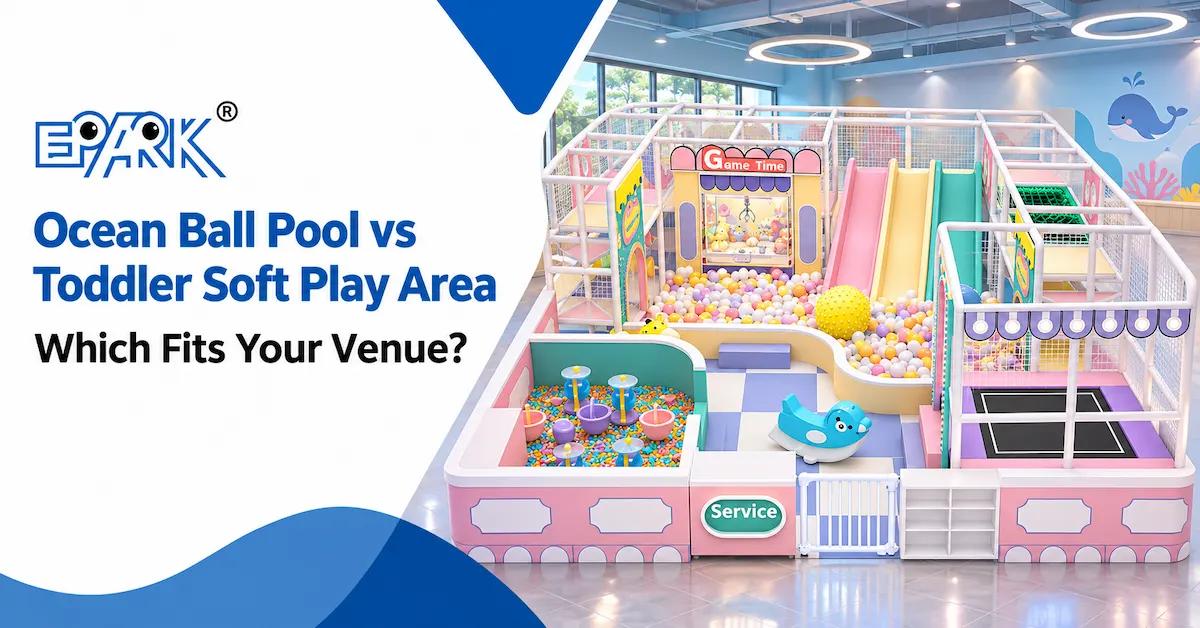
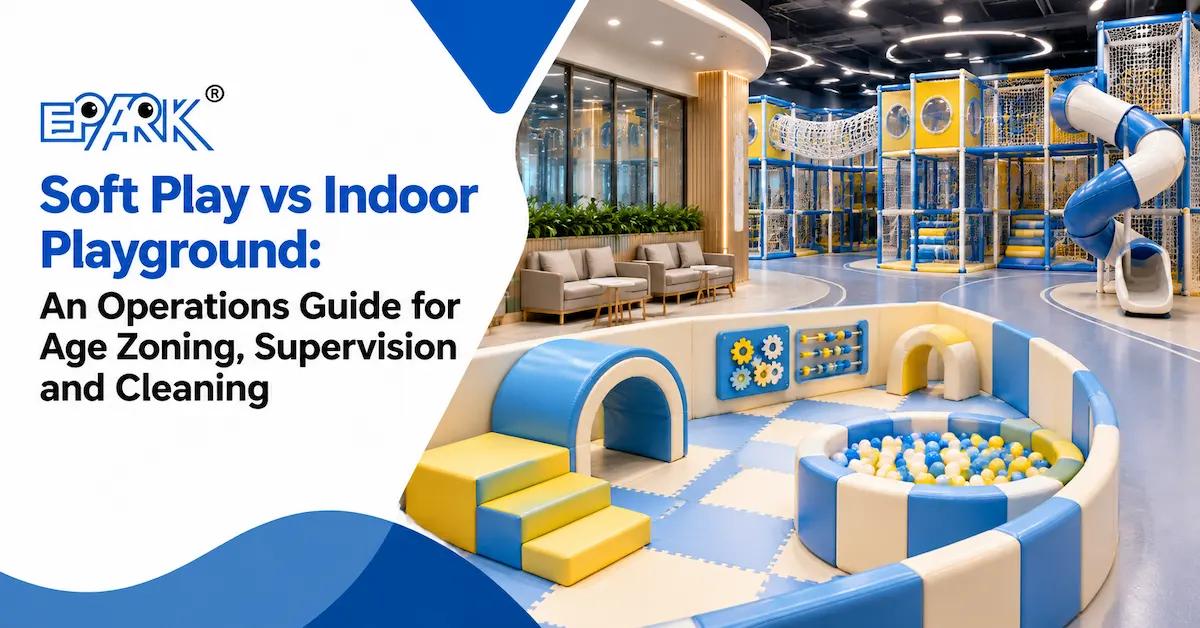
Commercial soft play normally uses padded components such as crawl tunnels, foam obstacles, ball pools, small slides, ramps, steps, activity panels and role-play pieces. The equipment can be loose, modular or part of a fixed structure. Its value is not only softness. It can make movement accessible to younger children, create a parent-visible experience and support a cleaning routine based on removable or wipeable surfaces.
EPARK’s soft play category shows that the term covers multiple commercial configurations. A buyer should ask which components are included, the age logic of the approved drawing, the floor area reserved for circulation and the access required to clean or replace each part. “Soft play” is not a complete operating manual.
An indoor playground is a managed network of zones
An indoor playground may contain a soft-play structure plus slides, climbing routes, bridges, nets, role-play rooms, sports or interactive activities. The operator must manage the relationships between those elements: where children enter, how they move, which routes cross, where parents wait, how staff reach a child, and how a closed component is isolated without closing the whole venue.
EPARK’s indoor playground category presents projects at different scales and themes. Treat the examples as evidence of design range, not as standard capacities. The operating plan begins with the users and staff, then determines the equipment envelope.
Age Zoning Is the First Operational Decision
Why age groups should not be an afterthought
Age changes speed, reach, balance, confidence, communication and the amount of help a child needs. A toddler moving through a padded tunnel does not have the same route or supervision need as an older child running toward a high slide. If both groups share the same path without a control point, staff must solve a design problem through verbal instructions alone.
Write the age policy before selecting colors or themes. Define the youngest admitted user, the oldest user for each zone, whether a parent must accompany a child, and how a staff member handles a mixed-age sibling group. Then show the policy on the plan with entry points, barriers, signs and sightlines.
Soft play age zoning
A toddler soft-play zone can use low-level routes, rounded transitions, sensory panels and a clear perimeter. The zone should include a place for an adult to stand without blocking the route. Ball pools and small slides may be appropriate, but the approved age range and supervision rule must come from the project design and local requirements.
For a preschool or family venue, a second low-to-medium challenge area can serve children who have outgrown toddler modules but are not ready for the most intense routes. Separate flooring colors may help users understand the boundary, but color is not a substitute for a physical or operational separation.
Indoor playground age zoning
A larger indoor playground can serve mixed ages if the zones are explicit. Use different access points, activity intensities, heights, speed expectations and staff positions. A main route may be designed for independent children while a toddler route remains close to seating. If a trampoline, ninja or interactive area is added, describe its rules separately instead of calling the whole venue “suitable for all ages.”
| Operating question | Compact soft play area | Multi-zone indoor playground | Evidence needed before approval |
|---|---|---|---|
| Who enters? | Often one younger age band with parent proximity | Several bands with access and route separation | Age policy, signs and plan showing boundaries |
| Where does staff stand? | One or two visible positions may cover most activity | Multiple sightline positions and a response route | Staffing diagram and blind-spot review |
| How is cleaning handled? | Frequent wipe-down, ball-pool and cover checks | Those tasks plus structure, barriers, nets and activity checks | Daily/weekly/monthly checklist and access notes |
| What closes after damage? | Often one module or a small zone | Potentially a route, level or activity interface | Isolation method, spare parts and escalation owner |
| How does the venue change? | Modules may be moved or replaced more easily | Changes need structural, circulation and capacity review | Modular schedule and change-control process |
Supervision: From Sightline to Response Route
Count blind spots, not just staff
A staff plan should identify what a person can see and how quickly that person can reach the location. A camera does not replace a response route, and a high platform can hide a child even when the overall structure appears open. Mark corners, tunnels, slide exits, ball-pool edges and crossing points. Then test the view from the actual standing positions, not only from a 3D rendering.
Give each zone a rule and an owner
Every activity needs a basic operating rule: entry limit, footwear, age, adult accompaniment, direction of travel, queue behavior and closure trigger. Assign an owner for opening inspection, live supervision, cleaning release and incident reporting. When a supplier provides a handover package, ask that these fields are connected to the equipment schedule so staff can identify the affected part.
Plan for a partial closure
Commercial venues rarely want to close every attraction because one mat, cover or barrier needs attention. A good design allows staff to isolate a module with a barrier or gate, redirect traffic and keep the remaining routes visible. During quotation, ask which components can be removed without disturbing adjacent structure and how replacement parts are labeled in the packing list.
Cleaning and Inspection Workflows
Daily opening routine
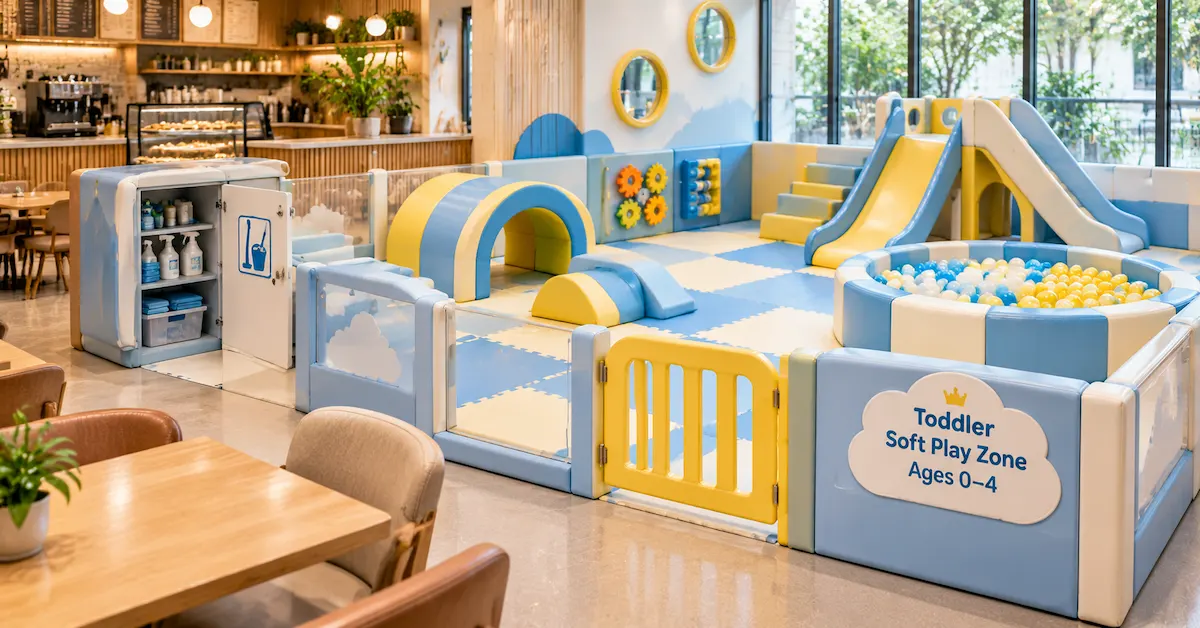
Before the first session, staff should check entrances, floors, seams, covers, ball-pool walls, slide landings, nets, barriers and any sharp or loose element. The checklist should include the areas parents cannot see easily. Record the person, time, defect and action. A short form creates a more reliable history than relying on memory during a busy shift.
Between-session reset
For venues using timed sessions, reset points should be defined. Remove visible contamination, return loose modules to their marked positions, check the floor around the slide exit and confirm that a temporary barrier has been removed only after inspection. If the venue serves food, keep service routes outside the play entrance where possible.
Weekly and monthly checks
Weekly checks can focus on fasteners, seams, anchors, padding compression, nets, rails and the condition of high-touch panels. Monthly checks should review the whole route, including concealed interfaces, storage, signage, emergency access and the cleaning equipment itself. The exact interval must be adapted to use, manufacturer guidance and local requirements.
EPARK’s public safety and materials information describes components such as galvanized steel pipes, high-density foam, soft PVC, EVA or PU mats, safety nets, railings and FRP/composite-resin slides. The precise material and care instructions belong to the purchased configuration. Request a product-specific maintenance document rather than applying a generic cleaning chemical to every surface.
Evidence rule: a general factory photograph or certificate label does not prove that a particular cover, mat, net or slide in your order has the same specification. Ask for the material schedule, inspection record, sample approval and document scope tied to the final bill of materials.
How the Choice Affects Staffing and Customer Experience
Soft play supports close parent participation
A compact soft-play area can allow parents to remain near the activity, which may reduce staff intervention for low-risk movement. That does not eliminate supervision. Staff still need to manage entry, cleaning, birthday groups, ball-pool hygiene and children who need help. Seating should be placed so it supports observation without narrowing the route.
Indoor playgrounds need a rhythm of active supervision
In a larger system, staff may patrol, monitor queues, check levels, manage age conflicts and coordinate a temporary closure. The venue should define handover between shifts and the maximum area one person can reasonably observe. If the attraction includes separate activities, write the response route from reception to each zone.
Noise, wayfinding and waiting are operational inputs
Children do not experience a layout as a technical drawing. They experience a queue, a blocked slide, a confusing gate or a parent who cannot see them. Use signs and color sparingly to support the rule. Keep waiting areas outside high-speed paths, and give staff a way to explain the route without shouting across the whole venue.
Choosing by Venue Type
Kids cafe or restaurant
When the cafe is the primary business, a parent-visible soft-play zone often makes the easiest operating fit. Keep the entry away from food-service traffic, provide a wipeable floor boundary and make the play offer clear without turning tables into a queue. A larger indoor playground is appropriate when the venue sells paid play as a destination rather than an amenity.
Hotel or resort
Hotel operations need guest access control, housekeeping coordination, quiet hours and multilingual rules. Soft play can work near a family lounge or restaurant when supervision is close. A larger indoor playground needs a dedicated recreation team, clearer closure procedures and a plan for peak holiday sessions. The EPARK customization process can be used to discuss layout and installation scope, but the hotel must define its operating owner.
School or preschool
Teachers need predictable sightlines and a route that supports the day’s learning plan. Low-impact soft play may fit a classroom or multipurpose room. A larger structure can work in a dedicated hall when age access, cleaning and emergency procedures are documented. Choose the format the teaching team can supervise, not only the format that looks most impressive.
Mall or FEC
Malls and FECs often need a signature attraction plus a quieter toddler option. A split can reduce conflict and give families a reason to stay while different children choose different intensities. Ask the designer to include queues, shoe storage, parent seating, party traffic, arcade sound, service access and emergency routes in one coordinated plan.
Soft Play vs Indoor Playground: The Opening-Day Operations Test
Before signing off the final drawing, run a practical opening-day test for the soft play vs indoor playground decision. Pretend that a family arrives ten minutes before a busy session, a toddler needs help at the entrance, an older child is waiting for a slide, and a staff member has found a loose edge. The chosen format should let the team respond without blocking the whole venue.
Test the first fifteen minutes
Map arrival, shoe storage, payment or check-in, handwashing, entry, parent seating and the first activity. Ask how a staff member explains the age rule, where a child waits, and whether a stroller or wheelchair can pass without crossing a high-speed route. If a soft-play area depends on parents staying inside, make that expectation visible before the child enters. If an indoor playground uses separate zones, test whether the gates and signs are obvious to a first-time visitor.
Test a defect during a live session
Choose a realistic defect such as a torn cover, displaced mat, dirty ball-pool edge or closed slide. The operator should be able to isolate the affected component, redirect users, record the issue, clean or repair it, and reopen only after inspection. Ask the supplier which tools, spare parts and access points are needed. This test exposes whether the layout is maintainable or merely attractive in a rendering.
Test the end-of-day reset
At closing, staff should know where loose pieces go, which surfaces require a deeper clean, how to dry the floor, how to lock or barrier the route, and who signs the inspection. Count the minutes and people required for the reset. A format that looks efficient at noon may become a bottleneck when the venue needs to clean, inspect and reopen several times in one day.
Record the result as an operating assumption in the project file. The assumption is not a capacity guarantee; it is a question for the final layout, staffing model and local operating rules. This discipline keeps the equipment decision connected to real work rather than to a product label.
Changeover, Spares and Future Expansion
Ask what can be changed without rebuilding
Soft-play modules may be easier to move, replace or re-theme, but the actual flexibility depends on the anchoring and floor plan. A fixed indoor playground can still support phased expansion when the structure, access and spare connection points are designed for it. Ask for a modular schedule that labels fixed, replaceable, optional and future elements.
Make spare parts identifiable
A replacement cover, mat, net or fastener is easier to order when it has a part code, material reference, color name and location. Request a spare-parts list with the handover documents. Avoid relying on a photograph and a description such as “the blue panel near the slide.”
Review operations before adding attractions
Before adding a trampoline, interactive wall, arcade area or new slide, repeat the sightline, queue, sound, power, cleaning and emergency review. More equipment can increase choice, but it can also increase inspection points and staff workload. The best expansion is the one the operating team can support during the busiest realistic session.
Turn the operating plan into a supplier brief. Include the age policy, staff positions, cleaning schedule, parent route, partial-closure method, spare-parts expectations and future expansion idea.
Send My Operating BriefFrequently Asked Questions
Is soft play safer than an indoor playground?
Neither label guarantees safety. When comparing soft play vs indoor playground, remember that soft play may reduce impact in some low-level activities, while a larger indoor playground can be safe when it has appropriate age zoning, supervision, barriers, maintenance and documentation. Evaluate the approved configuration and operating controls.
Which format needs fewer staff?
A compact, parent-visible soft-play area may be simpler to supervise, but staffing depends on attendance, age mix, layout and operating rules. A larger system usually needs more sightline positions and a defined response route. Ask the designer to show the staffing assumptions.
Can toddlers and older children share one indoor playground?
They can share a venue when the route, access, activity intensity and supervision model separate the age groups. Do not rely on a sign alone. Use physical or operational controls and confirm the age policy in the final plan.
What should a cleaning plan include?
It should name surfaces, frequency, approved chemicals, dilution, contact time, drying, inspection, defect isolation and the person responsible. Ball pools, seams, slide landings, floors, covers and touch panels should be listed separately.
What does EPARK provide during a project?
EPARK publicly describes consultation, design, material selection, production, inspection, secure packaging, delivery, installation and after-sales stages. The quotation should state the exact drawings, documents, installation support, training and spare parts included for your order.
How do I avoid choosing equipment that staff cannot run?
Write the operating brief before the final equipment list. Test the plan against peak attendance, age conflicts, cleaning downtime, partial closure and staff response. Then ask the supplier to show those assumptions on the layout and in the handover documents.
Conclusion
Soft play vs indoor playground is an operations decision before it is a design decision. Choose a compact soft-play system when younger users, parent visibility, low-impact movement and a simple cleaning route are central. Choose a coordinated indoor playground when the venue can manage multiple age zones, higher activity intensity, more inspection points and a destination-led visit. A hybrid can work when the operator wants both a calm toddler experience and a stronger main attraction.
Before approving a quote, document age policy, sightlines, staff positions, cleaning access, partial closures, floor and material interfaces, spare parts, handover records and future changes. EPARK’s company information, safety and materials information, product categories and customization process can start the discussion. Exact configuration, certificates, test reports, MOQ, lead time and commercial terms must be confirmed in the project documents.
Need an operations-led recommendation? Share the venue plan and operating constraints so the next step is a measurable scope rather than a generic equipment list.
Plan My Play Area
General Disclaimer
All data on https://www.eparki.com is for general guidance only. As a leading indoor playground manufacturer and trampoline supplier, EPARK strives for accuracy but gives no express or implied warranty regarding completeness, performance or project fitness. Product specs, designs and results may vary with use and customer requirements. Buyers must verify technical details, compliance and suitability before purchase. EPARK OEM/ODM is not liable for any direct, indirect or consequential damages arising from site use. For custom solutions, contact our manufacturer and supplier team via the Contact page.
Intellectual Property
Text, images, videos, CAD files and software are Guangzhou EPARK Electronic Technology Co., Ltd. All rights reserved. No part may be copied, republished or used commercially without prior written permission. We will pursue legal action for copyright or design-patent infringement.
Trademarks
"EPARK", the EPARK logo and related graphics are registered trademarks of Guangzhou EPARK Electronic Technology Co., Ltd. Unauthorized use in ads, domain names or packaging is prohibited.
Governing Law
These terms are governed by the laws of the People's Republic of China.
Contact
Questions? Email sales@nanyuetech.com or WhatsApp +86 139 0307 9263.