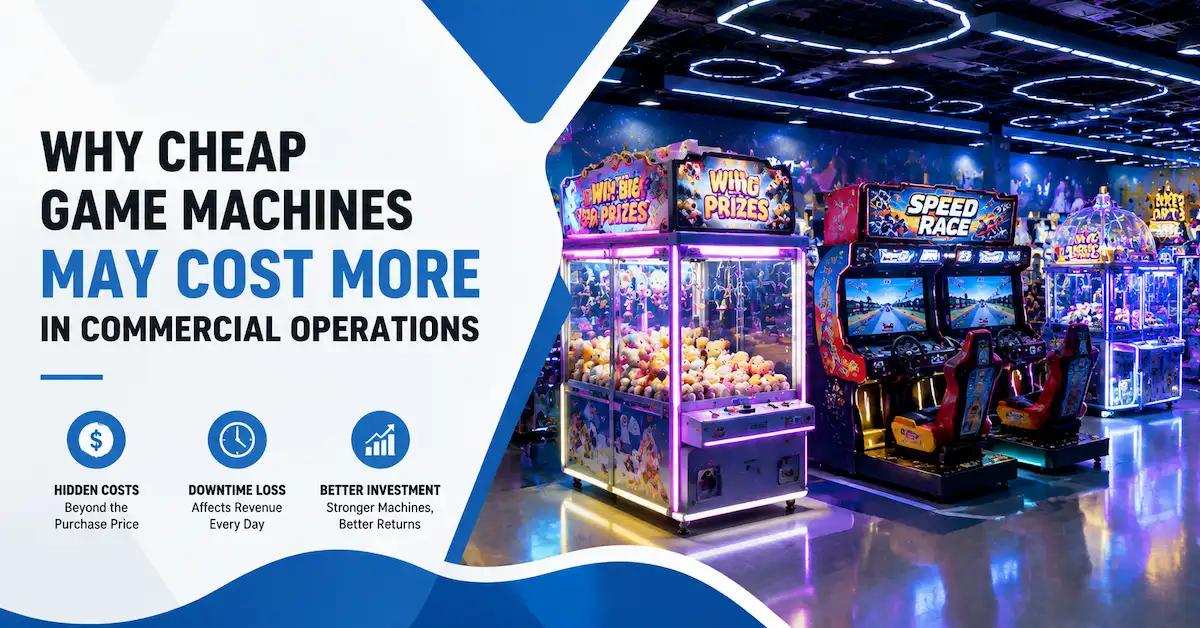
When starting an arcade, indoor playground, family entertainment center, or entertainment zone, many buyers naturally focus on reducing initial investment.
A lower equipment quotation may appear attractive because it helps control startup costs and allows operators to purchase more machines within the same budget.
However, commercial entertainment equipment is not a one-time purchase.
Machines operate every day, serve hundreds of customers, and directly affect revenue generation. A low-priced machine that requires frequent repairs, experiences downtime, or creates a poor customer experience can become more expensive than a higher-quality alternative.
Understanding the cheap game machines risk helps buyers make better purchasing decisions based on total ownership value instead of only the initial purchase price.
Explore EPARK’s commercial amusement equipment to compare professional arcade machines, redemption games, claw machines, and complete FEC solutions.
Why Buyers Are Attracted to Cheap Game Machines
Lower Initial Investment
The main advantage of cheap equipment is obvious:
- Lower purchase price
- Smaller startup budget
- Ability to buy more machines
- Faster initial setup
For new operators, especially first-time investors, reducing upfront costs can seem like the safest approach.
However, the initial purchase price represents only one part of the business investment.
The Hidden Cost Problem
Commercial buyers should consider:
Initial Cost + Maintenance Cost + Downtime Cost + Replacement Cost
A machine with a lower price may create additional expenses through:
- Frequent repairs
- Expensive replacement parts
- Shorter service life
- Lost revenue
- Customer complaints
- Higher labor requirements
The cheapest machine is not always the lowest-cost solution.
Understanding Cheap Game Machines Risk
The biggest mistake buyers make is evaluating equipment only by appearance and price.
A machine may look similar from the outside while having major differences internally.
The cheap game machines risk usually comes from:
- Lower-quality components
- Weak cabinet structures
- Limited testing
- Poor software stability
- Difficult maintenance
- Lack of spare parts
- Weak supplier support
These problems become more serious in commercial environments where machines operate continuously.
Risk 1: Higher Maintenance Costs
Frequent Component Failures
Low-cost machines often reduce expenses by using cheaper components.
Common failure areas include:
- Power supplies
- Control boards
- Buttons
- Sensors
- Motors
- Displays
- Payment systems
- Ticket systems
In a commercial venue, repeated failures create ongoing repair expenses.
Small Problems Become Expensive Problems
A single damaged button may seem insignificant.
However, when dozens of machines experience small failures every month, costs accumulate through:
- Technician labor
- Replacement parts
- Shipping fees
- Staff time
- Customer compensation
Professional operators evaluate maintenance requirements before purchasing.
Risk 2: Increased Downtime and Lost Revenue
A broken machine does not generate income.
For commercial operators, downtime creates direct financial loss.
Potential impacts include:
- Lost game plays
- Reduced customer satisfaction
- Lower venue attractiveness
- Negative reviews
- Staff workload
For example:
A popular racing machine generating $150 per day that remains unavailable for ten days may lose $1,500 in potential revenue.
The repair cost is only part of the problem.
The lost earning opportunity may be much higher.
Risk 3: Shorter Equipment Lifespan
Commercial machines face much heavier use than home entertainment products.
They must handle:
- Thousands of customer interactions
- Long operating hours
- Repeated mechanical movement
- Different user behaviors
- Frequent cleaning
Cheap equipment may have a shorter commercial lifespan because of:
- Weak materials
- Lower-quality motors
- Poor electrical systems
- Limited structural reinforcement
A machine replaced after two years may cost more than a durable machine operating successfully for five years.
Risk 4: Poor Customer Experience
Customers do not judge only the machine price.
They judge the entertainment experience.
Problems caused by low-quality equipment may include:
- Slow response
- Game interruptions
- Poor controls
- Screen problems
- Weak lighting effects
- Unstable payment systems
For FECs and arcades, customer experience directly affects:
- Repeat visits
- Word-of-mouth marketing
- Membership retention
- Revenue growth
A cheap machine that disappoints customers may damage the entire venue reputation.
Risk 5: Limited Spare Parts Availability
One major challenge with low-cost equipment is after-sales support.
Some suppliers may provide machines but lack:
- Long-term spare parts supply
- Technical documentation
- Repair guidance
- Remote support
This creates problems when operators need:
- Replacement boards
- Sensors
- Motors
- Payment modules
- Mechanical parts
A machine can become unusable because of a small unavailable component.
Risk 6: Higher Labor Requirements
Maintenance time is also a business cost.
Low-quality equipment may require:
- More frequent inspection
- More troubleshooting
- More technician involvement
- More staff attention
For large entertainment centers, labor efficiency is important.
Reliable machines allow employees to focus on:
- Customer service
- Operations
- Marketing
- Revenue improvement
Instead of constantly repairing equipment.
Risk 7: Difficulty Scaling Business Operations
For chain entertainment brands and distributors, consistency matters.
Cheap machines may create problems when expanding:
- Different component standards
- Different repair methods
- Different spare parts
- Different software systems
Professional operators prefer equipment that can be standardized across locations.
Standardized equipment improves:
- Training efficiency
- Maintenance management
- Purchasing efficiency
- Expansion planning
Comparing Cheap Machines vs Commercial-Grade Machines
| Factor | Cheap Game Machines | Commercial-Grade Machines |
|---|---|---|
| Initial Price | Lower | Higher |
| Component Quality | Basic | Professional |
| Maintenance Frequency | Higher | Lower |
| Downtime Risk | Higher | Lower |
| Service Life | Shorter | Longer |
| Spare Parts | Limited | More Stable |
| Customer Experience | Variable | More Reliable |
| Long-Term ROI | Uncertain | More Predictable |
The right decision depends on business goals, but commercial venues usually benefit from reliable equipment.
Total Cost of Ownership Matters More Than Purchase Price
Professional buyers evaluate total ownership cost.
A simple calculation:
Total Cost = Purchase Price + Maintenance + Downtime Loss + Replacement Cost
Example:
| Cost Factor | Machine A | Machine B |
|---|---|---|
| Purchase Price | $4,000 | $6,000 |
| Annual Maintenance | $1,500 | $500 |
| Downtime Loss | $1,000 | $200 |
| Three-Year Cost | $11,500 | $8,100 |
Although Machine B costs more initially, it may provide better long-term value.
The correct purchasing decision should consider profitability, not only price.
How to Evaluate Arcade Equipment Quality
Before purchasing, buyers should check:
Cabinet Construction
Ask about:
- Material thickness
- Structural design
- Surface protection
- Door and lock quality
Electronic Components
Evaluate:
- Brand of components
- Testing process
- Cooling system
- Wiring quality
Mechanical Systems
Check:
- Motor quality
- Moving parts
- Replacement availability
- Maintenance access
Software and Payment Systems
Confirm:
- System stability
- Payment compatibility
- Update support
- Error management
Questions to Ask Before Buying Low-Cost Equipment
Before choosing cheaper machines, ask:
- Why is this machine cheaper than competitors?
- What components are being used?
- How long is the expected commercial lifespan?
- Are spare parts available after several years?
- How are machines tested before shipment?
- What warranty is provided?
- Who supports repairs after installation?
- Can local technicians repair the equipment?
- Are replacement parts standard?
- What is the estimated maintenance cost?
These questions help reveal hidden risks.
When Cheap Game Machines May Be Acceptable
Low-cost machines are not always unsuitable.
They may work in some situations:
- Temporary events
- Short-term promotions
- Small private venues
- Low-traffic locations
- Testing new markets
However, high-traffic commercial venues usually require stronger equipment standards.
The operating environment should determine the equipment level.
How to Choose a Reliable Game Machine Supplier
A professional supplier should provide more than competitive pricing.
Important evaluation factors include:
Manufacturing Capability
Review:
- Factory experience
- Production capacity
- Export history
- Customer projects
Quality Control
Check whether the supplier performs:
- Function testing
- Electrical inspection
- Aging tests
- Packaging checks
After-Sales Support
Important services include:
- Spare parts
- Technical support
- Troubleshooting
- Product guidance
Learn more about EPARK’s company capabilities.
Why Choose EPARK for Commercial Game Machines?
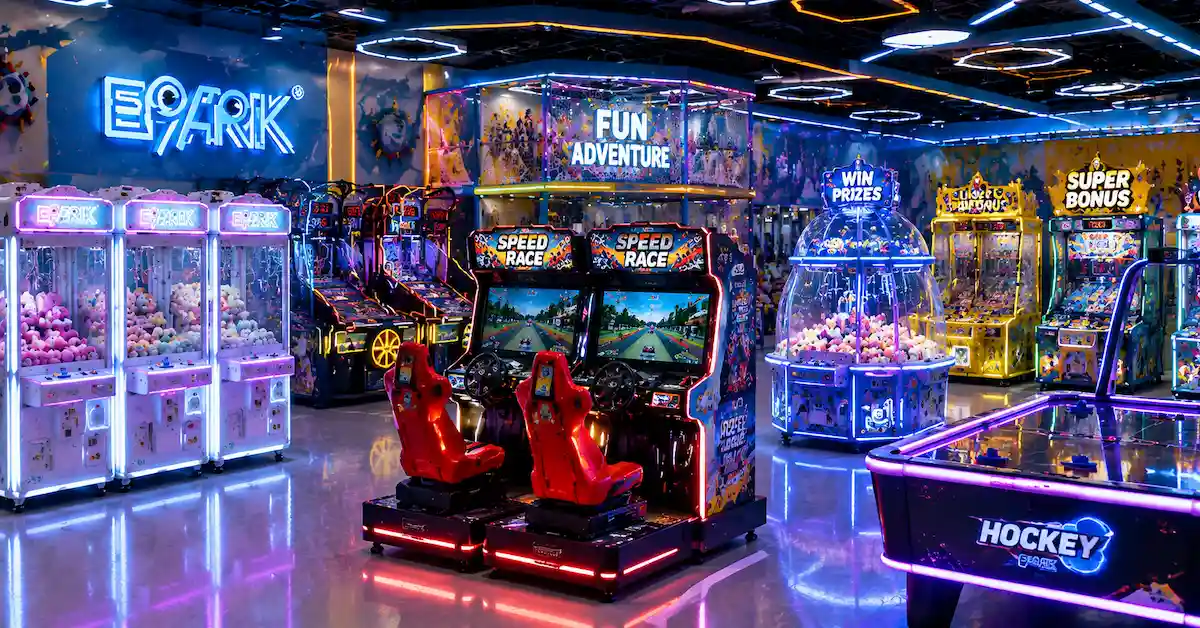
EPARK provides commercial amusement equipment solutions for:
- Family entertainment centers
- Indoor playgrounds
- Shopping malls
- Hotels
- Resorts
- Arcade operators
- Distributors
EPARK focuses on:
- Commercial durability
- Stable performance
- Equipment customization
- Quality inspection
- Export support
- Spare parts planning
- Long-term cooperation
Explore EPARK’s amusement equipment catalog, check the EPARK FAQ page, or contact EPARK for your project requirements.
FAQ About Cheap Game Machines Risk
Are cheap game machines always a bad choice?
Not always. They may work for low-traffic or temporary applications. However, commercial venues should carefully evaluate durability, maintenance, and supplier support.
Why can cheap arcade machines become more expensive?
Because additional costs may appear through repairs, downtime, replacement parts, labor, and lost revenue.
What should commercial buyers prioritize besides price?
Buyers should consider reliability, lifespan, maintenance requirements, spare parts availability, warranty, and supplier capability.
How can operators reduce arcade machine maintenance costs?
Choose reliable equipment, maintain machines regularly, keep spare parts available, and work with suppliers offering technical support.
Are expensive arcade machines always better?
Not necessarily. The best choice is equipment that provides the strongest balance between price, reliability, operating cost, and revenue potential.
Can EPARK help compare equipment options?
Yes. Buyers can explore EPARK products or contact EPARK with their venue requirements for professional recommendations.
Conclusion
The biggest cheap game machines risk is not the lower purchase price itself. The real problem is the hidden cost created during daily commercial operation.
Frequent repairs, downtime, poor customer experience, limited spare parts, and shorter service life can quickly eliminate the savings from a cheaper purchase.
For FEC operators, arcade owners, shopping malls, and entertainment businesses, equipment should be evaluated as a long-term revenue investment.
Choosing reliable commercial game machines helps protect revenue, improve customer satisfaction, and create a more sustainable entertainment business.
Need Help Choosing Reliable Game Machines?
Share your venue type, traffic level, floor plan, and budget requirements.
EPARK can help you compare equipment options, evaluate long-term value, and select suitable commercial arcade solutions.
General Disclaimer
All data on https://www.eparki.com is for general guidance only. As a leading indoor playground manufacturer and trampoline supplier, EPARK strives for accuracy but gives no express or implied warranty regarding completeness, performance or project fitness. Product specs, designs and results may vary with use and customer requirements. Buyers must verify technical details, compliance and suitability before purchase. EPARK OEM/ODM is not liable for any direct, indirect or consequential damages arising from site use. For custom solutions, contact our manufacturer and supplier team via the Contact page.
Intellectual Property
Text, images, videos, CAD files and software are Guangzhou EPARK Electronic Technology Co., Ltd. All rights reserved. No part may be copied, republished or used commercially without prior written permission. We will pursue legal action for copyright or design-patent infringement.
Trademarks
"EPARK", the EPARK logo and related graphics are registered trademarks of Guangzhou EPARK Electronic Technology Co., Ltd. Unauthorized use in ads, domain names or packaging is prohibited.
Governing Law
These terms are governed by the laws of the People's Republic of China.
Contact
Questions? Email sales@nanyuetech.com or WhatsApp +86 139 0307 9263.