When purchasing equipment for an arcade, family entertainment center, indoor playground, shopping mall, hotel, or resort, buyers often begin by comparing quotations.
The initial game machine cost is important, but it does not represent the complete financial commitment. A lower-priced machine can become expensive over time if it requires frequent repairs, uses difficult-to-source components, experiences repeated downtime, or needs early replacement.
Commercial buyers should therefore compare the purchase price with the total cost of owning and operating the machine throughout its useful life.
A better purchasing question is not:
Which supplier offers the lowest unit price?
It is:
Which machine delivers the best combination of purchase cost, reliability, maintenance support, operating efficiency, and long-term revenue?
Buyers can explore EPARK’s commercial game machine range when comparing claw machines, redemption games, racing machines, sports games, kiddie rides, prize machines, and complete arcade equipment packages.
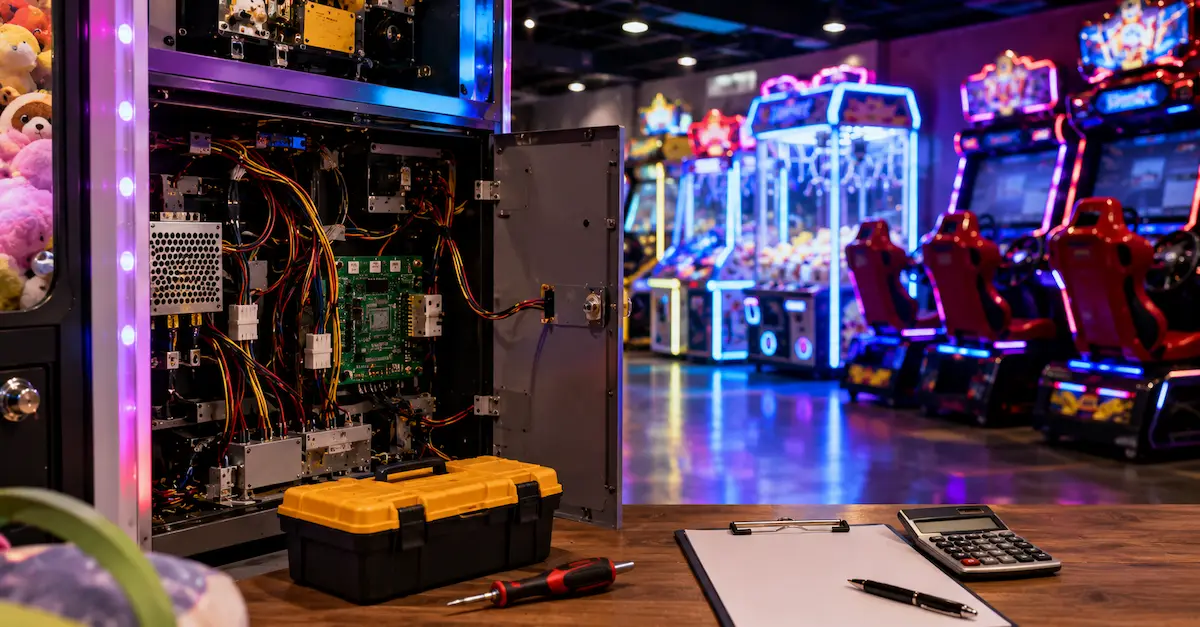
Why the Lowest Game Machine Cost Is Not Always the Best Deal
A low quotation may look attractive during project budgeting, especially when a buyer needs dozens of machines. However, the initial price may exclude important costs such as:
- Spare parts
- Payment system configuration
- Custom branding
- Export packaging
- Installation support
- Technical documentation
- Software updates
- Warranty service
- Replacement components
- International freight
After opening, additional expenses may appear through maintenance, labor, electricity, prize replenishment, and revenue loss during downtime.
For this reason, buyers should evaluate both:
Initial game machine cost + long-term ownership cost
A slightly more expensive machine may provide better value if it has durable components, fewer breakdowns, easier maintenance, and a longer commercial service life.
What Is Included in the Initial Game Machine Cost?
Before comparing quotations, buyers should confirm what each supplier includes.
| Cost Item | Questions Buyers Should Ask |
|---|---|
| Machine Cabinet | What materials and thickness are used? |
| Electronic Components | Are the power supply, boards, and wiring commercial grade? |
| Display System | What screen type, size, and resolution are included? |
| Payment System | Does the price include coins, cards, QR payment, or bill acceptors? |
| Game Software | Are software licenses and updates included? |
| Branding | Is logo, color, artwork, or language customization included? |
| Export Packaging | Is the machine packed for international shipping? |
| Spare Parts | Are initial replacement parts supplied? |
| Warranty | What components and service are covered? |
| Technical Support | Is remote troubleshooting available? |
Two machines with similar appearances may have very different internal components and service packages.
The quotation should therefore be evaluated together with specifications, warranty terms, inspection procedures, and spare-parts support.
What Is Long-Term Maintenance Cost?
Long-term maintenance cost includes every expense required to keep a machine operating reliably after installation.
These costs may include:
- Preventive inspections
- Cleaning
- Replacement buttons and joysticks
- Sensors
- Motors
- Claw assemblies
- Card readers
- Coin acceptors
- Power supplies
- Screens
- Control boards
- Wiring
- Technician labor
- Software troubleshooting
- International spare-parts shipping
Maintenance should not be viewed only as repair after a failure. Preventive maintenance protects machine availability and reduces unexpected downtime.
Total Cost of Ownership for Commercial Game Machines
Total cost of ownership, often called TCO, provides a more complete comparison than unit price.
A simplified calculation is:
Total ownership cost = Purchase cost + shipping + installation + operating cost + maintenance + downtime loss − residual value
| TCO Component | Examples |
|---|---|
| Purchase Cost | Machine, software, accessories, customization |
| Logistics Cost | Freight, insurance, customs, local delivery |
| Installation Cost | Electrical connection, positioning, testing |
| Operating Cost | Electricity, payment fees, prizes, staffing |
| Maintenance Cost | Labor, inspections, replacement parts |
| Downtime Loss | Revenue lost while the machine is unavailable |
| Replacement Cost | Major parts or early machine replacement |
| Residual Value | Resale, relocation, or remaining equipment value |
A professional buyer should compare TCO over three to five years, depending on the expected equipment lifecycle.
Purchase Price vs Maintenance: An Illustrative Comparison
The following example is hypothetical and intended only to show the comparison method.
| Cost Item | Machine A | Machine B |
|---|---|---|
| Initial Purchase Cost | $5,500 | $6,800 |
| Estimated Annual Maintenance | $1,200 | $500 |
| Estimated Downtime Loss per Year | $1,000 | $300 |
| Three-Year Ownership Cost | $12,100 | $9,200 |
| Reliability Level | Moderate | Higher |
| Parts Availability | Limited | Stable |
Machine A has a lower initial price, but its higher repair expenses and downtime make it more expensive over three years.
Machine B requires a larger upfront investment but may produce a lower long-term cost and more stable revenue.
Actual results depend on machine type, operating hours, customer traffic, local labor costs, maintenance practices, and supplier support.
How Component Quality Affects Maintenance Cost
The internal components of a machine directly affect reliability.
Cabinet and Structural Materials
Commercial cabinets should withstand:
- Continuous customer use
- Movement during installation
- Vibration
- Accidental impact
- Cleaning chemicals
- Humid operating environments
Weak structures can create alignment problems, loose doors, damaged panels, and additional repair work.
Power Supplies and Wiring
Unstable power supplies and poorly organized wiring may cause:
- Random shutdowns
- Screen problems
- Control-board failures
- Payment system errors
- Difficult troubleshooting
Clear wiring layouts and labeled connectors make maintenance faster.
Buttons, Joysticks, and Controls
Customer-contact components experience repeated use. Buyers should ask whether controls are:
- Commercial grade
- Easy to replace
- Based on standard dimensions
- Available through the supplier
- Supported with wiring diagrams
Motors and Mechanical Parts
Claw machines, ticket games, kiddie rides, and moving attractions rely on motors, belts, gears, and sensors.
Durable mechanical components can reduce:
- Motion errors
- Calibration problems
- Noise
- Unexpected stops
- Frequent replacement
Why Downtime Is a Hidden Game Machine Cost
A machine that is not operating cannot generate revenue.
Downtime may create several losses:
- Missed plays
- Customer complaints
- Poor venue appearance
- Reduced arcade capacity
- Staff time spent troubleshooting
- Technician travel costs
- Refunds or replacement credits
For example, a machine that normally generates $100 per day and remains unavailable for seven days may lose approximately $700 in gross revenue before repair costs are included.
This is why machine reliability should be evaluated as part of the game machine cost.
High-performing equipment should be supported by:
- Stable components
- Clear error codes
- Accessible maintenance panels
- Technical manuals
- Remote troubleshooting
- Available spare parts
Spare-Parts Availability and Replacement Time
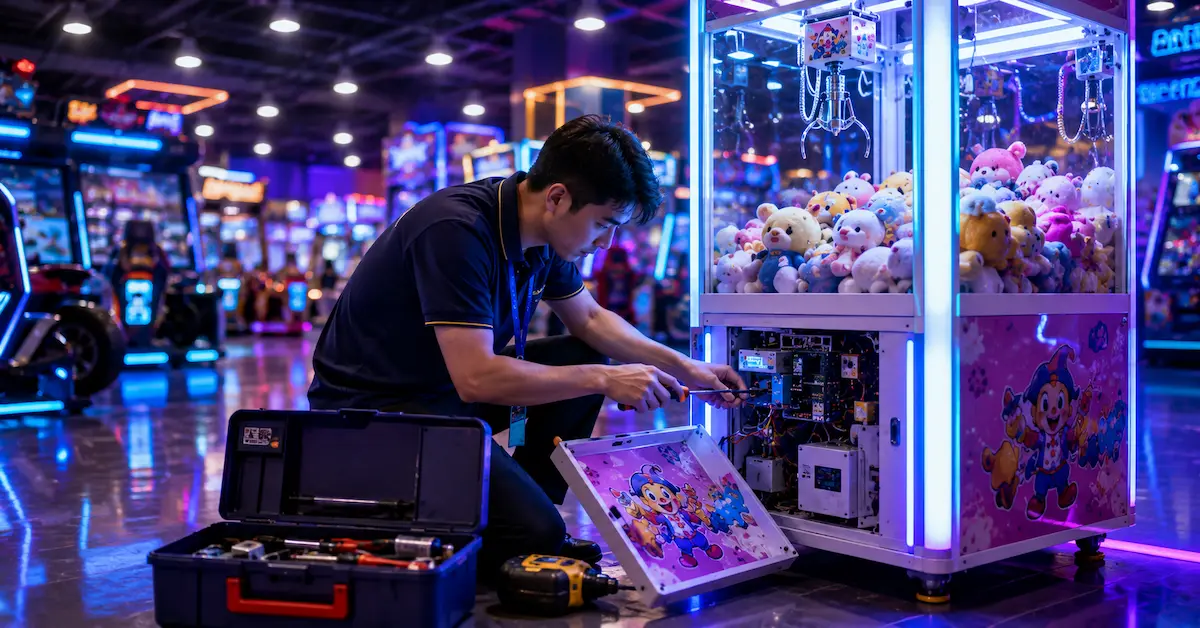
Even reliable machines eventually require replacement components.
Before ordering, buyers should confirm:
- Which parts commonly wear out
- Recommended spare-parts quantity
- Parts pricing
- Production lead time
- Shipping method
- Compatibility between machine models
- Whether standard components are used
- Whether local technicians can complete repairs
A low-priced machine becomes risky when a small unavailable component keeps it out of service for several weeks.
For large FEC projects, buyers should consider purchasing a starter spare-parts package with the main shipment. This reduces international freight costs and shortens future repair time.
Warranty Terms Buyers Should Compare
A warranty should be reviewed carefully rather than judged only by duration.
| Warranty Question | Why It Matters |
|---|---|
| What components are covered? | Some suppliers exclude screens, controls, or consumable parts |
| When does the warranty begin? | It may start at shipment rather than installation |
| Who pays international freight? | Replacement shipping can be expensive |
| Is labor included? | Many warranties cover parts only |
| Is remote diagnosis available? | Faster troubleshooting reduces downtime |
| What evidence is required? | Buyers may need photos, videos, or error reports |
| Are software issues covered? | Digital machines may require software support |
A clear warranty process is more valuable than a long but vague promise.
Buyers can review common service questions on the EPARK FAQ page.
Maintenance Requirements by Machine Type
Different game categories have different maintenance priorities.
| Machine Type | Main Maintenance Areas |
|---|---|
| Claw Machine | Claw assembly, motor, cable, prize sensor, door lock |
| Redemption Game | Ticket dispenser, sensors, buttons, card reader |
| Racing Machine | Steering system, pedals, seat, screen, control board |
| Basketball Machine | Ball return, scoring sensor, net, motor |
| Air Hockey | Blower, puck surface, scoring sensors, rails |
| Kiddie Ride | Motor, safety switch, structure, sound system |
| VR Machine | Headset, tracking sensor, software, cables |
| Arcade Cabinet | Joystick, buttons, display, motherboard, power supply |
Buyers should select machines that match their maintenance capability.
A small indoor playground without a full-time technician may benefit from simple, modular machines. A large arcade with trained staff may manage more complex attractions.
Preventive Maintenance Reduces Long-Term Costs
Preventive maintenance helps operators identify problems before they cause complete failure.
Daily Checks
Staff should inspect:
- Machine cleanliness
- Payment system operation
- Buttons and controls
- Sound and lighting
- Visible damage
- Prize levels
- Error messages
Weekly Checks
Operators can review:
- Loose screws
- Door locks
- Cable condition
- Sensor alignment
- Cooling fans
- Moving parts
- Ticket or prize systems
Monthly Checks
Technical staff may inspect:
- Electrical connections
- Power supplies
- Control boards
- Motor condition
- Software performance
- Revenue data
- Maintenance records
A written schedule improves accountability and helps chain operators standardize maintenance across multiple locations.
Energy Consumption and Operating Efficiency
Electricity may appear small compared with the purchase price, but it becomes significant when dozens of machines operate for long hours.
Buyers should ask suppliers about:
- Rated power
- Standby power consumption
- LED lighting efficiency
- Sleep mode
- Cooling requirements
- Recommended operating temperature
A difference of only a small amount per machine can create a meaningful annual cost when multiplied across a large arcade.
Energy-efficient machines may also produce less heat, reducing the load on the venue’s air-conditioning system.
Commercial Lifespan and Upgrade Potential
A machine’s commercial life depends on both physical durability and customer appeal.
Buyers should compare whether the equipment can be:
- Rebranded
- Relocated
- Updated with new software
- Fitted with new prizes
- Connected to another payment system
- Refurbished
- Reused in a secondary venue
Modular equipment can remain commercially useful longer than machines that depend on proprietary components or outdated software.
A higher initial game machine cost may be justified when the machine offers upgrade flexibility and a longer revenue-producing life.
Questions Buyers Should Ask Suppliers
Before placing an order, ask:
- What components are used inside the machine?
- Which parts require regular replacement?
- Are spare parts available for several years?
- What is included in the warranty?
- Is remote technical support available?
- Can local technicians repair the machine?
- Are wiring diagrams and manuals provided?
- What preventive maintenance is recommended?
- How quickly can replacement parts be shipped?
- Can multiple machines share standard spare parts?
- Is the payment system easy to replace or upgrade?
- How is each machine tested before shipment?
Buyers can learn more about EPARK’s manufacturing and project capabilities before requesting a quotation.
How to Compare Supplier Quotations Fairly
Do not compare only the final price. Build a structured comparison table.
| Evaluation Area | Supplier A | Supplier B | Supplier C |
|---|---|---|---|
| Machine Price | |||
| Specifications | |||
| Component Quality | |||
| Payment System | |||
| Spare Parts Included | |||
| Warranty | |||
| Technical Support | |||
| Packaging | |||
| Delivery Time | |||
| Estimated Maintenance | |||
| Expected Lifespan | |||
| Total Ownership Value |
This method makes hidden differences easier to identify.
Why Work with EPARK?
EPARK supplies commercial amusement equipment for family entertainment centers, indoor playgrounds, arcades, shopping malls, hotels, resorts, and distributors.
EPARK can support buyers with:
- Equipment selection
- Project-based machine packages
- OEM and ODM customization
- Payment system configuration
- Quality inspection
- Export packaging
- Spare-parts planning
- Technical guidance
- After-sales assistance
- Long-term repeat orders
Buyers can explore EPARK’s amusement equipment catalog or contact EPARK with their project size, target market, equipment list, and maintenance requirements.
FAQ About Game Machine Cost and Maintenance
Is a cheaper game machine always more expensive to maintain?
Not always, but buyers should verify component quality, parts availability, warranty, and repair requirements. A low purchase price does not guarantee low ownership cost.
What maintenance costs should buyers include in their budget?
Include inspections, cleaning, technician labor, spare parts, international shipping, software support, downtime, and major component replacement.
How much should buyers budget for spare parts?
The amount depends on machine type, quantity, operating hours, and local access to components. Buyers should request a recommended spare-parts list from the supplier.
Why is machine downtime important when comparing costs?
Downtime reduces revenue and customer satisfaction. It can also create labor, refund, and technician expenses beyond the repair itself.
Are modular game machines easier to maintain?
Generally, modular designs with accessible panels, labeled wiring, standard components, and replaceable assemblies can reduce repair time.
Can EPARK help buyers prepare spare-parts packages?
Yes. Buyers can browse EPARK’s game machines or contact the EPARK team to discuss equipment selection, replacement parts, payment systems, and project support.
Conclusion
Comparing game machine cost requires more than checking the purchase quotation.
Commercial buyers should evaluate component quality, expected maintenance, spare-parts availability, warranty coverage, energy use, downtime, technical support, service life, and upgrade potential.
The lowest-priced machine may be suitable when it is reliable, easy to repair, and supported by standard components. However, a higher initial investment may deliver better value when it reduces downtime and remains profitable for a longer period.
A total-cost-of-ownership comparison helps FEC investors, arcade operators, indoor playground owners, and distributors make more sustainable purchasing decisions.
Explore EPARK’s commercial amusement equipment, learn more about EPARK’s company capabilities, or contact EPARK to compare suitable machines for your project.
General Disclaimer
All data on https://www.eparki.com is for general guidance only. As a leading indoor playground manufacturer and trampoline supplier, EPARK strives for accuracy but gives no express or implied warranty regarding completeness, performance or project fitness. Product specs, designs and results may vary with use and customer requirements. Buyers must verify technical details, compliance and suitability before purchase. EPARK OEM/ODM is not liable for any direct, indirect or consequential damages arising from site use. For custom solutions, contact our manufacturer and supplier team via the Contact page.
Intellectual Property
Text, images, videos, CAD files and software are Guangzhou EPARK Electronic Technology Co., Ltd. All rights reserved. No part may be copied, republished or used commercially without prior written permission. We will pursue legal action for copyright or design-patent infringement.
Trademarks
"EPARK", the EPARK logo and related graphics are registered trademarks of Guangzhou EPARK Electronic Technology Co., Ltd. Unauthorized use in ads, domain names or packaging is prohibited.
Governing Law
These terms are governed by the laws of the People's Republic of China.
Contact
Questions? Email sales@nanyuetech.com or WhatsApp +86 139 0307 9263.