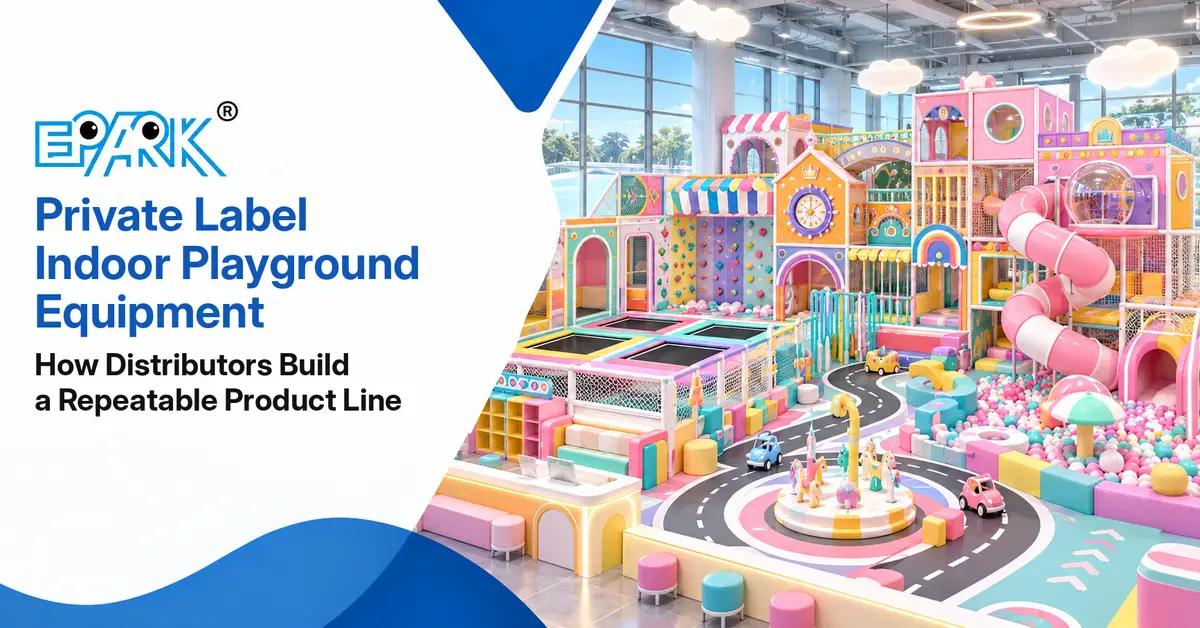
Private label indoor playground equipment is ready for a distributor to sell only when the product range, brand rules, technical specification, packaging, inspection evidence, and repeat-order process are controlled together. Adding a logo to a standard photograph is not a private-label program. The buyer needs a factory that can translate a brand brief into repeatable play modules, approved materials, customer-facing files, and a documented reordering system.
This guide is for playground distributors, importers, regional dealers, franchise groups, and multi-site operators that want to sell or deploy private label indoor playground equipment under their own commercial identity. The central question is not whether a factory can print a logo. It is whether the factory can help the buyer create a product line that remains recognizable, quoteable, inspectable, and serviceable after the first shipment.
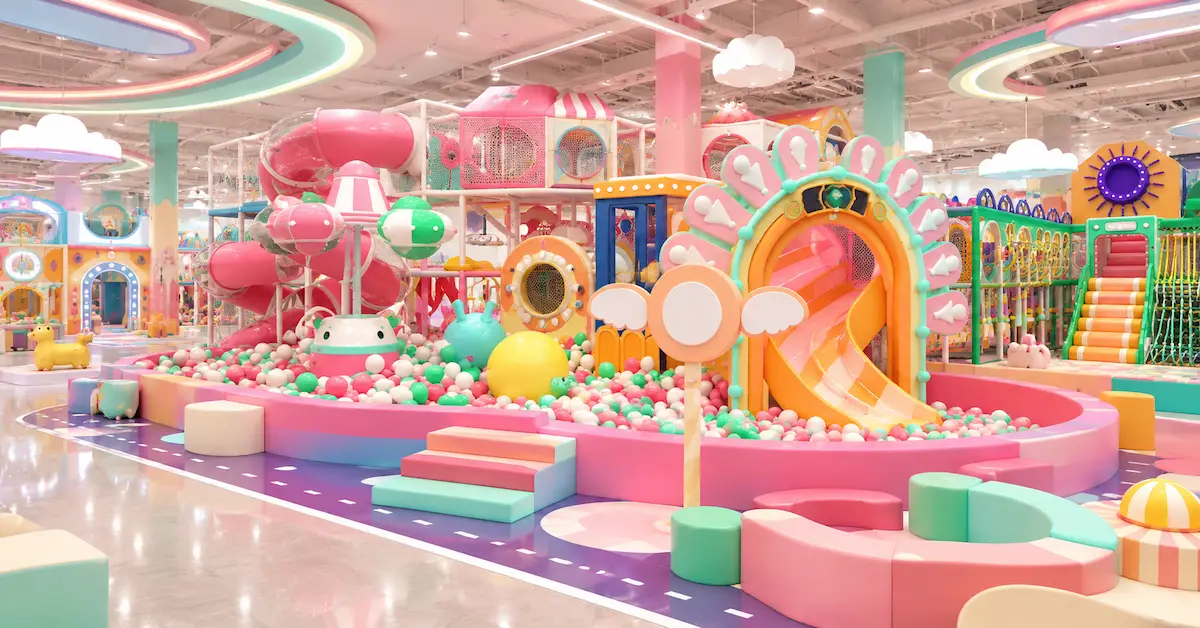
Guangzhou EPARK Electronic Technology Co., Ltd. identifies itself as an indoor playground and children’s amusement equipment supplier and manufacturer in Panyu District, Guangzhou, China. Its public company information says the business was established in 2012 and describes a 25,000 m2 facility, 400-plus machines, and more than 100 workers. Those are manufacturer-published entity facts. They establish who and where the supplier is, but they do not prove that every private-label project has identical capacity, MOQ, lead time, certification, or production staffing.
Building a private-label line? Send the target market, product tiers, brand assets, preferred age groups, sample requirements, and first-order scope so the factory can separate standard modules from genuine customization.
Review Distributor Playground OptionsWhat Private Label Indoor Playground Equipment Must Control
A private-label indoor playground equipment program has four layers. The first is the play product: structures, slides, ball pools, climbing features, soft play modules, toddler elements, or other equipment that the distributor will quote. The second is the commercial identity: name, colors, graphics, labels, catalog language, packaging marks, and photography. The third is the evidence package: drawings, bills of materials, material descriptions, inspection records, certificates or test reports, manuals, and spare-part references. The fourth is continuity: revision control, reorder codes, approved substitutions, and a process for handling changes.
If one layer is missing, the program becomes fragile. A distributor may have attractive renders but no approved dimensions. A factory may make safe-looking equipment but use different materials in the next batch. A brand may own a mascot but lack permission to reproduce a licensed character. A first order may arrive correctly while the replacement part has no code or installation instruction. Private labeling is therefore a supply-chain and product-governance decision, not a decoration request.
| Program layer | Buyer decision | Factory output to request | Failure if omitted |
|---|---|---|---|
| Play product | Which modules, age bands, sizes, themes, and optional components form the line? | Product list, drawings, component codes, material schedule | Every quotation becomes a new design exercise |
| Brand identity | Which logo, colors, graphics, labels, photos, and language may be used? | Brand brief, artwork proof, label layout, approved image list | Inconsistent presentation or unauthorized artwork |
| Evidence package | Which safety, material, inspection, and market documents are required? | Document register, inspection plan, certificate or report scope | Sales claims cannot be supported at customer review |
| Continuity | How will reorders, spare parts, substitutions, and design changes be controlled? | Revision log, reorder codes, spare-parts list, change approval | Batch differences and difficult after-sales support |
Choose the Distributor Model Before Choosing Equipment
Regional catalog distributor
A regional distributor normally needs a compact catalog that can be quoted repeatedly. The important decisions are not only which products look attractive, but which modules can be explained with stable dimensions, materials, packaging assumptions, and optional upgrades. A small line of clearly defined products is often more useful than a large gallery in which every image has a different construction.
For this model, ask the factory to separate a base configuration from options. For example, a soft-play module may have a core structure, a slide or climbing element, optional graphics, and a replacement-parts list. The distributor can then sell a consistent base while adapting the visible theme or site connection. Do not call every visible change a new SKU; define which changes affect drawings, tooling, inspection, packaging, or MOQ.
Private-label project reseller
A project reseller may use its own brand while selling complete indoor playground concepts to malls, hotels, schools, or family entertainment centers. The line needs enough flexibility to fit different rooms, but the reseller still benefits from a controlled component library. A project-specific floor plan can be new while the slide families, padded posts, flooring choices, netting details, and service parts remain identifiable.
The reseller should decide which documents will be customer-facing and which are internal. A client may need a layout, equipment schedule, material description, maintenance instructions, and acceptance checklist. The factory may also need internal production drawings, packing marks, and inspection records. Keeping these document levels separate protects confidential manufacturing information without leaving the customer with an unexplained rendering.
Multi-site or franchise operator
A multi-site operator needs repeatability more than novelty. The first site may be a pilot, but the real commercial value is the ability to open another location with a known brand system, a controlled equipment family, and a documented approval process. Define the non-negotiable elements: color palette, logo placement, age zoning, safety signage language, cleaning access, spare parts, and staff training materials.
Ask the supplier how a later order will be matched to the approved first order. “Same as last time” is not a technical instruction. The reorder should reference a drawing revision, material schedule, finish code, component code, and approved artwork version. If the factory proposes a substitution, the change should be recorded and approved before production, especially where the substitution affects a contact surface, structural interface, padding, netting, or landing.
Build a Private-Label Product Architecture
Start with product families, not a photo folder
A distributor catalog for private label indoor playground equipment should tell a buyer what can be combined, what is optional, and what requires a new design. A practical architecture can group products by use rather than by random image order: toddler soft play, compact soft-play structures, active climbing and obstacle modules, themed play elements, slides and connected components, and expansion or replacement parts. The exact families depend on the intended market and the factory’s approved range.
Give every family a short internal code. The code does not need to appear in public marketing, but it should connect the quotation, drawing, production order, packing list, inspection record, spare-parts list, and future reorder. If a customer changes only the color or graphic, the base code can remain stable while the finish revision changes. If the structure or interface changes, use a new revision or component code instead of hiding the change in a sales description.
Separate standard modules from engineered variations
Standard modules are useful because they can reduce drawing time, simplify replacement, and support more predictable packing. Engineered variations are useful when the site has columns, low ceilings, unusual exits, special age separation, or a strong brand requirement. The catalog should state which is which. A private-label buyer should not promise a “standard” module if the factory must redesign its support, platform, entry, landing, or fixing method for every order.
Use a three-level description in the brief:
- Base: the approved structure, component family, material description, and standard interface.
- Configurable: color, graphics, theme forms, optional modules, language, or layout changes that the factory confirms can be revised.
- Engineered: changes that require new drawings, structural review, tooling, prototypes, tests, or a different packing method.
Control the Visible Brand and the Hidden Specification
Visible brand controls
Visible controls include the brand name, logo position, color references, graphic language, character permissions, safety-sign wording, catalog photography, packaging marks, and customer-facing manuals. Provide artwork in a controlled folder with file names and approval status. A low-resolution image sent through a chat message is not a reliable production reference.
Ask the factory to return an artwork proof before production. The proof should show scale, placement, orientation, color assumptions, surface limitations, and whether the artwork is printed, applied as a panel, molded, sewn, or otherwise integrated. If a design uses a third-party character or logo, the distributor must confirm that it has permission to reproduce the artwork. A supplier’s willingness to print an image is not proof of intellectual-property authorization.
Hidden specification controls
The hidden specification is what makes the brand reliable after installation. It includes the frame or support description, padding, sleeves, flooring, slide or climbing interfaces, fasteners, nets, labels, finish, packaging protection, and maintenance access. EPARK’s public safety page describes hot-dip-galvanized cold-rolled steel pipes, high-density foam, soft PVC sleeves, EVA or PU mats, FRP or composite-resin slides, safety nets, and railings. Treat those as public material descriptions, then request the project-specific schedule for the exact private-label configuration.
Evidence rule: A material name is not a complete specification. Ask which component uses it, which finish applies, how the surface is inspected, what document supports the claim, and whether the same description is locked for repeat orders.
Factory Evidence That Protects Repeat Orders
Request a sample that can be approved
A sample may be a physical component, a finished panel, a color and material board, an artwork proof, a prototype module, or a complete small configuration. Define what the sample is intended to prove. If the sample proves color only, do not treat it as proof of structural performance. If it proves a surface or edge treatment, record the approved appearance and the inspection method. The sample approval should identify the project, revision, date, responsible parties, and allowed deviation.
Connect production photos to the order
Production photos are useful when they show the actual order or a clearly identified reference process. Ask for photos of material preparation, frame or panel production, padding and covering, surface finishing, assembly, inspection, and packing where those stages affect acceptance. A generic factory photograph can establish that a facility exists, but it cannot prove that the quoted private-label product was made to the approved drawing.
Use a document register
For a distributor, the document register is a sales asset as well as a quality tool. It can include the approved quotation, layout, bill of materials, component list, artwork proof, material schedule, inspection plan, test or certificate references, packing list, installation instructions, cleaning guidance, spare-parts list, warranty scope, and open-item log. Mark each document with revision, date, owner, and status. This makes it easier to answer a downstream customer without searching through old email attachments.
Map standards to the product, not to the logo
For commercial soft-contained play, a buyer may ask how the configuration relates to ASTM F1918, while a trampoline court may require a separate review against ASTM F2970; European projects may use EN 1176 or another local framework. These named standards are reference points for the technical review, not proof that every private-label configuration meets every requirement. Ask the supplier to identify the applicable edition, tested sample or inspection method, product scope, and destination-market authority for the exact drawing.
MOQ, Samples, Lead Time, and Cost Variables
Private-label buyers of indoor playground equipment often ask for one MOQ, one sample price, and one lead time. Those numbers are meaningful only after the deliverable is defined. MOQ may apply to one complete system, a custom shell, a graphic batch, a packaging run, a spare part, or a future expansion. An OEM/ODM product page may describe a partnership starting from a single complete system, but that page-specific statement should not be generalized to every module, color, branded package, or replacement part.
Lead time also has a start condition. Ask whether the clock begins after the deposit, site drawing approval, artwork approval, material approval, prototype approval, or all of those approvals. EPARK’s FAQ gives a general reference of 3–7 days for design and 15–30 days for production after design confirmation, while another OEM/ODM page gives a different production reference. Use the signed project quotation and approved drawing as the controlling schedule.
| Commercial question | What to define | Why a private-label buyer needs it |
|---|---|---|
| MOQ | Complete system, module, color, artwork, packaging, spare part, or tooling | Prevents a low MOQ claim from excluding the branded elements the customer actually needs |
| Sample | Physical sample, material board, artwork proof, prototype, or reference photo | Clarifies what has been approved and what remains untested |
| Lead time | Approval gates, production window, inspection, packing, shipping, and installation readiness | Allows the distributor to promise a realistic customer schedule |
| Cost | Design, tooling, branded graphics, packing, spare parts, freight, installation, and local requirements | Protects margin by separating equipment price from delivered project cost |
Design the Reorder and After-Sales System Before the First Shipment
A private-label range creates a customer expectation that the same product can be purchased again. To support that expectation, ask for a reorder data sheet. It should show the base code, revision, dimensions, materials, finish, artwork version, packaging reference, compatible spare parts, and any approved alternatives. If a component becomes unavailable, the supplier should describe the proposed replacement and obtain approval before changing the product.
After-sales support also needs a brand decision. Will the customer contact the distributor, the manufacturer, or both? Which party supplies cleaning guidance, replacement padding, nets, fasteners, labels, and installation instructions? Which defects must be photographed and reported, and within what time? The answer can vary by contract, but the private-label manual should tell the operator where to go and what information to send.
Recommended reorder record: customer project code, equipment family, component code, drawing revision, artwork revision, material schedule revision, approved sample reference, production date, package number, spare-parts list, inspection status, and support contact.
Private-Label RFQ Checklist for Distributors
Send a brief that makes the brand and engineering decisions visible. The factory should be able to identify what is fixed, what is flexible, and what requires a separate technical review.
- Target market, sales channel, customer type, destination country, and language requirements.
- Brand name, logo files, color references, graphic rules, character permissions, and packaging marks.
- Product families, age bands, venue types, preferred activity mix, and base configurations.
- Measured site drawings, floor area, clear height, columns, exits, services, access route, and installation constraints when selling a complete project.
- Base modules, configurable options, engineered variations, and items that must remain unchanged for future reorders.
- Requested sample type, approval criteria, prototype requirements, and artwork proof process.
- Material schedule, safety documents, inspection records, certificate or test-report scope, and destination-market requirements.
- MOQ by deliverable, design and tooling charges, payment gates, production trigger, packaging, shipping, and installation responsibility.
- Reorder codes, spare parts, manuals, warranty scope, change control, and response route for after-sales issues.
Turn the brief into a controlled product line. Ask EPARK to map your brand assets and target assortment to standard modules, custom decisions, evidence documents, and repeat-order controls.
Review the Customization ProcessFrequently Asked Questions
What is private label indoor playground equipment?
It is indoor playground equipment manufactured for sale or deployment under the buyer’s brand. A complete program may include product selection, brand graphics, labels, packaging, manuals, customer-facing images, technical documents, and a reorder process. The exact scope must be written into the quotation.
Is private label the same as OEM or ODM?
Private label describes the brand and commercial ownership experience, while OEM and ODM describe different manufacturing and design relationships. A private-label program may use proven modules, buyer-supplied designs, supplier-developed designs, or a mix. Define design ownership, approvals, customization, and repeatability instead of relying on the acronym.
Can a distributor start with one complete playground?
A specific EPARK OEM/ODM product page describes partnerships starting from a single complete system, but that is a page-specific reference rather than a universal MOQ for every private-label module or branded package. Request MOQ by system, component, artwork, packing, and spare part.
What materials does EPARK publicly describe?
EPARK’s public safety page describes galvanized cold-rolled steel pipes, high-density foam, soft PVC sleeves, EVA or PU mats, FRP or composite-resin slides, safety nets, and railings. Ask for the project-specific material and finish schedule, because a public material list is not the complete specification for every private-label order.
How can I protect brand artwork?
Use a written artwork register with file names, revision dates, approval status, permitted uses, and the party responsible for intellectual-property permissions. Ask the supplier to return an artwork proof before production. Contractual confidentiality, ownership, territory, and exclusivity terms should be reviewed by the parties’ legal advisers.
What evidence should a private-label buyer request?
Request the approved drawing, bill of materials, material schedule, artwork proof, sample record, inspection plan, order-specific production or packing evidence, certificate or test-report references, installation instructions, cleaning guidance, spare-parts list, and warranty scope. The evidence should identify the product and revision it supports.
How long does private-label production take?
Timing depends on design, artwork, materials, tooling, approvals, production, inspection, packing, shipping, and installation readiness. EPARK’s FAQ provides a general design and production reference, but the approved quotation should define the start condition and project schedule.
What makes a private-label line repeatable?
Repeatability in private label indoor playground equipment comes from stable product codes, approved drawings, controlled materials, artwork revisions, inspection records, packing references, spare-part codes, and a documented change process. A consistent logo alone does not make two batches technically equivalent.
Conclusion
Private label indoor playground equipment becomes commercially useful when the distributor controls a product architecture rather than a collection of attractive images. Define the base modules, brand layers, technical evidence, MOQ assumptions, approval gates, packing records, reorder codes, and support route before the first purchase order. Use EPARK’s public product, customization, safety, certificate, and company pages as starting points, then require the project-specific quotation and document register to close the remaining gaps.
The most important question for a private-label buyer is simple: can the supplier reproduce the approved product and explain it to the next customer without changing the story, the specification, or the support process? If the answer is documented, the brand can grow with less avoidable supply-chain risk.
Ready to evaluate a private-label playground range? Send your target market, product families, brand files, sample plan, and first-order scope for a distributor-focused review.
Discuss a Private-Label Project
General Disclaimer
All data on https://www.eparki.com is for general guidance only. As a leading indoor playground manufacturer and trampoline supplier, EPARK strives for accuracy but gives no express or implied warranty regarding completeness, performance or project fitness. Product specs, designs and results may vary with use and customer requirements. Buyers must verify technical details, compliance and suitability before purchase. EPARK OEM/ODM is not liable for any direct, indirect or consequential damages arising from site use. For custom solutions, contact our manufacturer and supplier team via the Contact page.
Intellectual Property
Text, images, videos, CAD files and software are Guangzhou EPARK Electronic Technology Co., Ltd. All rights reserved. No part may be copied, republished or used commercially without prior written permission. We will pursue legal action for copyright or design-patent infringement.
Trademarks
"EPARK", the EPARK logo and related graphics are registered trademarks of Guangzhou EPARK Electronic Technology Co., Ltd. Unauthorized use in ads, domain names or packaging is prohibited.
Governing Law
These terms are governed by the laws of the People's Republic of China.
Contact
Questions? Email sales@nanyuetech.com or WhatsApp +86 139 0307 9263.