Soft play is usually the better fit for a compact, younger-child, parent-visible area; an indoor playground is the better fit when the venue needs multi-level movement, a wider age range, stronger destination value, and several activity zones. The right commercial decision depends on the building envelope, target ages, supervision model, maintenance capacity, and how the operator earns revenue. A hybrid can be the most practical answer when a cafe, hotel, mall, or FEC needs a calm toddler zone next to a higher-energy main attraction.
Buyers searching for soft play vs indoor playground are usually not asking for a dictionary definition. They are deciding what to put into a real venue: a kids cafe with limited floor area, a hotel lobby that needs a supervised play corner, a school or daycare that needs low-impact activity, or a family entertainment center that must justify a larger capital project. The choice affects the layout, quote, installation method, staffing, cleaning routine, parent experience, and the type of content the venue can sell.
Need a comparison based on your venue? Send the usable area, clear height, target ages, destination market, and preferred activity mix so a supplier can separate a soft play quote from a full indoor playground scope.
Request a Venue ComparisonWhy Buyers Hesitate Between Soft Play and an Indoor Playground
The words overlap in supplier catalogues
“Soft play” often describes the construction approach and the type of activity: padded modules, low-impact climbing, crawl-through pieces, ball pools, ramps, and slides. “Indoor playground” usually describes a complete commercial play environment that may include soft play but can also contain multi-level frames, larger slides, rope or net elements, sports activities, role-play houses, trampolines, interactive projection, and age-specific zones. A supplier may use both terms for one project, which makes a simple keyword comparison unreliable.
Ask what the supplier means by the label. Does the quote cover a few loose modules, a fixed toddler zone, a complete structure, or a turnkey venue with design, manufacturing, packing, installation, and after-sales support? The phrase “indoor playground equipment” is not a scope of work by itself.
The visible attraction is only one part of the decision
A soft play corner may look less complex, but it still needs a safe circulation path, a cleaning plan, access to replaceable covers, a parent sightline, and a clear separation from tables, doors, and food-service traffic. A full indoor playground may create stronger destination value, yet it introduces more interfaces: higher structures, different activity intensities, installation access, inspection points, and potentially more staff training.
Buyers also compare the wrong financial objects. The cost of a soft play set is not the same as the delivered cost of a commercial soft play area. Likewise, the equipment price for an indoor playground is not the same as the project budget once design, flooring, packing, shipping, installation, building work, permits, local compliance, and opening preparation are considered. Use a scope matrix before comparing numbers.
What Is Soft Play and Who Is It For?
For a buyer comparing soft play vs indoor playground, the first useful distinction is whether the play zone supports another business or is the destination customers are paying to visit.
Soft play is a material and activity system
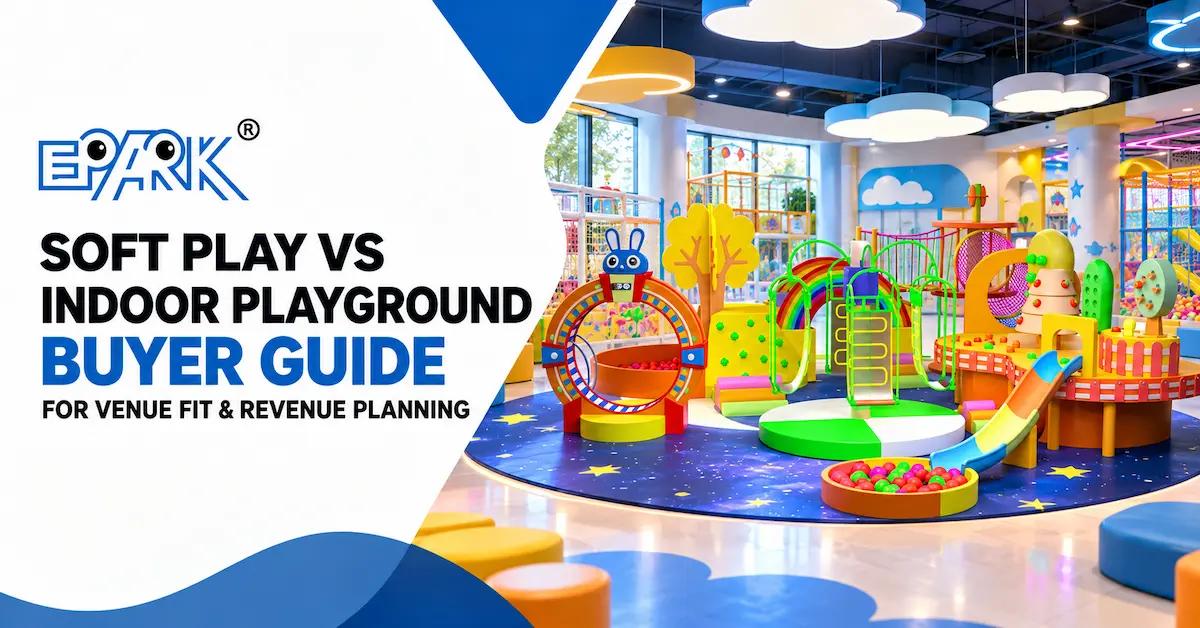
Commercial soft play uses padded, rounded, low-impact elements to create movement and discovery. Typical components include foam blocks, crawl tunnels, padded steps, small slides, ball pools, activity panels, playhouses, ramps, and soft barriers. The system can be a stand-alone toddler area or one layer inside a larger indoor playground.
EPARK’s public soft play category shows a range of commercial soft play examples, including play structures, interactive elements, themed layouts, and special-purpose applications. The category is a product navigation page, not a single fixed model. Age range, dimensions, materials, capacity, and installation method must be confirmed from the selected project drawings.
Soft play fits venues that value visibility and flexible use
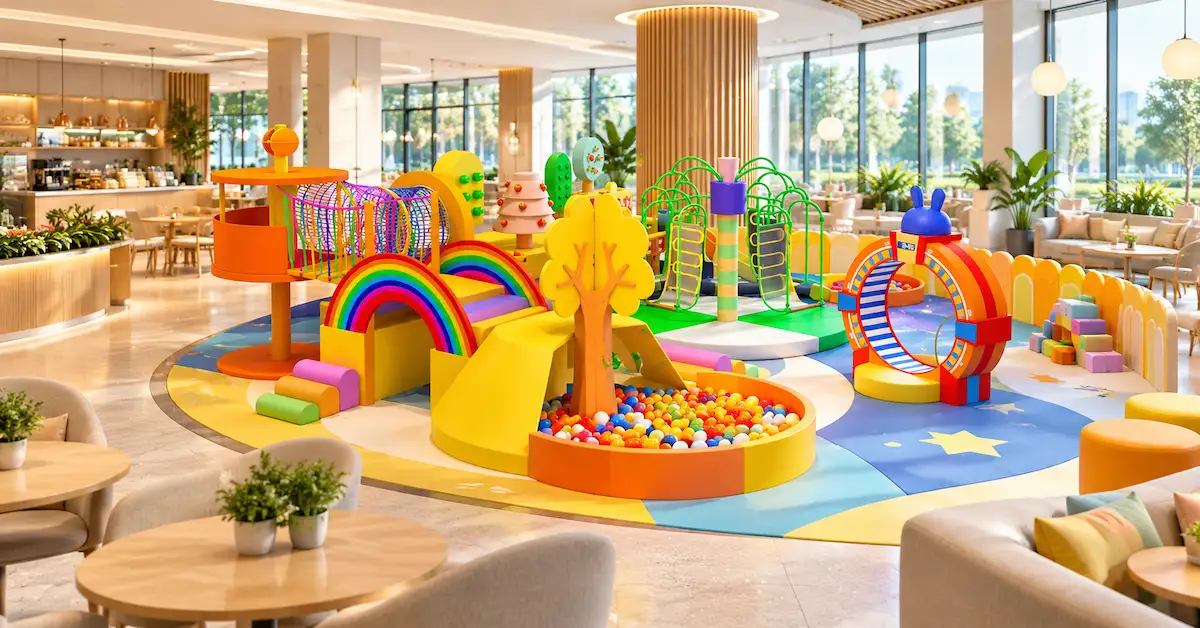
Soft play is often appropriate when an operator wants children to play while adults remain close. That can suit a cafe where tables surround the play zone, a hotel where parents need a short activity between check-in and meals, a daycare or early-learning setting, or a mall activation that must fit an irregular footprint. The lower visual height can make it easier for staff and parents to scan the space.
That does not make soft play only a small-business product. Large commercial soft play can include themed structures, ball pools, climbing challenges, slides, interactive walls, and repeatable modules. The useful question is whether the selected components create enough activity variety for the intended visit length and audience.
Soft play trade-offs to test before approval
- Age range: Low-level modules can serve younger children, while older children may need more height, challenge, speed, or sport-based activity.
- Cleaning: Covers, seams, ball pools, flooring joints, and touch panels need a written cleaning and inspection routine. “Easy to clean” should be tied to actual materials and access.
- Durability: Foam and upholstery can be replaceable, but the buyer should confirm cover construction, spare-part coding, and repair responsibility.
- Revenue model: Soft play can support timed admission, cafe minimum spend, hotel guest value, memberships, parties, or an add-on to a larger FEC. The equipment itself does not guarantee any revenue result.
- Branding: Soft shapes and panels allow color, logo, mascot, and theme integration, but licensed artwork and intellectual-property rights must be documented by the buyer.
What Is an Indoor Playground and Who Is It For?
The soft play vs indoor playground decision becomes clearer when the operator describes the intended visit: a short supervised play period beside a meal, or a longer activity session that anchors a family entertainment trip.
An indoor playground is a coordinated venue, not just a larger soft play set
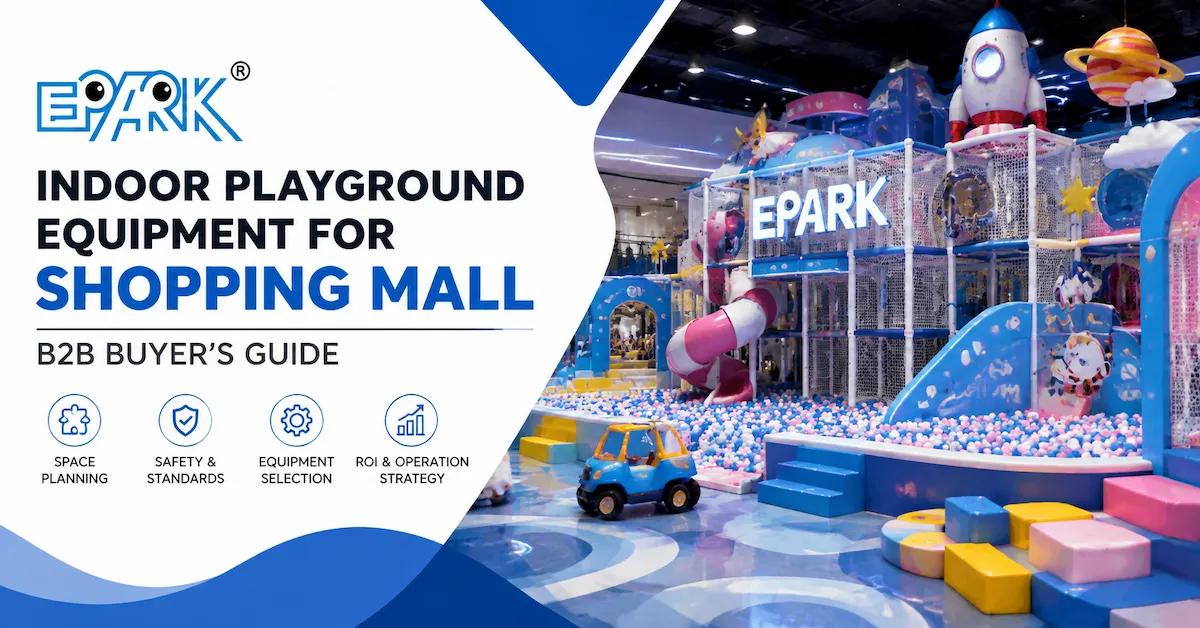
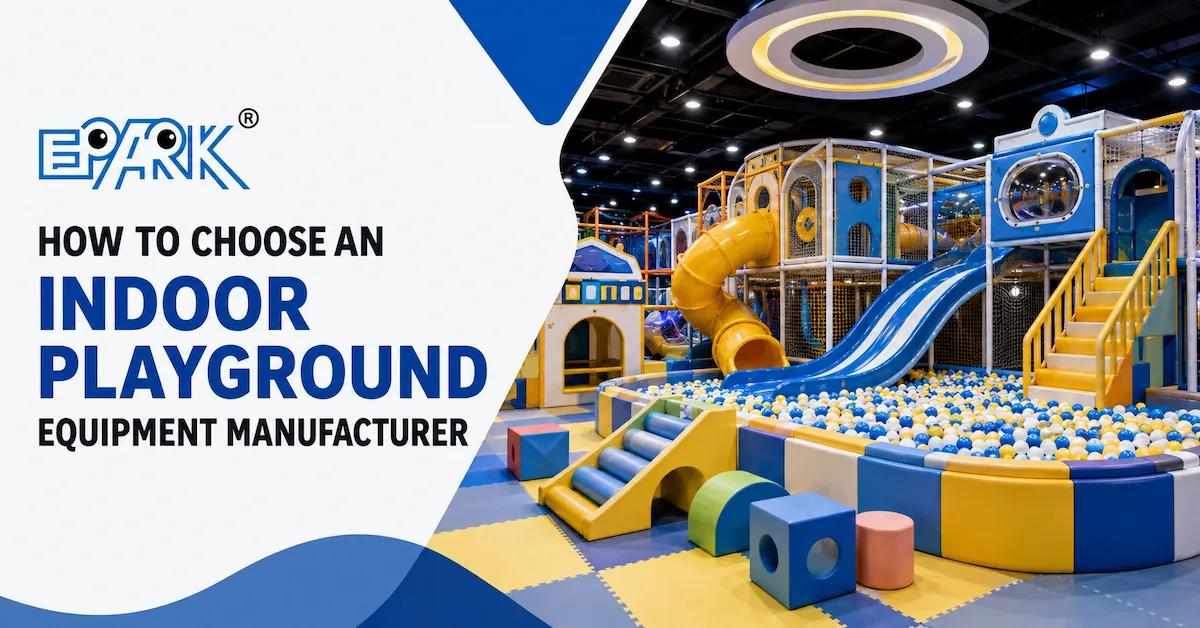
An indoor playground is a planned system of zones, circulation, access, supervision, and activities. It may include a soft play structure as the central attraction, then add ball pools, slides, climbing, bridges, obstacle courses, role play, sports, trampolines, or interactive elements. The purpose is to create a coherent visit for a defined group of users, not to fill every square meter with equipment.
EPARK’s indoor playground category includes project examples across different areas and themes. Those areas are examples of published projects, not standard sizes or guaranteed capacity bands. A buyer should treat them as evidence that the manufacturer works with multiple scales, then request a new layout based on the actual site.
Indoor playgrounds fit destination-led commercial venues
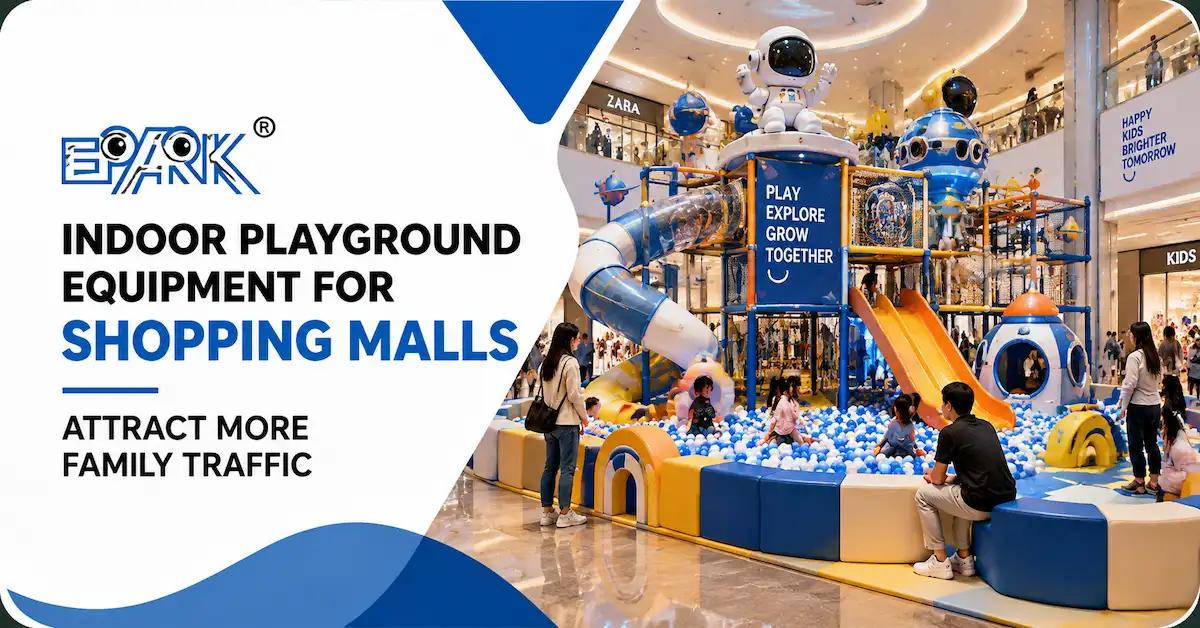
A full indoor playground can make sense for an FEC, shopping mall, family entertainment center, indoor play center, resort, or large restaurant that wants a reason for families to stay longer. It may support admission, memberships, birthday rooms, food and beverage, retail, school-group bookings, or cross-selling with arcade and interactive attractions. Each revenue path needs its own operating and commercial plan.
The format also works for a compact site when the design is disciplined. A smaller indoor playground can still use a clear age split, one signature feature, a visible toddler area, and efficient circulation. “Indoor playground” should not be treated as synonymous with a huge multi-level structure.
Indoor playground trade-offs to test before approval
- Building fit: Check floor area, clear height, columns, exits, doors, HVAC, sprinklers, loading route, and local building requirements before design approval.
- Operations: More zones can require clearer staff sightlines, inspection points, rules, cleaning access, and shift procedures.
- Installation: Confirm whether the supplier provides drawings, packaging labels, installation supervision, local labor guidance, training, and spare parts.
- Flexibility: A fixed structure can create a strong identity but may be harder to reconfigure than modular soft play. Ask which modules can be changed later.
- Compliance evidence: Standards and certificates are not interchangeable. Ask for documents that match the exact product, material, configuration, and destination market.
Soft Play vs Indoor Playground: Commercial Comparison
The table below is a planning comparison, not a universal specification. A custom soft play system can be larger or more technical than the example suggests, and a compact indoor playground can be simpler. Use it to identify questions for the RFQ.
| Decision factor | Commercial soft play | Indoor playground system | Buyer question |
|---|---|---|---|
| Primary role | Low-impact play, toddler engagement, parent-visible activity | Destination attraction with multiple zones and activity intensities | What guest problem must the area solve? |
| Typical age logic | Younger children or a clearly separated low-impact zone | Mixed ages when the layout has explicit age and activity zoning | Which ages are admitted together and who supervises? |
| Space requirement | Can work in a compact or irregular footprint, subject to circulation | Needs a coordinated envelope for structures, exits, access, and sightlines | What is the usable area after non-play functions are removed? |
| Clear height | Often more forgiving, but component dimensions still require review | May be decisive for multi-level structures, slides, and overhead services | What is the lowest obstruction, not only the advertised ceiling height? |
| Maintenance | Frequent cover, seam, ball-pool, mat, and touch-surface checks | All soft-play checks plus structural, barrier, access, and activity inspections | Can staff reach every inspection and cleaning point? |
| Revenue use | Cafe spend, timed play, hotel amenity, daycare, parties, or add-on | Admission, membership, parties, groups, F&B, retail, and cross-attraction sales | Which revenue assumption is supported by actual local demand? |
| Design flexibility | Modules and panels can support phased or themed updates | Strong visual identity and broader activity mix, with more fixed interfaces | Which parts can be replaced without rebuilding the whole area? |
| Project risk | Scope can be underestimated if flooring, storage, cleaning, and spares are omitted | Scope can be underestimated if drawings, installation, logistics, permits, and handover are omitted | Are inclusions, exclusions, options, and buyer responsibilities written down? |
Cost, Area, Age, Maintenance, and Revenue: How to Compare Without Guessing
In a soft play vs indoor playground quotation, ask the supplier to show the same cost categories and the same site assumptions for both options.
Cost is driven by scope, not the label
There is no responsible universal price for either format without a site and bill of materials. Cost changes with usable area, structure height, activity mix, theming, material selections, flooring, interactive or powered elements, design work, packaging, shipping, installation, destination requirements, and site preparation. A small themed structure with custom graphics can require more design work than a larger standard configuration.
MOQ and packaging need their own line in the quote. EPARK’s published OEM/ODM example says cooperation can begin with a single complete system on that page, but it does not establish one MOQ for every soft play module, spare part, branded package, or custom development. Ask for MOQ by deliverable and ask how cartons, labels, hardware bags, and installation sequence are identified. Secure packaging and a final component count are part of the published customization route, while the project quotation should define the actual packing list and responsibility for shipping damage.
When comparing quotations, ask each supplier to separate equipment, design, packaging, freight, installation, travel, local labor, taxes, permits, utilities, flooring, and after-sales items. EPARK’s published customization process lists consultation, space planning, material selection, manufacturing, quality inspection, secure packaging, delivery, installation, and after-sales support. The quotation should identify which of those stages are included for your project.
Area must be measured as usable play area
Do not send only a gross floor-area number. Mark reception, shoe storage, seating, party rooms, food service, toilets, staff areas, storage, exits, columns, and equipment that cannot move. Then define the remaining play envelope. The same 200 m2 headline can produce very different solutions depending on the building shape and non-play functions.
Age segmentation protects the operating model
Soft play is often selected for toddlers because its scale and padding can support low-impact activity, but suitability depends on the approved design, supervision, and local rules. An indoor playground can serve several ages when it separates toddler, junior, and higher-challenge zones and provides clear circulation. Mixing ages without a zoning plan increases conflict and makes supervision harder.
Maintenance should be costed as a recurring task
Ask for daily, weekly, monthly, and event-based inspection routines. Clarify who cleans ball pools, how covers are removed, which disinfectants are permitted, how damaged foam is tagged, and whether spare covers, nets, mats, fasteners, and interactive components can be reordered. EPARK states that its process includes after-sales guidance and spare-parts availability; the buyer should request the actual maintenance documents and part codes for the purchased system.
Revenue is an operating hypothesis, not an equipment claim
Soft play may support shorter, repeat visits attached to food or another service. A larger indoor playground may support admission windows, parties, memberships, school groups, and cross-selling. Neither format guarantees revenue. Test the local customer, price, seasonality, staffing, cleaning downtime, and available complementary spend before using revenue assumptions in an investment model.
How to Choose Based on Venue Conditions
Use the following venue tests to turn soft play vs indoor playground from a visual preference into a documented procurement decision.
Kids cafe or restaurant
Start with sightlines, table circulation, food hygiene, noise, and session length. A compact commercial soft play zone can keep parents close and make the play offer visible from the seating area. Add a small role-play or sensory module only if staff can clean and reset it between sessions. A full indoor playground is justified when play is a core destination rather than a short dwell-time amenity.
Hotel, resort, or serviced residence
Choose the format based on guest mix and the length of stay. Soft play can serve as a weather-proof amenity near a lobby, restaurant, or family lounge. A larger indoor playground may work in a dedicated recreation building, but the operator must plan access control, guest safety rules, maintenance during occupied hours, and multilingual signage. Ask for materials and cleaning instructions that match the hospitality operating routine.
School, daycare, or early-learning center
Prioritize age appropriateness, teacher sightlines, low-impact transitions, accessible routes, and predictable cleaning. Soft play may be easier to supervise in a classroom or multipurpose room. An indoor playground can work when the school has a dedicated hall and a clearly defined activity curriculum, but the design should not be selected only for visual scale.
Mall, FEC, or indoor play center
These venues often need a stronger destination proposition and multiple ways to use the floor area. A full indoor playground can anchor admission and parties, while a soft play or toddler zone can reduce age conflict and give parents a quieter option. If arcade, trampoline, or interactive attractions are added, ask the designer to show queueing, supervision, power, sound, and emergency access for the whole FEC rather than each attraction in isolation.
Small or irregular footprint
Do not assume a small site requires a loose soft play set. A tailored indoor playground can use a signature slide, a compact climbing route, a visible toddler zone, and storage that preserves circulation. Conversely, do not force a tall structure into a low-ceiling room because the venue wants “a real playground.” The site envelope should decide the format.
Recommended Combination Plans
Many operators do not need an either-or answer. A staged soft play vs indoor playground review can identify a main attraction and a separate low-impact zone that share the same brand language.
Plan A: Parent-visible cafe soft play
Use a low-to-medium-height soft play structure, ball pool or sensory feature, small slide, role-play panel, padded flooring, and a direct sightline from tables. Keep food-service paths outside the play entry. This plan is suited to kids cafes, restaurants, hotels, and mall waiting areas where the play zone supports another primary business.
Plan B: Toddler plus main-play split
Place a defined soft play toddler area beside a larger indoor playground zone. Use different colors, entry controls, and activity intensity to make the separation obvious. This is often more useful than trying to make every component suitable for every child. Confirm the age policy, staff route, cleaning access, and parent seating in the plan.
Plan C: Compact destination playground
For a smaller FEC, combine one signature indoor playground structure with a compact soft play or role-play zone and one flexible party or activity area. The goal is a coherent visit, not maximum component count. Use the indoor playground product category and the soft play category as starting points, then ask for a site-specific layout.
Plan D: Themed soft play as a brand asset
Choose a theme when it supports the venue’s identity, not simply because it looks colorful. EPARK lists candy, castle, jungle, ocean, and space as product themes. A theme can be applied to panels, colors, signs, role-play props, and the main structure while keeping the activity schedule and maintenance logic explicit. Review the candy theme product category only after deciding the audience, site, and brand rules.
Prepare a quote-ready brief. Include a dimensioned plan or CAD file, clear height, columns and exits, target ages, activity list, theme direction, destination, opening date, and whether you need design, production, packing, installation, and after-sales support.
Send Project Details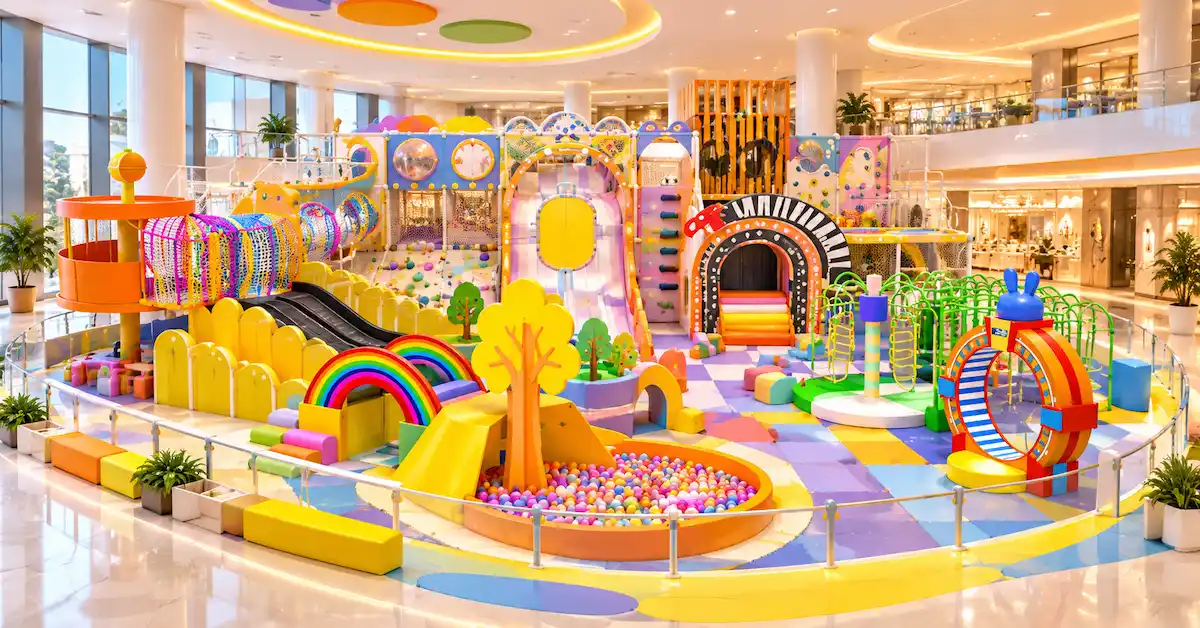
Supplier Questions That Prevent an Unclear Comparison
These questions keep the soft play vs indoor playground comparison tied to evidence that can be checked after delivery.
- Is the proposal a loose soft play set, a fixed zone, or a complete indoor playground project?
- Which floor-area number is usable play area, and which area is reserved for reception, seating, storage, toilets, parties, or staff?
- What age groups and activity intensities are assumed in the layout?
- Which materials are proposed for the framework, foam, covers, mats, slides, nets, barriers, and interactive components?
- Which drawings, samples, bill of materials, inspection records, certificates, and test reports will be issued?
- What does the published safety or certificate evidence apply to, and what still needs destination-market confirmation?
- What is the reference design and production timeline, and which buyer approvals start the clock?
- Who handles site preparation, freight, customs, unloading, local labor, tools, installation, training, and final acceptance?
- How are cleaning, inspections, spare parts, damaged components, warranty, and after-sales requests handled?
- Which elements can be replaced, expanded, or re-themed after opening?
Frequently Asked Questions
The short answers below summarize the most common soft play vs indoor playground questions raised during early project reviews.
Is soft play the same as an indoor playground?
No. Soft play usually describes padded, low-impact equipment or a dedicated zone. An indoor playground is a coordinated commercial environment that may include soft play plus climbing, slides, ball pools, role play, sports, trampolines, interactive elements, and age-specific circulation.
Which option is better for a kids cafe?
A parent-visible soft play zone is often the simpler starting point when the cafe is the primary business and the play area supports table use. A full indoor playground can work when the venue sells play admission or needs a destination attraction. Compare the usable area, sightlines, cleaning access, and operating model before choosing.
Which option is cheaper?
There is no reliable universal answer. Cost depends on scope, materials, structure, theme, flooring, interactive items, design, packaging, logistics, installation, and local work. Request comparable quotations that show inclusions and exclusions instead of comparing a soft play equipment price with a turnkey playground project price.
Can soft play be used inside a larger indoor playground?
Yes. A toddler soft play zone can sit beside a higher-energy indoor playground when the design provides clear age separation, sightlines, access control, and maintenance routes. The supplier should show the relationship in the plan and explain the operating rules.
What materials does EPARK publicly describe?
EPARK’s materials and safety page describes cold-rolled steel pipes with hot-dip galvanization, high-density foam, soft PVC sleeves, EVA or PU mats, FRP or composite-resin slides, safety nets, railings, and padded components. Confirm the exact material schedule, samples, and supporting documents for your configuration.
Does a theme change the equipment choice?
It should. A good theme connects visual elements with activity, age, circulation, signage, cleaning, and brand use. Do not approve a theme from a rendering alone. Request the equipment schedule, material and finish schedule, logo or artwork permissions, and maintenance implications.
How long does an EPARK project take?
The company FAQ publishes a general reference of 3-7 days for design and 15-30 days for production after design confirmation. Another product page shows a different production reference. Treat those as website guidance, not a contract promise; the signed quotation should state the current schedule and approval dependencies.
What should I send for a first quotation?
Send a dimensioned CAD plan or measured drawing, clear height, columns and obstructions, doors and exits, site photos, destination market, target ages, preferred activities, theme or brand files, desired opening date, and the scope you expect for design, manufacturing, packaging, delivery, installation, training, and after-sales.
Conclusion
Soft play vs indoor playground is a venue-fit decision, not a universal ranking. Choose commercial soft play when parent visibility, younger users, flexible footprint, and a supporting role are the priority. Choose a coordinated indoor playground when the venue needs a destination attraction, multiple activity zones, broader age coverage, and a structured admission or party model. Choose a hybrid when the business needs both a calmer toddler experience and a stronger main attraction.
The best procurement brief makes the distinction measurable: usable area, clear height, age zoning, activity schedule, materials, inspection and cleaning access, revenue assumptions, design deliverables, installation scope, documents, and spare parts. EPARK’s published company information, materials and safety information, product categories, and customization process can help start that conversation. The final configuration, compliance evidence, lead time, MOQ, and commercial terms should be confirmed in the project quotation.
Turn the comparison into a project scope. Share your venue details and ask for a layout that shows what is included, what is optional, and which items need local or order-specific confirmation.
Start a Custom Playground Review
General Disclaimer
All data on https://www.eparki.com is for general guidance only. As a leading indoor playground manufacturer and trampoline supplier, EPARK strives for accuracy but gives no express or implied warranty regarding completeness, performance or project fitness. Product specs, designs and results may vary with use and customer requirements. Buyers must verify technical details, compliance and suitability before purchase. EPARK OEM/ODM is not liable for any direct, indirect or consequential damages arising from site use. For custom solutions, contact our manufacturer and supplier team via the Contact page.
Intellectual Property
Text, images, videos, CAD files and software are Guangzhou EPARK Electronic Technology Co., Ltd. All rights reserved. No part may be copied, republished or used commercially without prior written permission. We will pursue legal action for copyright or design-patent infringement.
Trademarks
"EPARK", the EPARK logo and related graphics are registered trademarks of Guangzhou EPARK Electronic Technology Co., Ltd. Unauthorized use in ads, domain names or packaging is prohibited.
Governing Law
These terms are governed by the laws of the People's Republic of China.
Contact
Questions? Email sales@nanyuetech.com or WhatsApp +86 139 0307 9263.