What Makes an Amusement Game Equipment Factory Different?
An amusement game equipment factory serving commercial buyers needs to manage more than one type of machine.
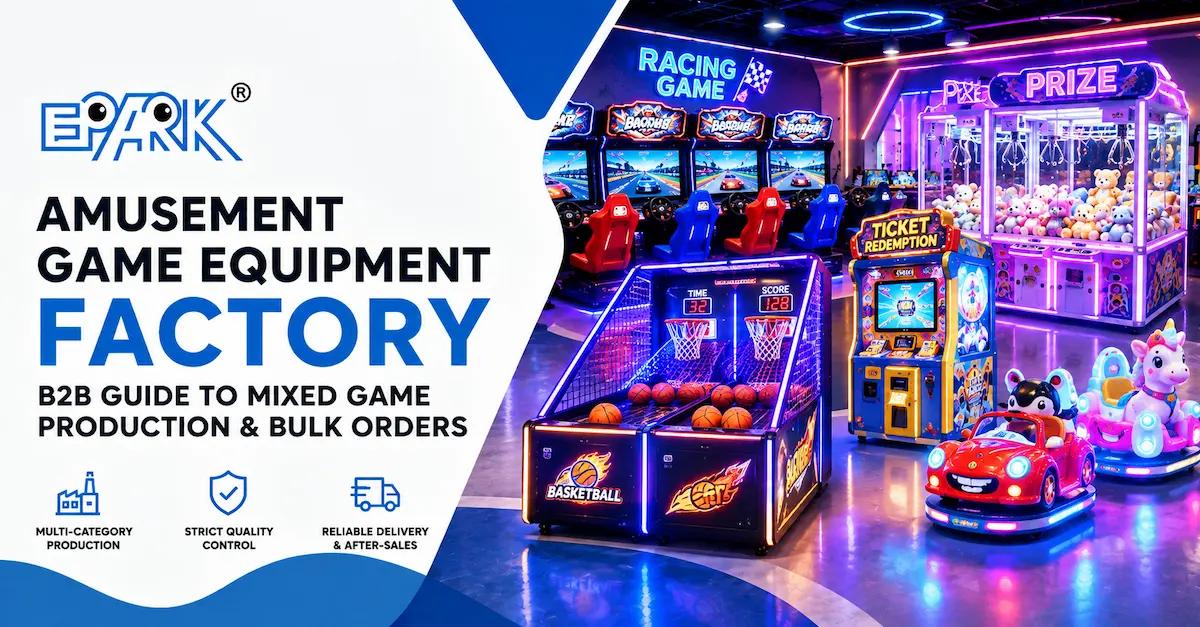
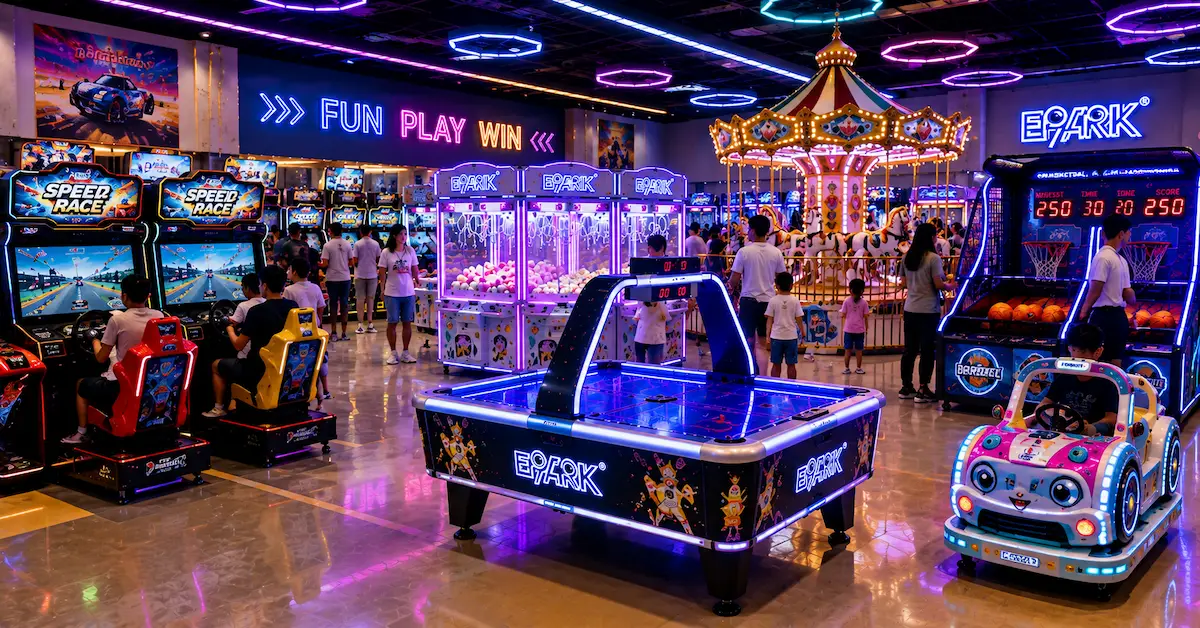
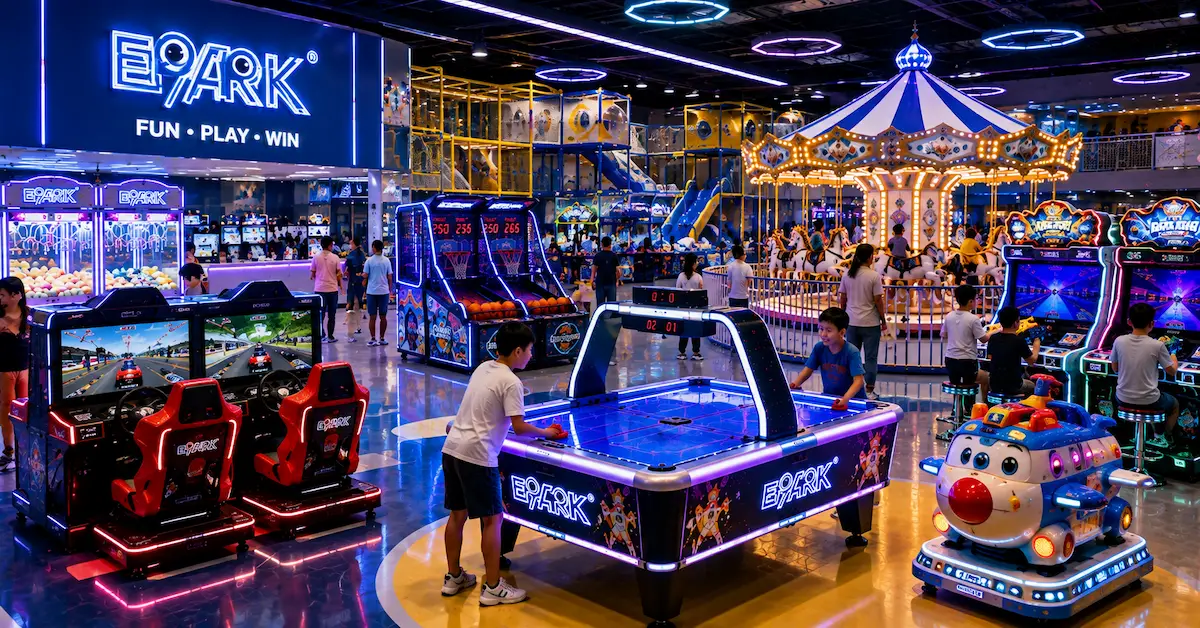
A new family entertainment center may require racing simulators, claw machines, basketball games, redemption equipment, shooting games, kiddie rides, air hockey, and other interactive attractions in the same project.
That creates a different production challenge from manufacturing a large quantity of one identical machine.
The factory must coordinate:
- Multiple machine structures
- Different electronic components
- Different control systems
- Payment interfaces
- Electrical configurations
- Artwork and branding
- Spare parts
- Inspection procedures
- Packaging schedules
- Container loading
For B2B buyers, the key question is therefore not simply whether a factory can build a game machine.
It is whether the factory can deliver a mixed commercial equipment order with consistent specifications and controlled quality.
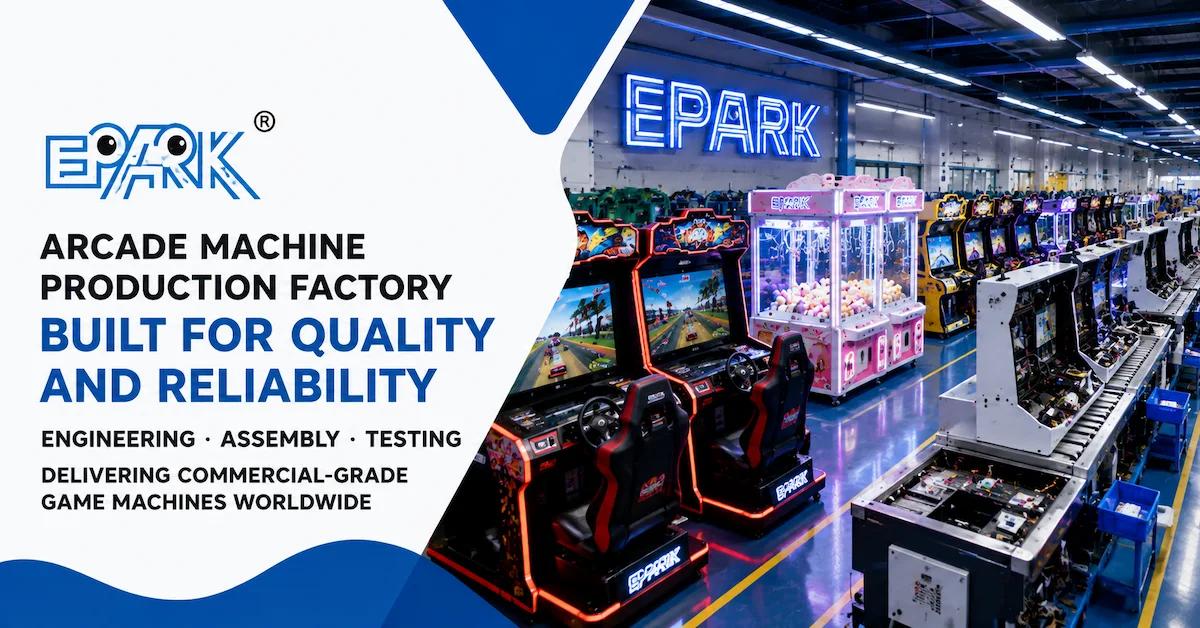
EPARK currently describes its business as integrating product development, manufacturing, sales, and after-sales support across arcade machines, game machines, indoor playground equipment, trampoline parks, and customized amusement projects. Buyers can review About EPARK for its current factory and project capabilities.
Which Buyers Need Multi-Category Factory Capability?
Family Entertainment Centers
FEC projects normally require several play motivations.
A balanced equipment plan may include:
- Prize play
- Competitive play
- Skill games
- Physical activity
- Parent-child interaction
- Redemption
- Digital entertainment
Producing these machines under one coordinated order can simplify technical specifications and project delivery.
Shopping Mall Entertainment Centers
Mall projects frequently need different machine sizes and customer experiences while maintaining a consistent visual environment.
Important factors include:
- Floor-space efficiency
- Strong visual attraction
- Easy operation
- Family suitability
- Payment-system consistency
- Maintenance access
Distributors and Importers
Distributors may purchase several models for different customers.
Their concerns often include:
- Stable wholesale supply
- Repeatable models
- OEM branding
- Spare-parts availability
- Consistent technical specifications
- Container utilization
Arcade and FEC Chains
Chain operators face an additional challenge: reproducing the same experience at several locations.
They need machines that can be reordered with consistent:
- Appearance
- Controls
- Electrical setup
- Payment configuration
- Spare parts
Evaluate the Factory by Product Families, Not Catalog Size
A large catalog does not automatically mean strong production capability.
Buyers should identify which product families the factory can actually coordinate.
| Equipment Category | Important Production Focus | Buyer Risk |
|---|---|---|
| Racing games | Steering, pedals, seat, display | Control inconsistency |
| Shooting games | Sensors and calibration | Accuracy problems |
| Basketball games | Frame and scoring system | Mechanical wear |
| Claw machines | Crane mechanism and settings | Unstable prize operation |
| Redemption games | Ticket/e-ticket system | Payment incompatibility |
| Air hockey | Table structure and electronics | Service difficulty |
| Kiddie rides | Motion system and controls | Reliability issues |
| Interactive games | Sensors, display, software | Technical support needs |
Ask the factory which processes it performs directly and which components are sourced from specialist suppliers.
The objective is not to demand that every component be produced in-house. The objective is to understand how the factory controls incoming components and final machine integration.
Build a Technical Specification Matrix Before Production
Mixed orders are vulnerable to configuration mistakes.
One machine may require 110 V while another is configured for 220 V. Different cabinets may be prepared for different card readers or credit settings.
Before production, create a specification matrix.
Recommended Fields
Include:
- Model
- Quantity
- Voltage
- Frequency
- Plug type
- Language
- Payment interface
- Credit setting
- Ticket system
- Artwork version
- Spare-parts requirement
- Packaging requirement
This document should become the reference for production and final inspection.
For buyers using EPARK's customized project services, its published customization process currently includes needs assessment, space planning, design, material selection, custom production, quality inspection, packaging, and after-sales support.
Standardize Components Where Practical
One of the most valuable strategies for mixed commercial orders is component standardization.
Where technically practical, several machines may use compatible:
- Power supplies
- Buttons
- Locks
- Coin acceptors
- Card readers
- Sensors
- Ticket dispensers
- Connectors
Why Standardization Matters
For operators, it can reduce:
- Spare-parts inventory
- Technician training
- Troubleshooting time
- Emergency purchasing
- Maintenance complexity
For distributors, standardized parts can also make after-sales support easier across several machine models.
The goal is not to force every machine to use identical components, but to reduce unnecessary variation.
Payment-System Integration Must Be Planned Across the Project
An FEC may use:
- Coins
- Tokens
- RFID cards
- Stored-value cards
- Cashless readers
- Paper tickets
- E-ticket redemption
When dozens of machines come from a mixed order, payment compatibility should be treated as a project-level specification.
Confirm Before Production
Ask:
- Can the same reader be installed across the selected machines?
- Is there enough cabinet space?
- Are credit signals compatible?
- Can redemption machines work with e-tickets?
- Can default credit values be standardized?
- Who provides wiring diagrams?
Payment-system problems discovered after international delivery are much more expensive to solve.
Quality Control Should Be Adapted to Each Machine Category
A professional amusement game equipment factory should not use one generic QC checklist for every product.
Different machine types create different failure risks.
Racing Machine Checks
Inspect:
- Steering response
- Pedals
- Seat mounting
- Screen
- Sound
- Game communication
Claw Machine Checks
Inspect:
- Crane movement
- Grab strength
- Limit switches
- Prize settings
- Door locks
- Payment input
Basketball Game Checks
Inspect:
- Basket structure
- Scoring sensors
- Ball return
- Timer
- Display
Redemption Game Checks
Inspect:
- Scoring
- Ticket output
- E-ticket interface
- Credit settings
A general final inspection should additionally check:
- Cabinet finish
- Internal wiring
- Lighting
- Power supply
- Accessories
- Labels
- Spare parts
- Packaging
Use Sample Approval to Control Bulk Production
For customized projects, buyers should approve a sample or representative configuration before mass production.
The approved sample should document:
- Appearance
- Dimensions
- Components
- Controls
- Software
- Electrical setup
- Payment configuration
- Artwork
- Packaging
The purpose is to create a measurable reference for the bulk order.
Otherwise, phrases such as “same quality as sample” are too subjective.
Monitor Component Changes During Production
Electronic components can become unavailable during a large order.
A factory should have a change-control process.
Before approving the order, ask:
- Will component substitutions require approval?
- Will equivalent components be tested?
- Can the change affect software?
- Will wiring change?
- Will future spare parts remain compatible?
This is particularly important for distributors and chain operators that expect to reorder the same machines later.
Production Capacity Is More Than a Monthly Number
Buyers often ask:
“How many machines can you produce per month?”
That number alone does not explain whether the factory can complete your specific mixed order.
A better capacity assessment looks at:
- Component availability
- Assembly capacity
- Skilled labor
- Testing stations
- Customized artwork preparation
- Packaging capacity
- Current workload
EPARK currently states that its manufacturing plant covers approximately 25,000 m², with more than 400 machines and a team of over 100 workers. Its About page also describes production, inspection, customization, packaging, and delivery as part of its factory operation.
Buyers should still verify capacity against the actual order quantity and delivery date.
Plan the Production Schedule by Milestone
Instead of accepting only a final delivery date, request production milestones.
| Production Stage | Buyer Control Point |
| Specification confirmation | All technical data approved |
| Component preparation | Critical parts available |
| Cabinet production | Structures completed |
| Machine assembly | Hardware installed |
| Software/configuration | Settings confirmed |
| Functional testing | QC completed |
| Final inspection | Quantity/spec verified |
| Packaging | Protection and labels checked |
| Container loading | Packing list confirmed |
Milestones make it easier to identify delays before they affect the opening date of an FEC project.
OEM and ODM Requirements Should Be Locked Early
Common OEM customization can include:
- Logo
- Cabinet artwork
- Colors
- Language
- Labels
- Packaging
More advanced customization may include:
- Cabinet structure
- Control layout
- Screen configuration
- Payment interface
- Special functions
For mixed orders, create one brand guideline covering all machines.
This prevents different products from arriving with inconsistent logo sizes, colors, graphics, or interface language.
Spare-Parts Planning Should Follow the Machine Mix
Do not request a random box of spare components.
Ask the factory to classify parts into:
Routine-Wear Parts
Examples may include buttons or selected mechanical components.
Model-Specific Parts
Components that cannot easily be sourced locally.
Downtime-Critical Parts
Components whose failure stops operation completely.
For multi-category projects, a spare-parts matrix can identify which parts are shared between machines and which are unique.
This reduces unnecessary inventory.
Packaging Must Match the Equipment Type
Different game machines require different packaging protection.
A racing simulator may require protection for:
- Display
- Steering wheel
- Seat
- cabinet edges
A claw machine may need:
- Glass protection
- Crane securing
- Interior protection
Buyers should request:
- Packing dimensions
- Gross weight
- Packing method
- Machine identification
- Accessory labels
- Loading plan
Photographs of completed packaging before container loading can also help verify that machines and accessories are correctly identified.
Calculate Project Cost, Not Only Factory Price
A lower equipment quotation can become more expensive if it creates operational problems.
Consider:
Machine cost + customization + spare parts + freight + import costs + installation + maintenance + downtime
When comparing factories, evaluate:
- Machine consistency
- Payment compatibility
- Spare-parts support
- Packaging
- Technical documentation
- Repeat-order availability
- After-sales response
A slightly higher factory price may represent better commercial value when it reduces operational risk.
What Should Buyers Send With an RFQ?
A useful RFQ should include:
- Venue type
- Floor plan if available
- Equipment categories
- Quantity by model
- Target customer groups
- Destination country
- Voltage and frequency
- Plug type
- Payment system
- Redemption method
- OEM requirements
- Spare-parts requirements
- Budget
- Target delivery date
- Shipping destination
Buyers can review EPARK Products, its Safety & Quality information, and common cooperation questions in the EPARK FAQ before preparing a project inquiry. EPARK's current FAQ covers customization, safety, shipping, installation, pricing, and international cooperation topics.
FAQ
What is an amusement game equipment factory?
An amusement game equipment factory manufactures or integrates commercial game and entertainment machines for venues such as FECs, arcades, shopping malls, and indoor entertainment centers.
What machines can an amusement game factory produce?
Depending on its capability, the product range may include racing machines, shooting games, claw machines, redemption games, sports games, kiddie rides, air hockey, and interactive equipment.
How is an amusement game equipment factory different from an arcade factory?
The terms overlap, but amusement game equipment can describe a broader range of entertainment machines beyond conventional arcade cabinets.
What should buyers check before placing a mixed order?
Confirm product categories, components, electrical settings, payment compatibility, QC procedures, OEM specifications, lead times, spare parts, and packaging.
Can different machines use the same cashless system?
Often yes, but each model's physical mounting, signal interface, credit settings, and redemption functions should be confirmed before production.
Should I approve samples before bulk production?
For customized or high-value orders, approving representative samples or configurations can reduce specification differences during mass production.
How should factories control component substitutions?
Important substitutions should be communicated, technically evaluated, tested, and documented before being applied to production units.
What spare parts should be included with a mixed FEC order?
The correct list depends on the machines. Prioritize routine-wear, model-specific, and downtime-critical parts.
How should buyers evaluate production lead time?
Review material preparation, assembly, configuration, testing, inspection, packaging, and shipping milestones rather than relying only on one promised completion date.
How can I request an EPARK amusement game equipment proposal?
Prepare your venue layout, equipment categories, quantities, destination country, electrical requirements, payment system, customization requirements, and schedule, then submit them through Contact EPARK.
Conclusion
Choosing an amusement game equipment factory requires evaluating how well the factory manages multiple machine categories as one commercial project.
For FEC operators, distributors, importers, shopping mall projects, and entertainment chains, product variety is only useful when production specifications remain controlled across the entire order.
A reliable factory should coordinate machine configurations, components, payment systems, QC, OEM branding, spare parts, production schedules, packaging, and repeat-order requirements.
For buyers planning a multi-category entertainment center, explore EPARK Products, review About EPARK, or contact EPARK with your floor plan, equipment list, destination market, and technical requirements for a project-specific discussion.
General Disclaimer
All data on https://www.eparki.com is for general guidance only. As a leading indoor playground manufacturer and trampoline supplier, EPARK strives for accuracy but gives no express or implied warranty regarding completeness, performance or project fitness. Product specs, designs and results may vary with use and customer requirements. Buyers must verify technical details, compliance and suitability before purchase. EPARK OEM/ODM is not liable for any direct, indirect or consequential damages arising from site use. For custom solutions, contact our manufacturer and supplier team via the Contact page.
Intellectual Property
Text, images, videos, CAD files and software are Guangzhou EPARK Electronic Technology Co., Ltd. All rights reserved. No part may be copied, republished or used commercially without prior written permission. We will pursue legal action for copyright or design-patent infringement.
Trademarks
"EPARK", the EPARK logo and related graphics are registered trademarks of Guangzhou EPARK Electronic Technology Co., Ltd. Unauthorized use in ads, domain names or packaging is prohibited.
Governing Law
These terms are governed by the laws of the People's Republic of China.
Contact
Questions? Email sales@nanyuetech.com or WhatsApp +86 139 0307 9263.