What Is an Arcade Machine Production Factory?
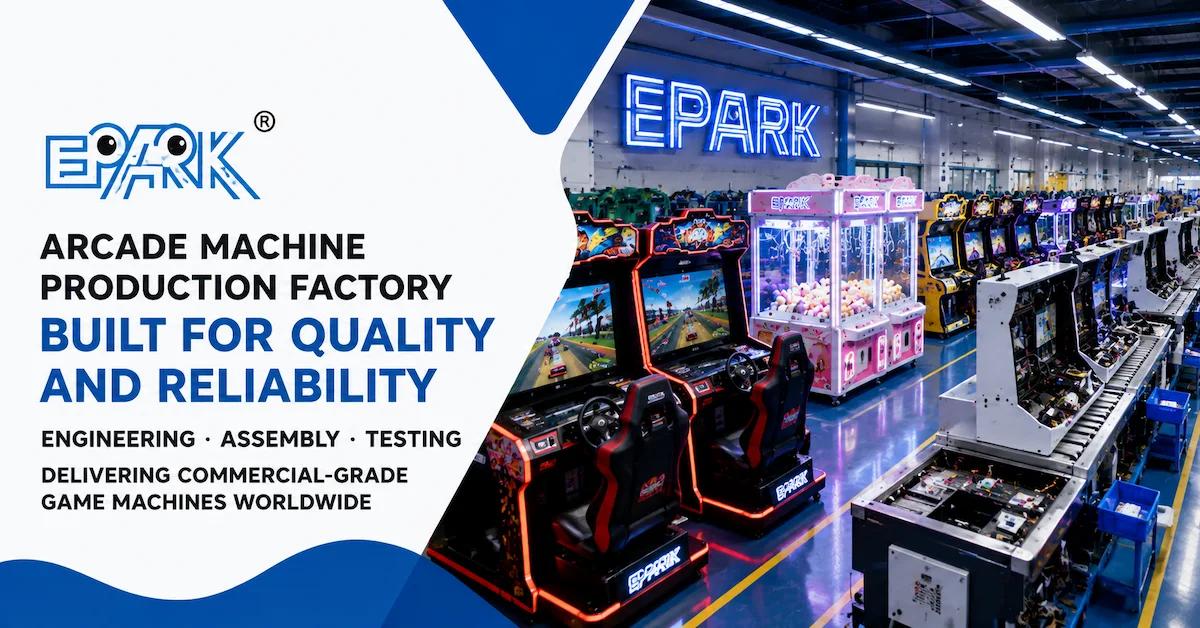
An arcade machine production factory is a manufacturing facility responsible for transforming a game concept and technical specification into finished commercial arcade equipment ready for installation in arcades, family entertainment centers, shopping malls, and other entertainment venues.
A professional factory may coordinate several production stages:
- Product and structural design
- Arcade cabinet manufacturing
- Electronic component integration
- Control-system installation
- Game and payment configuration
- Assembly and functional testing
- Quality inspection
- Packaging and bulk-order preparation
For B2B buyers, the important question is not simply whether a company can produce one attractive sample.
The real question is whether the factory can reproduce the approved machine consistently across 10, 50, or 100 units while maintaining the agreed components, configuration, appearance, testing standards, and delivery schedule.
Buyers evaluating commercial products can first review EPARK's current arcade and amusement equipment solutions and learn more about its manufacturing and company capabilities.
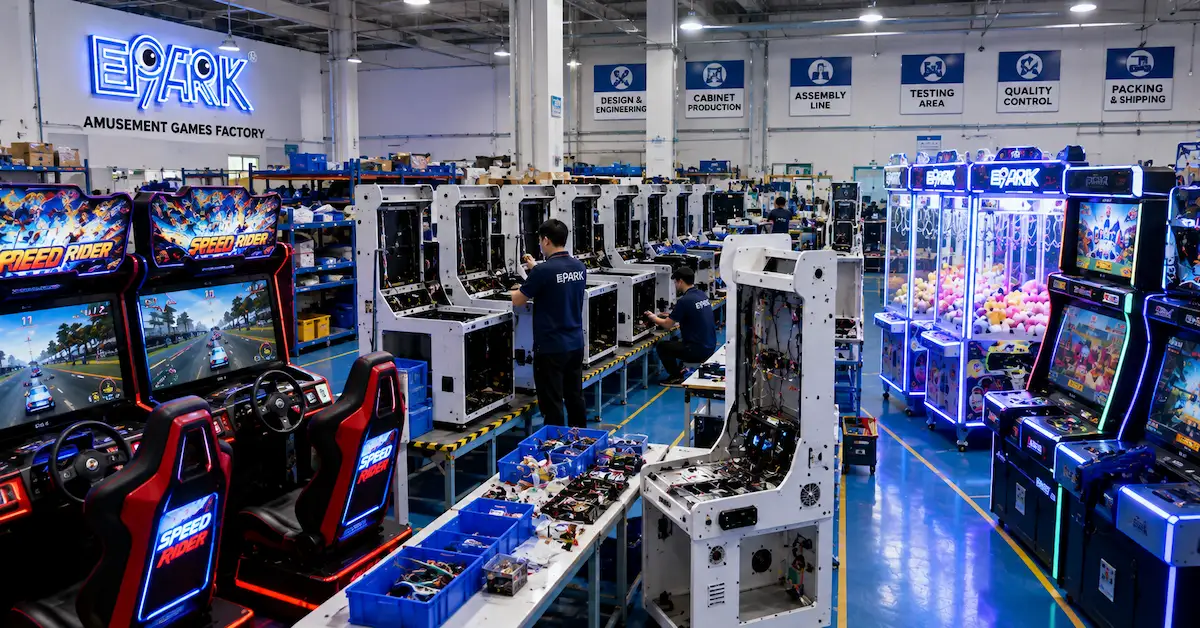
Why Production Capability Matters for Commercial Buyers
Commercial arcade equipment is different from equipment intended for occasional home use.
Machines installed in a commercial venue may experience:
- Long operating hours
- Frequent button and control use
- Repeated payment transactions
- Continuous lighting and display operation
- Regular customer interaction
- Daily cleaning and maintenance
This makes production consistency a major purchasing factor.
Sample Quality Is Only the Beginning
A sample proves that one machine can be assembled successfully.
It does not automatically prove that a factory can reproduce:
- The same cabinet dimensions
- The same electronic components
- The same artwork
- The same controls
- The same payment configuration
- The same wiring layout
For bulk orders, buyers should establish an approved specification before production begins.
Production Consistency Reduces Operational Risk
If each machine uses different buttons, power supplies, locks, or wiring arrangements, future maintenance becomes more difficult.
Consistent production can help operators reduce:
- Spare-parts complexity
- Technician training time
- Troubleshooting difficulty
- Reorder inconsistencies
Step 1: Product Design and Engineering Development
Arcade machine production begins before physical assembly.
A capable factory should first understand the intended commercial application.
Venue and User Analysis
The equipment may be intended for:
- Arcade centers
- Family entertainment centers
- Shopping malls
- Indoor amusement parks
- Distributor catalogs
These applications can influence:
- Cabinet size
- Player position
- Control type
- Visual design
- Maintenance access
Mechanical Design
Engineering teams may define:
- Cabinet structure
- Internal component positions
- Display mounting
- Control-panel layout
- Service doors
- Cooling and ventilation
Good design should balance appearance with practical maintenance.
Prototype Development
Customized products may require a prototype before bulk production.
A prototype helps verify:
- Overall dimensions
- Player ergonomics
- Hardware fit
- Display angle
- Control accessibility
- Internal layout
OEM buyers can review EPARK's customization process when planning branded or project-specific equipment.
Step 2: Arcade Cabinet Manufacturing
The cabinet is both the visual shell and structural platform of an arcade machine.
Commercial cabinet production may involve different combinations of:
- Metal structures
- Wood-based panels
- Acrylic
- Tempered glass
- Decorative panels
- Printed graphics
The exact material depends on the machine design and application.
Cutting and Fabrication
Manufacturing requires dimensional accuracy so that:
- Displays fit correctly
- Control panels align
- Doors close properly
- Internal assemblies are secure
Poor dimensional control can create assembly problems later in production.
Surface Finishing
The exterior may require:
- Painting
- Lamination
- Printed artwork
- Lighting
- Decorative components
Buyers should inspect:
- Surface consistency
- Edge finishing
- Panel alignment
- Graphic quality
- Visible scratches or defects
Maintenance Access
A commercial cabinet should also allow technicians to reach frequently serviced components.
Important areas include:
- Power supply
- Main controller
- Payment system
- Sensors
- Display
- Wiring
A visually impressive cabinet that is difficult to maintain may increase operating costs.
Step 3: Electronic Component Assembly
After the cabinet is prepared, electronic systems are installed.
Depending on machine type, important components may include:
- Main controller
- Power supplies
- Displays
- Speakers
- LED systems
- Wiring harnesses
- Buttons
- Joysticks
- Sensors
- Payment modules
Why Component Specifications Matter
Two machines can look identical externally while using very different internal parts.
For commercial buyers, the specification of critical components affects:
- Reliability
- Spare-parts availability
- Maintenance
- Repeat orders
For larger orders, request a component or BOM reference for important parts.
Component Substitution Control
Components can occasionally become unavailable during production.
Buyers should ask:
- Will substitutions be communicated?
- Will replacement components be tested?
- Will wiring or software change?
- Will future spare parts remain compatible?
This is particularly important for distributors and chain operators.
Step 4: Control, Game and Payment Configuration
The physical machine is only part of the finished product.
Factories may also configure:
- Game software
- Language
- Credit settings
- Difficulty settings
- Ticket functions
- Coin or token systems
- Card-reader interfaces
Payment Configuration
Commercial machines may operate with:
- Coins
- Tokens
- Rechargeable cards
- RFID systems
- Other cashless systems
Payment requirements should be finalized before bulk production.
For mixed-machine orders, buyers should create a table showing the required configuration for each model.
Step 5: Mechanical and Functional Assembly
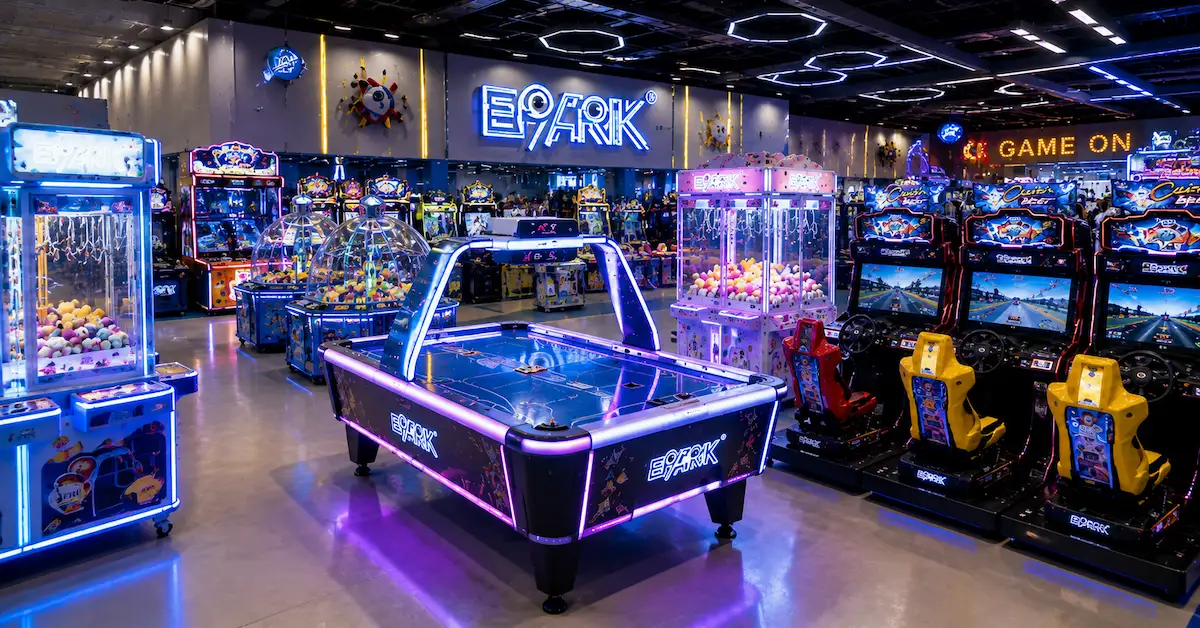
Different arcade categories require different assembly and testing priorities.
Racing Machines
Production may involve:
- Steering systems
- Pedals
- Seats
- Displays
- Sound systems
Key checks include steering response and mechanical stability.
Shooting Games
Important areas include:
- Gun controls
- Sensors
- Calibration
- Display synchronization
Basketball Machines
Production should verify:
- Frame assembly
- Basket alignment
- Ball-return system
- Scoring sensors
Claw Machines
Important areas include:
- Crane movement
- Grab mechanism
- Limit switches
- Door locks
- Prize settings
Redemption Games
The factory should verify:
- Scoring
- Ticket output
- Credit settings
- Redemption interfaces
This is why a single generic checklist is rarely enough for every arcade machine.
Step 6: Quality Control During Production
Quality inspection should occur throughout manufacturing rather than only after the machine is finished.
Buyers can review EPARK's published safety and quality information when evaluating its QC approach.
Incoming Inspection
Important incoming parts may be checked before assembly, including:
- Displays
- Power supplies
- Controllers
- Sensors
- Payment modules
In-Process Inspection
During assembly,QC may verify:
- Wiring connections
- Fasteners
- Component positions
- Mechanical operation
- Cabinet alignment
Final Inspection
The completed machine should be inspected for:
- Appearance
- Functions
- Controls
- Electrical configuration
- Accessories
- OEM requirements
Step 7: Functional and Burn-In Testing
One of the most important responsibilities of an arcade machine production factory is verifying that the completed equipment works consistently before shipment.
Basic Functional Testing
Typical checks may include:
- Power-on operation
- Display performance
- Buttons and controls
- Sensors
- Sound
- Lighting
- Scoring
- Payment functions
- Ticket systems
Why Longer Operation Testing Matters
A machine that operates correctly for five minutes may still develop problems after longer use.
Extended testing can help identify issues such as:
- Loose wiring
- Unstable power supply
- Intermittent sensors
- Heat-related problems
- Software instability
The exact testing duration should depend on the machine and factory process, so buyers should ask what “tested before shipment” actually means.
Step 8: Controlling Bulk Production Consistency
For importers and distributors, batch consistency is one of the most important indicators of factory capability.
A strong production-control system can use:
| Production Control | Buyer Value |
|---|---|
| Approved sample | Creates a clear production benchmark |
| BOM specification | Controls critical component selection |
| Approved artwork | Keeps branding consistent |
| Standard assembly process | Reduces unit-to-unit variation |
| QC checkpoints | Identifies problems earlier |
| Final testing | Reduces shipment risk |
Keep an Approved Sample Specification
The approved reference should record:
- Dimensions
- Components
- Artwork
- Controls
- Voltage
- Payment system
- Software configuration
This provides a measurable basis for evaluating the bulk order.
OEM Arcade Machine Production
OEM production is especially important for:
- Distributors
- Private-label brands
- Arcade chains
- Customized FEC projects
Customization can include several levels.
Branding
- Logo
- Cabinet artwork
- Colors
- Packaging
Electrical and Market Configuration
- Voltage
- Frequency
- Plug type
- Language
Operational Configuration
- Credit settings
- Payment interface
- Ticket settings
- Selected game parameters
Structural Customization
More advanced projects may involve:
- Cabinet changes
- Control-panel layout
- Screen configuration
- Hardware integration
The deeper the customization, the more important prototype approval and engineering communication become.
Packaging and Bulk Shipment Preparation
Production does not end when the machine passes functional testing.
Arcade equipment can include fragile:
- Screens
- Glass
- Electronics
- Decorative panels
- Mechanical controls
Packaging should match the machine structure.
Buyers Should Confirm
- Screen protection
- Corner protection
- Internal fixing
- Moisture protection
- Accessory identification
- Spare-parts labeling
For large orders, request packing photos and a final machine list before loading.
What Should Buyers Verify Before Mass Production?
Before approving bulk production, confirm:
- Machine model and quantity
- Approved sample
- Cabinet dimensions
- Critical components
- Voltage and frequency
- Payment system
- Language
- Artwork
- Spare-parts package
- Packing method
- Production schedule
- Final testing requirements
A detailed specification reduces misunderstandings later.
How to Evaluate an Arcade Machine Production Factory
Production Capability
Ask whether the facility can support the required:
- Machine categories
- Quantity
- Delivery schedule
Engineering Support
For OEM projects,confirm whether technical staff can handle:
- Structural changes
- Hardware integration
- Configuration changes
Quality Control
A professional factory should be able to explain:
- Incoming inspection
- In-process QC
- Final inspection
- Functional testing
Repeat-Order Capability
Distributors should ask whether the factory can reproduce the same:
- Cabinet
- Artwork
- Components
- Payment configuration
Spare Parts and Technical Support
Confirm:
- Recommended spare parts
- Replacement availability
- Technical guidance
- After-sales communication
Common cooperation questions can also be reviewed through the EPARK FAQ.
Arcade Machine Factory vs Equipment Supplier
Factory and supplier relationships solve different buyer problems.
| Arcade Machine Production Factory | Equipment Supplier |
|---|---|
| Controls manufacturing | Focuses on product sourcing |
| Supports engineering changes | Offers broader product selection |
| Controls assembly and testing | Coordinates purchasing |
| Suitable for OEM development | Suitable for mixed sourcing |
| Strong for repeat production | Strong for flexible procurement |
Buyers requiring deep customization or repeat production may place greater value on factory capability.
Buyers requiring multiple unrelated product categories may prioritize supplier coordination.
Common Mistakes When Choosing an Arcade Machine Factory
Choosing Based Only on Unit Price
A lower quotation may lead to higher long-term costs if equipment creates:
- Frequent repairs
- Parts shortages
- Downtime
Not Verifying Production Capability
A showroom demonstrates products, not necessarily production capacity.
Buyers should understand which processes the factory actually controls.
Ignoring Batch Consistency
Always establish an approved reference before mass production.
Skipping Pre-Shipment Testing
Testing equipment after arrival is far more expensive than detecting problems before shipment.
Not Planning Spare Parts
Identify high-wear, machine-specific, and downtime-critical parts before shipment.
FAQ
What is an arcade machine production factory?
An arcade machine production factory develops, assembles, configures, tests, and prepares commercial arcade machines for operators, distributors, FECs, and entertainment projects.
How are commercial arcade machines manufactured?
Production commonly involves design, cabinet manufacturing, component installation, electrical assembly, software configuration, machine testing, final inspection, and export packaging.
What materials are used for arcade cabinets?
Depending on the design, cabinets may use metal structures, engineered wood panels, acrylic, tempered glass, decorative panels, and other materials.
How does a factory test arcade machines?
Testing may include power-on operation, controls, displays, sensors, sound, lighting, payment functions, scoring, and other model-specific functions.
Can an arcade machine factory provide OEM production?
Yes. Depending on factory capability, OEM options may include branding, artwork, electrical configuration, payment systems, language, packaging, and structural customization.
How do factories control bulk-order quality?
Factories can use approved samples, specification sheets, controlled components, assembly procedures, QC checkpoints, and final functional inspections.
Should buyers approve a sample before mass production?
For customized or large orders, sample approval provides a clear reference for appearance, configuration, components, and quality.
How long does arcade machine production take?
Lead time depends on machine type, quantity, customization, component availability, testing requirements, and current factory workload.
Do factories provide spare parts?
Professional factories can normally recommend or supply spare parts based on the specific machines ordered. Buyers should confirm the actual parts package before placing an order.
Can arcade machines be configured for different countries?
Depending on model capability, machines may be configured for different voltage, plug, language, payment, and operating requirements.
Conclusion
Choosing an arcade machine production factory should be treated as a production-control decision rather than simply a search for the lowest machine price.
Commercial buyers should evaluate how the factory manages design, cabinet production, electronic assembly, configuration, QC, functional testing, batch consistency, OEM requirements, spare parts, and export packaging.
For distributors, FEC operators, arcade chains, and project buyers, a controlled production process can reduce purchasing risk and make future expansion easier.
Explore EPARK's commercial arcade equipment, learn more about its manufacturing capabilities, review its quality control approach, or contact EPARK with your equipment list, quantity, destination market, and customization requirements for a project-specific discussion.
General Disclaimer
All data on https://www.eparki.com is for general guidance only. As a leading indoor playground manufacturer and trampoline supplier, EPARK strives for accuracy but gives no express or implied warranty regarding completeness, performance or project fitness. Product specs, designs and results may vary with use and customer requirements. Buyers must verify technical details, compliance and suitability before purchase. EPARK OEM/ODM is not liable for any direct, indirect or consequential damages arising from site use. For custom solutions, contact our manufacturer and supplier team via the Contact page.
Intellectual Property
Text, images, videos, CAD files and software are Guangzhou EPARK Electronic Technology Co., Ltd. All rights reserved. No part may be copied, republished or used commercially without prior written permission. We will pursue legal action for copyright or design-patent infringement.
Trademarks
"EPARK", the EPARK logo and related graphics are registered trademarks of Guangzhou EPARK Electronic Technology Co., Ltd. Unauthorized use in ads, domain names or packaging is prohibited.
Governing Law
These terms are governed by the laws of the People's Republic of China.
Contact
Questions? Email sales@nanyuetech.com or WhatsApp +86 139 0307 9263.