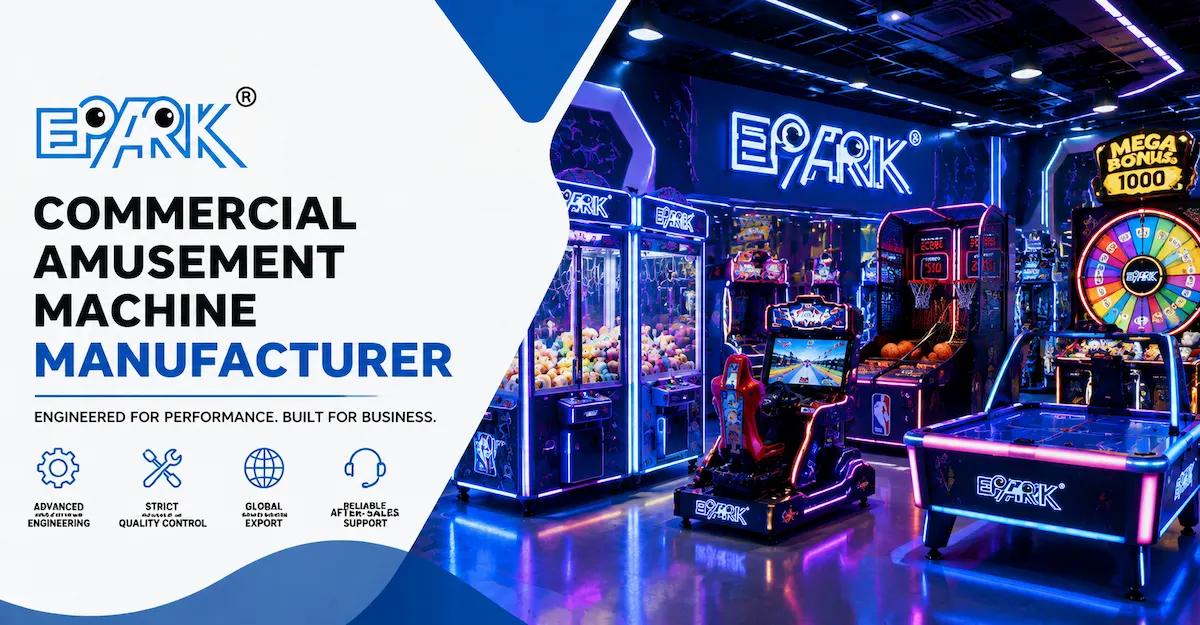
What Makes a Commercial Amusement Machine Truly Commercial-Grade?
A commercial amusement machine manufacturer should design equipment around repeated operation, maintenance access, component replacement, electrical configuration, and long-term venue use—not simply around appearance.
For an FEC operator or distributor, an attractive cabinet has limited value if technicians cannot access service components, replacement parts are difficult to source, or the same model cannot be reproduced consistently for future locations.
Commercial buyers should therefore evaluate five areas before ordering:
- Machine structure
- Electrical and control components
- Operating reliability
- Serviceability
- Long-term parts support
EPARK currently operates across arcade machines, game machines, indoor playground equipment, trampoline parks, and customized amusement projects. Buyers can review the EPARK company profile and product solutions when evaluating whether its wider entertainment equipment capabilities match a planned project.
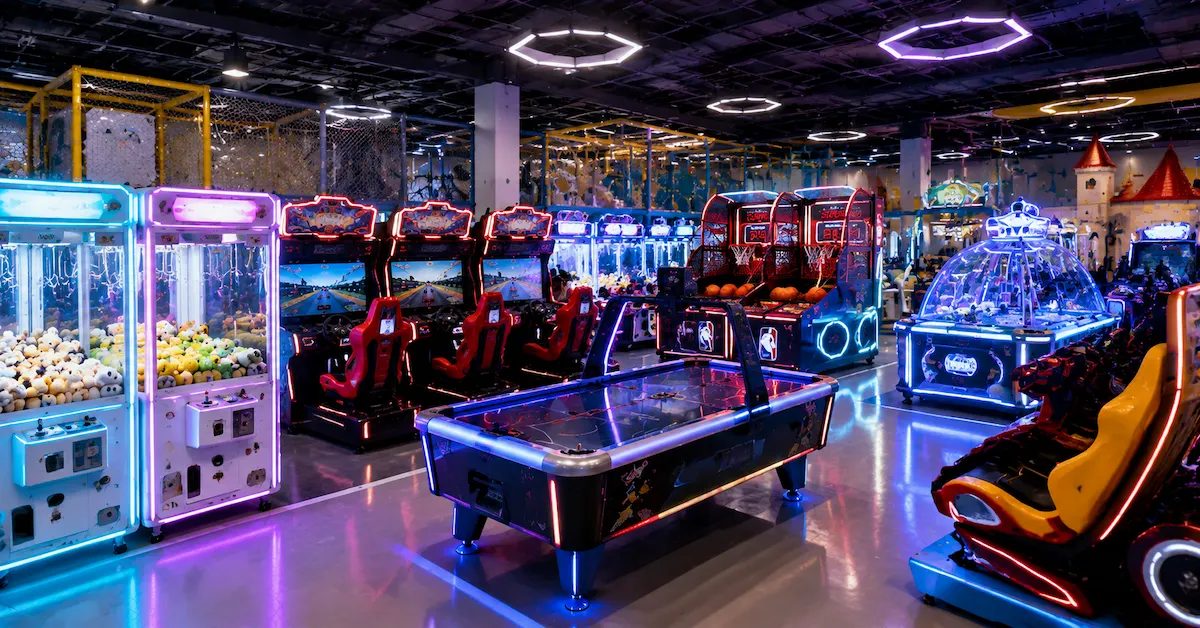
Which Commercial Amusement Machines Fit Different Venues?
“Amusement machine” is broader than a traditional video arcade cabinet.
Commercial projects may combine several equipment categories.
| Machine Category | Typical Application | Key Procurement Concern |
|---|---|---|
| Claw & prize machines | Malls, FEC entrances | Mechanism reliability, prize setup |
| Redemption machines | FEC core zones | Ticket/e-ticket system |
| Racing simulators | Teen/family areas | Steering, pedals, seats, displays |
| Basketball machines | Active zones | Frame, scoring sensors |
| Air hockey | Social competition | Table durability, service access |
| Kiddie rides | Children’s zones | Controls, footprint, age suitability |
| Driving simulators | Arcade/FEC | Control system and display |
| Shooting games | Competitive zones | Sensor accuracy and calibration |
| Bowling-style machines | Family entertainment | Mechanical reliability |
| Interactive machines | Modern FECs | Sensors, software, technical support |
IEC 60335-2-82:2024 specifically lists commercial amusement-machine examples including billiard tables, bowling machines, driving simulators, gaming machines, kiddie rides, laser shooting appliances, pinball machines, and video games. This illustrates how broad the commercial amusement-machine category can be.
The best machine mix should therefore be based on the venue rather than on one popular product category.
Match Machine Selection to the Commercial Environment
Family Entertainment Centers
A full FEC normally needs different play motivations.
An equipment plan may combine:
- Prize play
- Skill play
- Competition
- Physical activity
- Parent-child interaction
- Digital entertainment
This prevents the floor from becoming visually varied but functionally repetitive.
EPARK's existing FEC content similarly treats game machines as revenue-generating commercial assets whose value depends on factors such as customer group, payment system, durability, floor efficiency, maintenance, and long-term support.
Shopping Mall Entertainment Zones
Shopping mall machines should usually balance:
- Strong visibility
- Compact footprint
- Fast customer understanding
- Easy operation
- Family appeal
- High-frequency commercial use
A visually strong prize machine may work near the entrance, while racing or basketball equipment can create deeper destination zones.
Distributors and Multi-Site Operators
These buyers should focus more heavily on:
- Specification consistency
- Repeat production
- Spare-part standardization
- OEM branding
- Export packaging
- Model continuity
A machine that is suitable for one arcade may still be unsuitable for a distributor that needs hundreds of units or repeat orders across several years.
Look Inside the Machine, Not Only at the Cabinet
A professional buyer should ask what creates the machine's operating reliability.
Structural Design
Check:
- Cabinet rigidity
- Frame connections
- Door alignment
- Lock quality
- Service panels
- Component mounting
- Cable routing
Frequent-service areas should be accessible without requiring technicians to dismantle unnecessary parts.
Control Components
Depending on the machine, these may include:
- Buttons
- Joysticks
- Steering wheels
- Pedals
- Guns
- Sensors
- Scoring devices
- Coin mechanisms
- Ticket dispensers
Ask which components are proprietary and which can be replaced using standardized parts.
Electrical System
Important elements include:
- Power supply
- Controller
- Display
- Wiring harness
- Lighting
- Speakers
- Cooling
- Payment interface
The specification sheet should identify important configurations rather than relying only on exterior dimensions and machine photos.
Serviceability Can Matter More Than Visual Complexity
Commercial equipment eventually requires inspection, cleaning, adjustment, or component replacement.
For this reason, maintenance access should be considered during product selection.
A buyer can ask:
- Can the power supply be replaced easily?
- Can the display be accessed without removing major cabinet panels?
- Are wiring connectors labeled?
- Can sensors be calibrated?
- Can payment components be accessed from the service door?
- Is a wiring diagram available?
- Are diagnostic instructions supplied?
A machine that takes 15 minutes to service is operationally different from one requiring several hours of disassembly.
For high-traffic FECs, that difference can influence downtime and labor costs.
Quality Control Should Test the Machine as an Operating System
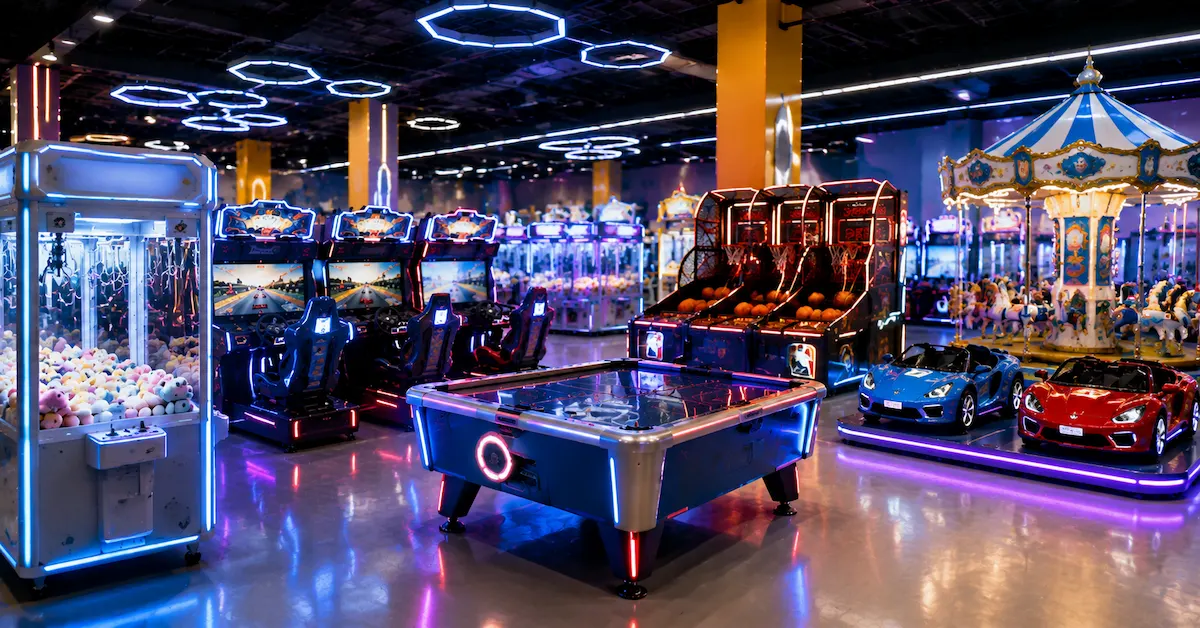
Visual inspection alone is not enough.
A useful commercial QC process should check the complete operating chain.
Functional Checks
Before shipment, buyers should confirm that the manufacturer checks:
- Power-on operation
- Displays
- Controllers
- Buttons
- Sensors
- Scoring
- Sound
- Lighting
- Payment input
- Ticket output where applicable
- Locks
- Cooling
- Internal wiring
Configuration Checks
For export orders, the inspection should also confirm:
- Correct voltage
- Correct frequency
- Plug type
- Language
- Credit settings
- Payment interface
- OEM artwork
- Accessories
- Spare parts
This is especially important for mixed orders where individual machines may have different configurations.
Production Consistency Matters for Repeat Orders
A commercial buyer may approve one sample and then order 20, 50, or more machines.
The challenge is ensuring later units remain consistent.
Manufacturers should have a method for controlling:
- Approved artwork
- Component specification
- Software version
- Electrical configuration
- Payment setup
- Cabinet dimensions
- Packaging
Ask About Change Control
A useful purchasing question is:
What happens if one internal component becomes unavailable during production?
The manufacturer should communicate important substitutions rather than silently replacing components with technically different alternatives.
For chain operators and distributors, change control can be more important than adding another decorative feature.
Standardize Components Across Multiple Machines
Component standardization can reduce maintenance complexity.
Where technically feasible, B2B buyers may request common:
- Power supplies
- Buttons
- Locks
- Coin acceptors
- Card readers
- Sensors
- Ticket dispensers
This can reduce:
- Spare-parts inventory
- Technician training
- Diagnostic time
- Maintenance complexity
For a multi-site operation, standardized service parts can become a significant procurement advantage.
Confirm Electrical Requirements Before Manufacturing
International projects should define:
- Destination country
- Voltage
- Frequency
- Plug type
- Intended operating environment
IEC 60335-2-82:2024 addresses safety requirements for electric commercial amusement machines, with rated-voltage scope up to 250 V for single-phase equipment and 480 V for other equipment.
However, referencing an IEC standard does not prove that a particular machine complies with it.
The buyer should verify requirements for the actual:
- Machine model
- Electrical configuration
- Destination market
- Intended installation
This is more reliable than accepting a generic “international standard” statement.
Verify Compliance Documentation by Product and Configuration
European-market buyers should also understand what CE marking actually means.
Official EU guidance states that manufacturers are responsible for ensuring products meet applicable EU requirements and, where CE marking applies, for conformity assessment, technical documentation, the relevant declaration, and affixing the marking.
Therefore, buyers should ask:
- Which EU requirements apply to this model?
- Is the documentation for the actual machine?
- Does it match the supplied voltage?
- Are customized components included in the documented configuration?
- Which test or technical documents will ship with the order?
A generic certificate image should not replace model-level verification.
OEM and ODM Should Cover More Than Logo Printing
A capable commercial amusement machine manufacturer may support several levels of customization.
Branding
Possible options include:
- Logo
- Cabinet artwork
- Color
- Venue identity
- Packaging
Operating Configuration
Depending on the product:
- Language
- Credit settings
- Difficulty
- Prize parameters
- Ticket settings
- Payment interface
Export Configuration
Possible requirements include:
- Voltage
- Frequency
- Plug
- Labels
- Manuals
- Spare-parts packages
Buyers should approve customized specifications before bulk production.
EPARK's FAQ currently covers customization, shipping, pricing, installation, and cooperation questions for international amusement projects.
Calculate Lifecycle Cost Instead of Unit Price Alone
A low purchase price is not automatically a low operating cost.
B2B buyers should consider:
Machine price + freight + customization + spare parts + maintenance + technician time + downtime risk
Consider two similar machines.
Machine A costs slightly more but uses standardized service parts.
Machine B is cheaper but requires difficult-to-source proprietary sensors.
If a failed sensor keeps Machine B offline for several weeks, its lower purchase price may become irrelevant.
Compare Manufacturers Using Operational Questions
| Factor | Question to Ask |
| Spare parts | How long will replacements remain available? |
| Service access | Can technicians reach major components easily? |
| Component standardization | Are parts shared across models? |
| Repeat orders | Can the same configuration be reproduced? |
| Documentation | Are wiring/manual files supplied? |
| Export configuration | Can voltage and plug be confirmed before production? |
| QC | What operational tests occur before packing? |
| After-sales | How are technical problems handled? |
What Should a B2B RFQ Include?
Do not ask only:
“What is your best price?”
Send enough information for the manufacturer to evaluate the real requirement.
Include:
- Venue type
- Machine categories
- Quantity
- Target customer group
- Floor plan if relevant
- Destination country
- Voltage and frequency
- Plug type
- Payment system
- Redemption system
- OEM requirements
- Spare-parts requirements
- Target delivery date
- Shipping destination
This gives the manufacturer enough context to discuss machine configuration, not merely unit price.
Buyers can review EPARK Products, browse related commercial arcade equipment sourcing guidance, or submit requirements through Contact EPARK. EPARK's current site presents its business around commercial amusement equipment and broader entertainment-project solutions.
FAQ
What is a commercial amusement machine manufacturer?
A commercial amusement machine manufacturer produces electrically or mechanically operated entertainment equipment intended for commercial venues such as FECs, arcades, shopping malls, indoor playgrounds, and entertainment centers.
What types of commercial amusement machines can manufacturers offer?
Depending on the manufacturer, categories may include prize machines, redemption games, racing simulators, shooting games, basketball machines, air hockey, kiddie rides, driving simulators, and interactive machines.
What makes an amusement machine commercial-grade?
Commercial buyers should evaluate structural durability, component quality, service access, electrical configuration, repeat-use reliability, spare-parts availability, and maintenance support.
How should buyers evaluate machine quality before ordering?
Review specifications, components, cabinet construction, controls, payment systems, electrical configuration, QC procedures, spare parts, and operating videos or sample equipment where appropriate.
Can commercial amusement machines support cashless payment?
Many machines can be configured for card readers or other cashless systems, but compatibility needs to be confirmed for each machine before production.
Can amusement machines be customized?
Depending on product and order quantity, customization may include logos, graphics, colors, languages, payment configurations, game parameters, electrical specifications, and packaging.
Why is component standardization important?
Using common service parts across several machines can reduce spare-parts inventory, technician training requirements, and maintenance time.
Should I request spare parts with a new order?
For commercial projects, it is usually useful to identify high-wear, machine-specific, and downtime-critical parts before shipment and prepare an appropriate spare-parts kit.
How should I compare amusement machine manufacturers?
Compare engineering, QC, component consistency, OEM capability, compliance documentation, maintenance access, export experience, spare parts, reorder consistency, and after-sales support—not only unit price.
How can I request a commercial amusement equipment proposal from EPARK?
Prepare your machine categories, quantity, destination country, electrical configuration, payment system, OEM requirements, and project schedule, then send them through the EPARK contact page.
Conclusion
Choosing a commercial amusement machine manufacturer should be treated as a long-term equipment reliability decision rather than a simple cabinet-price comparison.
For FEC operators, distributors, importers, shopping mall projects, and entertainment chains, the strongest manufacturer relationship combines commercial-grade engineering, accessible maintenance, consistent production, appropriate electrical configuration, documented QC, OEM flexibility, spare-parts planning, and future reorder support.
This page intentionally focuses on commercial-duty machine engineering, serviceability, production consistency, and lifecycle cost, distinguishing it from EPARK's existing commercial arcade equipment manufacturer, commercial arcade equipment supplier, amusement arcade equipment manufacturer, and amusement arcade equipment supplier content.
Explore EPARK's product solutions, learn more about EPARK, or contact EPARK with your equipment list and technical requirements for a project-specific discussion.
General Disclaimer
All data on https://www.eparki.com is for general guidance only. As a leading indoor playground manufacturer and trampoline supplier, EPARK strives for accuracy but gives no express or implied warranty regarding completeness, performance or project fitness. Product specs, designs and results may vary with use and customer requirements. Buyers must verify technical details, compliance and suitability before purchase. EPARK OEM/ODM is not liable for any direct, indirect or consequential damages arising from site use. For custom solutions, contact our manufacturer and supplier team via the Contact page.
Intellectual Property
Text, images, videos, CAD files and software are Guangzhou EPARK Electronic Technology Co., Ltd. All rights reserved. No part may be copied, republished or used commercially without prior written permission. We will pursue legal action for copyright or design-patent infringement.
Trademarks
"EPARK", the EPARK logo and related graphics are registered trademarks of Guangzhou EPARK Electronic Technology Co., Ltd. Unauthorized use in ads, domain names or packaging is prohibited.
Governing Law
These terms are governed by the laws of the People's Republic of China.
Contact
Questions? Email sales@nanyuetech.com or WhatsApp +86 139 0307 9263.