Wholesale Redemption Arcade Equipment Is a Reward System, Not Just a Machine
When buying wholesale redemption arcade equipment, the machine itself is only one part of the commercial system. The player pays or uses credits, completes a game, receives tickets or electronic points, and then exchanges those rewards for prizes. If the payment setup, scoring logic, ticket output and prize-counter system are not planned together, even technically functional machines can create operating problems after installation.
For FEC operators, this means equipment selection should begin with the intended customer journey and redemption model. Distributors need an additional layer of control because they may have to reproduce the same configuration for several customers and support replacement parts later. EPARK’s redemption game machine buying guide provides a useful starting point for evaluating equipment configuration, reward output, inspection and supplier support before commercial purchasing.
Who Should Buy Redemption Arcade Equipment in Bulk?
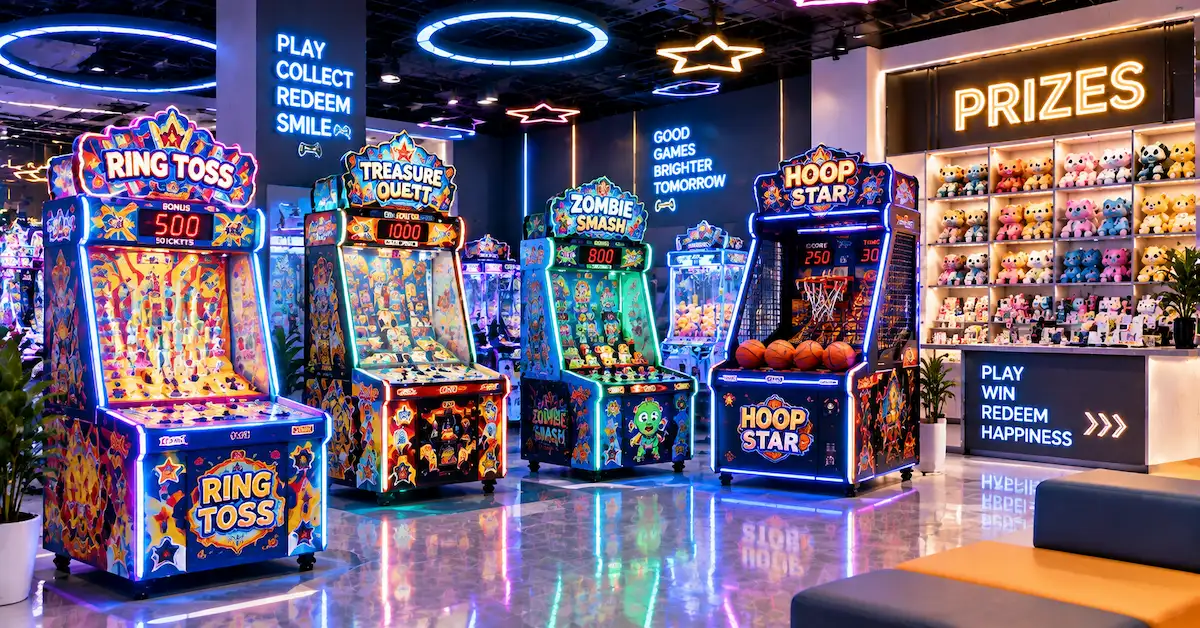
Wholesale purchasing is most relevant to family entertainment centers, arcade chains, shopping mall entertainment operators, regional distributors, importers and contractors developing commercial game zones. These buyers normally need multiple machines that work within one payment and prize-management system rather than isolated cabinets.
A new venue may want several redemption formats to create different levels of play intensity and skill. A distributor may prefer fewer standardized platforms that are easier to stock and service. An existing FEC may only need to replace aging machines or expand one weak section of the game floor. These are different purchasing objectives, so the supplier should not respond to every inquiry with the same machine package.
Bulk purchasing may be less appropriate when the venue has not yet defined its floor plan, payment system, prize strategy or target users. In that case, validating a smaller equipment mix first can reduce the risk of ordering many machines whose reward systems or service requirements do not match local operations.
Define the Reward System Before Choosing the Machine Mix
Before comparing wholesale redemption arcade equipment, determine how players will receive and use rewards. Traditional paper tickets remain one possible model, while some commercial venues use electronic ticket balances associated with a card or account. Neither approach should be assumed to be universally available on every machine.
For a paper-ticket system, buyers need to consider ticket dispensers, ticket loading, ticket jams, storage and operator access. For electronic redemption, the important questions shift toward reader compatibility, communication between the machine and the venue system, account or card logic and system-support responsibility.
EPARK’s coin-operated equipment guide emphasizes that payment recognition, credit allocation and game activation should be tested as a complete sequence. Redemption equipment adds another stage: the correct reward output must also follow the game result.
A useful purchasing rule is therefore:
Payment → Credit → Gameplay → Score/Result → Ticket or Point Output → Prize Redemption
Every stage that depends on hardware or software should have an identified responsibility.
Compare Redemption Equipment by Function, Not Just Appearance
Redemption equipment can serve different purposes within an FEC. Instead of filling the venue with machines that offer similar play patterns, build a mix that provides different interactions and reward experiences. The following table is a purchasing framework rather than a fixed EPARK product package; current machine availability and configuration should be confirmed for the actual project.
| Redemption equipment type | Commercial role | Configuration to check | Main operating concern |
|---|---|---|---|
| Basketball redemption games | Active, easy-to-understand competitive play | Scoring sensors, timer, ball return and reward output | Sensor reliability, playing space and ball management |
| Skill redemption games | Rewards timing, coordination or accuracy | Difficulty settings,scoring logic and ticket output | Settings must remain consistent across machines |
| Wheel or bonus games | Short play cycle with visible reward result | Sensors, display, reward table and output logic | Prize/ticket values must match venue strategy |
| Video redemption games | Screen-based play connected to a reward system | Software version, controls, scoring and reward interface | Software and system compatibility |
| Multiplayer redemption games | Group or competitive play | Player stations,scoring relationship and output logic | More hardware increases maintenance requirements |
| Compact redemption cabinets | Adds games to smaller arcade zones | Footprint, payment hardware and service access | Limited space should not restrict maintenance |
Create a Technical Specification for Every Redemption Machine
One of the most important controls in a wholesale order is a model-specific specification sheet. Product photographs and catalog names are not enough because two cabinets with the same appearance may contain different readers, ticket dispensers, controllers or settings.
The following specification table can be used when requesting a quotation. It is a buyer checklist, not a list of universal EPARK specifications.
| Specification area | Information to confirm before production |
|---|---|
| Machine identity | Model code, configuration revision and quantity |
| Installed size | Length, width, height and required playing area |
| Electrical setup | Voltage, frequency, plug and applicable power requirements |
| Payment method | Coin, token,card or other supported system |
| Credit logic | Credits received per payment and credits required per play |
| Game controls | Buttons, balls, sensors, touchscreens or other interfaces |
| Scoring | How game results are measured and displayed |
| Reward output | Paper ticket, electronic ticket/points or other confirmed system |
| Ticket hardware | Dispenser model, interface and operator access where applicable |
| Software | Version, language and adjustable game parameters |
| Service access | Doors and access to payment, ticket,controls and electronics |
| Accessories | Keys, manuals, cables and agreed supplied items |
| Spare parts | Model-specific replacement references |
| Packing | Package count, packed size, gross weight and detachable sections |
| Batch control | Approved sample or specification revision used for QC |
Test Ticket Output as Carefully as Gameplay
A machine can start correctly, display the score correctly and still have a problem in its redemption function. Ticket or electronic reward output should therefore be included in sample approval and batch testing.
For paper-ticket equipment, the test should confirm that the dispenser receives the correct instruction, produces the intended reward under the agreed configuration and remains accessible for loading and service.The exact ticket dimensions, dispenser configuration and interface should be confirmed for the selected machine rather than assumed from another model.
For electronic systems, buyers should determine which party is responsible for the card reader, software integration and communication with the venue management system. “Cashless compatible” or “e-ticket ready” should not be accepted as complete technical specifications without identifying what has actually been integrated and tested.
Record the machine configuration and reward settings used during approval so the production batch can be compared against the same reference.
Control Payout Settings Instead of Chasing a Universal Ticket Number
There is no single “correct” ticket payout suitable for every FEC. Reward settings must fit the venue’s pricing, prize costs, game difficulty and operating strategy.
When reviewing machines, ask which parameters operators can adjust and which should remain controlled. Depending on the equipment, relevant settings may include game duration, difficulty, score thresholds or ticket values. The actual available parameters need to be confirmed by model.
Avoid requesting settings simply because a competing venue appears to use them. Two venues can have different game prices, customer profiles and prize costs.A configuration that works commercially in one market may not produce the same result elsewhere.
The better approach is to establish a documented starting configuration, operate the equipment, collect real venue data and make controlled changes where appropriate.
Plan the Prize Counter Together With the Game Floor
Wholesale redemption arcade equipment does not end at the ticket outlet. Players eventually need somewhere to use the rewards they have earned.
A redemption counter introduces questions about prize inventory, display, storage, point values, customer flow and staff procedures. If the game floor can generate rewards faster than the prize operation can process them, the customer experience can become inefficient even though the machines themselves work correctly.
EPARK’s prize arcade equipment guide discusses the relationship between prize games, redemption systems and commercial operations. For a venue project, translate this into a practical layout: identify where players finish games, where they check balances or tickets, where they choose prizes and where staff replenish prize stock.
The redemption counter should therefore be treated as part of the equipment-planning conversation rather than an afterthought added after the machines arrive.
Include Service Access in the Layout
A redemption cabinet needs space for the player, but it also needs space for operators and technicians. Ticket dispensers may require loading or clearing; payment hardware needs collection or service access; sensors and controls may eventually need maintenance.
Do not determine the number of machines by dividing total floor area by cabinet footprints. Request installed dimensions and applicable operating/service requirements, then review the proposed layout.
For each cabinet, mark the customer playing position and the doors or panels used for regular service. Machines placed tightly against walls or neighboring cabinets can look efficient in a drawing while creating maintenance problems after installation.
This matters particularly for sports and larger redemption games because the player activity zone can extend well beyond the physical cabinet.
Make Reward-System Testing Part of Batch QC
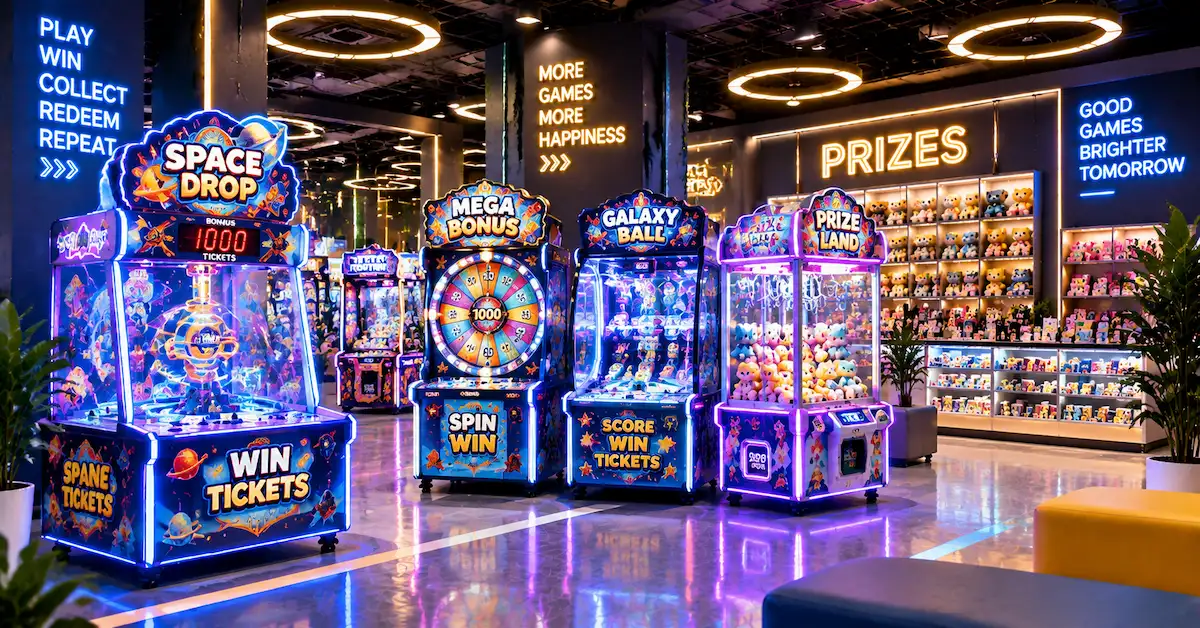
A wholesale batch should not be accepted solely because the exterior finish looks consistent. Each machine category requires functional inspection related to how it actually operates.
A common QC layer can cover model identity, electrical configuration, payment, controls, appearance and accessories. Redemption-specific checks should then address scoring and reward output.
EPARK’s arcade equipment factory guide highlights the importance of component control, assembly inspection, functional verification and pre-shipment checks for commercial equipment. Buyers can adapt that logic to their selected machines.
For example, a basketball game may require sensor and score verification, while a timing-based machine needs its controls and score thresholds checked. Ticket dispensers require their own operation checks.Agree on the inspection method and acceptance criteria for the actual order rather than using one generic checklist for every product.
Keep Quality Documents Connected to the Actual Equipment
Buyers should distinguish company quality information from documents that apply to a specific machine, component or project.
EPARK publishes a broader Safety and Quality section, but a commercial arcade equipment buyer should still request documentation relevant to the models and destination configuration being purchased. A material report for one product category should not automatically be represented as evidence covering another machine.
For redemption equipment, the procurement record should identify which documentation applies to the electrical configuration, payment system or other relevant parts of the purchased equipment. If the destination market requires specific review, that requirement should be raised before production rather than after the shipment has been completed.
Build a Model-Specific Spare-Parts Plan
Redemption equipment combines mechanical, electrical and sometimes software-related components, so spare-parts planning should follow the actual machine list.
Possible service areas can include payment modules, controls, sensors, ticket dispensers, locks, power-related components and machine-specific mechanisms. The correct list depends on the selected models.
EPARK’s game machine maintenance guide emphasizes that ownership cost includes replacement components, technical work and downtime rather than initial purchase price alone.
Ask the supplier for identifiable parts rather than a generic “free spare parts package.” For distributors, part references are especially valuable because customer support may happen months after the original shipment. Connect each important spare to the relevant machine revision so later substitutions do not create compatibility problems.
Compare Purchase Cost and Reward-System Cost Separately
Two redemption machines with similar factory prices can have different operating economics. The equipment quotation may include the cabinet and basic electronics but differ in payment hardware, ticket system, accessories, customization or initial spare parts.
Separate the commercial review into equipment cost and operating-system cost. Equipment cost can include machine configuration, OEM work, packing and shipping preparation. Operating cost can include tickets or reward-system fees, prizes, staff time, maintenance and replacement parts.
Avoid using invented “average earnings” or guaranteed payback periods when selecting equipment. Actual results depend on venue traffic, pricing, machine placement, prize strategy, operating costs and customer behavior.
A wholesale buyer should first make sure the system can be operated and supported consistently; revenue assumptions should then be built from the buyer’s real operating data.
Separate OEM Graphics From Reward-System Customization
Private-label buyers often want matching cabinet artwork, logos and colors across an arcade.These visual changes should remain separate from changes to ticket logic, payment hardware, controllers or game software.
EPARK’s customization process provides a broader framework for requirement confirmation, design and manufacturing coordination. For redemption equipment, use separate approval records for cabinet artwork and functional configuration.
If only the graphics change, retain the approved technical version. If the reward system, controls or electronics change, treat the request as a technical revision and determine whether a new test is required.
This distinction is particularly useful for distributors because private-label appearance can remain consistent even while several technical platforms are used underneath.
Plan Lead Time Around the Approval Process
A useful commercial schedule is more detailed than a single production lead-time number. Divide the project into machine selection, specification confirmation, payment and reward-system confirmation, artwork approval where applicable, reference-machine approval, production, QC, packing and shipment.
Mixed orders may take longer to coordinate because different equipment can use different components or customization processes. Ask whether the proposed schedule begins after deposit, specification approval, artwork confirmation or another defined milestone.
EPARK’s wholesale arcade equipment guide treats specifications, quantity, quality control, packaging and logistics as connected parts of the wholesale process. Apply the same principle to delivery planning: a commercial production date should be linked to the approvals needed to reach it.
Protect Repeat Orders With a Redemption Configuration Baseline
For distributors and arcade chains, the second order matters almost as much as the first. Save the approved model, payment configuration, ticket or e-ticket system, score/reward settings, electrical version, artwork, accessories and important spare-part references.
Attach that baseline to future orders and ask the supplier to disclose proposed changes before production. A controller, dispenser or payment-interface substitution can affect parts inventory and technical support even when the cabinet looks unchanged.
A controlled reorder process also makes multi-location expansion easier. Operators can train staff around familiar machines and reduce the number of configurations technicians need to understand.
The goal is not to assume that every component will remain available forever. It is to make changes visible before they reach the arcade floor.
Use This Comparison Before Approving a Wholesale Program
For many buyers, comparing purchasing readiness is more useful than comparing machines only by appearance.
| Purchasing stage | Current status | Main risk | Recommended next action |
|---|---|---|---|
| Category shortlist | Redemption categories selected | Actual machine requirements remain unclear | Confirm venue roles and individual models |
| Quotation stage | Models and quantities priced | Payment/reward scope may differ between quotes | Normalize technical specifications |
| Sample/reference stage | Configuration available for review | Unverified scoring or reward output | Test complete customer transaction |
| Production stage | Specification frozen | Uncontrolled substitutions | Link QC to approved revision |
| Shipment stage | Machines packed and inspected | Missing accessories or documentation | Complete shipping-release check |
| Repeat-order stage | Proven equipment reordered | Configuration drift | Compare new batch with original baseline |
What Should You Send EPARK for a Wholesale Redemption Equipment Quote?
A useful inquiry should explain the commercial project, not merely request “best wholesale price.” Provide the destination country, venue or distribution business type, expected machine categories, quantities, floor plan where relevant, intended payment system, paper-ticket or electronic-redemption requirement, electrical configuration, private-label requirements, target shipment schedule and after-sales expectations.
EPARK’s About Us information identifies its business around arcade machines, game machines and wider indoor entertainment equipment. Buyers should still request the current redemption-equipment range and model-specific configurations rather than assuming every reward format is available across every machine.
For a project-specific proposal, submit your requirements through EPARK Contact Us so machine selection, payment requirements, reward configuration and wholesale quantities can be discussed together.
Frequently Asked Questions About Wholesale Redemption Arcade Equipment
1. What is redemption arcade equipment?
Redemption arcade equipment rewards a player according to the result of a game, commonly through paper tickets, electronic points or another supported reward mechanism that can later be exchanged for prizes. The exact reward system should be confirmed for each machine.
2. Is a redemption game the same as a prize machine?
Not always. A claw or direct-prize machine can dispense merchandise directly, while redemption games commonly provide tickets or points that are exchanged separately. EPARK’s prize machine guide discusses several reward-equipment formats.
3.Should I choose paper tickets or electronic redemption?
Choose according to your venue system, existing infrastructure, operating procedures and technical support capability. Confirm machine compatibility before ordering because the two arrangements can require different hardware and integration.
4. Can all redemption machines use the same card system?
Do not assume so. Confirm the reader, interface, wiring, software requirements and responsibility for integration model by model. Test the intended customer transaction before approving production.
5. How many redemption machines should an FEC order?
There is no universal number. Determine the mix from venue size, target customers, complementary game categories, budget and service capability rather than filling floor space with as many cabinets as possible.
6.What should be tested before a bulk redemption order?
The test plan should cover the selected machine’s payment, credit registration, controls, scoring, game functions and reward output, plus relevant electrical, accessory and cabinet checks.
7. What spare parts should be purchased with redemption machines?
Build the list around actual models. Payment components, controls, sensors, ticket hardware and other specialized parts may be appropriate depending on the equipment. Ask for identifiable part references rather than one universal spare kit.
8. Can redemption machines be customized with my brand?
Branding, colors and artwork can be discussed as OEM requirements, while hardware or reward-system changes need separate technical confirmation. Keep visual and functional approvals on separate records.
9. How should distributors handle repeat orders?
Save the approved configuration, including payment system, reward method, settings, electrical version, artwork and key parts.Attach that record to future orders and request disclosure of proposed substitutions.
10. How can I request wholesale redemption arcade equipment from EPARK?
Prepare your machine requirements, quantity, destination, payment and redemption system, electrical configuration, branding requirements, venue floor plan where relevant and target schedule, then submit the project through the EPARK contact page.
Conclusion
Buying wholesale redemption arcade equipment successfully requires control of the entire reward process, not only the game cabinet. Define the payment method, credit logic, scoring, ticket or electronic reward output and prize-counter operation before committing to volume quantities. Then connect those decisions to model-specific specifications, QC, spare parts, layout, OEM control and repeat-order records. For FEC operators, this creates a more coherent redemption system; for distributors and arcade chains, it reduces configuration and service problems when equipment is reordered or deployed across multiple locations.Buyers planning a new redemption zone or wholesale program can contact EPARK with their destination, machine categories, quantities, payment system, reward method, branding requirements and project schedule for configuration-specific evaluation.
General Disclaimer
All data on https://www.eparki.com is for general guidance only. As a leading indoor playground manufacturer and trampoline supplier, EPARK strives for accuracy but gives no express or implied warranty regarding completeness, performance or project fitness. Product specs, designs and results may vary with use and customer requirements. Buyers must verify technical details, compliance and suitability before purchase. EPARK OEM/ODM is not liable for any direct, indirect or consequential damages arising from site use. For custom solutions, contact our manufacturer and supplier team via the Contact page.
Intellectual Property
Text, images, videos, CAD files and software are Guangzhou EPARK Electronic Technology Co., Ltd. All rights reserved. No part may be copied, republished or used commercially without prior written permission. We will pursue legal action for copyright or design-patent infringement.
Trademarks
"EPARK", the EPARK logo and related graphics are registered trademarks of Guangzhou EPARK Electronic Technology Co., Ltd. Unauthorized use in ads, domain names or packaging is prohibited.
Governing Law
These terms are governed by the laws of the People's Republic of China.
Contact
Questions? Email sales@nanyuetech.com or WhatsApp +86 139 0307 9263.