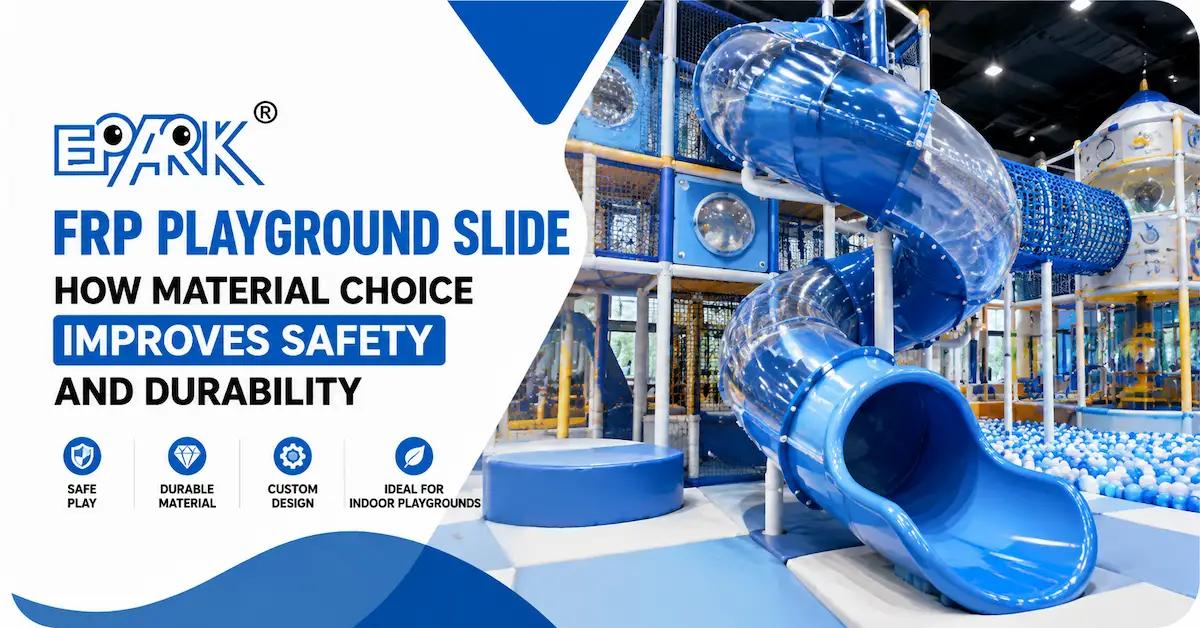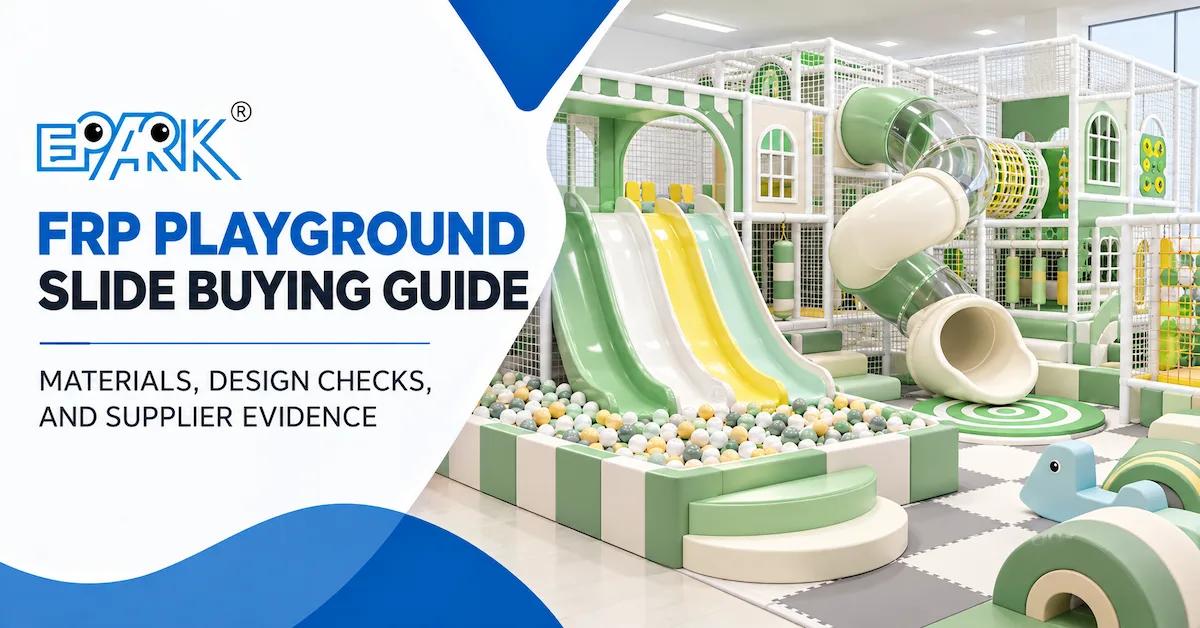
Choose an FRP playground slide when the project needs a smooth molded or composite-resin slide surface, a shaped theme element, and a supplier that can document the slide, supports, barriers, landing, and installation as one system. FRP is not a shortcut around engineering. The buyer still needs to verify the resin or composite construction, edge finish, UV and wear requirements, support interfaces, user age, cleaning access, fall and landing conditions, and the exact test or certificate scope.
“FRP playground slide” is a useful procurement phrase, but it does not describe one universal product. A slide may be straight, spiral, wave-shaped, tunnel-like, open, enclosed, dry, or connected to a larger indoor playground structure. It may be used in an indoor FEC, mall, school, hotel, family venue, soft-play room, or outdoor-adjacent environment. The correct choice depends on the route, height, speed, landing, supervision, material schedule, climate, and local requirements.
This guide is for commercial playground buyers, architects, distributors, project contractors, school and hotel operators, and family-entertainment developers. It explains what FRP means in a playground context, how to compare FRP with other slide surfaces, which design and material details belong in the RFQ, how to evaluate cleaning and maintenance, and what evidence should be requested before approving production. It does not invent resin grades, thicknesses, load values, UV hours, prices, or universal certification claims.
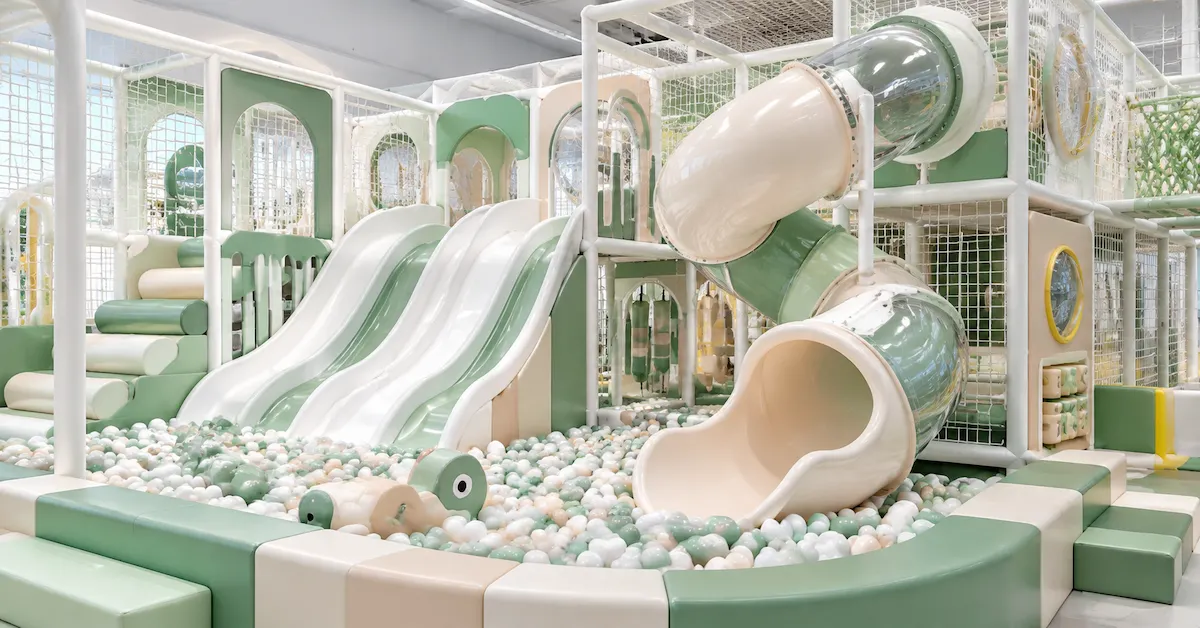
Need to specify a slide for a real site? Send the plan, height, route, landing area, user age, indoor or outdoor exposure, theme direction, destination market, and required safety documents.
Request an FRP Slide ReviewWhat FRP Means in Playground Slide Procurement
FRP is a composite family, not a single specification
FRP commonly refers to fiber-reinforced plastic or a fiberglass-reinforced polymer composite. In a playground slide, reinforcement and resin work together to form a shaped shell or slide surface. The practical buying questions are how the composite is constructed, what finish is applied, how edges are treated, how supports connect, and which environmental conditions the supplier has considered.
Do not assume that the acronym tells you the resin system, reinforcement layout, thickness, gel coat, surface texture, or fire behavior. Those details must come from the supplier’s material schedule or technical file. If a supplier uses “fiberglass,” “FRP,” and “composite resin” interchangeably, ask for a plain-language component description and the exact document that supports it.
Why a project may choose FRP
FRP can be useful when the design needs a continuous curved surface, a themed profile, a smooth transition, or a shape that is difficult to form from standard sheet or rotational-molded parts. It may support a straight slide, a wave contour, a spiral, a tunnel, a whale, a submarine, or another branded structure. The value is not merely the material name; it is the combination of geometry, surface, support, maintenance, and appearance.
Indoor projects may prioritize smoothness, cleanability, color, and integration with soft play. Projects near open doors or in humid climates may need more attention to UV, moisture, temperature, cleaning chemicals, and hardware corrosion. The supplier should know the intended environment before choosing the finish and support details.
FRP Playground Slide Compared with Other Slide Options
Material comparisons are useful only when the slide geometry, height, user age, landing, support, and operating conditions are held reasonably constant. A material cannot be judged from a sample photo alone.
| Slide option | Potential project value | Questions to control | Evidence to request |
|---|---|---|---|
| FRP or composite resin | Curved or themed shapes, smooth continuous surface, custom forms | Resin system, reinforcement, surface finish, edges, UV and cleaning exposure | Material schedule, finish sample, drawings, applicable test or certificate |
| Rotational-molded plastic | Repeatable molded components and replaceable standard forms | Wall consistency, joints, parting lines, fixing points, replacement codes | Component specification, inspection record, spare-parts route |
| Metal sheet or stainless steel | Specific structural or architectural applications | Welds, edges, heat, corrosion, surface temperature, noise, and finishing | Material grade, finish, weld and edge inspection, maintenance plan |
| Soft-play slide surface | Low-height toddler or indoor soft-play routes | Foam density, cover seams, deformation, cleaning, and intended height | Material schedule, cover and foam details, cleaning and repair notes |
Compare the whole slide assembly, not only the shell
A slide includes more than the visible running surface. Review the entry, transition, side walls, supports, barriers, platform, fasteners, landing, and surrounding floor. A strong FRP shell cannot compensate for an unstable support, a poor landing, a difficult access point, or an edge that staff cannot inspect.
Match the material to the use environment
For indoor use, ask about cleaning products, abrasion from shoes or clothing, ball-pit contact, humidity, and the effect of repeated wiping. For outdoor or semi-outdoor use, ask about UV exposure, rain, temperature changes, drainage, fastener corrosion, and color or surface maintenance. The supplier should state which conditions were assumed when selecting the material and finish.
Geometry and User Experience
Start with the user route
Before choosing a slide shape, define how a child reaches it, waits, enters, travels, exits, and returns to the next activity. The route should not cross an active landing or force younger children into a higher-energy zone. The drawing should show stairs, climbing access, platform barriers, entry opening, slide run, landing, and circulation around the equipment.
Height, angle, curve, width, and transition influence the experience, but they cannot be selected from generic online advice. The final values depend on the approved design, user group, applicable standard, site, and supplier engineering. Ask the supplier to identify the intended age group and any restrictions rather than treating a reference image as a specification.
Straight, wave, spiral, and tunnel forms
A straight FRP playground slide can make entry and exit easy to understand and may suit a compact layout. A wave slide can create visual movement and a themed landmark, but it needs careful review of transitions and landing visibility. A spiral or curved slide can use vertical space and create a stronger attraction, while requiring more attention to entry, internal lighting, inspection, and cleaning. A tunnel slide can deliver a distinct experience but should not create a route that staff cannot reach or observe.
Ask the supplier to show each form in a plan, elevation, section, and 3D view. The 3D image helps with theme and guest experience; the sections reveal support, barrier, edge, and clearance assumptions. Keep the approved technical drawing with the quotation so later visual changes do not silently alter geometry.
Landings are part of the slide specification
The landing should be clear, visible, and appropriate to the surrounding activity. It should not open directly into a queue, door, climbing route, or low-clearance area. For a soft-play system, the landing may connect to EVA or PU mats, foam, or a ball pool; the interface must be shown on the plan. Ask what happens when a child stops early, exits sideways, or needs adult assistance.
Materials and Finish: What to Put in the RFQ
Request the exact material schedule
EPARK’s public materials and safety page describes slides made of thick FRP or composite resin with smooth, wear-resistant, UV-protected surfaces. It also describes galvanized cold-rolled steel pipe, high-density foam, soft PVC sleeves, EVA or PU mats, safety nets, and railings. Treat these as published material descriptions. The project document must still identify which material and finish apply to the purchased slide, supports, barriers, landings, and surrounding equipment.
Ask for a sample or finish reference where color, gloss, texture, or graphics matter. Record whether the finish is molded, gel-coated, painted, laminated, printed, or otherwise applied. Ask how scratches, fading, chips, and local repairs are handled. A themed slide may be visually important, so replacement or repair instructions should be available before production.
Edges, seams, joints, and openings
Inspect every transition a child or adult can touch. Ask how the slide edge is finished, whether a seam is exposed, how hardware is covered, and how the shell joins the platform or support. Check openings, viewing windows, side walls, and tunnel entrances for access, cleaning, and entrapment concerns under the applicable requirements. Do not accept “smooth” as a sufficient description without a drawing or inspection method.
Supports and interfaces
The slide shell transfers loads through supports, platforms, brackets, frames, or the main play structure. Request the support detail, fixing method, interface material, corrosion protection, and access for inspection. If the slide connects to a custom steel structure, identify whether the supplier or building contractor is responsible for the connection and site anchor verification.
Cleaning, Maintenance, and Replacement
Make the running surface easy to inspect
A smooth surface is helpful, but a facility still needs a cleaning and inspection route. Ask how staff reach the upper entry, underside, supports, landing, side walls, and any tunnel. Identify approved cleaning products, dilution, drying, frequency, and restrictions. If the slide is installed in a ball pool or soft-play structure, specify how balls, foam, and debris are removed from the interface.
Plan for ordinary wear and local damage
High-traffic slides can develop scratches, dull areas, chips, loose hardware, damaged padding, or graphic wear. Ask whether a local repair is possible, whether a replacement shell or panel is available, and how the part is identified. Record the component code, supplier contact, expected reorder lead time, and any MOQ for replacement parts. A maintenance plan is more useful when it names an action and an owner.
Use a simple inspection checklist
Daily or session-based checks can include the slide entry, surface, side walls, edge treatment, fasteners, support, landing, floor, barriers, and surrounding circulation. Staff should record damage, isolate a risk, and escalate a repair. The supplier should provide a manual that matches the installed system, not a generic catalogue sheet.
Testing, Certification, and Evidence Boundaries
Ask what was tested and why it applies
When a supplier presents a test report or certificate, record the product name, model or drawing, tested sample, issuer, date, standard edition, conditions, and scope. A certificate for a material sample may not cover the complete installed slide. A document for one geometry may not cover a different curve, height, support, or landing. The buyer should map each document to the actual order.
EPARK’s public certificate page displays document images and labels such as CE, ZRC, NTEK, test reports, and SGS reports, while other pages reference international standards in different contexts. These pages are evidence entry points, not a universal statement that every FRP playground slide carries every certification. Confirm the exact document package required by the destination market and project authority.
Do not publish an unsupported certification claim. Use precise wording such as “the applicable report or certificate for the approved slide configuration is to be confirmed in the project document pack.” Record missing metadata as an RFQ action rather than filling it with assumptions.
Include acceptance criteria in the order
Acceptance may cover dimensions, color, surface finish, edges, supports, hardware, landing, graphics, packing, installation, and documents. Agree how deviations are measured, who approves a change, how damage is recorded, and which items must be corrected before shipment or opening. The acceptance checklist should refer to the approved drawing and material schedule.
Cost, MOQ, Lead Time, and Installation
Cost depends on more than FRP quantity
The price of an FRP playground slide changes with geometry, size, molds or tooling, finish, graphics, supports, barriers, platform, landing, surrounding structure, packing, freight, installation, and destination requirements. Compare the delivered system rather than assuming a material label determines value. A custom themed slide may require additional design and approval work; a repeatable form may reduce revisions but fit fewer buildings.
MOQ must be tied to the order scope
MOQ may refer to one complete slide, one custom shell, a mold, a color or graphic batch, replacement parts, packaging, or a future expansion. Ask the supplier to separate the MOQ for the complete assembly, custom component, artwork, prototype, spare shell, and repair parts. Do not generalize a page-specific OEM or ODM statement to every FRP component.
Lead time starts after design confirmation
Site measurement, geometry approval, material and color approval, artwork, payment, tooling, production, inspection, packing, shipping, and installation readiness affect the schedule. EPARK’s FAQ gives a general reference of 3–7 days for design and 15–30 days for production after design confirmation. Other product pages may show different references. Treat these as general website guidance and use the signed quotation for the project schedule.
Packaging protects the surface and the interface
FRP shells can be large, shaped, and vulnerable to impact or abrasion during loading. Ask for package numbers, edge protection, moisture protection, support separation, loading photos, packing list, and handling instructions. Confirm how the shell is stored before installation and how the installer checks the surface before fixing it into the structure.
EPARK’s customization process describes consultation, space planning, material selection, custom manufacturing, quality inspection and secure packaging, delivery and installation, and after-sales support. Use that route as a workflow reference, then require a slide-specific drawing, material schedule, inspection record, packing list, and handover file.
Specify the slide before requesting a final price. Send the geometry, height, landing, environment, theme, finish, destination market, and requested test or certificate documents.
Review Indoor Playground Solutions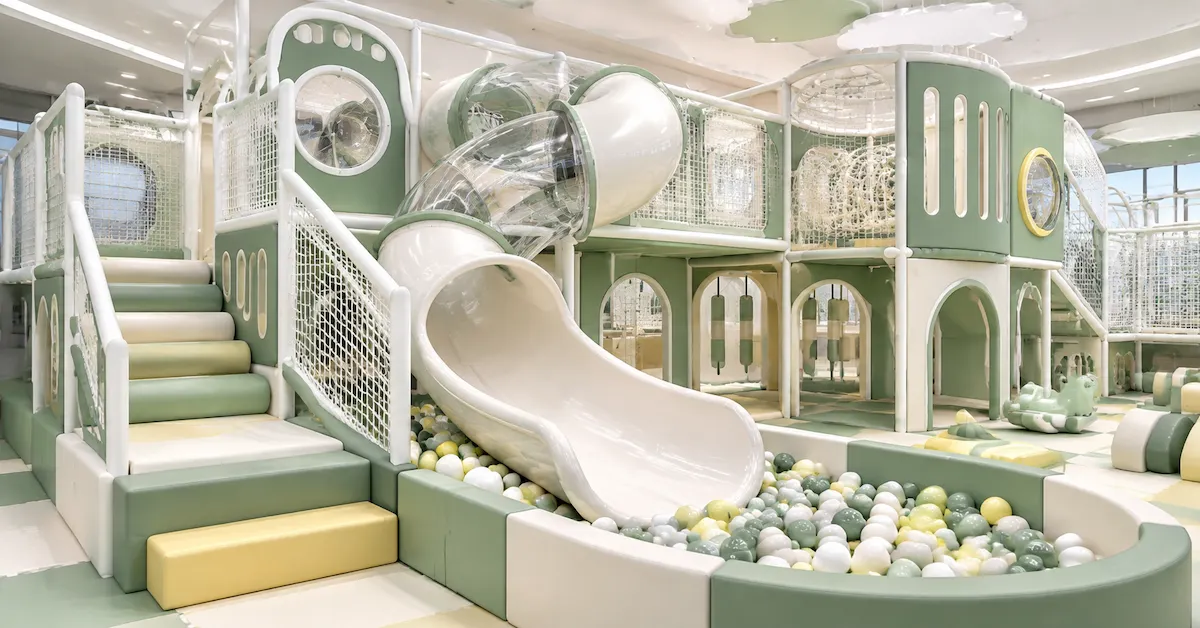
FRP Playground Slide RFQ Checklist
- Measured site plan with clear height, platform, surrounding structure, exits, and access route.
- Slide type, geometry, height, width, entry, run, landing, user age, and operating environment.
- FRP or composite-resin description, reinforcement or resin information available for the project, finish, color, and graphics.
- Edge, seam, opening, barrier, support, bracket, anchor, and interface details.
- Landing surface, surrounding floor, queue, circulation, supervision, and adult assistance position.
- Cleaning products, access points, inspection routine, repair method, replacement code, and spare-parts route.
- Applicable standards, test reports, certificates, issuer, date, sample, scope, and destination relevance.
- MOQ for complete assembly, custom shell, mold, artwork, packaging, and replacement parts.
- Design revisions, material approval, payment gate, production trigger, lead-time assumptions, and change control.
- Packing list, edge protection, unloading, installation, acceptance inspection, training, warranty, and after-sales responsibility.
Turn the material question into a complete project brief. Ask every supplier to return the same slide drawing, material schedule, evidence register, delivery scope, and acceptance checklist.
Frequently Asked Questions
What is an FRP playground slide?
An FRP playground slide uses a fiber-reinforced plastic or composite-resin construction for the slide surface or shell. The exact resin, reinforcement, finish, dimensions, supports, and testing must be confirmed in the project documents. FRP describes a material family, not one universal model.
Is an FRP playground slide better than plastic?
Neither material is automatically better for every project. Compare the complete assembly by geometry, surface, edges, supports, environment, cleaning, repair, replacement, documents, and cost. A repeatable molded plastic slide may suit one route, while a custom FRP shape may suit another.
Are FRP slides suitable for indoor playgrounds?
They can be suitable when the approved slide, support, landing, age group, surface, cleaning plan, and local requirements are appropriate. Indoor installation reduces some weather exposure but does not remove the need to inspect wear, hardware, edges, and landing conditions.
What does EPARK publicly state about slide materials?
EPARK’s materials and safety page describes thick FRP or composite-resin slides with smooth, wear-resistant, UV-protected surfaces. Request the project-specific material schedule and supporting evidence for the purchased slide, rather than treating the public description as a complete technical specification.
Does a certificate cover every slide shape?
Not necessarily. A document may apply to a material, model, sample, geometry, or complete configuration. Ask for the product scope, tested sample, issuer, date, standard edition, and destination relevance, then map it to the approved drawing.
How should an FRP slide be cleaned?
Follow the project-specific maintenance manual and approved cleaning products. The facility should be able to reach the entry, running surface, side walls, underside, supports, landing, and any tunnel or ball-pit interface. Record frequency, dilution, drying, inspection, and repair responsibilities.
Can an FRP playground slide be customized?
Customization may include geometry, color, finish, graphics, theme forms, length, platform connection, supports, and landing integration. Confirm which changes require new design work, tooling, a prototype, a new test document, or a different MOQ.
What is the usual FRP slide MOQ?
There is no universal MOQ. It may depend on a complete slide, custom shell, mold, color batch, artwork, replacement part, or expansion. Ask for MOQ by deliverable and record whether tooling, prototype, packing, and spare parts are included.
How long does an FRP playground slide take to produce?
Timing depends on geometry, approvals, materials, tooling, production, inspection, packing, shipping, and installation readiness. EPARK’s FAQ gives a general 3–7 day design and 15–30 day production reference after design confirmation, but the signed quotation and approved drawing control the actual project schedule.
What should I send for an FRP slide quotation?
Send the measured site, height, entry, run, landing, user age, indoor or outdoor exposure, theme, color, graphics, surrounding structure, destination market, opening date, and required test, certificate, installation, maintenance, and warranty documents.
Conclusion
An FRP playground slide can be a strong choice for a themed or custom indoor playground when its material, geometry, support, landing, maintenance, and evidence are specified together. The material label alone does not establish safety, durability, or value. Buyers should compare the complete slide assembly, request project-specific documents, define acceptance criteria, and make cleaning and replacement practical for the operating team.
EPARK’s materials and safety page, indoor playground category, customization process, certificate page, and FAQ can start the supplier discussion. Convert the slide concept into a measured drawing, material and finish schedule, support detail, landing plan, inspection evidence, packing list, installation scope, and handover file before approving production.
Ready to review an FRP slide for your playground? Share the site plan and slide brief so EPARK can identify the geometry, materials, interfaces, documents, and delivery responsibilities for review.
Discuss Your FRP Slide Project
General Disclaimer
All data on https://www.eparki.com is for general guidance only. As a leading indoor playground manufacturer and trampoline supplier, EPARK strives for accuracy but gives no express or implied warranty regarding completeness, performance or project fitness. Product specs, designs and results may vary with use and customer requirements. Buyers must verify technical details, compliance and suitability before purchase. EPARK OEM/ODM is not liable for any direct, indirect or consequential damages arising from site use. For custom solutions, contact our manufacturer and supplier team via the Contact page.
Intellectual Property
Text, images, videos, CAD files and software are Guangzhou EPARK Electronic Technology Co., Ltd. All rights reserved. No part may be copied, republished or used commercially without prior written permission. We will pursue legal action for copyright or design-patent infringement.
Trademarks
"EPARK", the EPARK logo and related graphics are registered trademarks of Guangzhou EPARK Electronic Technology Co., Ltd. Unauthorized use in ads, domain names or packaging is prohibited.
Governing Law
These terms are governed by the laws of the People's Republic of China.
Contact
Questions? Email sales@nanyuetech.com or WhatsApp +86 139 0307 9263.