Introduction
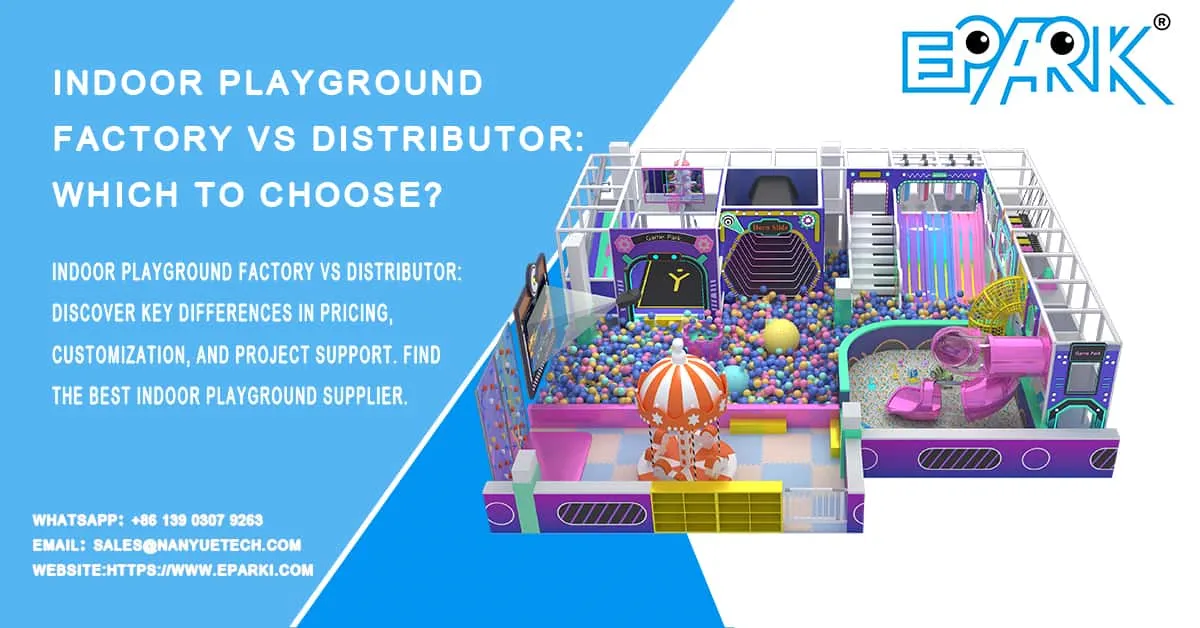
The indoor entertainment industry continues to grow as shopping malls, family entertainment centers, and recreational venues look for new attractions that can draw families and increase visitor engagement. Among these attractions, indoor playgrounds have become one of the most profitable and popular investments.
However, when planning an indoor playground project, investors quickly face an important question: Should you purchase equipment from an indoor playground factory or from a distributor?
Both options can supply indoor playground equipment, but they differ significantly in terms of pricing, customization flexibility, production control, and long-term support. For B2B buyers—such as entrepreneurs launching a family entertainment center (FEC) or shopping mall operators building a children's play zone—choosing the right supplier can directly impact project costs and profitability.
This guide will explain the differences between an indoor playground factory and a distributor, compare their advantages, and help you determine which option best fits your business goals.
If you are new to the industry, you may also want to read our guide:
Internal Link Suggestion: How to Start an Indoor Playground Business
What Is an Indoor Playground Factory?
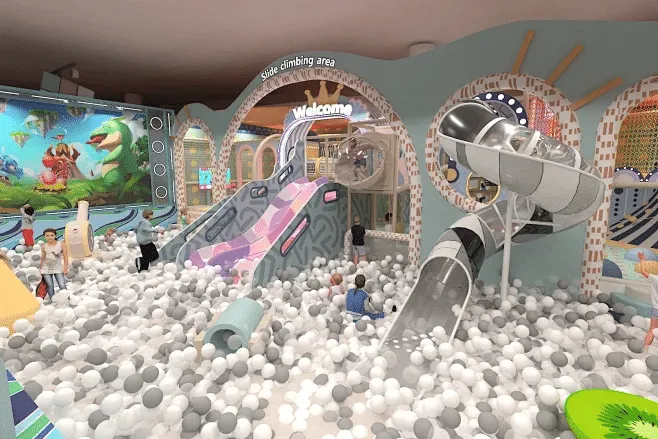
An indoor playground factory is a manufacturer that designs and produces indoor playground structures directly. Unlike resellers, factories control the entire production process—from concept design to final equipment manufacturing.
Professional playground factories typically operate multiple departments, including:
-
Product design teams
-
Structural engineering departments
-
Steel fabrication workshops
-
Soft padding and foam production
-
Quality inspection laboratories
Because they manage manufacturing internally, an indoor playground manufacturer can maintain strict quality control and ensure compliance with international safety standards.
Many factories also provide complete project solutions, helping clients design, manufacture, and install indoor play structures.
 How Indoor Playground Equipment Is Manufactured
Producing high-quality soft play equipment requires a combination of engineering design, safety testing, and durable materials.
A typical manufacturing process includes several stages:
-
Layout Planning
Engineers create 2D and 3D playground layouts based on the client's venue size, ceiling height, and theme concept. -
Material Selection
High-quality indoor playground systems often use galvanized steel pipes, eco-friendly PE plastic components, EVA foam padding, and fire-resistant PVC covering. -
Structural Fabrication
Steel frames are welded, sandblasted, and powder-coated to improve corrosion resistance and structural strength. -
Safety Padding Installation
Climbing areas and high-impact zones are covered with soft foam and protective materials to reduce injury risks. -
Quality Inspection and Testing
Before shipment, equipment is inspected for stability, durability, and safety compliance.
Reliable manufacturers follow international safety standards such as:
| Safety Standard | Region | Description |
|---|---|---|
| ASTM F1918 | United States | Standard for soft contained play equipment |
| EN1176 | Europe | Playground safety standard |
| CE Certification | European Union | Product safety compliance |
| ISO9001 | Global | Quality management system |
These certifications ensure that the indoor playground equipment meets professional safety and durability requirements.
Advantages of Buying from an Indoor Playground Factory
Working directly with an indoor playground factory offers several advantages for commercial playground investors.
Lower Equipment Costs
One of the biggest benefits of factory sourcing is pricing. Because factories sell equipment directly, buyers avoid the markup added by intermediaries.
For medium-sized playground projects, buying directly from a manufacturer can reduce costs by 20%–40% compared to retail distributors.
Lower equipment costs can significantly improve the return on investment (ROI) for indoor play centers.
Full Customization Options
Another advantage of working with an indoor playground manufacturer is the ability to fully customize your play center.
Customization options may include:
-
Playground themes (space, jungle, ocean, candy)
-
Activity zones for different age groups
-
Multi-level climbing structures
-
Interactive play systems
-
Brand color schemes
Custom designs allow operators to create a unique indoor playground experience, helping attract more families and stand out in competitive markets.
You can explore examples here:
Internal Link Suggestion: Custom Indoor Playground Equipment Designs
One-Stop Project Solutions
Many modern indoor playground factories offer turnkey project services, which means they handle every step of the project.
Typical services include:
-
Free layout design
-
3D visual rendering
-
Equipment manufacturing
-
Global shipping coordination
-
Installation guidance
This one-stop solution is especially helpful for entrepreneurs who are opening their first indoor playground business.
Direct Communication With Engineers
Working directly with a manufacturer allows buyers to communicate with designers and engineers instead of sales intermediaries.
This makes it easier to solve technical challenges such as:
-
Height restrictions
-
Space optimization
-
Fire safety regulations
-
Structural load calculations
Direct communication can also shorten project timelines and improve overall efficiency.
 What Is an Indoor Playground Distributor?
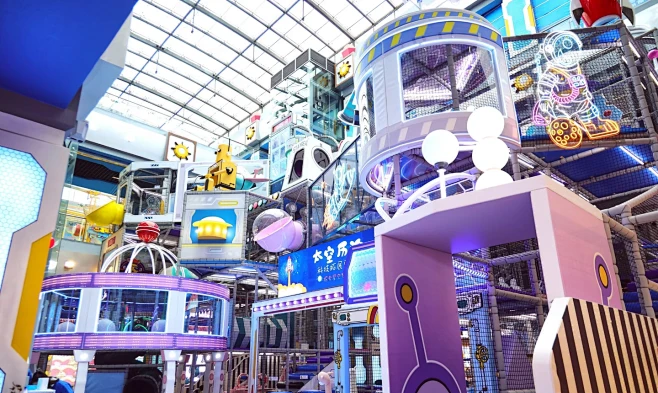
A distributor is a company that purchases equipment from manufacturers and resells it to local clients.
Unlike an indoor playground factory, distributors usually do not manufacture equipment themselves. Instead, they focus on sales, logistics, and local customer support.
Distributors typically provide services such as:
-
Product consulting
-
Local sales support
-
Installation services
-
After-sales maintenance
For small projects, distributors can offer a convenient purchasing option.
Advantages of Working With a Distributor
Although buying directly from a manufacturer has many benefits, distributors can still be useful in certain situations.
Local Communication and Support
Because distributors operate locally, they can communicate with clients in the same language and time zone. This can simplify discussions about project planning or equipment installation.
Local communication is particularly helpful for buyers who prefer face-to-face consultation.
Installation and Maintenance Services
Many distributors provide local installation teams that handle equipment assembly.
They may also offer maintenance services, which can help operators keep their indoor playground equipment in good condition.
Faster Delivery for Standard Equipment
Some distributors maintain inventory in local warehouses. This allows them to deliver standard soft play structures more quickly than factories that manufacture equipment to order.
For projects with tight opening deadlines, this faster delivery can be useful.
Indoor Playground Factory vs Distributor: Key Differences
The differences between a factory and a distributor can affect both project cost and flexibility.
| Factor | Indoor Playground Factory | Distributor |
|---|---|---|
| Equipment Cost | Lower factory price | Higher due to markup |
| Customization | Full customization available | Limited options |
| Product Range | Wide variety of equipment | Limited catalog |
| Technical Support | Direct engineering support | Sales-level support |
| Delivery Speed | Requires production time | Faster if inventory exists |
| Best For | Large or customized projects | Small or urgent projects |
For most commercial entertainment venues, working directly with an indoor playground factory provides better long-term value.
Which Option Is Better for Your Business?
The best option depends on your project size, budget, and experience.
When a Factory Is the Best Choice
Choosing an indoor playground factory is usually the best decision if:
-
Your playground size exceeds 200 square meters
-
You want custom themed playground equipment
-
You are opening a family entertainment center
-
You want to reduce equipment costs
-
You plan to expand to multiple locations
Factories are especially suitable for large commercial projects such as:
-
Shopping mall play centers
-
Indoor amusement parks
-
trampoline parks
-
children’s adventure zones
These projects often require customized layouts and specialized equipment.
When a Distributor May Be the Better Choice
A distributor may be a better option if:
-
Your project is smaller than 100 square meters
-
You need equipment delivered quickly
-
You prefer local installation services
-
Your design requirements are simple
For small cafés, daycare centers, or community play areas, a distributor may provide a simpler purchasing experience.
Tips for Choosing a Reliable Indoor Playground Supplier
Regardless of whether you choose a factory or distributor, selecting the right supplier is critical.
Here are several factors to evaluate.
Safety Certifications
Always verify that the supplier complies with international safety standards such as ASTM F1918, EN1176, and CE certification.
Safety compliance ensures that the indoor playground equipment is structurally safe for children.
Manufacturing Experience
Suppliers with 5–10 years of manufacturing experience typically have stronger engineering capabilities and more successful project cases.
Experienced companies also understand global shipping logistics and installation requirements.
Design Capabilities
Professional suppliers should offer:
-
free layout design
-
3D renderings
-
theme customization
-
space optimization
Creative design can greatly improve the attractiveness of a play center.
After-Sales Support
Reliable suppliers provide long-term support such as:
-
spare parts availability
-
installation guidance
-
maintenance instructions
-
technical consultation
Strong after-sales service helps ensure that your indoor playground business operates smoothly.
 Conclusion
Choosing between an indoor playground factory and a distributor is a key decision when launching an indoor playground project.
Factories offer lower costs, full customization, and direct engineering support, making them the best choice for large commercial projects and long-term investors.
Distributors, on the other hand, provide local communication, installation services, and faster delivery for standard equipment.
By carefully evaluating your project size, timeline, and customization needs, you can select the supplier that best supports your business goals.
If you want to learn more about equipment selection, you can also read:
Internal Link Suggestion: Best Indoor Playground Equipment for Family Entertainment Centers
Start Your Indoor Playground Project Today
If you are planning to build a profitable indoor playground or family entertainment center, working with a reliable indoor playground factory can help you reduce costs and create a unique attraction.
Our team offers:
-
Free playground layout design
-
Custom indoor playground equipment manufacturing
-
Global shipping and installation guidance
-
Competitive factory pricing
Contact us today to receive a customized solution and start building your indoor playground business.
General Disclaimer
All data on https://www.eparki.com is for general guidance only. As a leading indoor playground manufacturer and trampoline supplier, EPARK strives for accuracy but gives no express or implied warranty regarding completeness, performance or project fitness. Product specs, designs and results may vary with use and customer requirements. Buyers must verify technical details, compliance and suitability before purchase. EPARK OEM/ODM is not liable for any direct, indirect or consequential damages arising from site use. For custom solutions, contact our manufacturer and supplier team via the Contact page.
Intellectual Property
Text, images, videos, CAD files and software are Guangzhou EPARK Electronic Technology Co., Ltd. All rights reserved. No part may be copied, republished or used commercially without prior written permission. We will pursue legal action for copyright or design-patent infringement.
Trademarks
"EPARK", the EPARK logo and related graphics are registered trademarks of Guangzhou EPARK Electronic Technology Co., Ltd. Unauthorized use in ads, domain names or packaging is prohibited.
Governing Law
These terms are governed by the laws of the People's Republic of China.
Contact
Questions? Email sales@nanyuetech.com or WhatsApp +86 139 0307 9263.