What Should a Soft Play Equipment Manufacturer Provide for Commercial Projects?
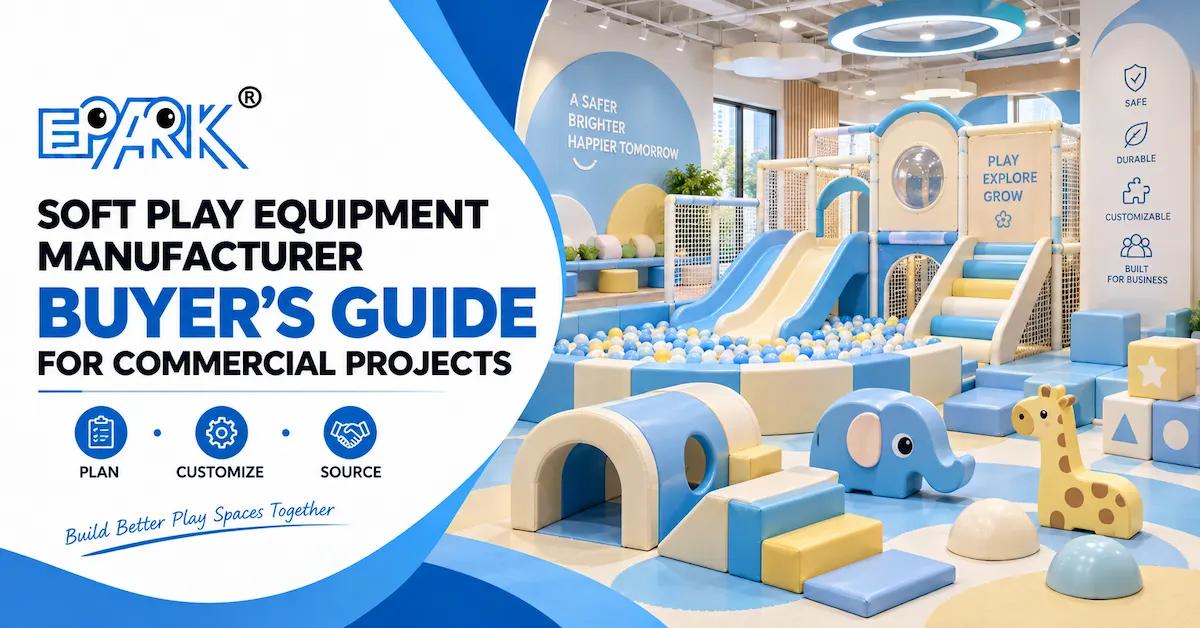
A soft play equipment manufacturer should provide more than padded shapes, small slides or colorful foam products. For a commercial project, the manufacturer should be able to turn the buyer’s venue, target age group and business model into a coordinated play solution that considers equipment selection, layout, themed appearance, materials, production, packing and installation preparation.
For shopping malls, indoor playground businesses, daycare centers and FECs, soft play equipment is often used as a dedicated toddler or younger-child zone. In other projects, it becomes one part of a larger indoor playground containing climbing structures, slides, tunnels and other entertainment areas.
The purchasing objective should therefore be clear from the beginning: determine what children need to do in the space, how parents or staff will supervise them, how the equipment will be maintained and whether the playground needs to support future expansion.
Which Buyers Need a Commercial Soft Play Equipment Manufacturer?
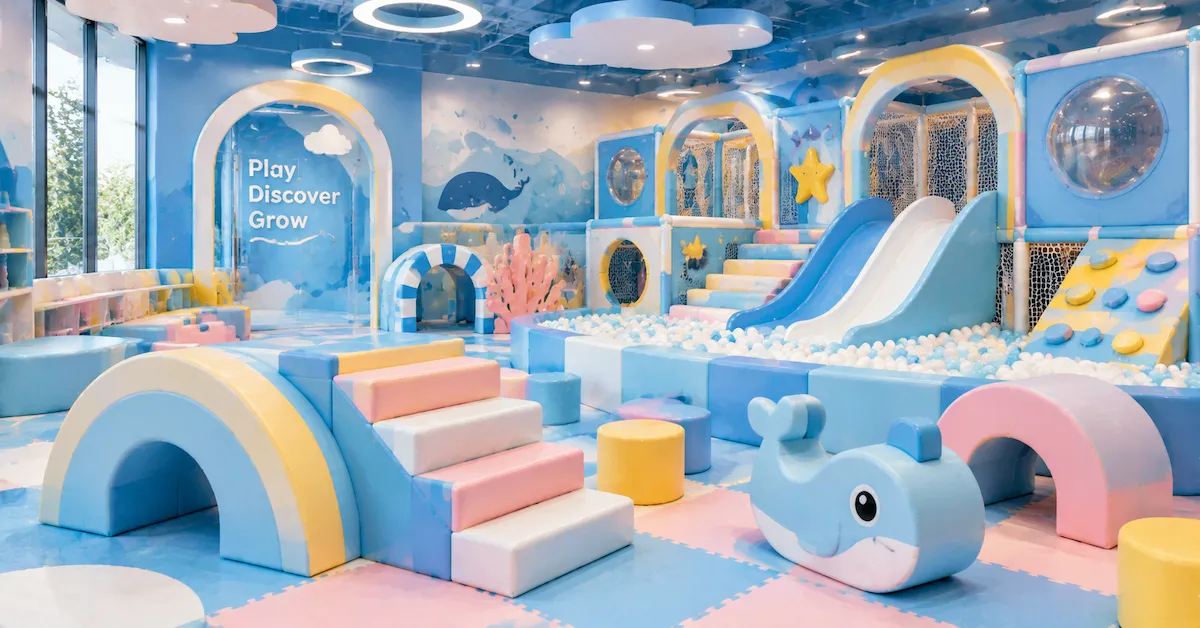
Different commercial buyers need very different soft play solutions. A supplier should understand those differences instead of proposing one standard set for every inquiry.
| Buyer Type | Typical Project | Main Purchasing Priority |
|---|---|---|
| Indoor playground operator | Toddler or preschool play zone | Activity variety and durability |
| Shopping mall | Family attraction area | Appearance and efficient use of space |
| FEC operator | Younger-child zone inside a larger venue | Age segmentation and integration |
| Daycare/preschool | Daily early-childhood play area | Visibility and practical maintenance |
| Hotel/resort | Kids club | Attractive appearance and manageable operation |
| Family restaurant | Compact children’s play corner | Small footprint and simple supervision |
| Project contractor | Commercial playground project | Drawings, production and installation coordination |
A daycare project may prioritize low-height modular pieces and easy observation, while a mall play center may need stronger theme integration and a more visually recognizable entrance.
Start With the Application, Not the Equipment Catalog
One of the easiest mistakes in commercial soft play sourcing is selecting products before defining the venue requirements.
Before asking for a quotation, determine:
- who will use the area;
- how much usable space is available;
- whether the project is standalone or part of a larger playground;
- which activities are required;
- how the space will be supervised;
- whether a custom theme is required;
- how the venue will clean and maintain the equipment.
Buyers can review EPARK’s broader product range before deciding whether the project should remain a dedicated soft play zone or become part of a larger indoor playground solution.
Build the Soft Play Area Around Age and Activity
Commercial soft play is most effective when different equipment serves different developmental and play functions instead of filling the room with visually similar foam pieces.
Toddler Activity Zone
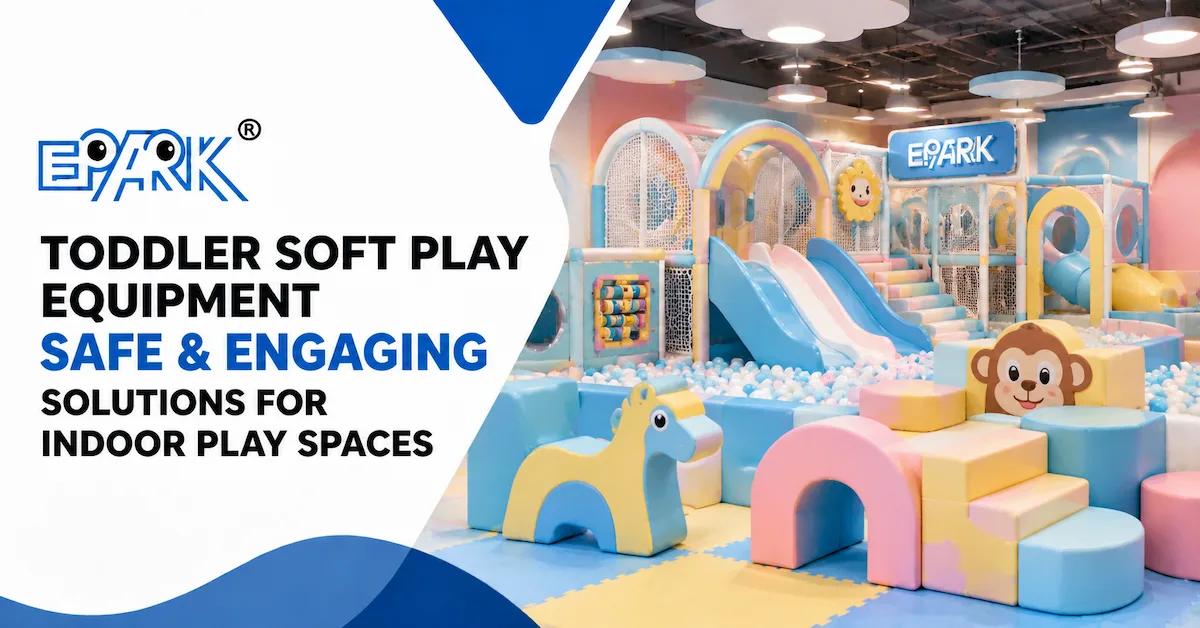
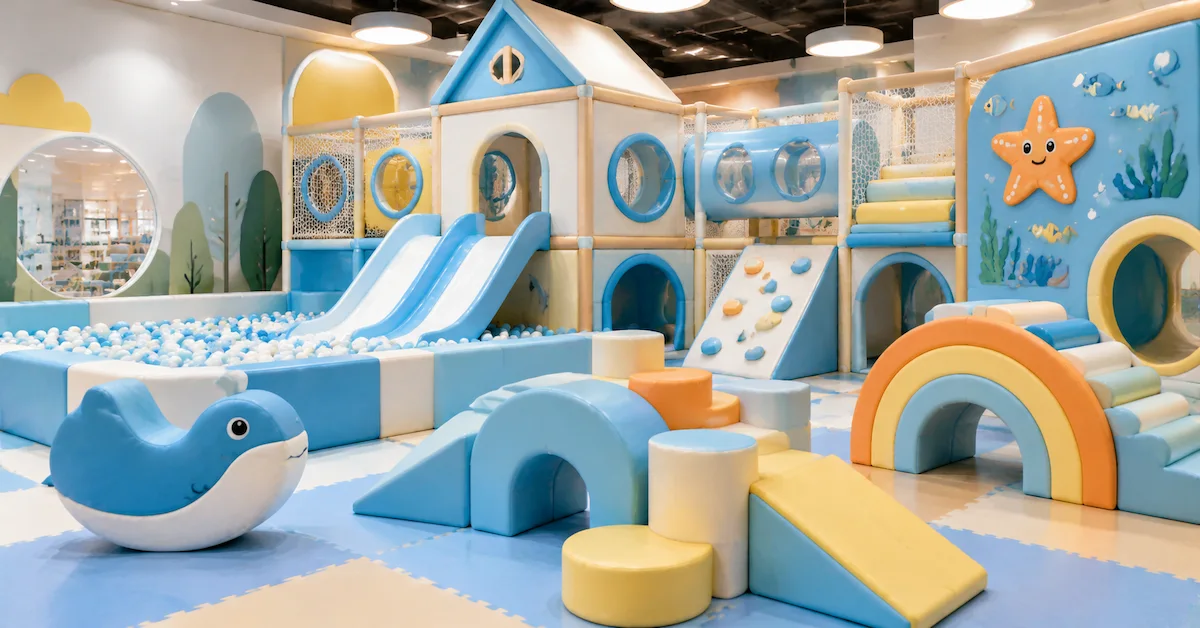
Toddler-focused areas typically benefit from low and simple activities such as soft ramps, crawl-through forms, foam steps, small slides, rockers and sensory play elements.
The objective is not to make the equipment look miniature. It should provide a lower-intensity environment that is clearly separated from faster play.
Preschool Activity Zone
Preschool children can engage with more varied combinations such as tunnels, soft climbing pieces, ball pools, balance elements and slightly longer movement routes.
Parent-Child Interaction Zone
Some commercial venues may also benefit from simple interactive activities where adults can assist younger children. This can be useful in mall play centers, family restaurants and hotel kids clubs.
What Types of Soft Play Equipment Can Be Combined?
A commercial project usually performs better when the activity mix is balanced.
| Equipment Type | Main Function | Typical Commercial Use |
|---|---|---|
| Soft steps | Basic climbing and movement | Toddler areas |
| Foam ramps | Balance and crawling | Toddler/preschool zones |
| Crawl tunnels | Exploration | Mixed soft play layouts |
| Small slides | Repeat movement | Main soft play attraction |
| Ball pool | Active sensory play | Indoor playgrounds |
| Soft rockers | Balance and imaginative play | Younger-child areas |
| Interactive wall panels | Sensory and quieter activity | Daycare and mall projects |
| Foam blocks | Open-ended play | Flexible activity zones |
| Themed soft shapes | Play + visual identity | Branded or themed projects |
A good soft play equipment manufacturer should help the buyer combine these functions around the actual floor plan rather than simply maximize the number of individual products.
Prepare a Commercial Soft Play Specification Before Quotation
A structured RFQ makes supplier comparison much easier and reduces misunderstanding during design.
| Requirement Area | What the Buyer Should Provide or Confirm |
|---|---|
| Venue | Mall, FEC, daycare, hotel or indoor playground |
| Floor dimensions | Usable length and width |
| Clear height | Actual usable height |
| Target users | Toddler, preschool or mixed ages |
| Activity requirements | Slides, ball pool, climbing, tunnels, sensory play |
| Theme | Standard colors or custom concept |
| Branding | Logo and venue color requirements |
| Supporting areas | Seating, entrance, storage or reception |
| Installation | Site access and responsibility |
| Delivery | Destination and target schedule |
| Maintenance | Cleaning and replacement expectations |
| Documentation | Drawings and project-specific information required |
The specification should remain the reference throughout design and production. When the buyer changes a requirement, the revision should be clear instead of being buried in separate messages.
How Should Buyers Evaluate Soft Play Materials?
A commercial buyer should not rely on descriptions such as “high quality foam” or “premium material.” Each component performs a different function and should be reviewed accordingly.
Foam and Padding
Ask what material configuration is proposed for the specific products and how the equipment is expected to retain its form during repeated commercial use.
Outer Surface
The covering affects appearance, cleaning and wear. Buyers should understand how frequently used surfaces are maintained and whether damaged coverings or modules can be replaced.
Supporting Structures
Not every soft play item is simply a foam block. Larger integrated structures may require supporting frames or connections that should be evaluated separately.
Floor Protection
The surrounding floor and transition zones should be considered as part of the play environment instead of being treated as an unrelated finishing decision.
EPARK provides broader project information through its Safety and Quality page. Buyers should still confirm which material information applies to the actual equipment included in their quotation.
Why Layout Matters as Much as the Equipment
A strong soft play layout needs to support both child movement and commercial operation.
Clear Activity Flow
Children should be able to move from one activity to another without unnecessary dead ends or congestion.
Supervision Visibility
Tall decorative pieces or closed structures should not unnecessarily block parent or staff visibility.
Age Separation
Where toddlers share a venue with older children, the soft play zone should be positioned so high-energy traffic does not pass through it.
Cleaning and Maintenance Access
Operators need enough access around equipment to clean surfaces, inspect wear points and replace components.
For custom projects, buyers can send site dimensions and requirements through EPARK’s customization process rather than selecting equipment only from photos.
Should You Choose Standard or Custom Soft Play Equipment?
The right level of customization depends on the commercial purpose.
| Project Route | Main Advantage | Main Limitation | Better Fit |
|---|---|---|---|
| Standard soft play | Faster selection | Limited differentiation | Small daycare or simple play corner |
| Color customization | Stronger venue matching | Layout remains relatively standard | Family restaurants and compact venues |
| Semi-custom project | Better balance of theme and cost | Requires design review | Malls and indoor playgrounds |
| Fully custom soft play | Strongest site and brand differentiation | More development coordination | Flagship venues and chains |
| Modular project | Easier later adjustment | Expansion must be planned early | Growing operators |
Customization should solve a clear project problem. Buyers do not need a completely new structure if an existing soft play configuration already fits the age group and site.
How Themed Soft Play Changes a Commercial Project
Theme customization can help an indoor playground or kids club create a recognizable identity.
Common directions include:
Ocean Theme
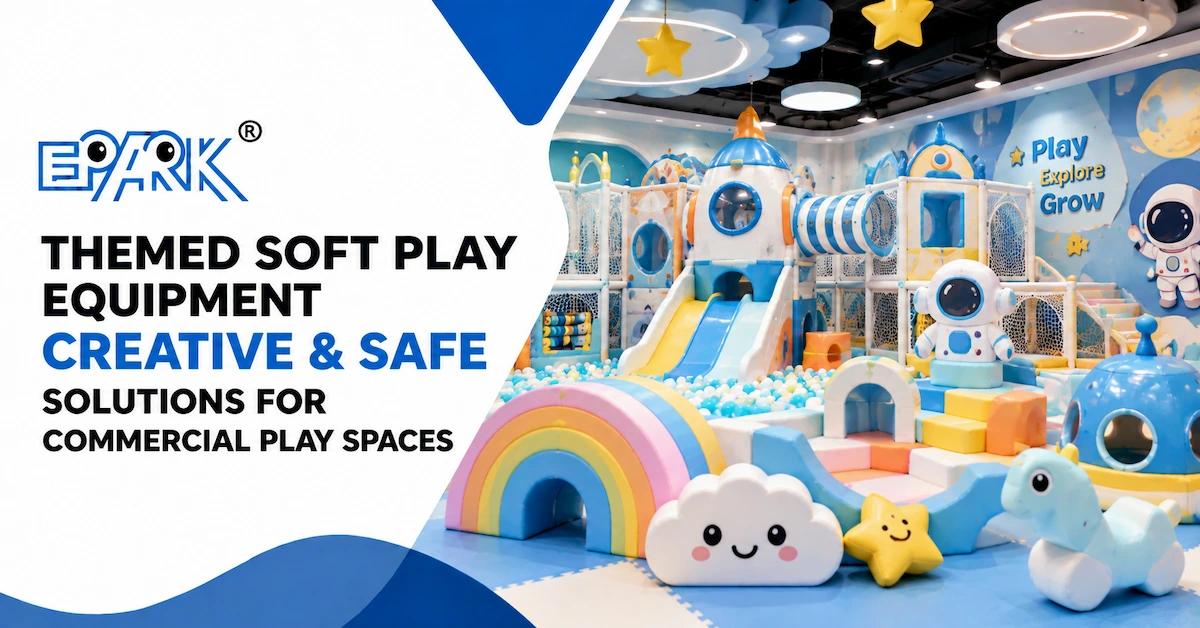
Marine animals, waves, coral forms and blue color palettes can be incorporated into soft climbing shapes and play zones.
Space Theme
Planets, rockets and futuristic forms work well for more immersive commercial environments.
Jungle or Forest Theme
Animals, trees and natural visual elements can create a softer family-oriented atmosphere.
Brand-Specific Theme
Chains and franchise operators may use their own mascots, logo, brand colors and signage.
A capable supplier should integrate the theme into the activity design rather than treating decoration as a separate layer.
How Should a Soft Play Equipment Manufacturer Handle Customization?
Customization should follow a controlled sequence:
Site requirements → layout → theme direction → equipment configuration → design approval → production → QC → packing → shipment
The buyer should know which stage releases production. Late layout or theme changes can affect manufacturing, packaging and project timing.
Buyers can review EPARK’s customization process when preparing a project brief.
What Should Quality Control Cover?
Commercial soft play QC should compare production against the approved project rather than only check whether the products look clean.
| QC Area | Buyer Check |
|---|---|
| Equipment list | All approved products are included |
| Dimensions | Important components match the approved design |
| Surface finish | Appearance matches the agreed reference |
| Soft protection | Correct protective components provided |
| Theme elements | Colors and graphics match approval |
| Accessories | Required hardware and components are complete |
| Packaging | Components are clearly identified |
| Documentation | Agreed installation references are available |
For a custom project, package identification becomes especially important because several components may appear visually similar once packed.
How Should Buyers Evaluate Manufacturing Capability?
A reliable soft play equipment manufacturer should be able to explain how the approved design moves into production.
Useful questions include:
- How is the approved project revision identified?
- How are custom colors and themed elements controlled?
- How are project components matched before packing?
- How are production changes communicated?
- How are missing or damaged items handled?
- Can replacement components later be identified from the original project?
These questions reveal more about manufacturing control than a general statement such as “we have strict quality control.”
How Should Lead Time Be Discussed?
There is no useful universal lead time for all soft play projects because a standard equipment order and a custom commercial playground involve different workloads.
A stage-based schedule is more useful:
Requirement confirmation → layout → design → approval → production → inspection → packing → shipping → installation
Buyers should ask which milestone starts production and which approvals depend on the buyer.
This also makes delays easier to diagnose. A late theme approval should not be confused with production delay.
Shipping and Installation Need to Be Planned Early
International projects often include many individual components, so packaging and installation should not be left until the end.
Before production is completed, buyers should clarify:
- site access;
- unloading conditions;
- package identification;
- installer responsibility;
- required assembly references;
- local preparation requirements.
EPARK’s FAQs can provide general project information, while the actual installation scope should be confirmed for the specific order.
What Determines Commercial Soft Play Equipment Cost?
There is no reliable universal cost per project because two soft play spaces of similar size can contain very different equipment density and customization.
Major cost drivers may include:
- total area;
- equipment quantity;
- equipment complexity;
- customization;
- theme development;
- special decorative features;
- packaging;
- shipping;
- installation.
A useful planning framework is:
Total Project Cost = Equipment + Customization + Packaging + Logistics + Installation + Opening Preparation
This is a buyer budgeting method rather than an EPARK pricing formula.
Soft Play Manufacturer vs General Playground Supplier
| Comparison | Soft Play Manufacturer | General Playground Supplier |
|---|---|---|
| Toddler-focused expertise | Usually more specialized | Depends on product range |
| Foam product variety | Stronger focus | May be broader but less specialized |
| Custom soft shapes | Often more flexible | Project dependent |
| Large playground integration | Depends on supplier scope | May be stronger in full projects |
| Multi-category projects | Needs broader capability | Often more suitable |
For a standalone toddler area, specialized soft play capability may be particularly important. For a full commercial playground, buyers may prefer a supplier able to integrate soft play with larger indoor playground equipment.
Common Mistakes When Choosing a Soft Play Equipment Manufacturer
Choosing by Color and Appearance Alone
Bright designs can hide weak project planning. Equipment should be evaluated for activity value, maintenance and compatibility with the venue.
Not Separating Age Groups
Toddler equipment should not simply be placed beside high-energy older-child activities without zoning.
Ignoring Cleaning Requirements
Complex decorative designs may create unnecessary maintenance work.
Comparing Unequal Quotations
One supplier may include customization or packing that another quotation excludes.
Not Planning Replacements
Commercial operators should ask how worn modules or coverings can be identified and replaced later.
A Practical Supplier Comparison Scorecard
| Evaluation Area | What to Look For |
|---|---|
| Project understanding | Supplier responds to the actual venue requirements |
| Equipment range | Enough products for intended activity mix |
| Design capability | Layout fits site and target users |
| Materials | Specifications are clearly explained |
| Customization | Theme and branding can be controlled |
| QC | Inspection matches approved project |
| Packing | Components are identified clearly |
| Installation support | Scope and responsibility are defined |
| After-sales | Replacement items can be traced |
| Communication | Open items and revisions are managed clearly |
This kind of comparison is more useful than choosing purely by quotation price.
What Should You Send a Soft Play Equipment Manufacturer?
A useful inquiry should include:
- floor plan;
- usable dimensions;
- clear height;
- venue type;
- target age groups;
- preferred equipment;
- theme direction;
- branding requirements;
- destination;
- expected opening schedule.
Buyers can review EPARK’s Indoor Playground products, products, Safety and Quality and FAQs, then submit the project through EPARK Contact Us.
Frequently Asked Questions About Soft Play Equipment Manufacturers
1. What does a soft play equipment manufacturer provide?
A soft play equipment manufacturer can supply padded commercial play equipment such as foam shapes, ramps, steps, tunnels, small slides, rockers and other younger-child activity products, depending on the manufacturer’s product range.
2. Who typically buys commercial soft play equipment?
Common buyers include indoor playground operators, shopping malls, daycare centers, preschools, FECs, family restaurants, hotels and project contractors.
3. Can soft play equipment be customized?
Yes. Projects may include customized colors, themes, layouts, logos and selected equipment shapes depending on project requirements and supplier capability.
4. What information should I provide before asking for a quotation?
Provide usable site dimensions, venue type, target ages, preferred activities, theme requirements, destination and project schedule.
5. How should I evaluate soft play materials?
Ask for the specific material configuration used in the proposed products and review padding, surface covering, supporting elements, cleaning needs and replacement options.
6. What is the difference between toddler soft play and general indoor playground equipment?
Toddler soft play typically emphasizes lower-height, padded and simpler activities, while broader indoor playground systems can include larger climbing structures and more complex routes.
7. How much does commercial soft play equipment cost?
Cost depends on the project size, equipment mix, customization, materials, packaging, logistics and installation requirements, so a site-specific quotation is more useful than a universal price.
8. How should soft play equipment be inspected before shipment?
Compare the produced equipment with the approved layout and product list, check surfaces and theme details, verify accessories and confirm package identification.
9. Can damaged soft play components be replaced later?
Replacement capability depends on the product and supplier. Commercial buyers should keep project records and ask how individual modules or coverings can be identified for future support.
10. How can I request a commercial soft play proposal from EPARK?
Prepare your floor plan, dimensions, target users, equipment requirements and theme direction, then submit them through EPARK Contact Us.
Conclusion
Selecting a soft play equipment manufacturer for a commercial project should begin with the venue, target age group and operating requirements—not simply with colorful product images. Buyers should compare equipment functions, materials, layout capability, customization, manufacturing control, QC, installation preparation and replacement support before committing to an order. For malls, FECs, daycare operators and indoor playground businesses, the strongest soft play projects combine age-appropriate activities with clear supervision, practical maintenance and a visual identity that fits the wider venue. Buyers can review EPARK’s Indoor Playground products, customization process, Safety and Quality and FAQs, then contact EPARK with the site plan, target users and project requirements for a customized commercial soft play proposal.
General Disclaimer
All data on https://www.eparki.com is for general guidance only. As a leading indoor playground manufacturer and trampoline supplier, EPARK strives for accuracy but gives no express or implied warranty regarding completeness, performance or project fitness. Product specs, designs and results may vary with use and customer requirements. Buyers must verify technical details, compliance and suitability before purchase. EPARK OEM/ODM is not liable for any direct, indirect or consequential damages arising from site use. For custom solutions, contact our manufacturer and supplier team via the Contact page.
Intellectual Property
Text, images, videos, CAD files and software are Guangzhou EPARK Electronic Technology Co., Ltd. All rights reserved. No part may be copied, republished or used commercially without prior written permission. We will pursue legal action for copyright or design-patent infringement.
Trademarks
"EPARK", the EPARK logo and related graphics are registered trademarks of Guangzhou EPARK Electronic Technology Co., Ltd. Unauthorized use in ads, domain names or packaging is prohibited.
Governing Law
These terms are governed by the laws of the People's Republic of China.
Contact
Questions? Email sales@nanyuetech.com or WhatsApp +86 139 0307 9263.