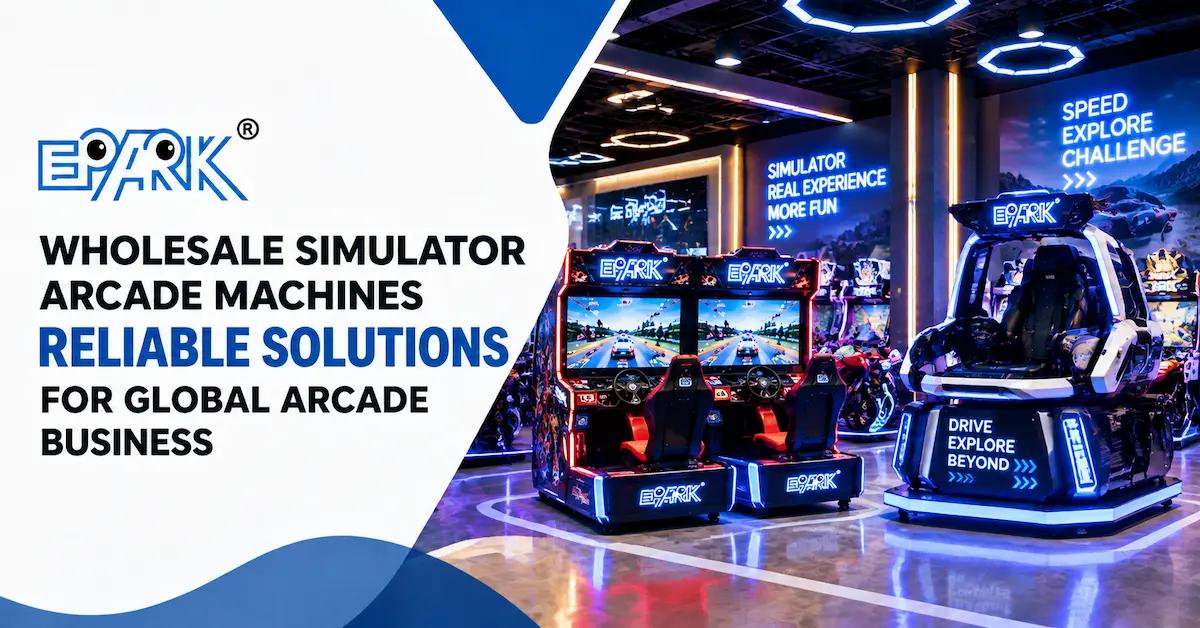
Define What “Simulator Arcade Machine” Means Before Requesting Prices
When sourcing wholesale simulator arcade machines, the first task is to define what type of simulation experience the project actually needs. Commercial arcade guidance on EPARK currently includes racing simulators, driving simulators, VR equipment and other interactive attractions, but these categories should not be treated as interchangeable products. A racing cabinet built around a steering wheel, pedals, seat and display creates a different installation and maintenance requirement from a motion-based VR attraction or another interactive simulator. EPARK’s commercial arcade equipment buying guide similarly separates racing equipment from interactive or VR equipment because their space, hardware, software and support requirements differ.
For an FEC operator, the question is usually which simulator adds a distinct experience to the existing machine mix. For a distributor, the larger concern is whether the approved configuration can be reproduced, serviced locally and reordered. Avoid sending suppliers only a request such as “send your best simulator price.” State whether the project needs driving, racing, VR, motion-based or another simulator format, then identify the number of player stations, venue type, available space and technical-support expectations.
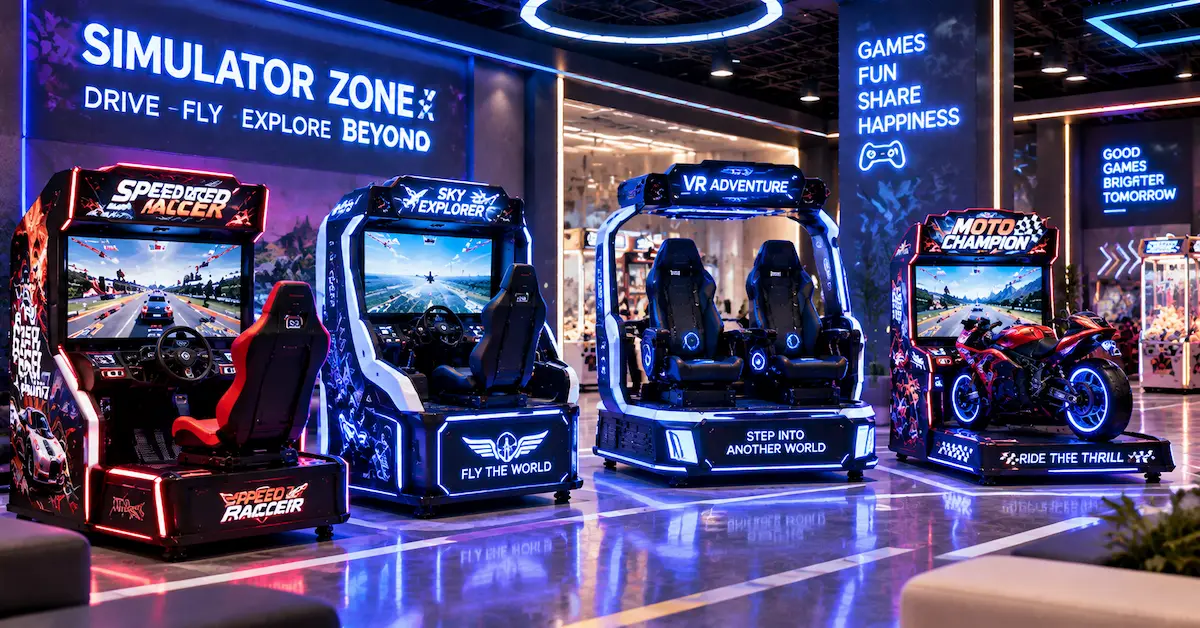
Who Should Buy Simulator Arcade Machines Wholesale?
Wholesale purchasing is most relevant to family entertainment centers, arcade chains, shopping mall entertainment projects, amusement-equipment distributors and importers planning multiple commercial installations. EPARK’s FEC content treats racing simulators and VR attractions as part of a wider commercial game mix that can also include redemption equipment, claw machines, shooting games and sports machines. The objective is not to fill every available meter with large simulators, but to combine attractions according to target visitors, floor area, payment strategy and long-term maintenance capability.
Wholesale may be less appropriate when a buyer has never tested the machine category, cannot yet define the installation space or has no technical plan for maintaining controls and motion hardware. In those situations, a smaller pilot quantity can provide more useful information than an immediate large order.Volume should follow validated demand and an approved configuration rather than become the reason for selecting a product.
Match the Simulator Type to the Venue
Different simulator categories create different operating requirements. The comparison below is a procurement framework, not a list of fixed EPARK models or guaranteed configurations. Current products, dimensions, linking capability and motion functions should be confirmed for the actual quotation.
| Simulator category | Typical commercial role | Main hardware to evaluate | Main purchasing risk |
|---|---|---|---|
| Racing simulator | Competitive driving attraction for FEC and arcade zones | Steering, pedals, seat, display, controller and confirmed linking system | Buying multiple stations before confirming multiplayer compatibility |
| Motorcycle simulator | Compact competitive or individual driving experience | Handlebar controls, seat/body structure,display and feedback system | Underestimating access, stability or replacement-control requirements |
| Driving simulator | Car-style driving experience with cockpit controls | Steering system, pedals, screen, seat adjustment and software | Assuming similar cabinet appearance means identical controls |
| VR simulator | Immersive attraction requiring dedicated hardware and content | Headset/display system, tracking, motion platform where fitted and software | Higher technical-support and content-management complexity |
| Motion simulator | Experience combining screen content with physical movement | Motion mechanism, actuators, controller,emergency/stop functions and seat structure | Ignoring moving clearances and maintenance requirements |
| Interactive simulator | Specialized digital experience using sensors or tracking | Sensors, controllers, screens and software | Hardware and software support becoming dependent on one configuration |
Build a Simulator Specification Sheet Before Comparing Suppliers
A quotation is difficult to compare if one supplier lists only “racing simulator” while another identifies the screen, control system, seat configuration, payment hardware and software version. Create a controlled specification for each selected model. EPARK’s B2B supplier guidance emphasizes repeatable specifications, export-ready configurations, spare parts and technical support for commercial entertainment equipment rather than selecting machines purely by appearance.
| Specification area | Information the buyer should confirm |
|---|---|
| Model identity | Product/model code, configuration revision and quantity |
| Simulator type | Racing, driving, motorcycle, VR, motion or other confirmed format |
| Player configuration | Single player, linked stations or other approved setup |
| Installed dimensions | Length, width,height and required operating clearance |
| Electrical setup | Voltage, frequency, plug and applicable power requirements |
| Display | Screen quantity, size, mounting and approved configuration |
| Controls | Steering, pedals, handlebar, buttons, guns or other interfaces |
| Seat/cockpit | Seat arrangement, adjustment where applicable and structural configuration |
| Motion system | Motion type, movement range and service requirements where applicable |
| Payment | Coin, token,card/cashless interface and credit settings |
| Software/content | Supplied version, language and agreed commercial-use scope |
| Networking | Linking hardware and multiplayer configuration where applicable |
| Service access | Access to controls, electronics, display and motion components |
| Accessories | Keys, cables, manuals and agreed supplied items |
| Spare parts | Part references and quantities included or recommended |
| Packing | Packed dimensions, gross weight,package count and detachable sections |
Evaluate Controls as Wear and Service Components
For simulator machines, the parts customers physically use can be among the most important maintenance items. Steering assemblies, pedals, buttons, handlebars, seats and other controls experience repeated interaction during commercial operation. Buyers should therefore evaluate more than whether the controls work on the first sample. Ask how the components are mounted, how technicians access them and how replacement parts are identified.
For racing equipment, test steering return, pedal response, buttons and the game start sequence using the intended software and payment configuration. If several stations will be linked, confirm that the approved multiplayer setup uses the same hardware and software revision planned for production. Do not assume that two visually identical driving cabinets can communicate with each other simply because they run the same type of game.
A distributor should also request identifiable control-component references. “Spare steering wheel” is less useful than a part reference connected to a particular model and revision. This becomes especially important when supporting machines several months after the initial shipment.
Treat Motion Systems as a Separate Technical Layer
A motion simulator adds another mechanical and control system beyond the game computer, display and player interface. Where movement is part of the selected machine, the supplier should explain the motion configuration, control relationship and maintenance access applicable to that model. The buyer should also identify the space required around moving structures rather than calculating installation area from the static cabinet footprint alone.
Do not infer motion range, actuator type, load limits or safety functions from photographs. These are model-specific technical points and should appear in the machine documentation or project quotation if they are relevant to the selected product. For wholesale simulator arcade machines, changing a motion platform or control component can represent a significant technical revision even when the seat and exterior graphics remain visually similar.
Plan Floor Space Around Operation, Not Cabinet Dimensions Alone
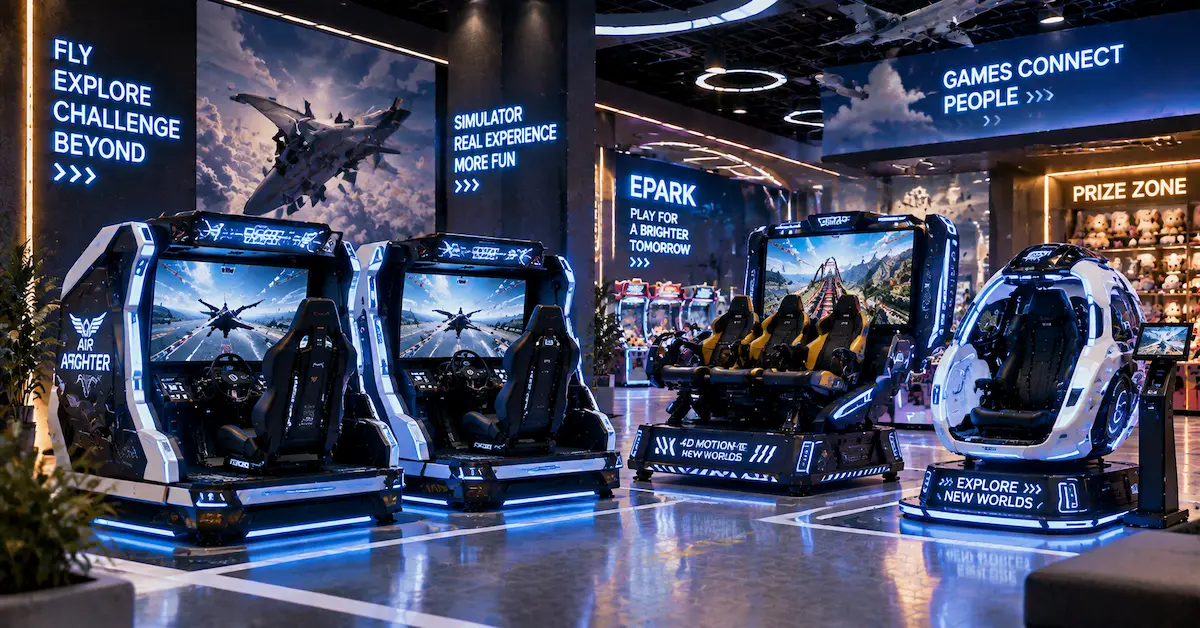
Simulator machines can occupy substantially more functional space than their external dimensions suggest. A racing cockpit needs player entry and exit space; linked stations need suitable arrangement between cabinets; a motion-based attraction may require defined clearance around moving sections; VR or interactive equipment can require an operating zone beyond the physical base.
EPARK’s FEC game machine layout guide recommends planning machine placement around customer flow, visibility, play frequency and operational access rather than filling empty spaces after equipment has already been purchased. Apply that principle before approving simulator quantities.
For every shortlisted machine, mark four areas on the layout: the cabinet or base footprint, the player position, required operating clearance and technician/service access. Then evaluate surrounding circulation. A machine that technically fits between two columns may still be a poor choice if players block a major walkway or the rear service panel cannot be opened.
Confirm Power, Networking and Payment Before Production
Simulator installation may involve more than plugging one cabinet into a wall outlet. Linked racing systems, multiple displays, motion hardware or VR equipment can introduce different electrical and communication requirements. Ask the supplier to identify the electrical configuration for the exact machine and whether multiple stations have any shared or separate connection requirements.
Payment should also be tested as part of the final configuration. If the project uses coins, tokens or a card system, verify payment recognition, credit allocation and normal game start. If several linked stations use independent payment hardware, establish how multiplayer sessions are initiated. Do not accept “cashless ready” as a complete specification unless the reader, interface and integration responsibility have been identified.
For an international order, lock voltage, frequency and plug configuration by destination before production. These items should appear on the approved model record rather than remain assumptions based on the buyer’s country.
Validate the Actual Simulator Experience on the Reference Machine
A simulator sample should be evaluated as a defined technical configuration rather than only as a visual showroom unit. Record the model, hardware revision, controls, software version, display configuration, payment system and linking setup. If motion is present, include the approved motion configuration in the record.
A practical racing-simulator review should cover normal payment and startup, steering, pedals, seat arrangement, screen behavior, game completion and linked play where applicable. For VR or interactive equipment, test the hardware and software combination that will actually be delivered. EPARK’s factory-selection guidance emphasizes functional testing and repeatable production control for commercial game-machine orders.
If a sample problem is corrected, identify the revised sample instead of continuing to refer to both machines as “approved.” A clear production reference prevents an early prototype from accidentally becoming the standard for the bulk order.
Use Simulator-Specific QC Instead of One Generic Arcade Checklist
A simulator requires common arcade checks plus category-specific functional testing.Cabinet appearance, voltage, payment operation and accessories may be common across equipment types, but simulator controls and linked functions need their own inspection criteria.
| Simulator area | QC question |
|---|---|
| Steering/handlebars | Does input operate correctly throughout the intended range? |
| Pedals | Are accelerator and brake inputs recognized consistently? |
| Buttons/controls | Are all controls mapped and functioning as approved? |
| Display | Does the approved display configuration operate correctly? |
| Seat/cockpit | Is the structure assembled and positioned according to the approved version? |
| Linking | Do linked stations communicate in the confirmed configuration? |
| Payment | Does payment create the correct credit and allow normal game start? |
| Audio | Does the supplied audio configuration function normally? |
| Motion | Does the approved motion function operate correctly where applicable? |
| Software | Does the delivered version match the approved configuration? |
| Accessories | Are keys,cables and agreed accessories supplied? |
| Appearance | Does the cabinet, artwork and lighting match the approved reference? |
The exact number of test cycles should be agreed for the selected machines rather than invented as one universal standard. The important issue is that the test method is linked to an identified function and an acceptance criterion.
Compare Simulator Configurations by Technical Scope
A price comparison becomes misleading when different simulator configurations are described using the same broad product name. The table below shows how buyers can structure the comparison; these are purchasing categories rather than confirmed EPARK packages.
| Configuration | Main characteristics | Best suited to | Additional checks |
|---|---|---|---|
| Single-station racing simulator | One seat, control set and display | Smaller arcade zones or product trials | Controls, footprint and software |
| Linked racing setup | Two or more compatible stations | Competitive FEC or arcade areas | Linking hardware,software revision and layout |
| Standard static simulator | Fixed cabinet/cockpit without active motion | Buyers prioritizing simpler maintenance | Controls, cabinet structure and service access |
| Motion simulator | Physical motion added to the experience | Dedicated immersive attraction zones | Motion clearance, components and maintenance |
| VR/immersive simulator | Specialized visual/tracking hardware and software | Premium immersive zones | Content, tracking hardware and technical support |
Calculate the Cost Beyond the Simulator Unit Price
The purchase price is only one part of the commercial decision.A larger simulator can increase shipping cost because of its packed volume and weight; a sophisticated motion machine may require specialized parts; linked stations can require additional hardware; VR equipment can involve software or content considerations.
Separate your cost review into equipment, logistics and operating support. Equipment cost can include the simulator, payment system, customization and optional hardware. Logistics should use actual packed dimensions and destination information. Operating support can include replacement controls, sensors, screens, specialized motion parts and technician time.
EPARK’s broader commercial equipment guidance treats maintenance and long-term support as part of machine selection, not as an issue to consider only after installation.
Avoid comparing projected earnings using unverified assumptions. Simulator performance depends on the venue, pricing, traffic, placement, customer profile and operating cost. For purchasing decisions, technical fit and supportability can be evaluated before revenue claims can.
Separate OEM Appearance From Simulator Engineering Changes
Private-label distributors may want custom cabinet colors, logos, header graphics or other visual modifications. These should be controlled separately from engineering changes such as different controls, displays, motion components or software.
EPARK’s customization process provides a broader project-development workflow that can be applied to custom entertainment projects. For simulator orders, maintain one approval record for artwork and another for technical configuration. A revised side graphic does not necessarily require another functional sample, while a changed steering assembly, controller or motion component may.
This separation is especially valuable for distributors because several branded simulator models may share a visual identity while using different technical platforms underneath.
Plan Spare Parts Around the Approved Simulator Configuration
Before shipment, ask which components are model-specific and which can be stocked across several machines. Racing simulators may require control-related parts; motion equipment introduces additional mechanical or control components; VR or interactive products can have specialized hardware.
Do not purchase a generic box labeled “simulator spare parts” without knowing what it supports. Ask for part references, applicable model revisions and replacement instructions. Where practical, have your technical team identify priority parts based on the actual purchased configuration.
For a distributor or chain operator, link the spare-parts record to each machine revision. If a component changes in a future batch, require confirmation of whether the original spare remains compatible.
Confirm Bulk-Order Capacity, Packing and Lead-Time Milestones
For wholesale simulator arcade machines, production timing can be affected by the machine type, customized artwork, control hardware, motion systems, software and current factory workload. EPARK’s bulk-order factory guide identifies production consistency, QC, spare parts, OEM/ODM capability and delivery management as key considerations when moving from a few machines to a commercial volume order.
Ask for a schedule that distinguishes technical confirmation, sample approval where required, customization approval, component preparation, production, testing, packing and shipment. Also request packed dimensions, gross weight and package count for each simulator. Racing cockpits and larger simulator structures can affect freight planning more than compact game cabinets, so logistics should be reviewed before final quantities are locked.
Protect Reorders With Hardware and Software Revision Records
Repeat ordering is particularly important for simulator equipment because component substitutions can affect controls, networking or spare-part compatibility. Save the approved model number, cabinet revision, steering or control hardware, display, software version, payment system, artwork and relevant spare-part references.
When placing the next order, attach this baseline and ask the supplier to identify proposed deviations before production. EPARK’s distributor-focused purchasing guidance emphasizes reproducible configurations and identifiable spare parts because supporting installed equipment is a different responsibility from simply receiving the first shipment. Review EPARK’s distributor sourcing guide for the broader approach.
This does not mean every component can remain unchanged indefinitely. It means a change becomes an approved commercial decision rather than a surprise discovered when a technician opens the machine.
What Should You Send EPARK for a Simulator Arcade Quote?
Prepare the venue type, floor plan, intended simulator category, number of stations, destination country, voltage and frequency, payment method, multiplayer requirement, branding requirement, approximate quantity, spare-parts expectations and target opening or shipment date. If motion or VR is required, state that clearly instead of using only the word “simulator.”
EPARK’s About Us page describes its wider indoor entertainment business as including arcade and game machines, while its current commercial arcade content discusses racing simulators, VR equipment and other interactive attractions within FEC and arcade projects. Current models and exact technical specifications should still be confirmed through a project-specific inquiry rather than inferred from category-level content.
Buyers can submit the project through EPARK Contact Us after preparing the technical and commercial brief so the discussion starts with an identifiable configuration instead of only a request for “best price.”
Frequently Asked Questions About Wholesale Simulator Arcade Machines
1. What are simulator arcade machines?
Simulator arcade machines are commercial attractions designed to recreate or imitate an activity through combinations of screens, controls, seats, software and, on some machines, motion or immersive hardware. Examples can include racing, driving, motorcycle, VR and other interactive simulator formats.
2. Are racing simulators and VR simulators the same type of equipment?
No. Racing simulators typically center on driving controls such as steering, pedals and seats, while VR or immersive simulators may use different visual, tracking or motion systems. Their installation, maintenance and technical-support requirements should be evaluated separately.
3. Should I buy single-player or linked racing simulators?
Choose according to the intended venue experience. If linked competition is important, confirm that the actual stations, hardware and software version support the required multiplayer arrangement before placing the bulk order.
4. How much floor space does a simulator arcade machine require?
Use the model’s installed dimensions plus player entry, operational clearance, circulation and service access. Motion-based equipment may also require additional clearance. Do not determine capacity using cabinet dimensions alone.
5.Do simulator machines need special power requirements?
Requirements vary by model. Confirm rated electrical information, voltage, frequency, plug and any requirements associated with displays, motion or linked stations before production and site installation.
6. Can simulator arcade machines use a cashless payment system?
Potentially, when the selected machine and payment hardware support the intended integration. Confirm the reader, interface, wiring, credit logic and responsibility for system integration rather than relying only on a “cashless ready” description.
7.What should be checked during simulator machine QC?
Check the approved payment, controls, display, software, audio, seat/cockpit, linking and motion functions where applicable, together with electrical configuration, accessories, artwork and cabinet condition.
8. Which simulator spare parts should be purchased with the first order?
Build the list around the selected models and your local technical capability. Control-related parts, specialized sensors, payment hardware and machine-specific components may be relevant, but the correct list should be based on identifiable part references rather than one universal kit.
9. Can simulator machines be customized with my brand?
Branding and cabinet artwork can be discussed as customization requirements, while changes to controls, displays, software or motion systems should be treated as separate technical revisions that may require additional evaluation.
10.How can I request wholesale simulator arcade machines from EPARK?
Provide your venue or distribution market, simulator type, quantity, floor plan where applicable, player configuration, voltage, payment system, branding needs, destination and target schedule through the EPARK contact page. Ask for model-specific specifications and current availability before confirming the order.
Conclusion
Buying wholesale simulator arcade machines successfully requires buyers to control the complete simulator configuration rather than judging the product only by screen size or cabinet appearance. Define whether the project needs racing, driving, VR, motion or another simulator type; verify controls, space, electrical and payment requirements; validate the approved reference; and make simulator-specific QC and spare-parts planning part of the order. For FEC operators, these steps help the attraction fit the actual venue and machine mix; for distributors, they also protect serviceability and repeat-order consistency. Buyers planning a simulator zone or wholesale program can contact EPARK with their simulator category, quantity, venue layout, destination, payment system, customization requirements and project schedule for configuration-specific evaluation.
General Disclaimer
All data on https://www.eparki.com is for general guidance only. As a leading indoor playground manufacturer and trampoline supplier, EPARK strives for accuracy but gives no express or implied warranty regarding completeness, performance or project fitness. Product specs, designs and results may vary with use and customer requirements. Buyers must verify technical details, compliance and suitability before purchase. EPARK OEM/ODM is not liable for any direct, indirect or consequential damages arising from site use. For custom solutions, contact our manufacturer and supplier team via the Contact page.
Intellectual Property
Text, images, videos, CAD files and software are Guangzhou EPARK Electronic Technology Co., Ltd. All rights reserved. No part may be copied, republished or used commercially without prior written permission. We will pursue legal action for copyright or design-patent infringement.
Trademarks
"EPARK", the EPARK logo and related graphics are registered trademarks of Guangzhou EPARK Electronic Technology Co., Ltd. Unauthorized use in ads, domain names or packaging is prohibited.
Governing Law
These terms are governed by the laws of the People's Republic of China.
Contact
Questions? Email sales@nanyuetech.com or WhatsApp +86 139 0307 9263.