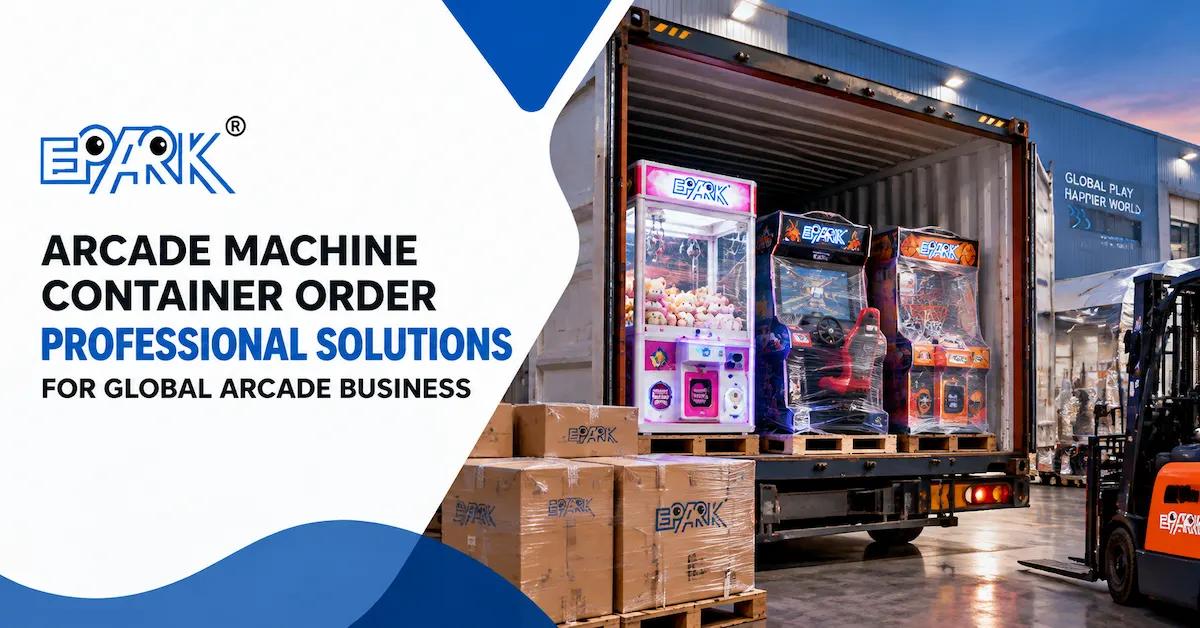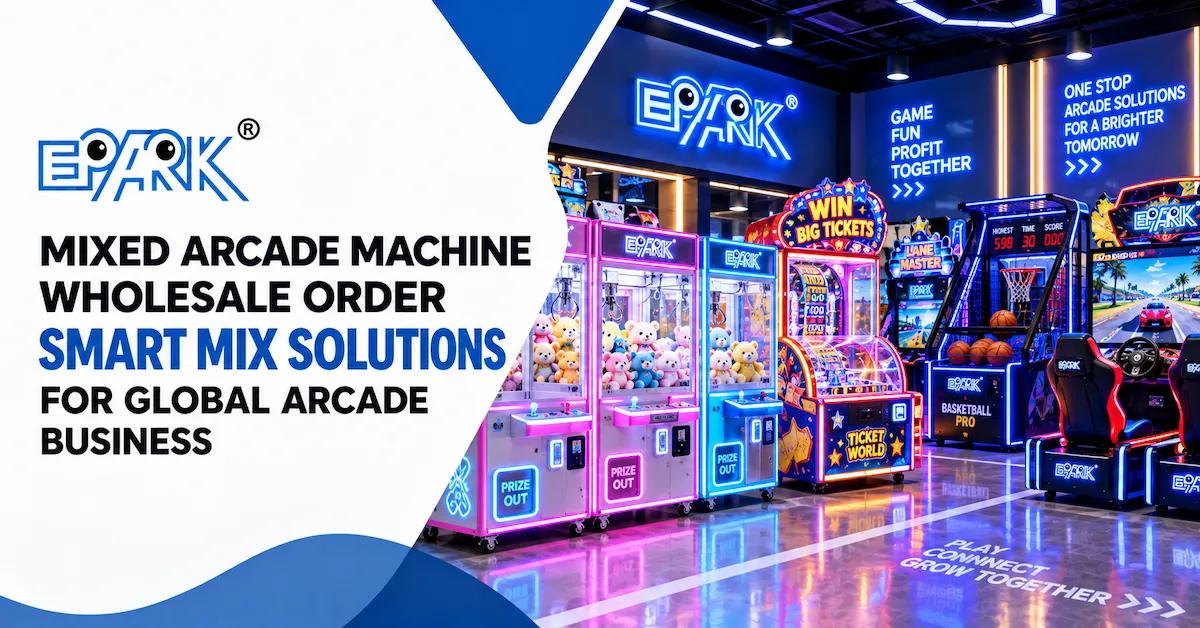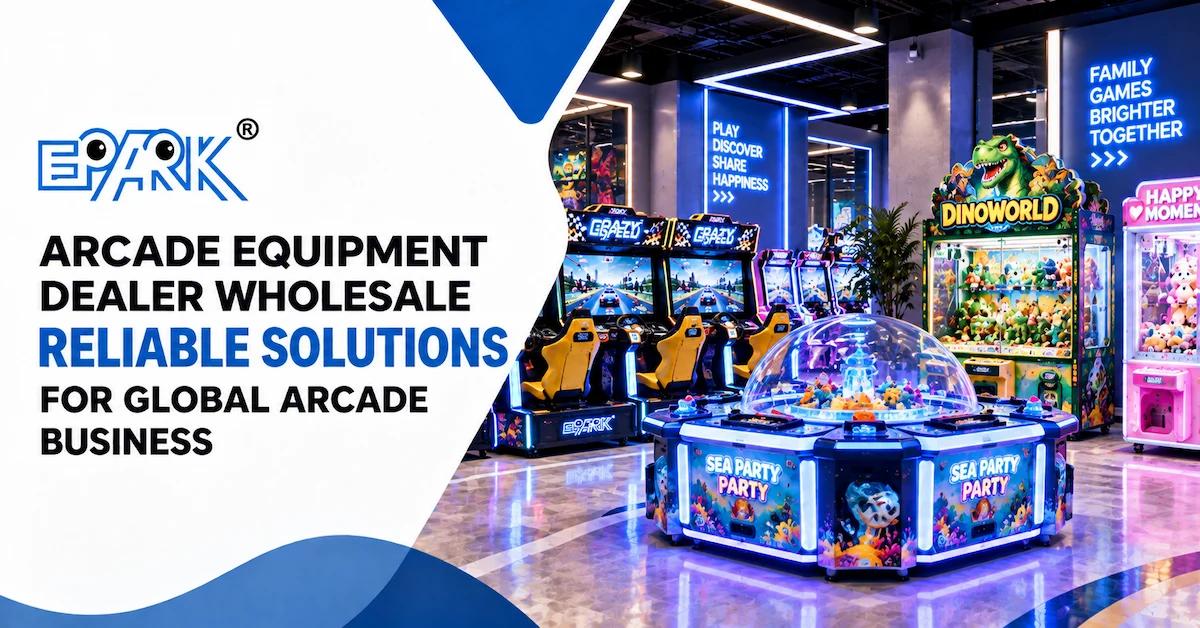

Commercial Arcade Machine Distributor Pricing Is More Than the Factory Unit Price
For a distributor, commercial arcade machine distributor pricing should answer a different question from “How much does this arcade machine cost?” A venue operator usually evaluates whether a machine fits one location. A distributor has to determine whether the product can be imported, stocked, demonstrated, sold at a workable margin, supported locally and reordered in the same configuration. That makes distributor pricing a combination of machine specification, order quantity, OEM scope, spare-parts planning, packing, freight and after-sales responsibility. EPARK’s commercial arcade wholesale guide makes the same distinction: professional wholesale purchasing follows a chain from product mix and specifications through price structure, QC, logistics and repeat supply rather than simply negotiating a larger-quantity discount.
The practical pricing question is therefore not “Which model has the lowest ex-factory price?” It is “What will this approved configuration cost to place into distributor inventory, and what additional cost will I carry when I sell and support it?” A lower factory price can still produce an unattractive distributor program if the cabinet occupies excessive freight volume, payment hardware needs modification, spare parts are difficult to identify or later batches cannot reproduce the original configuration.

Who Needs a Distributor Pricing Model?
This pricing method is most relevant to regional arcade equipment distributors, importers, wholesalers, private-label amusement brands and dealers supplying FECs, shopping mall entertainment operators or independent arcades. These buyers are not purchasing machines only for their own floors. They need a commercial product line that can be quoted repeatedly to downstream customers.
Different distributors also need different pricing logic. A dealer carrying several machines for local stock may prioritize manageable inventory and mixed-model shipments. An importer supplying large projects may care more about container utilization and project delivery. A private-label distributor may accept higher development costs if branding and configuration can be reproduced across repeat orders. A service-oriented distributor may deliberately carry additional spare parts to reduce customer downtime.
Bulk buying is less attractive when the local market has not been tested, the buyer does not yet understand customer demand, or a heavily customized product remains technically unapproved. In those situations, a smaller validation order can provide better commercial information than an aggressive volume price.
What Actually Changes Commercial Arcade Machine Distributor Pricing?
Two distributors requesting the same number of machines can receive different quotations because quantity is only one pricing factor. EPARK’s China commercial arcade wholesale guide identifies quantity, same-model volume, mixed products, payment systems, OEM artwork, spare parts, packaging and accessories as factors affecting wholesale supply.
| Pricing factor | Why distributor pricing can change | What to confirm |
|---|---|---|
| Machine category | Racing, claw, redemption, sports and simulator machines use different structures and components | Exact product/model |
| Quantity | Larger repeated quantities may affect production efficiency | Quantity by model |
| Same-model vs mixed order | Mixed batches require more coordination | Final model mix |
| Display and controls | Different screens, steering, joysticks, sensors or mechanisms change configuration | Component specification |
| Payment system | Coin, token or cashless preparation may use different hardware | Payment configuration |
| Electrical version | Voltage, frequency and plug can vary by destination | Market-specific version |
| OEM/private label | Artwork, labels, colors or packaging require approval and setup | Customization scope |
| Spare parts | Initial service inventory increases supply scope | Part list and quantity |
| Packing | Large or fragile machines require different protection | Packing method and CBM |
| Accessories | Cables, keys, manuals and extra components may differ | Included accessories |
| Support scope | Installation, technical assistance or warranty responsibilities may differ | Written service scope |
This is why a distributor RFQ should describe the actual order instead of requesting a generic “dealer price list.”
Normalize the Machine Specification Before Comparing Prices
A low quotation has little meaning when the equipment specifications are different. EPARK’s factory quotation comparison guide recommends comparing model, dimensions, voltage, payment system, controls, packing, spare parts, warranty, customization and shipping terms before judging price.
Create a distributor specification sheet for each shortlisted machine:
| Specification item | Distributor should record |
|---|---|
| Product identity | Model name/code and configuration revision |
| Quantity | Initial order and expected reorder quantity |
| Dimensions | Machine and packed dimensions |
| Electrical version | Voltage, frequency and plug |
| Payment system | Coin, token, card interface or another confirmed setup |
| Controls | Buttons, joystick, steering, pedals, sensors or other player interfaces |
| Display | Screen configuration and size where relevant |
| Software | Version, language and agreed content scope |
| Cabinet | Construction and approved finish |
| Branding | Logo, artwork, labels and color |
| Accessories | Keys, cables, manuals and agreed included items |
| Spare parts | Part references and quantities |
| Packing | Carton/crate method, package count and gross weight |
| Warranty | Coverage, exclusions and claim process |
Only after the specification is aligned can two distributor quotations be meaningfully compared.
Component Choices Can Change Both Purchase Price and Service Cost
Commercial arcade machines that look similar externally can contain different internal components. This matters because commercial arcade machine distributor pricing affects two parts of the business: purchase cost and after-sales cost.
Controls that experience frequent customer contact—buttons, joysticks, steering systems, pedals and sensors—should be identified well enough for future replacement. Payment components should be documented. Internal wiring should be accessible for service. Screens, controllers and machine-specific mechanisms may also affect long-term support.
EPARK’s game machine cost and maintenance guide highlights this difference between initial machine price and ownership cost, noting that replacement components, maintenance labor, payment hardware, spare parts and downtime can affect the commercial result after purchase.
For distributors, this means an expensive component is not automatically a problem and a cheaper component is not automatically an advantage. The useful question is whether the approved component is suitable for the machine, identifiable, replaceable and consistently available for service.
Calculate Landed Distributor Cost Before Setting Resale Prices
A distributor should build pricing from the complete supply chain instead of applying a percentage directly to the supplier’s machine price.
A useful internal formula is:
Landed Distributor Cost = Machine Cost + Customization + Initial Spares + Export Packing + Freight-Related Costs + Import Costs + Local Delivery + Commissioning Costs
The exact cost items depend on the destination and commercial arrangement. Import duties, taxes, domestic trucking and local labor should come from the appropriate providers in the buyer’s market rather than assumptions from the equipment supplier.
A distributor can then evaluate:
Indicative Gross Product Margin = Distributor Selling Price − Landed Distributor Cost
If calculating a percentage:
Gross Margin % = (Selling Price − Landed Distributor Cost) ÷ Selling Price × 100
This is a planning formula, not a recommended EPARK margin. Distributor overhead, sales commissions, warehousing, financing, tax, warranty reserves and other business expenses may still need to be deducted.
Unit Price and Landed Cost Can Tell Different Stories
Consider two quotations with no invented numbers. Supplier A quotes a lower machine price but does not include initial spare parts and uses a larger export package. Supplier B has a higher unit price but includes the confirmed payment hardware, defined spare parts and a more suitable packing structure.
The lower unit price does not establish which product will create a lower landed distributor cost.
EPARK’s wholesale guidance specifically advises commercial buyers to compare landed cost rather than factory unit price alone because freight, import expenses, warehousing, local delivery and after-sales responsibility influence distributor economics.
| Cost layer | Quote A | Quote B | Distributor action |
|---|---|---|---|
| Approved machine configuration | Confirm | Confirm | Align specifications |
| Unit price | Compare | Compare | Do not stop here |
| OEM | Included or extra? | Included or extra? | Normalize scope |
| Payment hardware | Included? | Included? | Confirm configuration |
| Initial spares | Included? | Included? | Price missing scope |
| Export packing | Method and cost | Method and cost | Compare protection and CBM |
| Packed CBM | Confirm | Confirm | Estimate logistics effect |
| Warranty | Confirm | Confirm | Compare responsibilities |
| Repeat-order configuration | Confirm | Confirm | Check long-term consistency |
Same-Model Volume and Mixed Orders Have Different Pricing Logic
A distributor ordering twenty units of one cabinet creates a different production and inventory structure from a distributor ordering twenty machines across ten models. Same-model quantities can be easier to batch, while mixed orders provide greater product variety but require more specification, packing and component coordination.
Neither model is universally better.
A distributor with proven demand for a successful claw machine may prefer deeper stock of one configuration. A new dealer building a showroom may need racing, prize, redemption and sports machines to test several customer segments. EPARK’s wholesale commercial arcade equipment guide recommends building machine mix around customer and venue requirements rather than selecting products only to achieve a quantity discount.
Ask the supplier to price quantity by model and identify any cost differences associated with mixed production, customization or packing rather than assuming that total machine count alone determines the price tier.
MOQ Should Be Discussed Together With Reorder Economics

“What is your MOQ?” is useful, but distributors should ask a second question: what quantity makes commercial sense for this configuration and shipment plan?
A very small quantity can increase freight or local handling cost per machine. A very large quantity can create unnecessary inventory exposure. Custom artwork or packaging can also have different minimum requirements from the standard machine itself.
For distributor pricing, evaluate at least three quantities where practical: a validation order, an expected regular reorder and a larger volume scenario. Do not assume these will receive a fixed percentage discount; ask for actual quotation conditions for the selected machines.
The correct quantity should balance demand confidence, inventory, logistics and unit economics rather than simply maximize discount.
OEM and Private Label Costs Should Be Separated From Base Machine Pricing
A distributor creating its own equipment range may request logo application, cabinet artwork, brand colors, labels, manuals or packaging. Depending on the project, technical configuration changes may also be requested.
Keep these costs separate from the standard machine price.
EPARK’s customization process provides a useful framework for defining customer requirements and moving them into design and production. For distributor purchasing, separate visual customization from technical customization. A logo change is different from changing a controller, payment interface or game configuration.
The quotation should make clear whether customization is:
- already included in the quoted machine price;
- an additional one-time development/setup cost;
- an additional cost per unit; or
- subject to a model- or quantity-specific evaluation.
This improves repeat-order pricing because the distributor can distinguish costs that occurred only on the first development from costs that continue with every batch.
Payment Configuration Can Affect Distributor Resale Value
A machine that cannot integrate with local payment practices may be difficult to sell even if the factory price is attractive. Distributor pricing should therefore account for the payment configuration required by downstream customers.
Confirm whether the intended buyers use coins, tokens or a cashless system. For card-system preparation, identify the reader/interface requirements and who handles the final integration. If distributors serve several markets, create separate configuration codes instead of allowing different payment versions to share one generic model description.
This matters commercially because incorrectly configured inventory can require additional modification before resale. The modification cost is only one problem; delay, technician time and customer dissatisfaction can reduce the effective margin as well.
Packing and CBM Can Change the Economics of Large Arcade Machines
Freight becomes especially important for racing simulators, basketball machines, large redemption games and other equipment with substantial packed volume.
EPARK’s wholesale guide recommends obtaining packed dimensions, gross weight, CBM and package count rather than estimating freight from the assembled machine.
For distributor planning, calculate logistics based on the final model mix. Ask whether large sections can be detached for shipment and what reassembly is required. A smaller package is useful only if protection and installation remain suitable; packing should not be reduced simply to lower freight cost.
Container efficiency can improve landed pricing, but avoid buying unwanted machines merely to fill unused loading space. Unsold inventory can cost more than an imperfectly utilized shipment.
Initial Spare Parts Should Be Priced Before the Order Ships
After-sales capability is part of the distributor’s selling proposition. If a machine requires a specialized controller or sensor and no replacement is available locally, one failure can affect the distributor’s customer relationship.
Prepare a spare-parts matrix before shipment:
| Machine category | Spare area to evaluate | Distributor decision |
|---|---|---|
| Racing | Steering, pedal and control components | Local stock or supplier replenishment |
| Claw/prize | Crane, sensor and control-related components | Confirm by exact model |
| Redemption | Ticket/reward and scoring components | Match approved configuration |
| Basketball | Sensors, controls and related service parts | Identify model-specific references |
| Simulator | Specialized controls, sensors and motion-related components where applicable | Prioritize difficult-to-source parts |
Do not confuse purchased spare parts with warranty coverage. Distributor pricing should show whether the business is intentionally carrying service inventory and whether that cost is allocated across the products it supports.
Warranty Cost Belongs in Distributor Pricing Even When No Claim Occurs
Warranty is often discussed only after a machine fails. A distributor should define the commercial responsibility before setting its resale price.
Ask what components are covered, how long the applicable coverage lasts, what evidence is required, who performs troubleshooting, who supplies a replacement part and who bears freight or local technician costs. Do not promise downstream customers more than the upstream supply agreement supports.
EPARK’s maintenance-cost guidance emphasizes that technical labor, replacement components, shipping and downtime can influence ownership cost even when initial machine pricing appears competitive.
For a distributor, expected support workload can therefore justify a different resale structure between a simple compact cabinet and a complex simulator even when their purchase prices appear close.
QC Has a Price, but Poor QC Can Have a Larger Distributor Cost
A distributor should understand what inspection is included in the machine price. Relevant checks depend on the equipment category but can include model identity, appearance, controls, payment, display, scoring, reward functions, software, accessories and electrical configuration.
Do not judge quality-control value from a generic statement such as “100% tested.” Ask what is tested, against which approved configuration and how nonconforming units are handled.
Poor QC can transfer costs to the distributor through local troubleshooting, customer visits, parts shipments and delayed installations. These costs rarely appear on the original factory quotation, but they influence distributor profitability.
This does not mean the highest-priced quote automatically has the best QC. It means the buyer should compare the actual inspection scope rather than assume price alone signals quality.
Repeat-Order Pricing Should Preserve the Approved Specification
The first quotation tells a distributor what the supplier can deliver today. Repeat-order pricing tests whether that commercial relationship can be reproduced.
Save the model code, display, controls, voltage, payment system, artwork, accessories, spare parts and packing structure from the approved order. When requesting a reorder, quote against that baseline and ask the supplier to identify proposed deviations.
EPARK’s wholesale guide highlights repeatability as an important part of distributor supply because apparently small changes to controllers, buttons, payment units or artwork can create inventory and service problems later.
A lower reorder price should be investigated when it results from a changed specification. A higher reorder price should also be explained rather than automatically accepted. Transparent change control makes price differences easier to understand.
Build a Distributor Price Ladder Around Commercially Meaningful Quantities
Instead of one dealer price, distributors can request quotations at several planned purchasing levels. The aim is not to pressure the manufacturer into arbitrary discounts; it is to understand how the commercial structure changes with the real purchasing plan.
A practical RFQ can request:
| Scenario | Purpose | What distributor learns |
|---|---|---|
| Trial quantity | Product and market validation | Entry cost and sample economics |
| Normal reorder | Expected replenishment volume | Sustainable regular pricing |
| Project quantity | Larger FEC or customer project | Project-based production economics |
| Mixed container/order | Broader portfolio purchase | Coordination and freight economics |
| Same-model volume | High-demand model | Whether scale changes production cost |
Ask for the same approved configuration across these scenarios. Otherwise, the “price ladder” is comparing different products rather than different quantities.
Do Not Set Dealer Margin From Factory Price Alone
A common mistake is to take the ex-factory price and add a fixed dealer percentage. That method ignores freight, warehousing, warranty, technical support and sales costs.
A more useful distributor pricing worksheet can include:
Supply cost: machine + OEM + initial spares + packing.
Import cost: freight + applicable import and destination expenses.
Local fulfillment: warehouse handling + local delivery + installation where included.
Support allocation: warranty reserve + technician support + locally stocked parts.
Commercial overhead: sales, marketing, finance and other internal expenses determined by the distributor.
Only then can the distributor evaluate a viable resale price.
The exact margin target is a business decision for the distributor. EPARK’s website does not provide a universal distributor margin or guaranteed resale return, so a responsible pricing model should use the buyer’s actual costs rather than invented industry percentages.
What Should a Distributor Send for an Accurate EPARK Quote?
A detailed RFQ produces more useful commercial arcade machine distributor pricing than asking for a general wholesale price list. Include destination country, distributor market, machine category, preferred models, quantity by model, expected repeat-order volume, voltage, frequency, plug, payment system, OEM requirements, spare-parts requirements, destination port or delivery point and target shipment date.
If you are still defining the range, review EPARK’s commercial arcade wholesale guide and quotation comparison guide, then prepare a shortlist based on local customer demand. EPARK’s About Us page provides background on the company and its broader entertainment-equipment business, while project-specific pricing and current configurations should be confirmed directly rather than inferred from general website information.
Once the machine list is ready, send it through EPARK Contact Us with quantity, destination and configuration requirements so the quotation can distinguish confirmed machine costs, options and items requiring further review.
Frequently Asked Questions About Commercial Arcade Machine Distributor Pricing
1. Is there a standard commercial arcade distributor price list?
A general product list may be useful for initial selection, but accurate distributor pricing depends on model, quantity, configuration, payment system, OEM requirements, packing and supply scope. Request an itemized quotation for the actual intended order.
2. Does ordering more arcade machines always lower the unit price?
Not necessarily in a fixed percentage. Production efficiency can change with quantity, but machine category, customization, mixed models and components also influence pricing. Ask for quotations at commercially realistic quantity levels instead of assuming a universal discount.
3. Are mixed arcade machine orders more expensive than same-model orders?
They can require more production, packing and specification coordination, but the actual commercial effect depends on the order. Mixed purchases may still make sense for distributors needing a broad showroom or customer portfolio.
4. What should I include when comparing wholesale arcade prices?
Compare the same machine configuration, payment hardware, electrical version, accessories, OEM scope, spare parts, packing, warranty and supply terms. EPARK’s quotation comparison guide provides a useful checklist.
5. Why is landed cost more important than ex-factory price?
Because distributor inventory also carries logistics, destination, storage and support costs. Two machines with different packing volume or spare-part requirements can create different commercial costs even when their factory prices are similar.
6. Should spare parts be included in distributor pricing?
Yes, when the distributor plans to stock them or include them with customer projects. Build the spare-parts plan around the actual machine models and keep it separate from warranty obligations.
7. Does private-label branding change arcade machine pricing?
It can. Logo, cabinet artwork, packaging, labeling and technical customization may affect the supply scope. Request those costs separately so the distributor can distinguish setup/development costs from recurring production costs.
8. How should distributors price warranty support?
First clarify upstream warranty coverage and local responsibilities. Then calculate the distributor’s likely parts inventory, labor, freight and customer-support obligations using its own service model rather than assuming every warranty cost is covered by the factory.
9. How can distributors keep repeat-order pricing comparable?
Use the approved specification from the previous order and ask the supplier to identify any change in components, payment setup, artwork, accessories, packing or other supply scope before comparing the new price.
10. How can I request commercial arcade machine distributor pricing from EPARK?
Prepare your model list, quantity by model, destination, electrical version, payment requirements, OEM needs, spare-parts expectations and shipment plan, then submit the inquiry through EPARK Contact Us. Ask for itemized pricing so optional and unresolved items remain visible.
Conclusion
Commercial arcade machine distributor pricing should be built around resale economics, not just the number printed beside the machine on a factory quotation. Distributors need to normalize specifications, understand same-model versus mixed-order pricing, account for OEM and payment configurations, calculate packing and landed cost, budget spare parts and support, and protect future reorders with an approved configuration baseline. A lower unit price creates value only when the machine can still be shipped efficiently, supported locally and reordered consistently. EPARK’s wholesale arcade purchasing guidance and game-machine quotation guide can help buyers structure that evaluation, while distributors ready for model-specific pricing can contact EPARK with their machine list, quantities, destination, payment configuration, branding requirements and repeat-order plan.
General Disclaimer
All data on https://www.eparki.com is for general guidance only. As a leading indoor playground manufacturer and trampoline supplier, EPARK strives for accuracy but gives no express or implied warranty regarding completeness, performance or project fitness. Product specs, designs and results may vary with use and customer requirements. Buyers must verify technical details, compliance and suitability before purchase. EPARK OEM/ODM is not liable for any direct, indirect or consequential damages arising from site use. For custom solutions, contact our manufacturer and supplier team via the Contact page.
Intellectual Property
Text, images, videos, CAD files and software are Guangzhou EPARK Electronic Technology Co., Ltd. All rights reserved. No part may be copied, republished or used commercially without prior written permission. We will pursue legal action for copyright or design-patent infringement.
Trademarks
"EPARK", the EPARK logo and related graphics are registered trademarks of Guangzhou EPARK Electronic Technology Co., Ltd. Unauthorized use in ads, domain names or packaging is prohibited.
Governing Law
These terms are governed by the laws of the People's Republic of China.
Contact
Questions? Email sales@nanyuetech.com or WhatsApp +86 139 0307 9263.