Choose Equipment for Shared Play, Not Just a Family-Themed Appearance
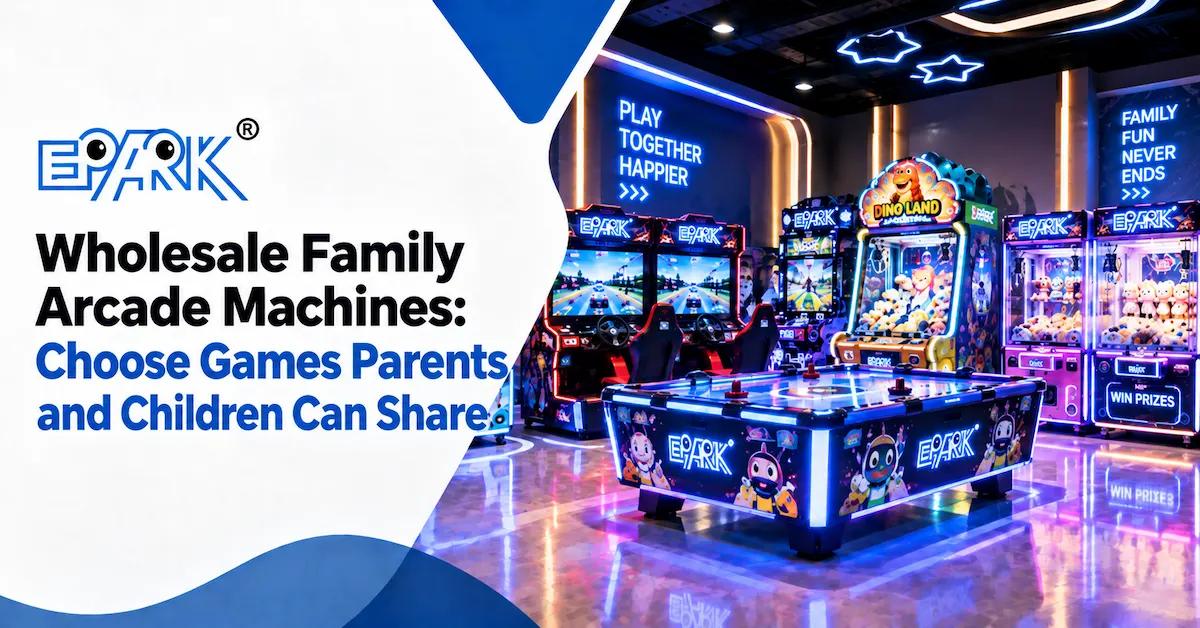
Start a wholesale family arcade machines order by deciding how parents, children and siblings will participate. Will they compete simultaneously, cooperate toward one result, take turns or watch another person play? These are different experiences, even when the cabinets have similar artwork. EPARK’s family entertainment equipment guide discusses easy operation, parent-child interaction and shared experiences as considerations for family-oriented projects. For purchasing purposes, use “family arcade” to describe commercial equipment selected for these visits—not home-use cabinets or a guarantee that every machine suits every age. A useful first filter is to identify who can actually operate the selected model, how participation works and what other family members do during the session.
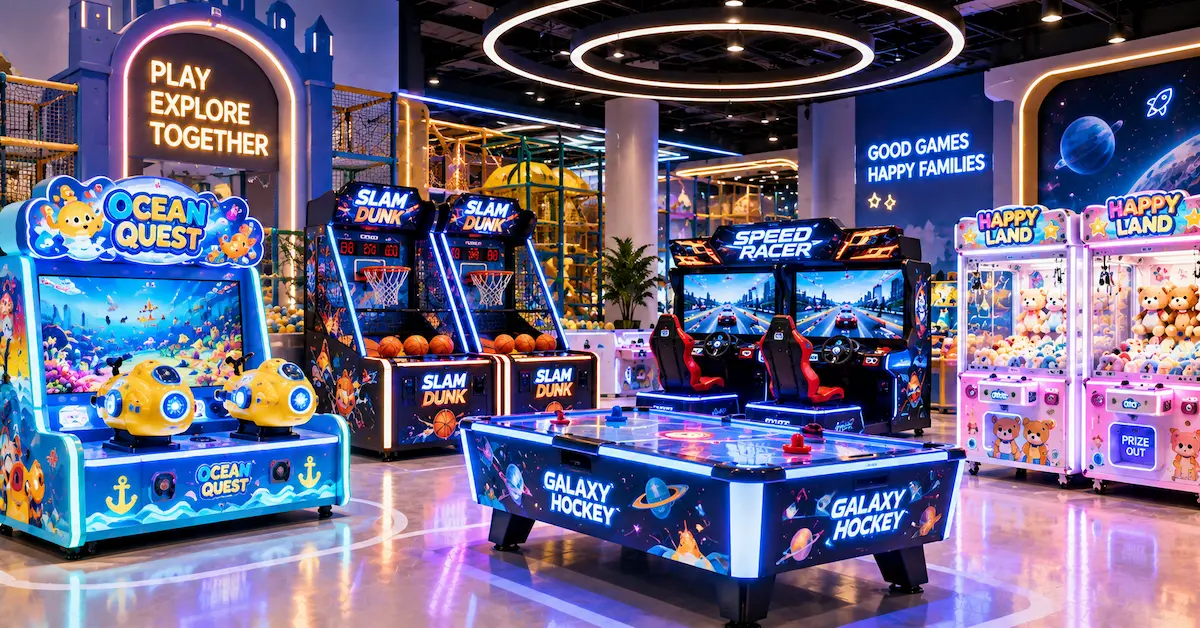
Write the Buying Brief Around Your Visitors and Venue
A practical way to define the project is to describe three intended visits: an adult accompanying a younger child, siblings with different abilities, and older children playing alongside adults. These are suggested planning profiles, not equipment eligibility categories. For a new family entertainment center, or FEC, use them to identify gaps in the proposed machine mix. For an indoor playground adding an arcade corner, decide whether the new equipment is intended for shared play or a separate activity. A hotel or restaurant should also specify nearby seating, circulation and operating supervision. Distributors can use the same exercise with downstream customers instead of recommending an identical package to every venue. When the location or customer requirement is still uncertain, validate a smaller selection before committing to repeated quantities.
Compare Wholesale Family Arcade Machines by Participation Format
EPARK’s family arcade equipment supplier guide covers children’s interactive equipment, racing, sports, multiplayer and redemption categories. Use those categories as a starting point, then compare how individual models involve players. The table below is a shortlisting framework rather than a confirmed EPARK model package; availability, user restrictions and technical specifications require individual confirmation.
| Equipment format | Participation to evaluate | Potential role in a family venue | Main selection check |
|---|---|---|---|
| Linked racing machines | Simultaneous competition between compatible stations | A shared challenge for eligible players | Confirm actual linking, seat and pedal access, and payment per station |
| Basketball or sports games | Individual rounds, turn-taking or supported competition | An active-play section | Check player requirements, controls, ball handling and operating space |
| Multiplayer interactive games | Cooperative or competitive play, depending on software | Parent-child or sibling participation | Verify whether players share an objective or operate independent games |
| Compact children’s games | Individual play with nearby adult observation | A distinct activity for eligible younger visitors | Confirm reach, instructions and manufacturer-defined restrictions |
| Claw and direct-prize machines | One operator with other family members observing | A prize-focused attraction | Check controls, prize compatibility and collection access |
| Ticket redemption games | Gameplay followed by separate prize exchange | A reward-based section | Confirm ticket or electronic output and the venue’s redemption arrangements |
Check Control Reach and Instructions Before Approving the Cabinet
For wholesale family arcade machines, physical access deserves a separate review from visual appeal. EPARK’s children’s game equipment guide highlights straightforward controls, appropriate difficulty and child-oriented interaction. Turn those principles into model-specific questions: can the intended player reach the controls from the approved position, see the essential display information and understand how to begin? For seated equipment, request the actual seat and control arrangement rather than assuming it adjusts. Review the supplied language, start prompts and game-end instructions. Ask about seated access and assistance needs separately where relevant. Keep the manufacturer’s age, height, weight and supervision requirements with the selection record; colorful graphics and adult accompaniment do not replace those requirements.
Distinguish Two Seats From a Genuine Shared Game
During demonstration, ask the supplier to show exactly what happens when two people participate. Do both players enter the same session? Must they start together? Can one continue independently? Does each station require payment? Is the experience cooperative, competitive or simply two separate games positioned side by side? EPARK’s payment guidance identifies multiplayer operation and linked-machine start behavior as configuration points that need confirmation. For your review, record the hardware, software version and operating mode used in the demonstration. Avoid approving a multiplayer description solely from the cabinet layout. A two-seat arrangement can satisfy the visual brief while leaving the intended family interaction unverified.
Compare Session Capacity Without Confusing It With Revenue
For a planning exercise, compare player capacity rather than cabinet count alone. Suppose an approved two-player configuration has an assumed three-minute round and one minute between rounds. Its theoretical capacity would be two players × 60 minutes ÷ four minutes = 30 player sessions per hour. This illustrative calculation is not an EPARK performance claim, a recommended game duration or a revenue forecast; it assumes both positions are occupied every cycle. Replace the assumptions with observed timings during a pilot. Record instruction time, payment assistance, player changeover and interruptions separately. This gives the purchasing team a way to compare operating patterns without claiming that a larger cabinet, more seats or a shorter game will automatically produce better commercial results.
Leave Room for the Family Members Who Are Not Playing
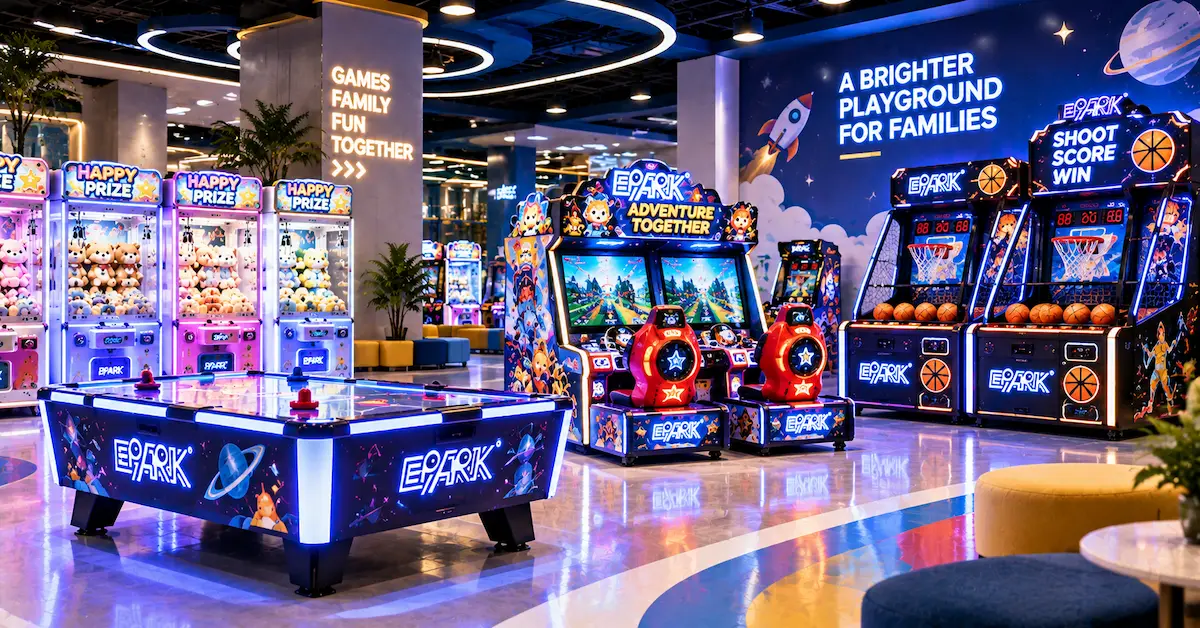
Plan wholesale family arcade machines around players, observers and service access—not equipment footprints alone. EPARK’s FEC layout guide connects machine placement with parent visibility, circulation, seating and maintenance. On your proposed drawing, mark where an accompanying adult and waiting sibling can stand without occupying another machine’s play area. Keep stroller parking, seating and entrances outside the required operating clearances. Review the proposed sound and lighting arrangements near quieter activities, dining areas and younger-child zones. Where an arcade borders a playground, preserve the entrance and exit arrangement instead of treating it as spare machine space. Have the final layout checked against the actual equipment instructions and project requirements before confirming quantities.
Create a Model Specification That Includes the Player Experience
A quotation for wholesale family arcade machines should identify what will be delivered and how it will operate. EPARK’s importer purchasing guide calls for confirmation of model details, dimensions, components and electrical requirements. Add the family-use requirements to that record. The following table is a buyer’s specification checklist, not a set of universal machine ratings.
| Specification area | Information to confirm |
|---|---|
| Model identity | Model code, quantity and approved configuration revision |
| Intended users | Documented restrictions and supervision requirements |
| Participation | Player count, cooperative or competitive mode, and linking where applicable |
| Player interface | Control positions, seat arrangement, display visibility and language |
| Installed space | Assembled dimensions, player positions and required operating/service clearances |
| Construction | Cabinet materials, finish, viewing panels, access doors and component mounting |
| Electrical setup | Rated input, frequency, power requirements and supplied plug |
| Payment and rewards | Hardware, credits per player or session, and reward-output configuration |
| Software | Approved version, included content and commercial-use documentation |
| Delivery and support | Packing data, accessories, manuals, parts references and agreed service scope |
Review Materials, Assembly and Cleaning Access Together
Ask for the construction specification behind the proposed cabinet rather than accepting “durable” as a complete description. EPARK’s arcade cabinet guide discusses materials, reinforcement, fasteners, removable panels and component access. During sample review, examine player-contact surfaces, control mounting, panel joints, doors and the routing of accessible cables. Request the manufacturer’s cleaning instructions and confirm the permitted methods for screens, graphics and control surfaces. Have a technician demonstrate access to an agreed replaceable component and check that the instructions match the machine. This review should establish how the cabinet will be used and serviced; it should not assume one material or thickness is best for every game category.
Make Family Payment Rules Clear Before Installation
Define whether the charge is per player, per station or per session before approving the operating configuration. For a family package, ask how included credits interact with multiplayer games and whether the proposed payment system supports the intended arrangement. EPARK’s coin-operated equipment guide treats payment recognition, credit allocation and game activation as connected checks. Test that sequence with the intended hardware. For reward games, also confirm where paper tickets or electronic balances are recorded and whether family balance sharing is supported by the venue system. Do not assume a card-reader opening establishes integration. Keep untested payment or reward functions identified until the responsible supplier or system provider completes verification.
Approve Function, Usability and Documentation Separately
For a wholesale family arcade machines order, use separate approval records for functional performance, intended-user suitability and supporting documents. EPARK’s factory evaluation guide describes checks covering assembly, controls, sensors, payment, scoring and appearance. Agree which apply to each model, which are performed on every unit and which follow an agreed sampling method. Record findings and corrective actions against the approved configuration. Separately, review the supplied instructions and user restrictions; a machine powering on does not establish suitability for every intended player. Request model-related technical and test documentation, and obtain qualified review of its relevance to the destination project. Neither a general certificate image nor an informal play demonstration replaces the applicable technical assessment.
Compare Complete Costs Before Increasing the Order
Compare wholesale family arcade machines on equivalent scope: the same operating configuration, payment hardware, accessories, branding, packing and support. EPARK’s ownership-cost guide identifies freight, installation, maintenance, labor, electricity and prize replenishment among costs beyond the initial machine price. For your project, separate opening costs from recurring operating expenses. Then ask what each proposed attraction adds to the family experience. A second copy of a validated shared-play game and an unfamiliar specialty attraction are different purchasing decisions. Keep uncertain demand, unpriced integration and additional service requirements visible. Do not use an assumed revenue increase or guaranteed payback period to justify quantity; use your budget, pilot observations and actual operating records.
Separate Family-Themed Branding From Engineering Changes
A coordinated family zone can use matching logos, colors and instructions without making every cabinet technically identical. EPARK’s arcade OEM guide discusses appearance, controls, language, software settings and payment configuration as distinct customization areas. For your project, approve artwork separately from functional changes. Moving controls, changing seats or requesting a new operating mode needs technical review rather than treatment as a graphic adjustment. Whether the proposal is described as OEM or ODM, identify who handles design, prototyping, testing and production approval. Also request clarification of the permitted use of supplied artwork and game content. Keep the approved visual and technical versions connected so later branding updates do not obscure equipment changes.
Confirm Minimum Quantities and an Order-Specific Delivery Plan
Ask for minimum quantities by model and customization scope, not one number for all wholesale family arcade machines. EPARK’s wholesale purchasing guide distinguishes repeated-model orders, mixed selections and project packages. Request confirmation of the production capacity available for your selected equipment and the schedule dependencies: technical approval, artwork, components, assembly, testing and packing. Clarify whether a delayed customized item would hold the entire shipment. Obtain packed dimensions, weights and reassembly instructions before finalizing delivery arrangements, then identify who handles unloading, positioning and commissioning. A factory completion date is not the venue opening date. Keep the receiving-site requirements and remaining setup work in the same project schedule.
Preserve the Shared-Play Configuration in Service and Reorders
Include a specific question in the support review: what happens to the intended family experience when one player position is unavailable? For an illustrative two-station installation, ask whether the unaffected station can operate independently and what the operator must do with the unavailable position. Do not assume either behavior. Request model-specific parts references, replacement instructions and an initial spares discussion with your service team. Record warranty coverage, claim evidence, replacement freight and local-work responsibilities separately. For reorders, retain the approved controls, software, language, payment settings and multiplayer configuration alongside the artwork. Require proposed changes to be identified before production so the next order can be evaluated against the experience you originally approved.
Prepare a Family-Use Brief for EPARK
EPARK’s company profile identifies Guangzhou EPARK Electronic Technology Co., Ltd. as a Guangzhou-based company established in 2012, with arcade machines, game machines and wider indoor entertainment equipment in its business scope. It describes product development, manufacturing, sales and after-sales activities. For a wholesale family arcade machines inquiry, turn that broad scope into a model-specific discussion. Send your venue type, floor plan, intended visitors, shared-play objectives, quantities, payment arrangement, destination, electrical requirements and opening schedule. Include branding and local service expectations. Ask for a proposal that distinguishes confirmed machine functions, available options and items requiring further review rather than treating a general equipment category as a final specification.
Frequently Asked Questions About Wholesale Family Arcade Machines
1. Are family arcade machines the same as children’s arcade machines?
Not necessarily. For purchasing, distinguish equipment intended for an individual child from games offering shared participation. Ask who operates each position, whether play is simultaneous or turn-based, and which restrictions apply to the exact model.
2. Does “family-friendly” mean suitable for every age?
Do not use that description as an eligibility rule. Obtain the model’s documented restrictions and operating instructions, then review them against the intended visitors. Adult accompaniment should not be treated as permission to disregard equipment limits.
3. Which games should parents and children play together?
Shortlist models with a verified participation format, then assess control access, instructions and the intended interaction. Prefer a demonstrated shared experience over assumptions based on two seats, matching cabinets or family-themed artwork.
4. How many machines should a family venue order?
Determine quantity after reviewing the layout, intended users, budget and operating plan. Separate established choices from experimental attractions. A smaller pilot is worth considering when shared-play functions or customer suitability remain unverified.
5. Can one family card pay for several players?
Confirm this with the payment-system provider and machine supplier. Ask how repeated uses, simultaneous sessions, credit deductions and rewards are handled for the proposed installation, then test the agreed arrangement before deployment.
6. Should a family arcade include prize redemption equipment?
Evaluate whether you are prepared to operate the full arrangement, including reward output, prize stock and customer assistance. Treat redemption as an optional operating model to assess—not a requirement that every family venue must adopt.
7. Can I combine arcade machines with an indoor playground?
Include both areas in one layout review, while retaining their separate operating requirements. Preserve entrances, circulation, supervision sightlines and service access rather than fitting machines into whatever floor space remains.
8. What should be demonstrated before a bulk order?
Request the agreed payment sequence, controls, participation mode, game completion and reward output where fitted. Review instructions, access and documentation separately, and record the approved hardware and software configuration before production.
9. Can equipment be customized with my family-venue brand?
Discuss logos, artwork, labels and language requirements by model. Keep these separate from changes to control positions, seats, electronics or gameplay, and request technical review where the proposal changes operation.
10. What should I send for a wholesale quotation?
Provide the venue or distribution brief, desired participation formats, quantities, destination, payment and electrical requirements, customization, service expectations and schedule. Attach a floor plan for an installation project and request itemized, model-specific pricing.
Conclusion
Choose wholesale family arcade machines by verifying how the intended visitors can participate together—not by cabinet appearance or quantity discount alone. Confirm control access, instructions, shared-play functions and payment behavior, then fit those decisions into a layout that also accommodates observers and maintenance. Use approved specifications and demonstrations to guide bulk purchasing, and retain the operating configuration for future service and reorders. Buyers planning a family arcade zone, playground extension or distributor range can contact EPARK with a family-use project brief, including the intended visitors, floor plan, participation goals, quantities, payment requirements and delivery schedule.
General Disclaimer
All data on https://www.eparki.com is for general guidance only. As a leading indoor playground manufacturer and trampoline supplier, EPARK strives for accuracy but gives no express or implied warranty regarding completeness, performance or project fitness. Product specs, designs and results may vary with use and customer requirements. Buyers must verify technical details, compliance and suitability before purchase. EPARK OEM/ODM is not liable for any direct, indirect or consequential damages arising from site use. For custom solutions, contact our manufacturer and supplier team via the Contact page.
Intellectual Property
Text, images, videos, CAD files and software are Guangzhou EPARK Electronic Technology Co., Ltd. All rights reserved. No part may be copied, republished or used commercially without prior written permission. We will pursue legal action for copyright or design-patent infringement.
Trademarks
"EPARK", the EPARK logo and related graphics are registered trademarks of Guangzhou EPARK Electronic Technology Co., Ltd. Unauthorized use in ads, domain names or packaging is prohibited.
Governing Law
These terms are governed by the laws of the People's Republic of China.
Contact
Questions? Email sales@nanyuetech.com or WhatsApp +86 139 0307 9263.