A Mixed Order Should Solve a Portfolio Problem, Not Just Fill Shipping Space
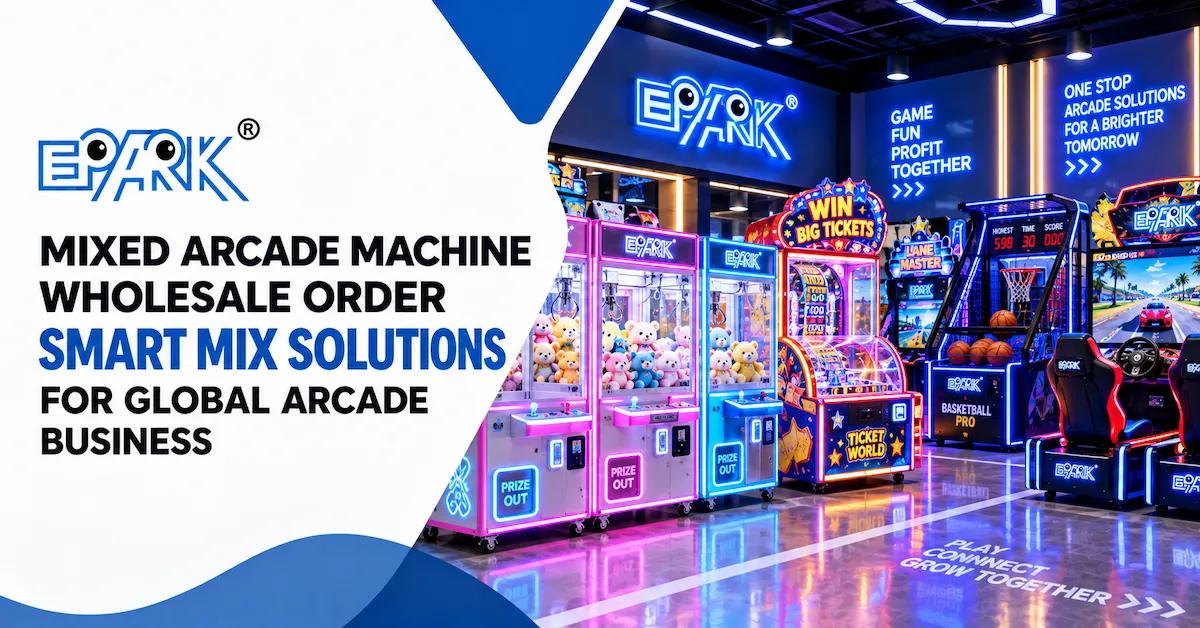
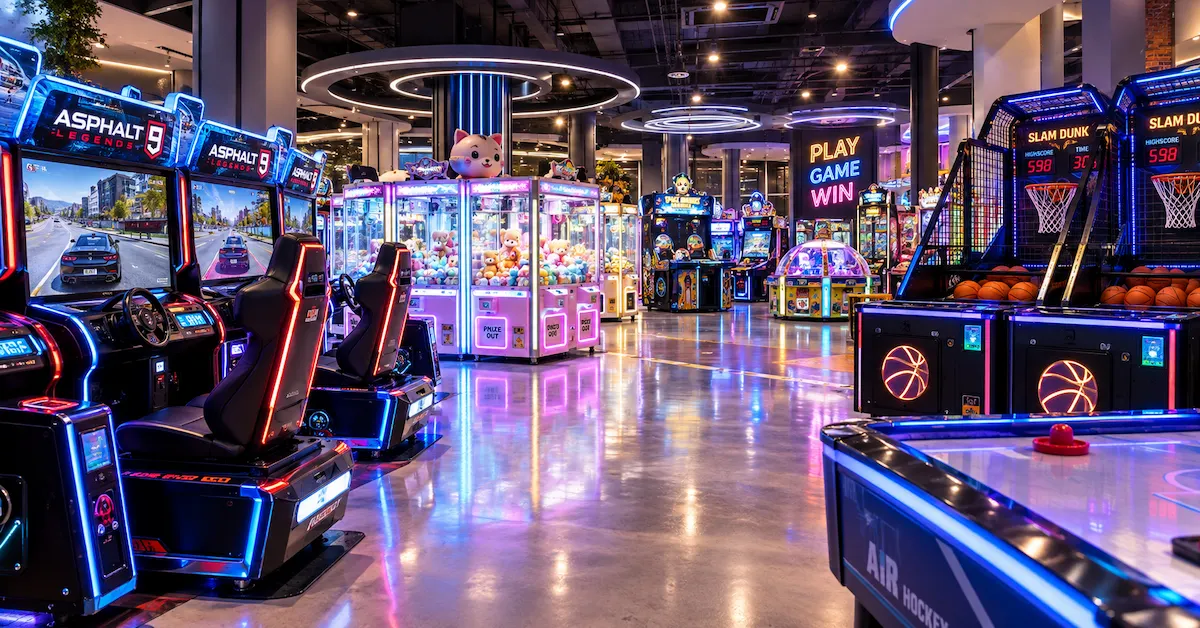
A mixed arcade machine wholesale order combines different machine categories or configurations within one commercial purchase. It may include racing simulators, claw machines, redemption games, basketball machines, video cabinets and other amusement equipment instead of purchasing a large quantity of one model. For an FEC operator, this can help create different play experiences within one venue. For a distributor, it can provide a broader demonstration or resale range. The challenge is that every additional model introduces another specification, parts list, packing configuration and possible support requirement.
EPARK’s arcade wholesale purchasing guide treats machine mix, configuration, quantity, quality control, spare parts, packing and repeat supply as connected purchasing decisions. That is the correct starting point for a mixed order: decide what each machine contributes commercially before discussing how many units can be loaded into a shipment.
Decide Why You Need Multiple Machine Categories
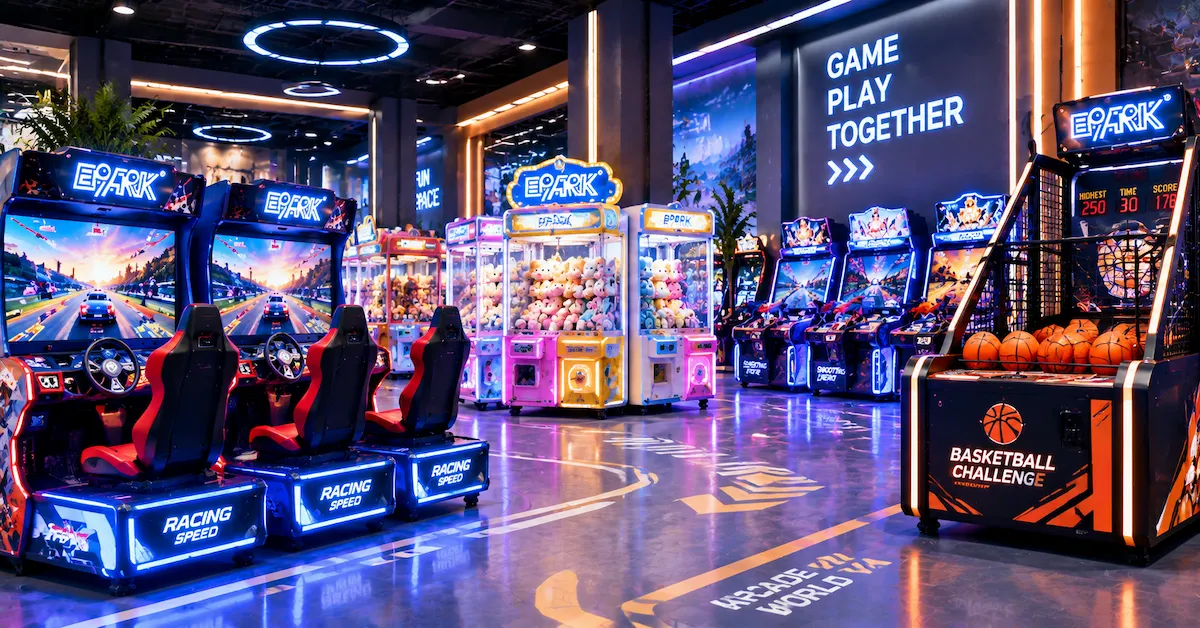
A mixed order makes sense when several machine types serve distinct functions. A new FEC may need racing equipment for competitive play, claw machines for direct-prize entertainment, redemption machines for a reward system and basketball machines for active play. A distributor may want several categories to show customers, but should still distinguish proven stock from demonstration models.
A mixed order is less attractive when the buyer selects unfamiliar machines simply because there is unused container space. Every additional model can create additional training, spare-parts and after-sales requirements. If demand for a new product is uncertain, consider a limited quantity rather than treating container utilization as the primary purchasing objective.
EPARK’s wholesale commercial arcade equipment guide similarly recommends building the machine mix around venue roles and customer requirements rather than buying different equipment only for visual variety.
Build the Machine Mix Around Commercial Roles
The following comparison is a purchasing framework, not a fixed EPARK package. Current models, dimensions, payment options and availability should be confirmed for the actual inquiry.
| Machine category | Role in a mixed order | Main specification to confirm | Main operating risk |
|---|---|---|---|
| Racing simulators | Competitive or immersive attraction | Number of stations, controls, linking and installed space | Large footprint and model-specific service parts |
| Claw/prize machines | Direct-prize attraction | Prize compatibility, mechanism, payment and refill access | Prize replenishment and mechanism differences |
| Redemption games | Adds ticket or electronic reward gameplay | Scoring, reward output and payment integration | Different reward systems creating integration complexity |
| Basketball/sports games | Active-play zone | Sensors, scoring, ball return and player space | Cabinet footprint not reflecting total play area |
| Video cabinets | Screen-based game variety | Display, controls, software and payment | Similar cabinets may use different internal hardware |
| Simulator/VR equipment | Premium or differentiated attraction | Motion/VR hardware, software, clearance and technical support | Higher service and integration requirements |
The objective is not to include every category. Remove any machine whose role cannot be explained clearly to the venue operator or downstream customer.
Create One Master Order Sheet and One Specification Per Model
The most important control in a mixed arcade machine wholesale order is separating order-level information from model-level information. The master order can show quantities, total shipment planning and project milestones, but each model still needs its own approved configuration.
EPARK’s arcade sourcing guide emphasizes specification approval before production. Apply that principle by creating a technical record for every line in the order.
| Specification area | Information to control |
|---|---|
| Model identity | Product name/code, quantity and revision |
| Machine category | Racing, prize, redemption, sports, simulator or other type |
| Dimensions | Installed size and operating/service space |
| Electrical configuration | Voltage, frequency, plug and applicable power requirements |
| Payment system | Coin, token, card interface or another confirmed setup |
| Controls | Steering, pedals, buttons, joysticks, sensors or other hardware |
| Display | Screen configuration and size where relevant |
| Software | Version, language and agreed content scope |
| Reward system | Prize, paper ticket, electronic reward or none |
| OEM requirements | Logo, artwork, colors and labels |
| Accessories | Keys, cables, manuals and included items |
| Spare parts | Part references and quantities |
| Packing | Packed dimensions, weight, package count and detachable sections |
| QC reference | Approved sample, drawing or specification revision |
Do not let one generic phrase such as “standard configuration” cover several unrelated machine types.
Standardize What Can Be Standardized
Mixed equipment does not mean every machine needs a completely different operating system. Where technically suitable, buyers can explore standardizing electrical versions, payment arrangements, labeling conventions and selected service components.
For example, a distributor serving one market may prefer the same voltage, frequency and plug across the order. A venue may want a consistent card-payment system. Standardized cabinet keys or payment hardware may also simplify service where the relevant machines support them.
However, standardization should never be forced when it creates technical compromises. A claw machine mechanism, racing control system and ticket dispenser perform different jobs. Shared appearance does not make their parts interchangeable.
The useful question is:
Which differences are necessary because the machines perform different functions, and which differences exist only because the configuration was never standardized?
Lock Payment Configuration by Model
Payment settings are especially easy to overlook in a mixed order because several machines may arrive from different product categories. EPARK’s coin-operated equipment guide separates payment recognition, credit allocation and game activation as individual functions that need verification.
For each model, document:
- the payment hardware;
- the supported coin, token or card interface;
- credits created per payment;
- credits required to start;
- reward output where applicable;
- integration responsibility.
A machine being described as “cashless ready” should not be treated as a finished integration. Confirm the reader, interface and testing responsibilities before production.
Where one venue uses several machine categories, consistent customer-facing payment rules can simplify operations, but each model should still be tested separately.
Do Not Confuse a Mixed Order With a Mixed Specification
One of the biggest purchasing risks occurs when buyers intentionally order several machine categories but unintentionally allow multiple configurations of the same model.
For example, five identical-looking racing cabinets may arrive with different software or payment setups because specifications were not controlled. A distributor may then have difficulty identifying spare parts or quoting later customers.
Give every approved configuration a revision. If the same model requires two destination-market versions, treat them as separate order lines.
A mixed order should contain different products by design, not hidden technical differences caused by incomplete purchasing records.
Approve Reference Units for Higher-Risk Models
Not every model requires the same sample process. Established configurations may already have sufficient documentation and previous purchasing history, while a heavily customized or unfamiliar machine may justify a dedicated reference review.
For higher-risk machines, confirm:
- cabinet and artwork;
- controls;
- payment behavior;
- software;
- scoring or reward output;
- service access;
- accessories;
- model-specific functions.
EPARK’s arcade equipment factory guide discusses functional testing, payment checks and pre-shipment quality control. In a mixed order, use those principles selectively according to the equipment’s actual function rather than applying one shallow inspection to every model.
Use Category-Specific QC Inside One Batch Plan
A mixed shipment needs a common inspection structure plus model-specific checks.
Common checks can include model identity, electrical version, appearance, payment, accessories and packing. Category-specific inspection can then go deeper.
| Machine type | Additional QC focus |
|---|---|
| Racing | Steering, pedals, display and linked operation |
| Claw/prize | Crane mechanism, prize handling and collection access |
| Redemption | Scoring, sensors and ticket/electronic reward output |
| Basketball | Sensors, score display and ball-return function |
| Simulator | Motion/VR functions, controls and software configuration |
| Video cabinet | Controls, screen, software and audio |
Agree which checks apply to every unit and which follow an accepted sampling plan. Do not use one arbitrary test-cycle number for every category.
Prepare Spare Parts by Model Instead of Ordering One Generic Kit
Mixed orders create a wider spare-parts requirement than same-model orders. EPARK’s game machine maintenance guide highlights replacement components, technical labor and downtime as important commercial considerations.
Create a parts matrix that connects each spare to the machines it supports.
A useful internal classification is:
Shared parts: confirmed components that support more than one approved model.
Model-specific parts: components that only fit a particular configuration.
Revenue-critical parts: payment or control components whose failure prevents normal operation.
Long-lead parts: components that may be difficult to source quickly.
Do not describe a component as shared simply because it looks similar. Confirm compatibility with the supplier.
For distributors, this parts matrix can become a long-term support asset when customers reorder machines or request service months later.
Compare Same-Model Volume and Mixed-Model Buying Properly
Same-model wholesale and mixed orders create different advantages.
| Purchasing structure | Main advantage | Main limitation | Best fit |
|---|---|---|---|
| High quantity of one model | Simpler production, parts and support | Higher inventory concentration | Proven distributor bestseller |
| Small quantity across many models | Broad catalog or venue variety | More specification and service complexity | New dealer showroom or FEC trial |
| Balanced mixed order | Combines core products with selected alternatives | Requires stronger order management | Established FEC or distributor |
| Customer-specific project order | Equipment aligned to one venue | Less suitable as general inventory | Project contractors and operators |
A mixed order should not automatically be compared against same-model pricing as though the manufacturing work were identical. Request actual prices by model and quantity instead of assuming that total unit count creates the same discount across every category.
Calculate Packing by Machine Before Finalizing Quantities
Mixed products often have very different shipping characteristics. A compact claw machine and a racing simulator may occupy very different volumes even when both count as one machine on the purchase order.
Request:
- packed length, width and height;
- package count;
- gross weight;
- detachable components;
- assembly requirements after delivery.
EPARK’s arcade export guide emphasizes packing and shipment planning as part of export purchasing.
Build the loading plan from actual packed dimensions rather than showroom dimensions. Avoid adding an unsuitable product only because the shipping planner identifies unused volume.
Container utilization matters, but unwanted inventory has a cost as well.
Separate Machine Cost From Mixed-Order Coordination Cost
When comparing quotations, first normalize the equipment specification. Then identify additional costs related to customization, spare parts, packing and logistics.
A lower machine price can be offset by:
- higher packed volume;
- additional payment integration;
- model-specific spare inventory;
- more complicated installation;
- local technical work;
- separate accessories not included in the quotation.
EPARK’s quotation comparison guide recommends comparing specification and supply scope before deciding which price is lower.
For a mixed arcade machine wholesale order, compare the commercial package as a coordinated project rather than ranking each machine only by unit price.
Coordinate Production Dates Across Different Machine Types
A mixed order rarely progresses at exactly the same speed across every model. Standard products may be ready sooner, while customized artwork, special components or newer configurations can create additional approval steps.
Ask the supplier to identify:
- technical approval date;
- artwork approval date;
- component preparation;
- production period;
- QC;
- packing;
- final shipment readiness.
Then define what happens if one model is delayed.
Will the entire shipment wait?
Can part of the order ship separately?
Would staged shipping create higher freight or handling costs?
The correct answer depends on the project. What matters is agreeing on the decision process before the problem appears.
Keep OEM Changes Separate by Product
EPARK’s arcade OEM guide discusses cabinet graphics, hardware and software customization.
For a mixed order, do not create one artwork approval message covering every machine unless the files clearly identify the products.
Create separate artwork references for:
- machine side graphics;
- marquees or headers;
- control panels;
- labels;
- packaging;
- manuals where applicable.
Also separate visual changes from engineering changes. Changing a logo is not the same as changing a payment controller or steering system.
This prevents branding work from hiding a technical modification.
Protect the Order When One Model Changes
Suppose a supplier informs you that a controller in one model is unavailable. That change should not automatically affect the rest of the mixed order.
Ask:
- Which model is affected?
- Which revision currently uses the component?
- What replacement is proposed?
- Does it change performance or spare compatibility?
- Is renewed testing required?
- Does it change price or delivery?
- Does it affect only this model or other machines?
This model-level approach reduces the risk of one sourcing issue turning into an undocumented batch-wide change.
For repeat orders, keep the approved configuration from the original shipment and compare any substitution against it.
Build the Reorder Plan Before the First Mixed Shipment Leaves
A distributor may discover that some machines sell much faster than others. An FEC may later add several copies of one successful attraction.
The first mixed order should therefore produce a useful reorder baseline.
Keep records for each model:
- final configuration;
- payment version;
- artwork;
- software;
- accessories;
- parts references;
- packed dimensions;
- supplier model code;
- internal buyer code.
EPARK’s distributor sourcing guide emphasizes repeat-order control because future supply depends on being able to reproduce the approved equipment rather than relying on a product photo.
A good first order is not only delivered successfully. It also makes the second order easier.
Use an Order-Readiness Matrix Before Paying the Balance
The following internal check helps identify whether each model is actually ready for shipment.
| Status | Meaning | Buyer action |
|---|---|---|
| Specification approved | Model and technical configuration locked | Continue production |
| Artwork approved | Branding files finalized | Release customization |
| Function approved | Required gameplay/payment functions verified | Use as QC reference |
| QC passed | Batch inspection completed | Prepare release review |
| Packing confirmed | Packages and shipment data verified | Finalize logistics |
| Exception open | A defect, document or configuration remains unresolved | Resolve before release |
| Reorder baseline saved | Final version archived | Ready for future replenishment |
Do not allow one fully approved machine to make the entire mixed shipment appear ready when another model still has an unresolved technical issue.
What Should You Send EPARK for a Mixed Wholesale Order?
A useful inquiry should explain both the total project and each machine category. Provide your business type, destination country, venue or distributor requirements, proposed machine categories, quantity by model, available floor plan where relevant, voltage, frequency, payment system, OEM requirements, spare-parts expectations and target shipment date.
EPARK’s About Us page identifies its business as including arcade machines and broader indoor entertainment equipment. Buyers should still confirm the current machine range, technical configurations and manufacturing responsibility for the products included in a particular mixed purchase.
After creating the shortlist, send it through EPARK Contact Us and request an itemized proposal rather than one combined total with unclear configuration differences.
Frequently Asked Questions About Mixed Arcade Machine Wholesale Orders
1. What is a mixed arcade machine wholesale order?
It is a commercial order containing several arcade machine models or categories rather than only repeated units of one product. It can be used for FEC projects, distributor inventory, showrooms or other multi-machine installations.
2. Is a mixed order better than ordering one arcade machine model in bulk?
Neither approach is always better. Same-model orders simplify inventory and service, while mixed orders provide more game variety. Choose according to venue requirements, customer demand and your support capability.
3. Can racing, claw and redemption machines be shipped together?
Potentially, subject to the order, packing and logistics arrangement. Confirm packed dimensions, weights, package counts and production schedules for every model before finalizing shipment planning.
4. Do all machines in a mixed order have to use the same payment system?
Not necessarily, but a venue may benefit from greater consistency. Confirm the technical compatibility of each machine rather than assuming one payment interface works across the whole order.
5. How should I compare pricing for mixed arcade machines?
Compare each approved configuration, quantity and included scope first. Then include spare parts, OEM work, packing and logistics. Do not compare visually similar machines if their technical configurations differ.
6. How should spare parts be ordered for multiple machine types?
Create a model-specific parts list and identify only genuinely compatible shared parts. Prioritize revenue-critical and difficult-to-source components according to your technical team's service plan.
7. Can I customize all machines with the same brand?
Brand consistency can be discussed, but artwork formats and cabinet shapes differ by model. Approve each machine’s graphics separately and keep branding changes distinct from hardware or software modifications.
8. What happens if one machine in the order is delayed?
Agree on the policy before production. Options may include waiting for the full shipment or discussing staged delivery, but cost and logistics effects should be reviewed before choosing either approach.
9. How do I make mixed-machine reorders easier?
Archive the approved configuration of every model, including payment setup, electrical version, software, artwork, accessories and spare references. Use those records in future purchase orders.
10. How can I request a mixed arcade machine quotation from EPARK?
Prepare the machine categories, model quantities, destination, electrical configuration, payment requirements, customization, spare parts and shipping schedule, then submit the project through EPARK Contact Us.
Conclusion
A mixed arcade machine wholesale order works best when product variety is controlled through model-level specifications rather than managed as one generic bulk purchase. Build the machine mix around clear commercial roles, standardize payment and electrical requirements where technically appropriate, use category-specific QC, prepare spare parts by model and calculate packing before finalizing quantities. Keep every approved configuration separate so one customization or component change does not create uncertainty across the whole shipment.For distributors and FEC operators, the strongest first mixed order also creates the records needed for easier future replenishment. Buyers can contact EPARK with their proposed machine mix, quantities, destination, payment requirements, branding needs and shipment schedule for a project-specific wholesale evaluation.
General Disclaimer
All data on https://www.eparki.com is for general guidance only. As a leading indoor playground manufacturer and trampoline supplier, EPARK strives for accuracy but gives no express or implied warranty regarding completeness, performance or project fitness. Product specs, designs and results may vary with use and customer requirements. Buyers must verify technical details, compliance and suitability before purchase. EPARK OEM/ODM is not liable for any direct, indirect or consequential damages arising from site use. For custom solutions, contact our manufacturer and supplier team via the Contact page.
Intellectual Property
Text, images, videos, CAD files and software are Guangzhou EPARK Electronic Technology Co., Ltd. All rights reserved. No part may be copied, republished or used commercially without prior written permission. We will pursue legal action for copyright or design-patent infringement.
Trademarks
"EPARK", the EPARK logo and related graphics are registered trademarks of Guangzhou EPARK Electronic Technology Co., Ltd. Unauthorized use in ads, domain names or packaging is prohibited.
Governing Law
These terms are governed by the laws of the People's Republic of China.
Contact
Questions? Email sales@nanyuetech.com or WhatsApp +86 139 0307 9263.