How to Maintain Indoor Playground Equipment Without Turning Maintenance Into Downtime
Indoor playground maintenance is not a task that begins when something breaks. For a commercial operator, maintenance is a repeatable operating system that starts with inspection, identifies wear before it becomes a larger problem, keeps high-contact components serviceable, records corrective actions, and makes replacement parts easy to identify.
If you are researching how to maintain indoor playground equipment, the most useful approach is to divide the playground into maintainable asset groups: structure, padding, nets, slides, flooring, ball pools, climbing elements, interactive components, hardware, and spare parts. Each group has a different wear pattern and therefore needs a different inspection and service routine.
Direct Answer: How Should Commercial Indoor Playground Equipment Be Maintained?
Maintain indoor playground equipment through a documented cycle of routine visual inspection, scheduled detailed inspection, cleaning, defect reporting, repair or replacement, spare-parts control, and maintenance records. Inspection frequency should follow the manufacturer's instructions, the equipment type, actual traffic level, local requirements, and the condition of the venue.
Operators should pay particular attention to damaged padding, loose hardware, torn nets, worn flooring, cracks or damage in rigid components, unstable connections, obstructed entrances or exits, ball-pit condition, and changes made after the original installation.
When a defect may create a safety hazard, the affected equipment or zone should not simply remain open while the issue waits for the next scheduled service. It should be assessed promptly and repaired, replaced, or isolated according to the venue's safety procedure.
EPARK's published project information supports this lifecycle approach. Its customization process extends beyond manufacturing to quality inspection, installation, after-sales guidance, maintenance, and spare-parts availability. Its current FAQ also describes maintenance support and states that typical product lifespan can vary according to usage and environment.
Why Maintenance Needs Its Own Operating System
Many playground operators combine cleaning and maintenance into one job. They are related, but they are not the same.
Cleaning removes dirt, residue, debris, and contamination. Maintenance keeps the equipment structurally sound, serviceable, complete, and suitable for continued operation.
A staff member may wipe a slide every day while missing a loose mounting point. A ball pit may look clean while a damaged border pad continues to deteriorate. A net may appear tidy from a distance while one attachment point is pulling away from the frame.
That is why learning how to maintain indoor playground equipment requires more than a cleaning checklist.
A strong maintenance program addresses five questions:
- What should be inspected?
- How will defects be recorded?
- Who decides whether equipment remains in service?
- How will repairs and replacement parts be managed?
- How will management verify that corrective action was completed?
ASTM F1918, the active ASTM standard for soft-contained play equipment, contains a dedicated maintenance section. In the EN framework, BS EN 1176-7:2020 specifically covers guidance on installation, inspection, maintenance, and operation.
The broader lesson is consistent: inspection and maintenance are part of playground safety, not optional work performed only after customer complaints.
Start by Creating an Equipment Asset Register
Before scheduling inspections, list what is actually installed.
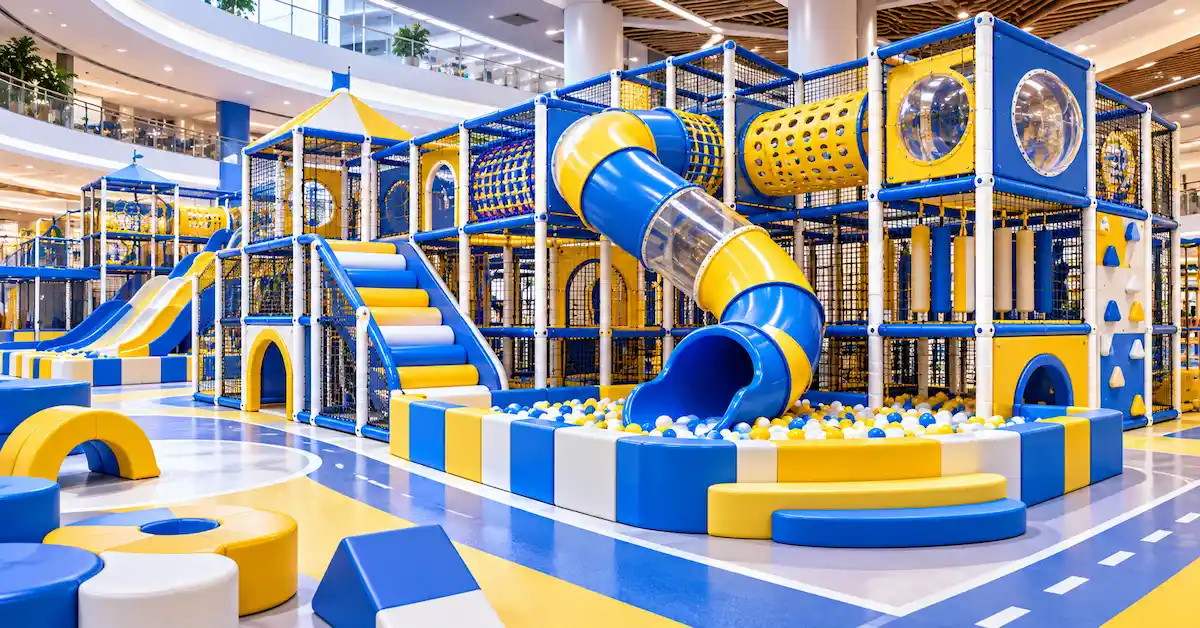
This sounds obvious, but custom commercial playgrounds can contain hundreds of separate pieces: structural frames, platform panels, PVC-covered pads, nets, tunnel sections, FRP slides, flooring tiles, connectors, climbing holds, decorative panels, interactive components, soft blocks, ball-pit borders, access gates, and hardware.
If the maintenance team does not know what equipment belongs to the project, replacement and fault reporting become vague.
What should the register contain?
| Asset Field | What to Record | Why It Matters |
|---|---|---|
| Zone | Toddler area, main soft play, slide zone, ball pit, climbing area, etc. | Makes faults easier to locate. |
| Component | Slide, net panel, pad, floor tile, bridge, stair, tunnel, barrier. | Defines what is being inspected. |
| Reference | Drawing number, part code, photograph, or manufacturer reference. | Supports accurate spare-parts orders. |
| Material | Steel, PVC-covered foam, EVA/PU, FRP/composite, netting, etc. | Different materials need different care. |
| Wear Classification | High-contact, structural, replaceable, decorative, moving, electronic. | Helps determine inspection priority. |
| Service History | Inspection, repair, replacement, modification dates. | Shows recurring problems and lifecycle cost. |
A practical asset register also helps staff avoid descriptions such as “the blue cushion beside the slide.” A photograph plus a component code is much more useful when contacting an overseas supplier six months later.
This becomes especially important for FEC chains, franchise operators, distributors, and multi-location playground businesses.
Use Three Levels of Inspection Instead of One Generic Checklist
There is no universal inspection frequency that should be copied blindly into every indoor playground. Traffic volume, equipment complexity, user age, operating hours, manufacturer instructions, and local requirements all affect the schedule.
A useful operator framework is to separate checks into three levels.
Level 1: Opening or Routine Visual Inspection
This is the fast operational check carried out before or during normal operation.
Staff should look for immediately visible conditions such as:
- torn or displaced padding;
- loose or missing hardware;
- damaged safety netting;
- frayed rope or cargo webbing;
- cracks or damage in slides or panels;
- flooring tears, lifting, gaps, or buckling;
- foreign objects or debris;
- blocked entrances, exits, or circulation routes;
- damaged barriers;
- loose play accessories;
- unapproved modifications;
- visible contamination or moisture.
The U.S. CPSC's soft-contained play equipment checklist specifically calls attention to torn safety netting, damaged rope or cargo webbing, torn floor surfacing, and general cleanliness. These are useful examples of conditions operators should be able to recognize quickly.
Level 2: Scheduled Detailed Inspection
A detailed inspection should go beyond what staff can see while walking through the venue.
Depending on the system, it may include:
- frame connections;
- anchors or structural fixing points;
- hardware tightness;
- net attachment points;
- padding beneath external covers;
- platform edges;
- slide mounting points;
- flooring condition under high-use areas;
- hidden service areas;
- tunnel connections;
- interactive equipment connections;
- wear around entrances and exits.
The exact procedure should follow the equipment manufacturer's documentation and applicable project requirements.
Level 3: Periodic Technical Review
Some issues require deeper review than normal venue staff should perform.
A periodic technical review may be appropriate after heavy operation, major repair, relocation, modification, unusual impact, structural concern, water exposure, or other conditions that could affect the original installation.
This is also a useful point to compare the installed playground with the final drawings. Operators sometimes add decorations, storage, furniture, ropes, signs, or other elements after opening. Those changes should not create new entrapment, access, fire, or circulation problems.
The inspection schedule should become more frequent when usage, wear, or operating conditions justify it. High-traffic venues should not assume the same inspection interval as a low-use private play room.
How to Maintain the Steel Frame and Structural Connections
EPARK's current Safety & Quality information describes cold-rolled steel pipe with hot-dip galvanization as part of its playground structural system.
Galvanized steel can provide useful resistance to corrosion, but the operator still needs to inspect the installed frame and its connections.
Look for movement, not only visible damage
A structure can develop maintenance issues before a pipe looks visibly broken.
During inspection, check for:
- unexpected movement;
- loose fasteners;
- misaligned connections;
- damaged protective covers around structural members;
- corrosion where metal is exposed;
- impact damage;
- changes at anchors or floor connections;
- components rubbing against adjacent structures.
Do not hide structural defects under new padding
If a protective cover is damaged, staff may be tempted to wrap or patch the area quickly.
Before covering it, determine whether the problem is only the external protective layer or whether the underlying connection also needs inspection.
A maintenance program should always distinguish between cosmetic repair and structural repair.
How to Maintain PVC-Covered Foam and Protective Padding
Soft protective surfaces often receive some of the heaviest contact in the entire playground.
EPARK identifies high-density foam with soft PVC protection within its current material system. These components can protect users from harder structural elements, so a damaged cover should not be treated as purely cosmetic.
Inspect for more than visible tears
Check:
- tears or punctures;
- open seams;
- loose covers;
- exposed foam;
- compressed or deformed padding;
- hard objects underneath the padding;
- water or moisture trapped inside;
- detachment from the intended position;
- sharp or rigid elements becoming exposed.
If foam no longer provides its intended protection, simply applying a surface patch may not restore the original condition.
Use replaceability as part of the maintenance strategy
Commercial buyers should identify which padded elements can be replaced individually.
That may include:
- post pads;
- step covers;
- platform-edge padding;
- wall pads;
- ball-pit borders;
- soft blocks;
- protective wraps.
When replacement parts have clear codes and drawings, downtime can be much shorter than when the operator must send several photographs and wait for the original factory to identify the part manually.
How to Maintain Safety Nets, Rope, and Webbing
Netting can look simple, but it performs an important containment function in many multi-level indoor playgrounds.
Routine inspection should look for:
- tears;
- fraying;
- broken strands;
- loose stitching;
- loose attachment points;
- unexpected openings;
- stretching or deformation;
- damage caused by users pulling or climbing in unintended locations.
CPSC guidance for soft-contained play specifically advises checking safety netting, cargo webbing, and rope equipment for tears or fraying.
The important operating rule is to inspect both the visible net surface and its connection to the supporting frame.
A net panel can appear intact while an attachment point is deteriorating.
How to Maintain Slides and Rigid Play Components
Rigid components such as FRP slides need a different maintenance approach from padded soft play.
EPARK states that its slide and climbing components may use thick FRP or composite resin with smooth, wear-resistant, UV-protected surfaces.
Operators should inspect for:
- cracks;
- chips;
- rough or damaged areas;
- sharp transitions;
- surface deformation;
- loose mounting points;
- damaged joints;
- changes at the entry or exit;
- objects obstructing the slide route;
- wear in the surrounding landing area.
A scratch and a structural crack are not the same maintenance issue. Staff should have a clear escalation process so uncertain defects can be reviewed before the component returns to normal service.
Inspect the interface, not just the slide
The slide should be reviewed together with:
- starting platform;
- guarding;
- entry point;
- support structure;
- exit zone;
- adjacent flooring;
- padding;
- traffic around the slide exit.
Maintenance should preserve the original safety relationship between these components.
How to Maintain EVA or PU Playground Flooring
Flooring receives continuous foot traffic and can become an early indicator of operational wear.
EPARK's Safety & Quality information identifies EVA or PU foam flooring within its playground systems and describes interlocking construction as supporting installation and cleaning.
Inspect flooring for:
- lifting edges;
- gaps;
- tears;
- holes;
- buckling;
- compressed areas;
- water underneath;
- loose sections;
- surface contamination;
- damage around slide exits and other high-traffic points.
If flooring forms part of the impact-protection system, replacement should preserve the required installed performance rather than simply match the color.
Keep replacement flooring identifiable
For custom colors or patterns, record:
- original material;
- thickness;
- color reference;
- tile dimensions;
- installation method;
- supplier reference.
This can make future repairs more consistent.
Ball-Pit Maintenance Needs Its Own Procedure
Ball pools combine a large quantity of loose components with a hidden floor surface, borders, entry points, and often nearby slides.
They therefore need a specific maintenance workflow.
Inspect more than the balls
Review:
- damaged or crushed balls;
- foreign objects;
- border padding;
- floor condition beneath the balls;
- internal corners;
- slide exits entering the ball pit;
- steps and access points;
- moisture;
- service access.
A large ball pit can require significant labor to empty. That is why maintenance access should ideally be considered during design rather than discovered after opening.
EPARK already has a dedicated article on easy-clean soft play equipment, which covers cleanability, ball-pit access, seams, geometry, flooring, storage, cleaning workflow, and replacement planning in greater depth.
Cleaning Is Part of Maintenance, But It Is Not the Whole Maintenance Program
One reason operators struggle with how to maintain indoor playground equipment is that cleaning is highly visible while structural and component wear is often hidden.
A clean-looking playground can still contain:
- loose hardware;
- damaged net attachments;
- compressed padding;
- flooring gaps;
- cracked rigid parts;
- unapproved modifications;
- worn connectors.
Likewise, an otherwise serviceable component can be damaged by using an unsuitable cleaning chemical.
Confirm chemical compatibility
Commercial playgrounds can include PVC coverings, foam, printed graphics, adhesives, FRP, plastics, steel, coatings, nets, and electronic components.
Do not assume one strong disinfectant is suitable for every surface.
Ask the manufacturer for cleaning guidance where available and create a venue procedure that specifies:
- which product is used;
- where it is used;
- required contact or drying procedure;
- materials that should not receive the product;
- who signs off before reopening the area.
Do not reopen wet or incomplete repairs
If cleaning or repair introduces moisture, adhesive, new coverings, or replaced parts, the zone should be restored to its intended service condition before reopening.
Maintenance quality is more important than completing the task quickly.
Create a Defect Classification System
A maintenance checklist is more useful when staff know what to do with the result.
One simple internal framework is to classify findings by operational response.
| Classification | Example | Operator Response |
|---|---|---|
| Monitor | Minor cosmetic wear with no current functional effect. | Record condition and review during the next scheduled inspection. |
| Service | Wear requiring maintenance but not indicating immediate safety loss after assessment. | Schedule corrective work and record completion. |
| Replace | A worn component can no longer perform its intended function reliably. | Order and install the correct replacement. |
| Isolate / Escalate | A defect could create a safety hazard or its significance is uncertain. | Prevent normal use and obtain competent review before reopening. |
This framework is an operational management tool, not a replacement for manufacturer instructions, inspection standards, or local requirements.
The main benefit is consistency. Staff should not make different decisions about the same defect depending on who happens to be working that day.
Repairs Should Restore the Intended Condition
Temporary repairs often become permanent simply because the venue continues operating.
Examples include:
- tape left on torn padding;
- unapproved cable ties;
- replacement hardware of unknown specification;
- foam inserted into a damaged area without restoring the original cover;
- netting tied to an unintended anchor point;
- flooring pieces cut to fit without confirming the original requirement.
A maintenance program should distinguish an emergency temporary control from an approved permanent repair.
Keep repair specifications
For recurring wear components, retain:
- original drawing;
- part code;
- material;
- dimensions;
- color;
- fixing method;
- approved replacement source.
This reduces the likelihood that a local repair gradually changes the equipment away from the original design.
Build a Spare-Parts Strategy Before Parts Fail
Waiting for a component to fail before identifying a replacement can create unnecessary downtime, especially for imported equipment.
Commercial operators should classify spare parts into three groups.
The exact spare-parts package depends on the equipment. Buyers should not copy a generic parts list from another venue.
Use part codes instead of visual descriptions
A strong spare-parts request might include:
- project number;
- zone;
- drawing reference;
- part number;
- photograph;
- quantity;
- color or finish;
- original order reference.
EPARK's customization process states that after-sales guidance and spare-parts availability form part of its project support. Buyers should confirm the exact spare-parts scope for their specific order.
Maintenance Records Are Part of Risk Control
If staff inspect the equipment but nothing is recorded, management has limited visibility into recurring defects.
A maintenance record should capture at least:
- inspection date;
- inspector;
- zone and component;
- condition found;
- photograph where useful;
- risk or priority classification;
- corrective action;
- person responsible;
- repair or replacement date;
- reopening confirmation.
Records reveal patterns
After several months, management can answer questions such as:
- Which zone creates the most repair work?
- Which padding wears fastest?
- Which replacement part has the longest lead time?
- Are the same net attachments repeatedly loosening?
- Does one slide exit damage flooring faster than others?
- Does one decorative feature create unnecessary maintenance?
This information can improve the next playground design.
For a chain operator, maintenance records become valuable procurement data because equipment can be standardized based on real operating experience rather than appearance alone.
Use Maintenance KPIs That Operators Can Actually Act On
Maintenance performance should not be judged only by total annual repair cost.
Useful internal metrics can include:
| Metric | What It Shows | How It Helps |
|---|---|---|
| Open defects | Number of unresolved maintenance items. | Prevents repair backlogs from becoming invisible. |
| Repeat defects | Problems returning in the same component or zone. | Identifies weak repairs or design issues. |
| Zone downtime | Time equipment cannot be used. | Shows commercial impact of maintenance. |
| Replacement lead time | Time between identifying a needed part and receiving it. | Improves spare-parts planning. |
| Inspection completion | Whether planned inspections are actually completed. | Supports operating discipline. |
| Maintenance cost by zone | Where repair resources are being spent. | Improves future equipment selection. |
These are internal management metrics rather than manufacturer performance guarantees.
Their purpose is to convert playground maintenance into measurable operating information.
Example Preventive Maintenance Schedule
The following is an example management framework, not a universal standard or a substitute for the manufacturer's maintenance instructions.
| Maintenance Layer | Typical Focus | Possible Timing Framework |
|---|---|---|
| Operational Visual Check | Visible damage, debris, nets, padding, floor, exits, loose parts. | Before opening and during operation as appropriate to traffic. |
| Routine Cleaning + Inspection | High-touch surfaces, contamination, seams, ball-pit boundaries, visible wear. | Based on venue hygiene policy and actual use. |
| Detailed Component Inspection | Connections, hardware, anchors, net attachments, hidden wear areas, slide interfaces. | At a scheduled interval set by manufacturer guidance, usage, and risk. |
| Technical Review | Structural condition, major wear, modifications, repeated defects, unusual events. | Periodically and whenever conditions justify additional review. |
| Post-Repair Verification | Correct part, secure installation, restored protection, safe reopening. | After safety-relevant repair or replacement. |
High-use shopping malls and FECs may need more frequent inspection than a low-traffic venue. A fixed schedule should therefore be adjusted when operational experience shows that components are wearing faster than expected.
Maintenance Responsibilities Should Be Defined Before Handover
One of the easiest ways to create after-sales confusion is to finish installation without defining who maintains what.
Before opening, clarify:
- what the supplier inspects during installation;
- what the buyer accepts at handover;
- what venue staff inspect routinely;
- what requires a trained technician;
- which replacement parts are supplied initially;
- how additional parts are ordered;
- what documentation is provided;
- what warranty or support terms actually apply;
- who approves modifications.
EPARK's Turnkey Indoor Playground Handover Guide covers the wider handover process, including final project references, spare parts, maintenance guidance, cleaning guidance, installation records, and operational readiness.
This is important because maintenance begins the day the playground opens, but the information required for maintenance should be prepared before handover.
How to Maintain Indoor Playground Equipment in Different Venue Types
Shopping Malls
Shopping mall playgrounds can experience strong weekend and holiday peaks.
Maintenance planning should focus on high-touch areas, visible wear, fast zone isolation, replacement stock, and inspection routines that can be completed without creating unnecessary customer disruption.
Family Entertainment Centers
FECs often contain several attraction types. Soft play, climbing, slides, interactive equipment, and game areas may have different maintenance responsibilities.
The operator should maintain separate asset groups while using one central defect-reporting system.
Hotels and Resorts
Hotel playgrounds may experience more variable use but high expectations around appearance and guest experience.
Maintenance should include visual presentation, cleanliness, access control, and quick reporting of damage.
Restaurants and Kids Cafés
These spaces often combine food service with play.
Cleaning requirements can be particularly important, but the venue should not let hygiene routines replace equipment inspection.
Preschools and Early-Education Venues
Equipment serving younger children should receive close attention to padding, floor condition, loose items, edges, access points, and age-appropriate components.
Operators should also avoid introducing replacement parts or accessories that change the original play environment without review.
Maintenance Should Influence What You Buy
The best time to solve many maintenance problems is before purchasing the equipment.
When comparing playground proposals, ask:
- Can staff reach behind and under the equipment?
- Can high-wear pads be replaced independently?
- Are net attachment points visible?
- Can flooring sections be replaced?
- Can the ball pit be serviced efficiently?
- Are tunnels accessible to maintenance staff?
- Are part codes supplied?
- Can custom colors be reproduced later?
- What spare parts are recommended?
- Does the supplier retain project drawings?
- What maintenance documentation is supplied?
A lower initial price can become less attractive if replacement components are difficult to identify or if routine inspection requires excessive disassembly.
For commercial buyers researching how to maintain indoor playground equipment, maintainability should therefore be part of the purchasing specification rather than an after-sales concern.
How EPARK Supports Long-Term Playground Maintenance
EPARK's published customization workflow describes seven stages covering consultation, planning, material selection, manufacturing, quality inspection, delivery and installation, and after-sales support.
The website also states that maintenance guidance and spare-parts availability are part of its after-sales process.
EPARK's current Safety & Quality information identifies the main material categories operators may need to maintain, including:
- cold-rolled steel structures with hot-dip galvanization;
- high-density foam;
- soft PVC protective coverings;
- EVA or PU flooring;
- FRP or composite resin slides;
- safety nets;
- railings.
Its FAQ currently states that, with proper maintenance, typical product lifespan is generally 5–10 years depending on usage frequency and environment. This should be treated as a general website reference rather than a guaranteed service life for every component or project.
For an actual project, buyers should confirm maintenance requirements, warranty scope, spare-parts availability, and replacement lead time in the quotation or contract.
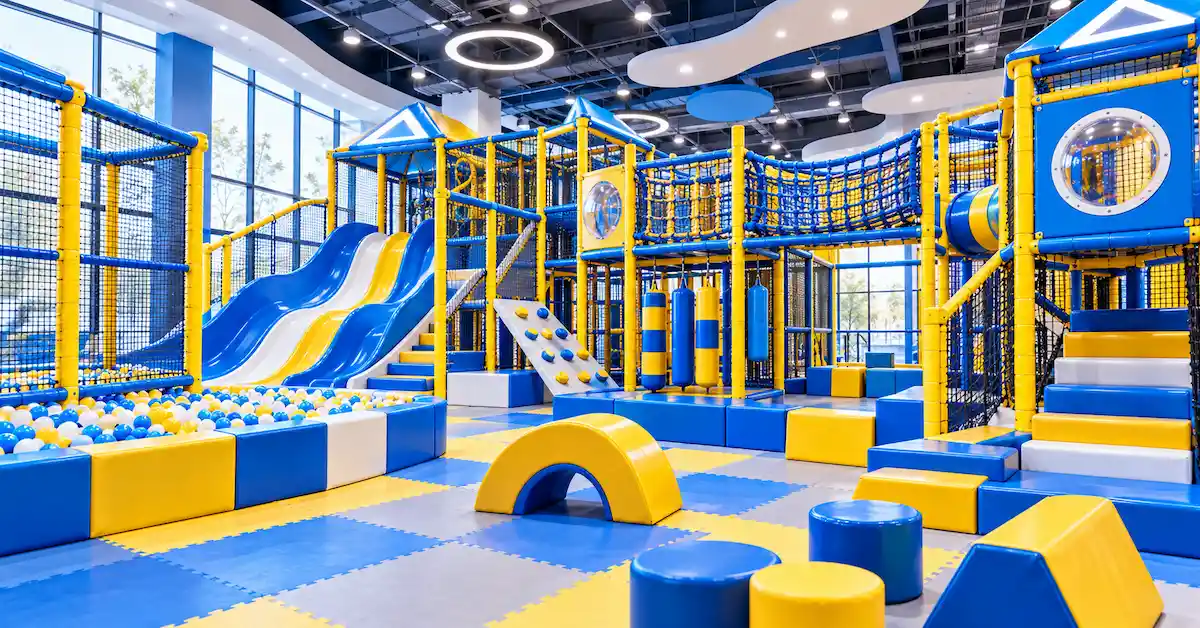
Indoor Playground Maintenance Checklist for Operators
| Area | Inspect | Typical Maintenance Action |
|---|---|---|
| Steel Frame | Movement, connections, exposed corrosion, impact damage. | Tighten or repair only according to approved procedure; escalate structural concerns. |
| PVC & Padding | Tears, seams, exposed foam, deformation, displaced covers. | Repair or replace damaged protective components. |
| Nets & Webbing | Frays, tears, openings, attachment points. | Replace damaged sections and verify fixings. |
| Slides | Cracks, rough surfaces, damaged edges, connections, exit zone. | Assess damage, repair or replace, then verify installation. |
| Flooring | Tears, lifting, gaps, buckling, compression, moisture. | Restore secure and appropriate surfacing condition. |
| Ball Pit | Damaged balls, debris, padding, base, access points. | Remove damaged items and perform planned cleaning/service. |
| Climbing Elements | Holds, ropes, attachments, surfaces, adjacent padding. | Repair or replace worn components and verify attachment. |
| Interactive Equipment | Mounting, surface damage, power connections, controls. | Follow manufacturer-specific electrical and technical guidance. |
| Signs & Access | Rules, exits, gates, circulation, blocked routes. | Restore visibility and remove obstructions. |
| Records | Open issues, repeated faults, overdue actions. | Close corrective actions and update service history. |
Frequently Asked Questions
How often should indoor playground equipment be inspected?
There is no single universal interval for every playground. Inspection frequency should follow the manufacturer's instructions, applicable standards, actual traffic, equipment complexity, venue conditions, and local requirements. Frequently used equipment generally deserves more frequent inspection than low-use equipment.
What should be checked every day in an indoor playground?
Operators commonly use a routine visual check for obvious defects such as damaged padding, torn nets, loose or missing parts, floor damage, debris, blocked access routes, visible cracks, contamination, and changes that may affect safe operation. The exact checklist should be adapted to the installed equipment.
Is cleaning the same as playground maintenance?
No. Cleaning is one part of maintenance. A complete program also covers equipment inspection, wear detection, structural and connection checks, repairs, component replacement, spare-parts management, documentation, and verification before reopening repaired equipment.
How do I maintain soft play padding?
Inspect PVC or other protective covers for tears, open seams, loose covers, exposed foam, deformation, trapped moisture, and displaced padding. If the underlying foam or protective function is compromised, the component may require replacement rather than only a cosmetic surface patch.
How should playground safety nets be maintained?
Check for tears, fraying, stretched areas, damaged stitching, unusual openings, and loose attachment points. Do not inspect only the center of the net; connections to the supporting structure also need attention.
How should FRP playground slides be inspected?
Inspect the surface for cracks, chips, rough areas or deformation, then review joints, mounting points, the entry platform, guarding, exit zone, surrounding padding, and flooring. A slide should be treated as part of a complete play system rather than an isolated component.
Which playground spare parts should operators keep?
The correct stock depends on the project. Buyers should identify fast-wear parts, critical parts that could close a zone, and made-to-order components with long replacement lead times. Typical examples may include padding, coverings, nets, flooring sections, hardware, and project-specific accessories.
Should indoor playground maintenance records be kept?
Yes. Records can document inspections, defects, photos, actions, replacements, responsible staff, and reopening decisions. Over time, these records help operators identify recurring problems, high-wear zones, replacement lead times, and maintenance costs.
When should damaged equipment be taken out of service?
If a defect may create a safety hazard or staff cannot confidently determine its significance, the affected equipment or zone should be isolated according to the venue's safety procedure until it has been properly assessed and restored to a suitable condition.
What should I ask a supplier about maintenance before ordering?
Ask for maintenance instructions, inspection guidance, spare-parts identification, replacement procedures, drawings, project references, cleaning compatibility information, warranty terms, and confirmation of how future customized parts can be reordered.
Conclusion
Knowing how to maintain indoor playground equipment means building a preventive system rather than reacting to failures. Commercial operators should combine routine visual checks, scheduled detailed inspections, cleaning, defect classification, approved repairs, spare-parts planning, and maintenance records.
Different components require different attention. Steel frames need connection and movement checks. PVC-covered padding needs inspection for tears, deformation, and exposed foam. Nets and webbing need fray and attachment checks. FRP slides need surface and mounting inspection. EVA or PU flooring needs monitoring for gaps, lifting, tears, and wear. Ball pits need both hygiene management and access to the hidden equipment beneath them.
Maintenance also begins before the playground opens. Buyers should select equipment that can be inspected, cleaned, repaired, and supplied with replacement components. Final drawings, component references, spare-parts information, maintenance instructions, and handover records can significantly reduce future downtime.
EPARK's published project process includes material selection, manufacturing, quality inspection, installation, after-sales guidance, maintenance support, and spare-parts availability. For a new commercial project, confirm the exact maintenance and replacement scope during quotation instead of waiting until the first component wears out.
Plan Maintenance Before Your Playground Opens
Send your floor plan, equipment requirements, target age groups, destination market, and after-sales expectations so maintenance access, replaceable components, spare parts, and project support can be considered during the design and quotation stage.
Request Playground Equipment & Maintenance SupportGeneral Disclaimer
All data on https://www.eparki.com is for general guidance only. As a leading indoor playground manufacturer and trampoline supplier, EPARK strives for accuracy but gives no express or implied warranty regarding completeness, performance or project fitness. Product specs, designs and results may vary with use and customer requirements. Buyers must verify technical details, compliance and suitability before purchase. EPARK OEM/ODM is not liable for any direct, indirect or consequential damages arising from site use. For custom solutions, contact our manufacturer and supplier team via the Contact page.
Intellectual Property
Text, images, videos, CAD files and software are Guangzhou EPARK Electronic Technology Co., Ltd. All rights reserved. No part may be copied, republished or used commercially without prior written permission. We will pursue legal action for copyright or design-patent infringement.
Trademarks
"EPARK", the EPARK logo and related graphics are registered trademarks of Guangzhou EPARK Electronic Technology Co., Ltd. Unauthorized use in ads, domain names or packaging is prohibited.
Governing Law
These terms are governed by the laws of the People's Republic of China.
Contact
Questions? Email sales@nanyuetech.com or WhatsApp +86 139 0307 9263.