What Does Kids Theme Park Equipment Indoor Mean for Commercial Buyers?
When commercial buyers search for kids theme park equipment indoor, they are usually not looking for one slide, one foam block set or one standalone playground product. The search often reflects a larger project requirement: building an indoor children’s entertainment venue that combines multiple activities, themed visual design, age-appropriate play zones and supporting commercial spaces.
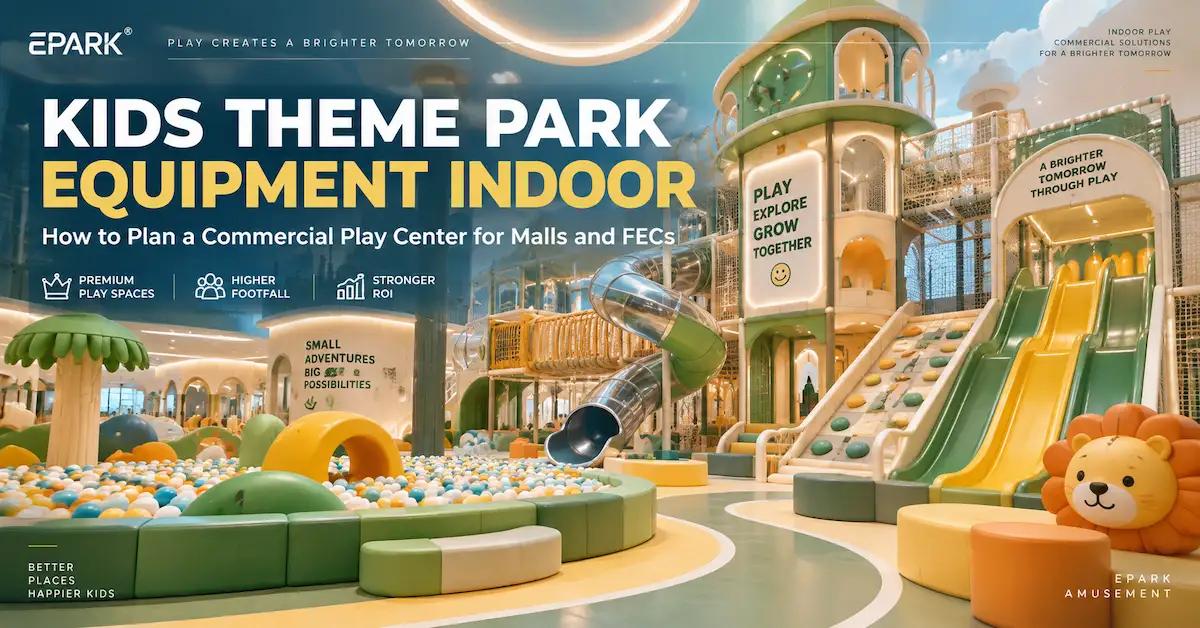
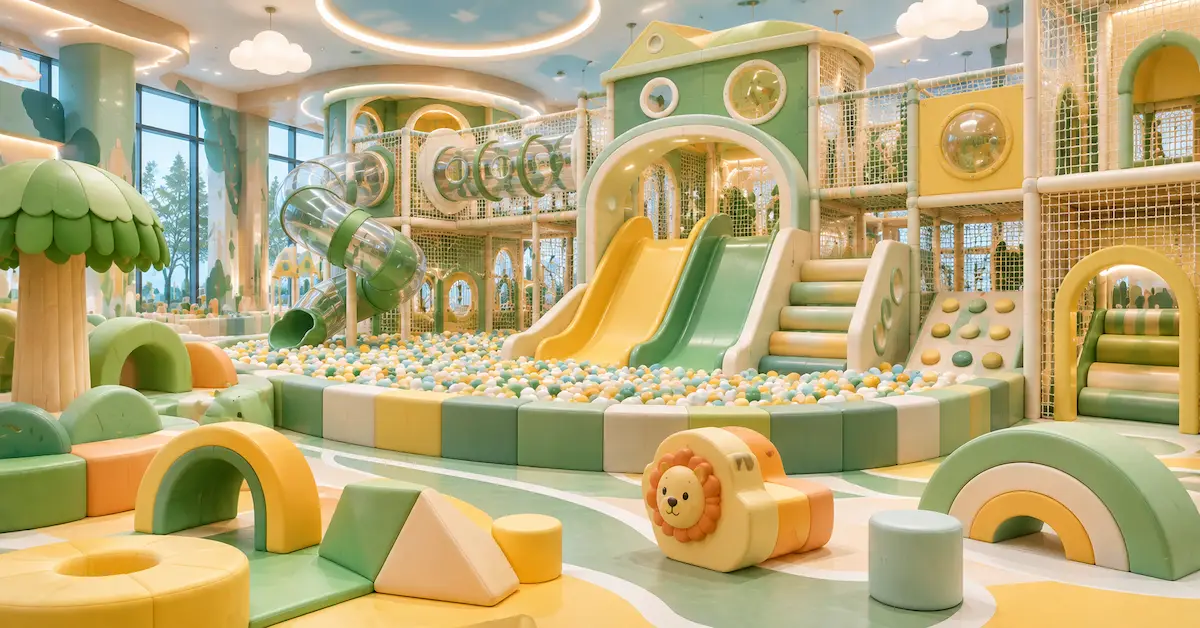
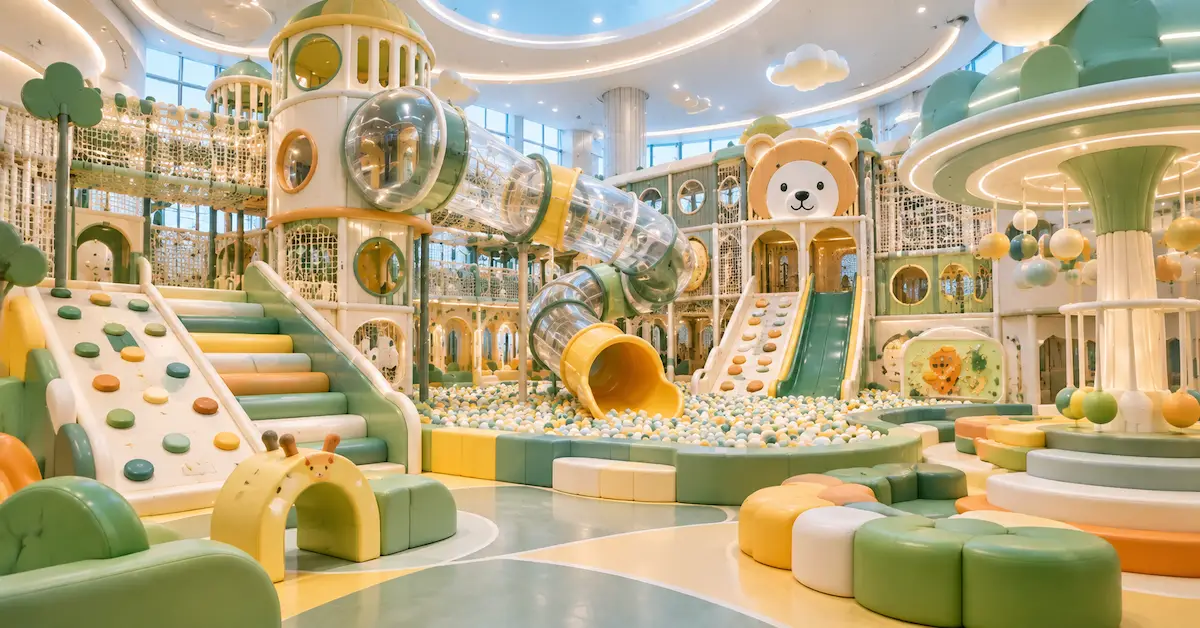
A commercial indoor kids theme park can include soft play equipment, multi-level climbing structures, slides, tunnels, ball pools, toddler areas, interactive panels, role-play activities and other indoor amusement elements. The exact combination depends on the venue, target users and business model.
For a B2B buyer, the key question is therefore not “Which equipment looks best?” It is “Which equipment mix fits my site, target ages, operating model and future expansion plan?” Buyers can first review EPARK’s indoor playground product range and broader products before defining a project-specific configuration.
Who Usually Buys Indoor Kids Theme Park Equipment?
The same equipment package should not be proposed to every buyer because different venues have different commercial objectives.
| Buyer Type | Typical Project | Primary Purchasing Priority |
|---|---|---|
| Shopping mall operator | Family attraction or tenant project | Visual impact, traffic flow and family dwell time |
| FEC investor | Multi-activity family entertainment center | Equipment variety and age segmentation |
| Indoor playground entrepreneur | Standalone ticketed playground | Play capacity and repeat-customer value |
| Property developer | Family-oriented commercial area | Project integration and space utilization |
| Hotel/resort | Kids club | Appearance, manageable operation and guest experience |
| Daycare/preschool | Younger-child activity zone | Lower-height play and supervision |
| Distributor/project contractor | Resale or turnkey projects | Repeatable supply, documentation and customization |
A mall project may prioritize a large centerpiece and attractive theme. An FEC often needs more activity diversity. A preschool requires a much lower-intensity equipment strategy. These are different purchasing problems even if all three buyers use the phrase kids theme park equipment indoor during supplier research.
Start With the Business Model Before Selecting Equipment
A common mistake is asking a supplier to fill an available floor area with as much equipment as possible. Equipment density should follow the commercial model rather than determine it.
Define the Main Customer
Consider whether the venue primarily targets toddlers, preschool children, school-age children or mixed-age families. The target user affects structure height, equipment complexity, supervision needs and age zoning.
Define the Visit Experience
Ask whether the venue is expected to deliver short drop-in play, longer family visits, birthday-party traffic, shopping-mall entertainment or a broader FEC experience. A two-hour ticketed playground needs a different activity mix from a small mall play corner.
Define the Revenue Role
The playground may be a standalone paid business, a family-traffic attraction inside a mall, part of an FEC package or an amenity supporting another business. Equipment investment should reflect that role.
Build the Indoor Theme Park Around Play Zones
A stronger commercial layout divides the venue by activity purpose instead of arranging products randomly.
Toddler Soft Play Zone
The toddler area should emphasize lower-height and softer activities, including small steps, crawl elements, soft slopes, foam obstacles, sensory panels and gentle slides. This zone should normally be separated from faster and higher-energy play.
Main Adventure Structure
The central indoor playground structure may combine climbing routes, tunnels, netted passages, slides and multi-level exploration. It can also become the visual centerpiece of the venue.
Ball Pool and Slide Zone
Ball pools can work as destination activities when integrated with slides, themed structures and surrounding soft protection rather than positioned as isolated pits.
Interactive and Sensory Zone
Interactive panels, rotating elements, wall activities and themed discovery features can add lower-intensity play and improve equipment variety.
Role-Play or Imagination Zone
Larger kids theme park projects may include mini shops, themed rooms or imaginative-play environments where the business concept requires them.
| Zone | Primary Function | Suitable Buyer Concern |
|---|---|---|
| Toddler soft play | Lower-intensity early-age activity | Separation and visibility |
| Main climbing structure | High-engagement exploration | Capacity and circulation |
| Ball pool/slides | Repeat active play | Layout and maintenance |
| Interactive zone | Sensory and lower-intensity activity | Variety |
| Role-play zone | Imagination and social play | Theme and commercial concept |
| Parent/support zone | Seating, observation and operations | Customer experience |
How Should Buyers Plan Age Segmentation?
Age zoning should be established before the detailed layout because mixing significantly different activity levels can create poor traffic flow.
Toddler-Focused Equipment
Toddler areas should use softer and simpler equipment with shorter movement routes. Buyers interested in this segment can also review project ideas through EPARK’s products when preparing a dedicated young-child zone.
Preschool Equipment
Preschool children can usually use more varied slides, tunnels, small climbing areas and interactive routes. This age group often benefits from strong themed storytelling.
Older Kids Equipment
Older-child zones may require larger structures and more challenging movement patterns, depending on the actual equipment design. Buyers should confirm the suitability of each proposed product rather than assigning age ranges based only on appearance.
Plan From the Real Floor Plan, Not a Reference Photo
An attractive reference project does not prove that the same arrangement works inside another building. A supplier needs accurate site information before producing a useful layout.
Provide Usable Dimensions
Send length, width and actual usable clear height. Building drawings should show columns, walls, doors, windows and other fixed features.
Confirm Ceiling Restrictions
Lighting, HVAC, beams, sprinklers and other services can reduce the vertical space available for playground equipment.
Mark Entrance and Exit Locations
The entrance affects reception, customer flow and the first impression of the play center. Large play structures should not create unnecessary bottlenecks.
Plan Parent Observation
Parent seating and supervision sightlines should be considered together with taller play structures and enclosed themed features.
Buyers planning a site-specific project can use EPARK’s customization process as a project discussion starting point.
Build a Clear Equipment Specification Before Requesting the Final Quote
Because kids theme park equipment indoor projects contain many individual components, buyers should avoid managing requirements through separate messages and screenshots. A controlled project brief makes pricing and supplier comparison much more useful.
| Requirement Area | Information to Define |
|---|---|
| Venue type | Mall, FEC, playground, hotel, school or other |
| Usable area | Length × width × clear height |
| Site constraints | Columns, entrances, windows and fixed services |
| Target users | Toddler, preschool, older children or mixed ages |
| Play zones | Required activity categories |
| Theme | Ocean, space, forest, custom brand or other |
| Core attractions | Slides, climbing, ball pools, tunnels, etc. |
| Supporting areas | Reception, seating, storage and shoe zone |
| Branding | Logo, colors and visual requirements |
| Delivery | Destination and target timeline |
| Installation | Site conditions and responsibility |
| Maintenance | Cleaning and component-replacement needs |
| Documentation | Required drawings and project records |
This controlled-specification approach follows the buyer-focused and technical-detail logic in your uploaded writing framework, which emphasizes specifications, applications, QC, risk and commercial decision-making rather than generic product promotion. SaleAI_Cross_Industry_SEO_Syste…
How Theme Design Changes Equipment Selection
Theme design should connect different play zones into one recognizable environment. Buyers can choose space, ocean, jungle, candy, forest, castle or a custom commercial theme.
A good theme does not require every component to be newly engineered. Existing soft play functions can be adapted through coordinated colors, façades, character shapes, graphics and selected landmark structures.
Space Theme
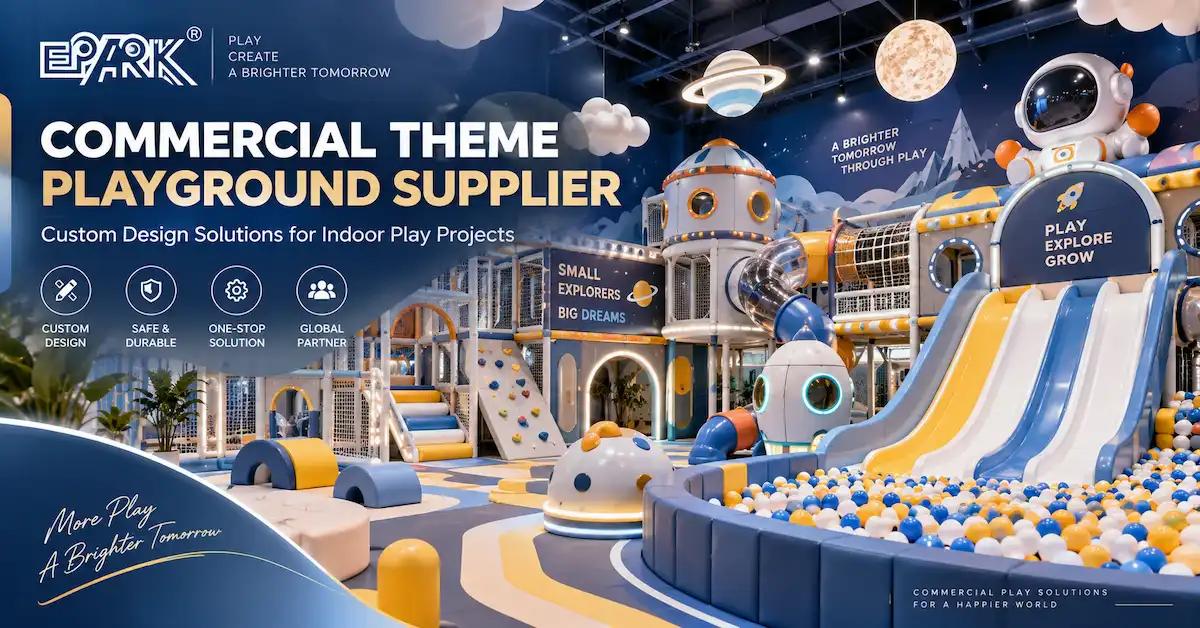
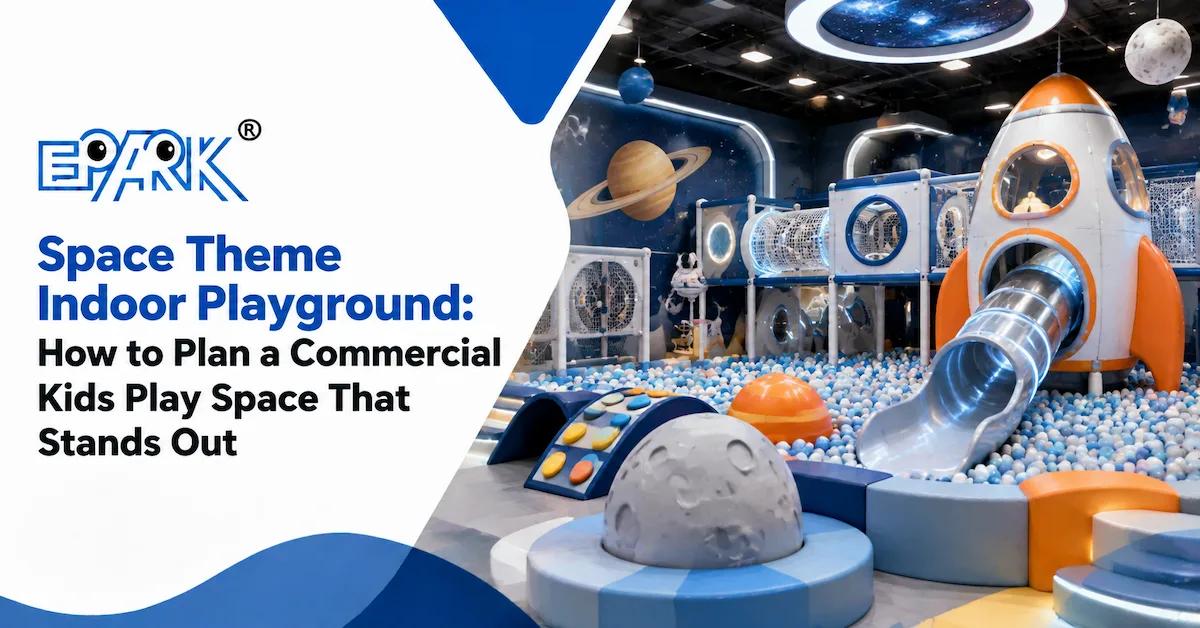
Rockets, planets, space stations and futuristic tunnels can work particularly well with multi-level structures and tube slides.
Ocean Theme
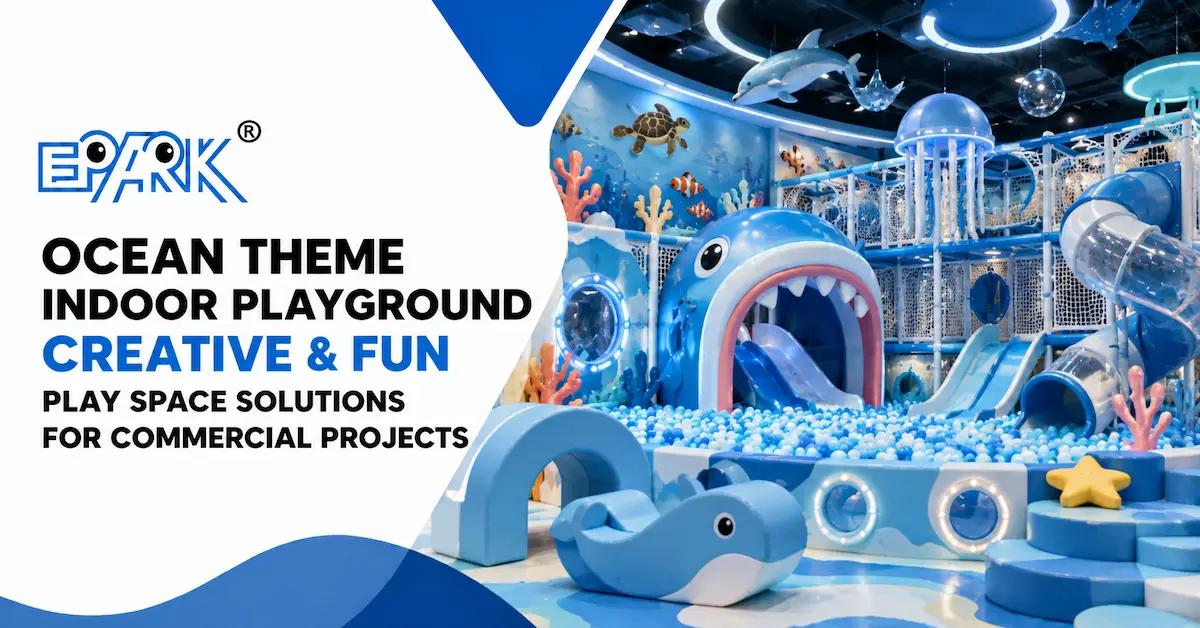
Submarine forms, whales, coral, waves and marine animals can be incorporated into ball pools, soft play shapes and themed climbing areas.
Forest or Jungle Theme
Trees, animals, bridges and natural-color elements suit family and education-oriented environments.
Custom Brand Theme
Chains and franchise operators may prefer a proprietary theme built around their logo, mascots and venue color system.
Buyers can review EPARK’s customization process before deciding how much of the project should be standard, semi-custom or fully customized.
Compare Standard, Semi-Custom and Fully Custom Solutions
| Project Type | Main Advantage | Main Limitation | Typical Fit |
|---|---|---|---|
| Standard equipment package | Faster selection | Lower differentiation | Small straightforward venues |
| Theme-color customization | Better visual consistency | Limited layout uniqueness | Budget-controlled projects |
| Semi-custom playground | Good balance of differentiation and complexity | Requires design approval | Malls and FECs |
| Fully custom indoor theme park | Strongest venue identity | More development and coordination | Flagship projects |
| Phased modular project | Easier future expansion | Requires early expansion planning | Growing operators |
The most expensive or most customized solution is not automatically the right one. Buyers should choose the level that solves actual commercial and site requirements.
How Should Materials Be Evaluated?
A commercial indoor kids theme park contains several different material systems, so buyers should avoid relying on one broad statement such as “high-quality material.”
Different areas may include structural frames, soft padding, foam modules, mesh barriers, flooring, plastic slides, interactive components and decorative surfaces. Buyers can review EPARK’s Safety and Quality information as background, then confirm the material specification associated with the actual proposed equipment.
High-Contact Areas
Ask what materials and coverings are used where children regularly crawl, climb or make contact.
Structural Components
The structure supporting multi-level equipment should be evaluated separately from soft decorative modules.
Frequently Replaced Elements
Buyers should ask whether high-wear soft components or interactive parts can be replaced individually instead of requiring large sections of the playground to be rebuilt.
Design for Cleaning and Maintenance Before Production
Maintenance is often overlooked during concept approval because the rendering focuses on customer appearance.
A practical project should provide access for inspection and cleaning. Highly decorative structures should not create unreachable spaces. Ball-pool areas, soft elements and frequently touched surfaces should be considered in the venue’s cleaning routine.
For operators planning multi-year use, replacement availability is also important. Ask how damaged or high-wear components are identified and ordered later.
How Should Buyers Evaluate Quality Control?
QC should compare production against the approved project rather than rely only on general factory inspection claims.
| QC Area | What to Check |
|---|---|
| Layout | Components correspond to approved design |
| Equipment list | Required modules are present |
| Structure | Correct project components supplied |
| Soft protection | Protective parts correspond to approved design |
| Slides/tunnels | Correct type and quantity |
| Theme | Colors and graphics match approval |
| Accessories | Hardware and project parts included |
| Packaging | Packages clearly identified |
| Installation documents | Agreed drawings/references supplied |
For a large indoor theme park project, packaging identification becomes particularly important because one shipment can contain many similar-looking components.
How Should Lead Time Be Discussed?
A supplier should not be expected to provide one universal lead time for every project because project complexity varies.
A more useful sequence is:
Site information → layout → theme concept → design review → revision → approval → production → QC → packing → shipment → installation
A standard equipment package may require less design work than a highly customized indoor theme park. Buyers should ask which approvals are required before production and which project milestone starts the manufacturing schedule.
Plan Shipping and Installation as Part of the Equipment Purchase
Large indoor playground projects should be designed with transport and installation in mind.
Buyers should clarify package identification, detachable structures, site unloading conditions and installation responsibility before shipment. If equipment must pass through restricted entrances or elevators, that information should be supplied during design rather than discovered when the shipment arrives.
EPARK’s FAQs and Contact Us pages can be used to discuss project-specific delivery and installation scope.
What Determines Kids Indoor Theme Park Project Cost?
There is no useful universal price because two projects with similar floor areas can contain very different equipment density and customization.
Major cost drivers include equipment mix, project size, structure height, theme complexity, interactive features, branding, packaging, shipping and installation.
A practical buyer budgeting framework is:
Total Project Investment = Equipment + Theme Customization + Packaging + Logistics + Installation + Opening Preparation
This is a planning framework rather than an EPARK quotation formula. Buyers should request project-specific pricing after the layout and supply scope are sufficiently defined.
How Should Buyers Compare Suppliers?
Supplier evaluation should include more than render quality and quotation price.
Design Capability
Can the supplier adapt the project to the actual building rather than only provide standard layouts?
Equipment Range
Can different age zones and activity functions be supplied within one project?
Customization
Can the visual theme and equipment layout be adapted to the buyer’s commercial concept?
Manufacturing and QC
Can production be checked against the approved design and equipment list?
Project Coordination
Can the supplier manage drawings, buyer approvals, production, packing and installation preparation in a controlled way?
After-Sales Support
Can replacement items later be traced to the original project?
Your uploaded 10-step content checklist emphasizes solving buyer questions across informational, commercial-investigation and transactional intent while using FAQ and CTA to reduce decision barriers; these are also the right categories of questions to ask during supplier evaluation. 独立站-高质量文章检查 10步法_副本(20260905-07…
When Is a Full Indoor Kids Theme Park Not Necessary?
Not every project needs a large theme park format. A daycare, small café or limited mall corner may get better operational value from a compact soft-play area.
A larger kids theme park equipment indoor project makes more sense when the venue has enough space, targets longer family visits, needs multiple age groups and wants play equipment to become a major commercial attraction.
Buyers should therefore distinguish between:
- a small soft-play corner;
- a commercial indoor playground;
- an FEC play zone;
- a larger indoor kids theme park.
This prevents unnecessary investment in equipment that does not match the business model.
What Should You Send EPARK for a Project Evaluation?
A useful inquiry should include the floor plan, usable dimensions, clear height, venue type, target ages, required activity zones, preferred theme, destination, target opening date and branding requirements. Site photographs and reference images can also help communicate the visual direction.
Buyers can review EPARK’s Indoor Playground products, products, Safety and Quality, customization process and FAQs, then submit a defined requirement through EPARK Contact Us.
Frequently Asked Questions About Kids Theme Park Equipment Indoor
1. What is kids theme park equipment indoor?
Kids theme park equipment indoor refers to commercial indoor children’s entertainment equipment arranged as a larger play environment. It can combine soft play, climbing structures, slides, tunnels, ball pools, interactive activities and themed areas.
2. What is the difference between an indoor playground and an indoor kids theme park?
An indoor playground may focus primarily on play structures, while a larger theme park concept can combine more zones, stronger theme design and a broader entertainment experience. The terminology can overlap, so buyers should define the actual equipment and project scope.
3. What equipment should be included?
The equipment mix depends on age groups, site size and business model. Common options include toddler soft play, multi-level climbing, slides, tunnels, ball pools and interactive areas.
4. Can the equipment be customized around a theme?
Yes. Project discussions can cover themes, colors, façades, layouts, logos and equipment combinations. The final scope should be defined using the real site dimensions.
5. Can toddler and older-child zones be included in one project?
Yes, but they should be deliberately zoned so activity levels are appropriate and higher-energy traffic does not dominate younger-child areas.
6. What information is needed for a quotation?
Provide floor dimensions, usable height, target ages, venue type, activity requirements, theme preference, destination and installation expectations.
7. What affects project pricing?
Project size, equipment quantity, structure height, customization, theme complexity, interactive equipment, packaging, freight and installation can affect total cost.
8. How should buyers evaluate safety and quality?
Review the project-specific materials, equipment design, protective elements, production QC, package identification and applicable documentation rather than relying on a general quality claim alone.
9. How long does an indoor kids theme park project take?
The schedule depends on the design and customization scope. Ask for a milestone-based plan covering design approval, production, QC, packing, shipping and installation.
10. How can I request an indoor theme park solution from EPARK?
Prepare your floor plan, dimensions, age groups, preferred theme, equipment requirements and project schedule, then submit them through EPARK Contact Us.
Conclusion
Selecting kids theme park equipment indoor should begin with the venue’s business model, real site conditions and target users rather than with a catalog picture. Commercial buyers should define age zones, select equipment according to play function, establish a theme that supports rather than replaces the play experience, and evaluate materials, maintenance, QC, shipping and installation before approving the project. For malls, FEC investors and indoor playground businesses, the strongest projects combine attraction value with practical supervision, serviceability and long-term operation. Buyers can review EPARK’s Indoor Playground products, Safety and Quality information, customization process and FAQs, then contact EPARK with the site plan, target ages, equipment mix and theme requirements for a project-specific proposal.
General Disclaimer
All data on https://www.eparki.com is for general guidance only. As a leading indoor playground manufacturer and trampoline supplier, EPARK strives for accuracy but gives no express or implied warranty regarding completeness, performance or project fitness. Product specs, designs and results may vary with use and customer requirements. Buyers must verify technical details, compliance and suitability before purchase. EPARK OEM/ODM is not liable for any direct, indirect or consequential damages arising from site use. For custom solutions, contact our manufacturer and supplier team via the Contact page.
Intellectual Property
Text, images, videos, CAD files and software are Guangzhou EPARK Electronic Technology Co., Ltd. All rights reserved. No part may be copied, republished or used commercially without prior written permission. We will pursue legal action for copyright or design-patent infringement.
Trademarks
"EPARK", the EPARK logo and related graphics are registered trademarks of Guangzhou EPARK Electronic Technology Co., Ltd. Unauthorized use in ads, domain names or packaging is prohibited.
Governing Law
These terms are governed by the laws of the People's Republic of China.
Contact
Questions? Email sales@nanyuetech.com or WhatsApp +86 139 0307 9263.