Why an Ocean Theme Indoor Playground Needs More Than Marine Decoration
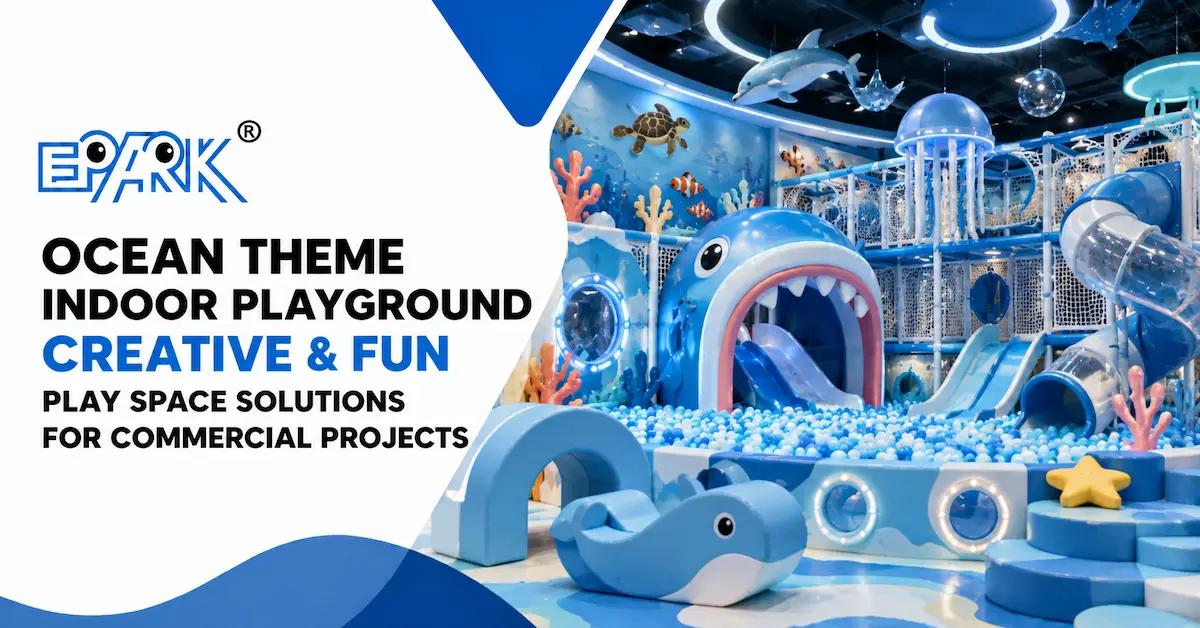
An ocean theme indoor playground works best when the visual concept and the play functions are designed together. Blue flooring, fish graphics, coral shapes and submarine decorations can make a project look themed, but those elements alone do not determine whether children have enough activities, whether parents can supervise effectively, or whether the operator can maintain the space efficiently.
For commercial buyers, the project should begin with the business and site conditions: Who will use the playground? How much usable floor area and clear height are available? Which age groups need separate zones? Which activities should become the main attraction? How will customers move from the entrance through the play area and back to parent seating?
EPARK’s Indoor Playground category includes themed commercial playground solutions, while the Ocean Theme category shows how marine visual elements can be combined with slides, ball pools, climbing and other indoor-play functions. These examples should be treated as project references rather than fixed layouts that can simply be copied into every building.
Which Commercial Buyers Usually Choose an Ocean Theme
An ocean concept is versatile because it can be adapted from a soft toddler environment to a larger adventure-style indoor playground. The buyer type determines how the theme should be developed.
| Buyer Type | Typical Application | Main Project Priority |
|---|---|---|
| Shopping mall operator | Family attraction or tenant play center | Visual impact, circulation and parent convenience |
| FEC investor | Multi-function family entertainment zone | Equipment variety and age segmentation |
| Indoor playground entrepreneur | Standalone ticketed business | Theme differentiation and playable capacity |
| Hotel or resort | Kids club or family facility | Premium appearance and manageable operation |
| Daycare or preschool | Younger-child play environment | Lower-height equipment and supervision |
| Commercial project contractor | Turnkey children’s play project | Site coordination, drawings and installation planning |
A mall project may want a highly visible “underwater world” entrance and photo-friendly centerpiece, while a daycare version may use lighter marine colors, small soft-play elements and simple sensory activities. The same theme should not produce the same equipment package for every customer.
Build the Ocean Story Before Selecting Individual Equipment
A strong ocean theme indoor playground normally has a clear design concept that helps different zones feel connected.
Choose a Specific Ocean Direction
“Ocean” is broad. Buyers can narrow it into concepts such as an underwater exploration center, coral reef adventure, submarine mission, tropical island journey or deep-sea discovery zone. A clearer direction helps designers make consistent choices for façades, play towers, wall graphics, colors and equipment shapes.
Translate the Theme Into Play Functions
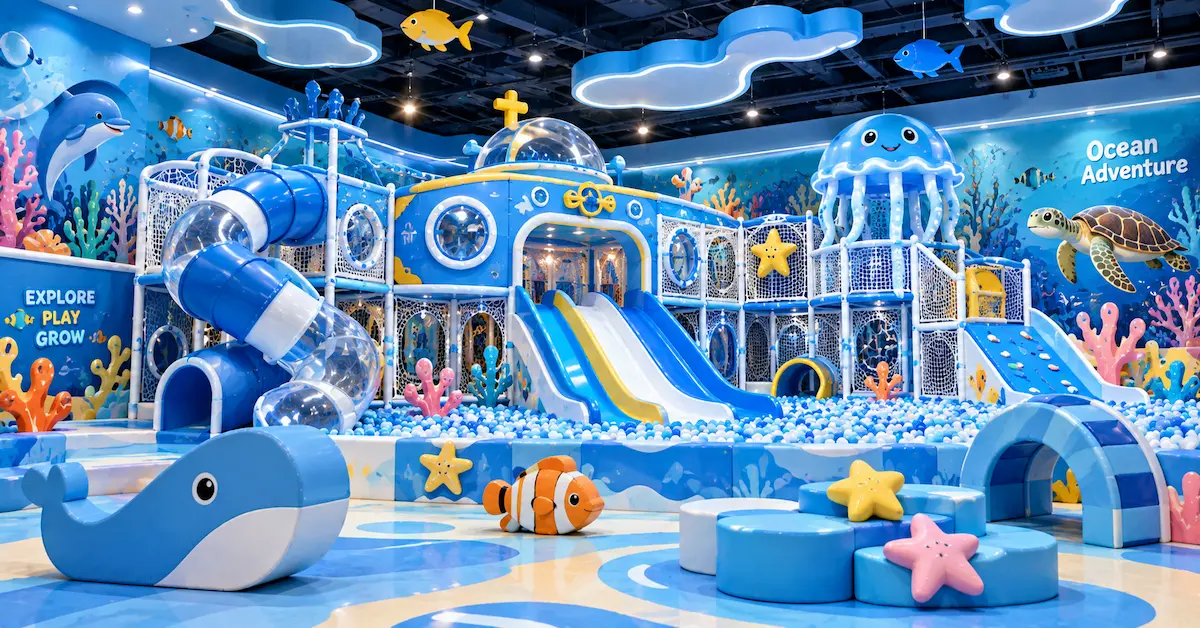
Each visual idea should support an activity. A submarine can become an elevated play structure, a coral reef can become a soft climbing feature, an underwater tunnel can become a crawl route, and a wave concept can be applied to a slide or padded obstacle.
This approach is stronger than adding decorative fish to unrelated equipment after the layout has already been completed.
Keep the Theme Understandable From the Entrance
The visitor should recognize the concept quickly. A clear entrance feature, coherent color palette and one or two major visual landmarks usually create a stronger identity than many small unrelated decorations.
Choose an Equipment Mix That Supports Different Play Behaviors
Themed design should not reduce equipment diversity. Children need different ways to move, explore, interact and rest.
| Equipment Type | Ocean Theme Interpretation | Main Play Function |
|---|---|---|
| Multi-level structure | Submarine, reef or underwater station | Exploration and circulation |
| Slide | Wave, sea-creature or ship-themed slide | Movement and repeat play |
| Ball pool | “Ocean” or “sea” ball area | Soft active play |
| Tunnel crawl | Undersea passage or submarine tunnel | Exploration |
| Climbing area | Coral, rock or island concept | Physical challenge |
| Rope/net route | Marine exploration bridge | Balance and movement |
| Interactive panel | Sea-life discovery activity | Sensory or interactive play |
| Toddler soft play | Small sea animals, waves and foam islands | Lower-intensity young-child activity |
| Role-play zone | Harbor, submarine station or marine shop | Imaginative play |
EPARK’s 280m² Ocean Theme Indoor Playground example demonstrates how marine decoration can be combined with multiple play functions rather than treated as a single product. The project area shown on a product page is an example, not a universal minimum area or capacity standard.
Separate Toddler, Preschool and Older-Kid Activity Levels
Age zoning is one of the most important parts of an ocean-themed commercial project.
Toddler Zone
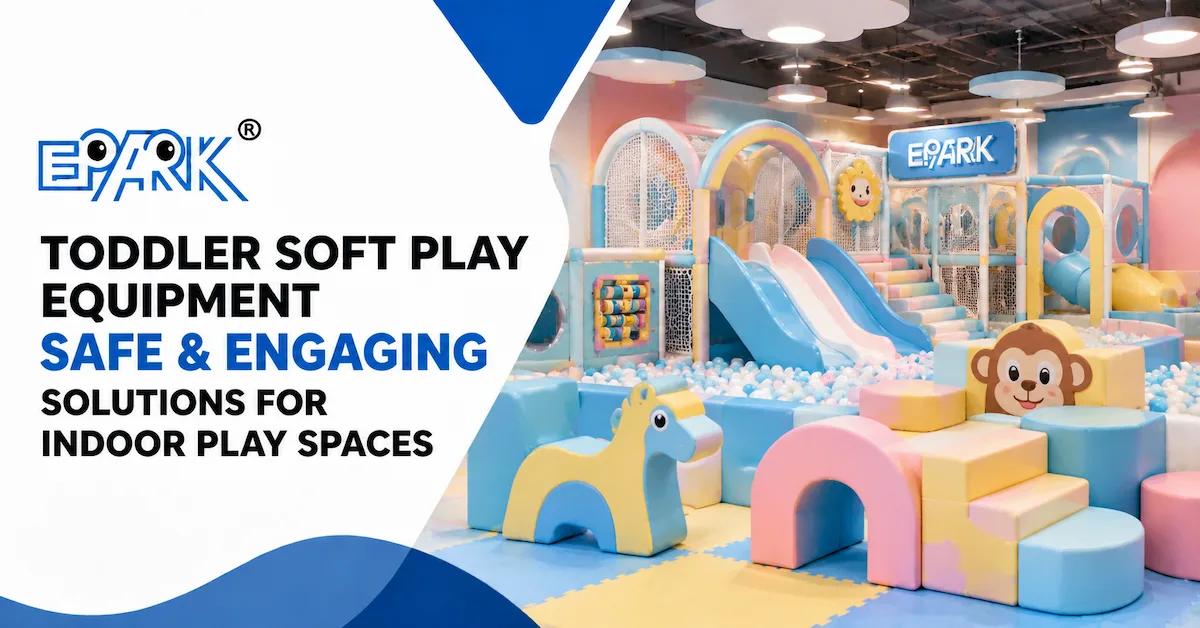
A toddler area should emphasize lower-height, softer and simpler equipment. Appropriate design directions can include foam sea animals, low tunnels, soft slopes, small slides, sensory panels and shallow ball-pool activities.
The toddler area should not simply be a miniature copy of the main playground. It needs its own movement difficulty, supervision visibility and circulation pattern.
Preschool Zone
Preschool children can typically engage with more varied routes, including moderate climbing, slides, soft obstacles and interactive structures. The ocean theme can be used to introduce exploration sequences, such as “enter the submarine,” “cross the reef” and “reach the island.”
Older Children’s Zone
For older children, buyers may consider higher or more complex climbing structures, interconnected routes, larger slides and more challenging obstacle combinations, subject to the final design and applicable equipment requirements.
The goal is to prevent high-energy traffic from dominating areas intended for younger children.
Plan the Layout Around the Building, Not Around a Catalog Picture
An ocean theme indoor playground should be designed from real site information. Before detailed design begins, the buyer should provide a floor plan and confirm usable dimensions.
Check Clear Height
Overall building height is not always usable equipment height. Beams, lighting, ventilation, sprinklers and other building services can affect the available vertical space.
Mark Columns and Fixed Obstacles
Columns can become part of the design, but they must be known before the layout is finalized. A column discovered late can interrupt slides, tunnels or circulation routes.
Plan Entrance and Exit Logic
The entrance should connect naturally to reception, shoe-changing areas, storage and parent waiting spaces where required. Avoid placing high-energy activities immediately across the entrance path.
Preserve Maintenance Routes
Technicians and operators need practical access to structures, interactive equipment and areas that require cleaning or inspection. An attractive layout that cannot be serviced easily can create long-term operating problems.
Use a Project Specification Instead of a Generic Playground Request
A detailed RFQ helps the supplier understand the actual project and gives the buyer a better basis for comparing proposals.
| Requirement Area | Information to Provide or Confirm |
|---|---|
| Venue | Mall, FEC, hotel, daycare or standalone playground |
| Site dimensions | Length, width and usable clear height |
| Fixed building features | Columns, entrances and other restrictions |
| Target users | Toddler, preschool, older children or mixed ages |
| Theme | Ocean concept and preferred visual direction |
| Main activities | Slides, ball pool, climbing, tunnels, soft play, role-play |
| Age zoning | Required separate areas |
| Branding | Logo, colors and venue identity |
| Supporting areas | Reception, seating, storage or shoe area |
| Installation | Site access and installation responsibilities |
| Delivery | Destination and project schedule |
| Maintenance | Replacement and cleaning considerations |
| Documentation | Project-specific drawings and relevant supporting information |
The specification should distinguish buyer requirements, supplier proposals, approved items and unresolved items. This approach follows the controlled B2B project logic emphasized in the writing framework you provided rather than managing the project through disconnected messages.
Materials and Construction Should Support the Function of Each Zone
Buyers often ask for “the safest material,” but an indoor playground contains several different material functions. Frame structures, padded contact areas, flooring, slides, nets and decorative elements do not all perform the same job.
EPARK’s Safety and Quality page describes materials and construction directions used across its indoor playground business, including structural framing and protective surface materials. For a specific ocean theme project, buyers should request the material information associated with the actual components being quoted rather than assuming every material shown on a general quality page applies identically to every design.
Structural Areas
Ask what structural system supports multi-level equipment and how connections are protected from normal user contact.
Soft Contact Areas
Padding and surface covering should correspond to where children climb, crawl or may make contact with structures.
Flooring
Floor treatment should be considered together with the activity type, cleaning method and overall venue operation.
Decorative Elements
Marine decorations need to be designed so that visual complexity does not create unnecessary protrusions, difficult cleaning areas or maintenance problems.
Do Not Treat “Ocean Ball Pool” as a Water Attraction
One important terminology issue is that an ocean-themed ball pool is generally a dry indoor play activity. It should not be described as a water park or aquatic facility simply because the visual concept is ocean-based.
This distinction matters for both SEO and purchasing communication. Buyers searching for an ocean theme indoor playground are normally evaluating themed dry indoor amusement equipment, whereas water-play projects involve very different construction, environmental and operating requirements.
Keeping these product categories clear helps buyers reach the correct supplier and prevents unrealistic project assumptions.
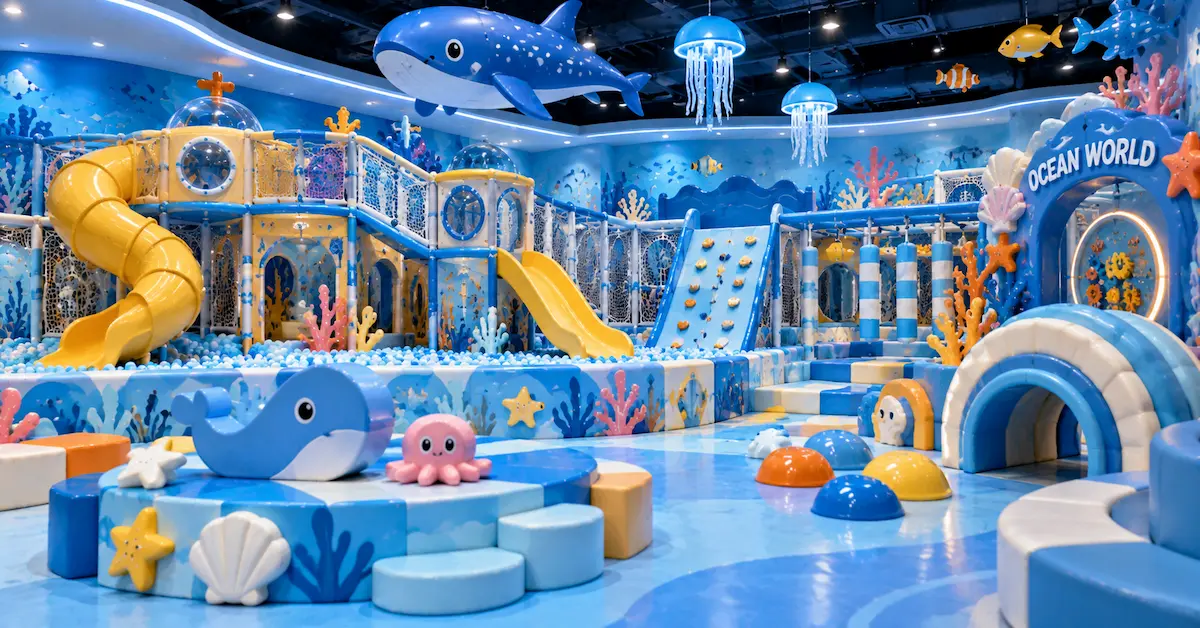
Use Theme Customization Without Losing Operational Practicality
Customization can include color palettes, marine characters, entrance façades, logos, signs, structure shapes and activity combinations. Buyers can review EPARK’s customization process to understand the broader workflow from project requirements through design and manufacturing.
Brand Integration
Commercial buyers may want the ocean concept to fit their own venue brand. Rather than placing a logo randomly across the structure, integrate brand colors, entrance signage and selected visual elements into the theme.
Theme Revision Control
Save the approved drawings and visual references. If a coral structure, entrance feature or main play tower changes after approval, document the new revision so production and installation teams work from the same design.
Avoid Over-Customization
Not every element needs to be newly engineered. Existing play functions can often be visually adapted to the ocean theme while retaining proven structural arrangements. This can reduce unnecessary development complexity.
Compare Ocean Theme Project Approaches
| Project Approach | Advantages | Limitations | Better Fit |
|---|---|---|---|
| Standard themed configuration | Faster planning | Lower differentiation | Buyers with straightforward sites |
| Semi-custom ocean project | Better site and brand fit | Requires additional design review | Most mall and FEC projects |
| Fully customized themed project | Strong visual identity | More design and approval work | Flagship venues and branded chains |
| Modular phased project | Easier future expansion | Requires early interface planning | Operators opening in stages |
A larger customization scope should solve a clear commercial or site requirement. Buyers should not choose the most complex option simply because it appears more premium.
Build QC Around the Approved Theme and Equipment Layout
Quality control should verify more than whether colors look correct.
A project-specific review can include:
| QC Area | Buyer Question |
|---|---|
| Layout | Does production match the approved design? |
| Structures | Are the expected modules and connections included? |
| Soft protection | Are protective elements installed as specified? |
| Slides/tunnels | Do they correspond to the approved arrangement? |
| Nets and barriers | Are the correct components provided? |
| Theme artwork | Are graphics and colors consistent with approval? |
| Accessories | Are required components and hardware included? |
| Package identification | Can installers identify where parts belong? |
| Documentation | Are installation references provided as agreed? |
For a custom project, package identification is especially valuable because one large playground may contain many sections that appear similar during installation.
Plan Installation Before Production Is Finished
Buyers should clarify installation responsibilities early. Site access, unloading, working hours, building conditions and installer arrangements can affect the project schedule.
EPARK’s broader customization process includes delivery and installation as part of project planning. The specific scope should still be confirmed in the quotation.
A realistic project schedule can include:
Site information → concept → layout → design revision → approval → manufacturing → inspection → packing → transport → installation → project handover
Design approval is not the same as production completion, and production completion is not the same as opening-day readiness.
Consider Maintenance While Designing the Ocean Theme
Highly themed environments can create additional maintenance work when decorative elements make surfaces difficult to reach or clean. Buyers should therefore ask how frequently used areas, soft coverings, ball pools, panels and interactive components will be inspected and cleaned.
A practical design should allow operators to:
- access major equipment zones;
- inspect wear points;
- clean contact surfaces;
- identify replacement components;
- maintain theme graphics;
- reach interactive or electrical parts where applicable.
Long-term visual quality is commercially important because worn decorative elements can reduce the premium impression that justified the themed project in the first place.
Understand the Main Cost Drivers
There is no reliable universal price for an ocean theme indoor playground because the project is normally site-specific.
Major cost drivers can include:
- total project size;
- number and complexity of play modules;
- vertical structure;
- theme complexity;
- custom façades and decorations;
- interactive components;
- packaging;
- logistics;
- installation scope.
A practical purchasing formula is:
Total Project Cost = Equipment + Theme Customization + Packaging + Logistics + Installation + Opening Preparation
This is an internal budgeting framework, not an EPARK quotation formula. Buyers should compare proposals after confirming that both suppliers are quoting similar layout, equipment and service scopes.
Evaluate Supplier Capability Beyond the Rendering
An attractive 3D concept is useful, but it does not establish manufacturing and project capability by itself.
When comparing suppliers, evaluate:
Theme Design Capability
Can the supplier create a complete environment rather than decorate unrelated products?
Product Integration
Can toddler soft play, slides, climbing, ball pools and other activities be integrated coherently?
Manufacturing Control
Can the approved design be translated into identifiable production components?
QC and Documentation
Can the supplier explain how project-specific components are inspected and organized before shipment?
Project Communication
Can the buyer understand what is included, what is customized, what needs approval and what remains unresolved?
After-Sales Support
Can replacement or maintenance questions be tied back to the original project design?
Buyers can review EPARK’s About Us, Indoor Playground products and FAQs when preparing this evaluation.
What Information Should You Send EPARK for an Ocean Theme Project?
The strongest inquiry includes the building plan rather than only the requested theme name.
Provide:
- venue type;
- project country/city;
- usable floor dimensions;
- clear height;
- columns and entrance positions;
- target age groups;
- preferred ocean concept;
- required play activities;
- branding requirements;
- expected timeline;
- installation expectations.
If available, include floor plans, site photographs and reference images. Buyers can first explore EPARK’s Ocean Theme product category, Indoor Playground category and customization process, then send the detailed brief through EPARK Contact Us.
Frequently Asked Questions About Ocean Theme Indoor Playgrounds
1. What is an ocean theme indoor playground?
An ocean theme indoor playground is a dry indoor children’s play environment using marine-inspired design elements such as underwater structures, fish, coral, submarines, waves and ocean colors together with functional play equipment.
2. What equipment can be included in an ocean-themed playground?
A project can include slides, ball pools, climbing structures, tunnels, soft-play components, interactive panels and age-specific activity zones depending on the final site and design.
3. Is an ocean theme suitable for toddlers?
Yes, when the project includes a dedicated toddler zone designed around lower-height, softer and simpler activities. Toddler requirements should be planned separately from higher-energy areas.
4. Is an ocean-themed ball pool a water-play facility?
No. In a typical indoor playground, an ocean-themed ball pool is a dry play area using the ocean concept visually. Water-play equipment belongs to a different project category.
5. Can an ocean theme indoor playground be customized for my brand?
Theme colors, entrance features, logos, graphics and equipment combinations can be discussed as part of a custom project. The exact scope depends on the selected layout and project requirements.
6. How much space does an ocean theme indoor playground need?
There is no single minimum area. EPARK’s ocean-theme pages show different project examples, but actual space requirements depend on the equipment mix, age zones, circulation and building conditions.
7. How should I compare ocean theme playground suppliers?
Compare design capability, equipment integration, materials, manufacturing control, QC, project communication, installation planning and after-sales support rather than comparing renderings alone.
8. What affects the price of an ocean-themed indoor playground?
Project area, play-module quantity, structure height, customization level, decorations, interactive equipment, transport and installation can all influence the overall cost.
9. What information should I provide before asking for a design?
Provide usable dimensions, clear height, venue type, target ages, required activities, theme direction, branding needs and project timeline. Site plans and photographs can improve the design discussion.
10. How can I request an ocean theme playground proposal from EPARK?
Review the Ocean Theme products, prepare your site information and requirements, and submit the project through EPARK Contact Us.
Conclusion
A successful ocean theme indoor playground should combine marine storytelling with functional equipment, clear age zoning, practical circulation, supervision, maintainability and project-specific quality control. Commercial buyers should avoid selecting a playground only from a rendering or copying another project’s size; instead, begin with the real building, target users and operating model, then use the ocean concept to unify the equipment and customer experience. Shopping malls, FEC operators, hotels and indoor playground investors can review EPARK’s Ocean Theme category, Indoor Playground products, Safety and Quality information and customization process, then contact EPARK with the floor plan, target ages, theme direction and project schedule for a project-specific proposal.
General Disclaimer
All data on https://www.eparki.com is for general guidance only. As a leading indoor playground manufacturer and trampoline supplier, EPARK strives for accuracy but gives no express or implied warranty regarding completeness, performance or project fitness. Product specs, designs and results may vary with use and customer requirements. Buyers must verify technical details, compliance and suitability before purchase. EPARK OEM/ODM is not liable for any direct, indirect or consequential damages arising from site use. For custom solutions, contact our manufacturer and supplier team via the Contact page.
Intellectual Property
Text, images, videos, CAD files and software are Guangzhou EPARK Electronic Technology Co., Ltd. All rights reserved. No part may be copied, republished or used commercially without prior written permission. We will pursue legal action for copyright or design-patent infringement.
Trademarks
"EPARK", the EPARK logo and related graphics are registered trademarks of Guangzhou EPARK Electronic Technology Co., Ltd. Unauthorized use in ads, domain names or packaging is prohibited.
Governing Law
These terms are governed by the laws of the People's Republic of China.
Contact
Questions? Email sales@nanyuetech.com or WhatsApp +86 139 0307 9263.