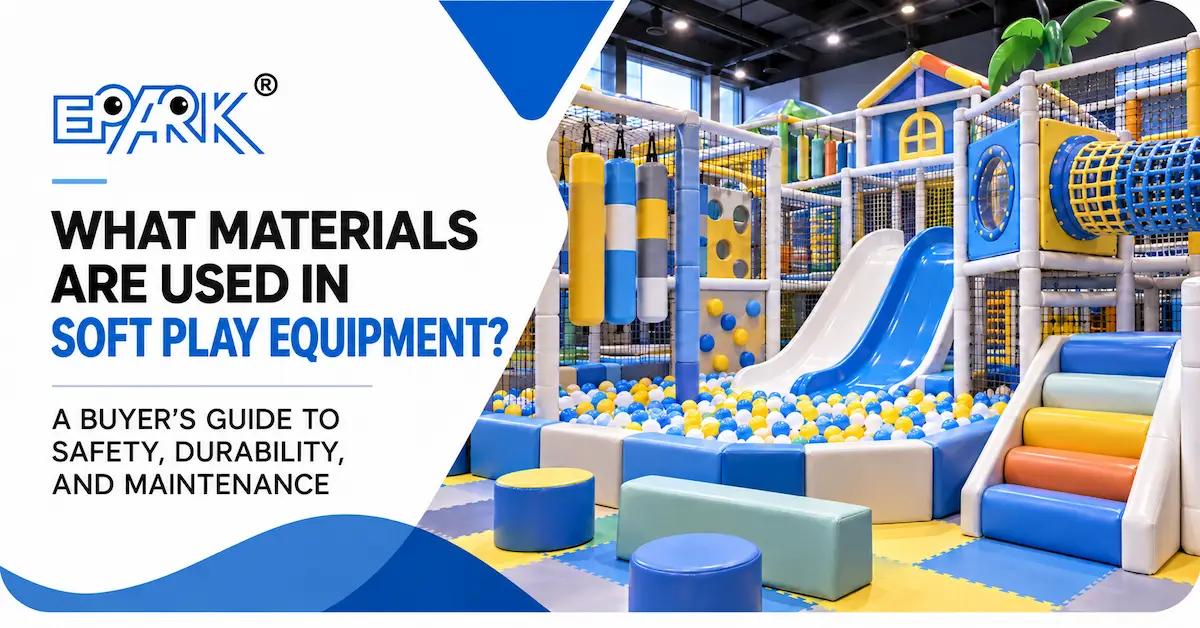
Why Soft Play Equipment Materials Matter for Commercial Buyers
Choosing soft play equipment is not simply a matter of comparing colors, themes, or equipment lists. The materials behind the finished playground determine how the structure handles repeated use, how contact areas absorb impact, how easily operators can clean the venue, and how much maintenance may be required over its service life.
For commercial buyers, understanding soft play equipment materials is therefore part of both safety evaluation and total-cost planning.
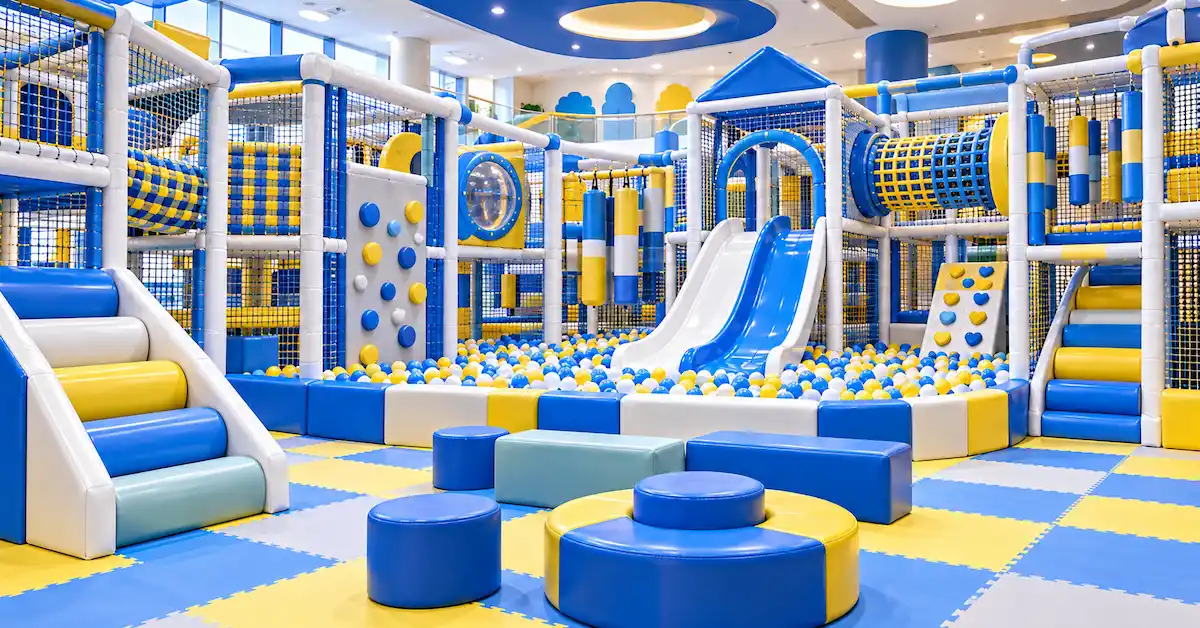
A typical commercial soft play or indoor playground system does not use one material. It combines structural steel, cushioning materials, surface coverings, flooring, slides, nets, hardware, and decorative components, with each material serving a different function.
EPARK’s current Safety and Quality information identifies cold-rolled galvanized steel, high-density foam, soft PVC sleeves, EVA or PU flooring, FRP or composite resin components, and safety nets among the materials used in its playground systems.
What Materials Are Commonly Used in Soft Play Equipment?
The following table provides a practical overview of the main soft play equipment materials a commercial buyer may encounter.
| Playground Component | Typical Material Used by EPARK | Main Function | What Buyers Should Evaluate |
|---|---|---|---|
| Structural framework | Cold-rolled steel pipe with hot-dip galvanization | Supports multi-level play structures | Structural stability, corrosion protection, connection quality |
| Protective padding | High-density foam | Cushions contact and impact areas | Density, deformation resistance, coverage, replacement access |
| Protective surface | Soft PVC sleeves or coverings | Protects foam and contact surfaces | Surface durability, cleaning, seams, wear points |
| Activity flooring | High-density EVA or PU foam mats | Provides cushioning and anti-slip surfaces | Condition, fit, cleaning access, replacement method |
| Slides | FRP or composite resin | Creates smooth sliding structures | Surface finish, wear resistance, mounting and edge treatment |
| Climbing protection | EVA padding and safety nets | Helps control fall and contact risks | Secure attachment, visibility, maintenance access |
| Containment barriers | Safety netting | Keeps users within designated play areas | Fixing points, wear, openings and replacement |
| Decorative components | Varies by project | Supports theme and visual identity | Safety, cleanability, durability and access for maintenance |
The important procurement lesson is that buyers should not judge these materials separately from their functions.
A visually attractive surface material cannot compensate for inadequate structural support. Likewise, a strong frame alone does not create a complete soft play safety system if contact points, floors, climbing zones, and exposed edges are not appropriately protected.
1. Galvanized Steel: The Structural Foundation
Multi-level commercial indoor playgrounds need an internal structure capable of supporting platforms, bridges, climbing elements, slides, barriers, and other activity modules.
EPARK states that its playground systems use cold-rolled steel pipes with hot-dip galvanization to provide structural stability and rust resistance.
For an operator, this material is mostly hidden after installation, but it is one of the most important parts of the entire project.
Why galvanization matters
Indoor playground structures may operate for many years. Depending on the venue, the frame can also be exposed to humidity, cleaning activity, temperature variation, and continual use.
Corrosion protection is therefore not only a cosmetic issue. Buyers should understand how the steel is protected before it is enclosed by padding and decorative materials.
For projects in humid climates, shopping malls, coastal markets, or high-use family entertainment centers, this deserves particular attention.
Questions buyers should ask
When reviewing the structural portion of a quotation, ask:
-
What type of steel is used?
-
How is the steel protected against corrosion?
-
Which parts receive galvanization or other surface treatment?
-
How are connection areas designed?
-
How are structural components identified during installation?
-
What inspection is completed before packing?
-
Can replacement or expansion modules be added later?
The goal is not to purchase the “heaviest” structure possible. The goal is to receive a structure that matches the approved playground design, equipment configuration, and intended commercial use.
Buyers planning a custom project can review EPARK’s Customization Process to understand how material selection fits into space planning, manufacturing, inspection, installation, and after-sales support.
2. High-Density Foam: Protection Around Contact Areas
Foam is one of the most recognizable soft play equipment materials, but commercial buyers should look beyond whether a component simply “feels soft.”
EPARK uses high-density foam on contact surfaces and describes the material as impact-absorbing, durable, non-toxic, and resistant to deformation.
Foam may be used around:
-
Structural posts
-
Platform edges
-
Steps
-
Climbing elements
-
Soft obstacles
-
Play blocks
-
Bridges
-
Activity modules
-
Other user-contact areas
Its role is to create cushioning between children and harder structural components.
What matters in commercial operation
Repeated use changes the way buyers should evaluate padding.
A soft component in a showroom may appear suitable, but commercial environments can experience thousands of repeated contacts over time. Operators therefore need to think about whether padding remains properly positioned, whether it becomes compressed or damaged, and whether individual sections can be replaced.
Ask the supplier how the padding system is fixed and how worn areas can be serviced after installation.
This is especially important around entrances, platform transitions, steps, climbing routes, and other high-contact locations.
3. Soft PVC Coverings: The Working Surface of Soft Play
Foam typically needs a protective exterior surface. EPARK identifies soft PVC sleeves as part of its protective padding system.
The covering performs several practical roles.
It separates users from the foam beneath it, creates a cleanable surface, protects internal cushioning, and contributes to the final color and appearance of the equipment.
For commercial buyers, the key issue is not simply whether PVC is present.
You should also evaluate how the surface is constructed.
Look at:
-
Seams
-
Corners
-
High-wear areas
-
Attachment points
-
Openings
-
Surface consistency
-
Cleaning accessibility
-
Replaceability
A well-designed soft covering should also support routine inspection. Operators need to be able to see when a surface has become damaged rather than having wear hidden behind decorative elements.
4. EVA and PU Flooring: Where Safety Meets Daily Operation
Flooring is another critical part of soft play equipment materials because nearly every visitor interacts with it continuously.
EPARK states that its children’s activity zones can use high-density EVA or PU foam mats, designed to provide anti-slip and cushioning properties while supporting installation and cleaning.
From a buyer’s perspective, playground flooring has several jobs:
-
Provide an appropriate activity surface.
-
Support impact management where required by the design.
-
Reduce slipping.
-
Remain practical for routine cleaning.
-
Allow worn or damaged areas to be inspected and replaced.
EVA or PU: which should you choose?
There is no useful universal answer without knowing the actual product specification and application.
Instead of choosing between EVA and PU based only on material names, commercial buyers should compare:
-
Intended activity
-
User age
-
Expected traffic
-
Location within the playground
-
Required cushioning
-
Surface finish
-
Cleaning routine
-
Installation method
-
Replacement strategy
-
Applicable destination-market requirements
A toddler soft play zone, a circulation aisle, and a high-energy activity area do not necessarily need to be treated as identical flooring applications.
That is why material decisions should follow the playground layout rather than be made before the layout is finalized.
5. FRP and Composite Resin for Slides and Formed Components
Slides need a different material system from soft blocks or floor mats.
EPARK states that its slides can use thick FRP or composite resin, with smooth, wear-resistant surfaces. Its Safety and Quality page also notes that slide and climbing structures are combined with protective railings, nets, and padded areas.
For commercial projects, buyers should inspect more than the visible color.
Important areas include:
-
Surface smoothness
-
Edges
-
Joints
-
Entry and exit transitions
-
Fixing locations
-
Accessibility for inspection
-
Relationship with surrounding padding
-
Ease of cleaning
A slide may be visually impressive, but its real performance depends on how the entire assembly is integrated into the play structure.
This is especially relevant for customized castle, ocean, jungle, candy, or space-themed playgrounds where formed decorative components may become part of the activity route.
You can compare different project styles through EPARK’s current indoor playground product range.
6. Safety Nets: A Material That Should Not Be Treated as Decoration
Safety netting is easy to overlook during procurement because it is less visually prominent than slides, ball pools, or themed façades.
However, it performs an essential containment function.
EPARK identifies safety nets around climbing structures and elevated activity areas as part of its playground protection system.
For a commercial project, buyers should evaluate:
-
Where netting is required
-
How it is attached
-
Whether fixing points are accessible for inspection
-
Whether damaged sections can be replaced
-
Whether the design maintains supervision visibility
-
Whether decorative features interfere with inspection
A common procurement mistake is to focus so heavily on theme design that operational visibility is reduced.
A good themed playground should remain inspectable, cleanable, and manageable after the decorative work is complete.
How Do Soft Play Equipment Materials Work Together?
Evaluating materials individually is useful, but the final playground operates as a system.
Consider a multi-level climbing area.
The steel frame provides structural support. Foam and PVC protect contact zones. Flooring provides an appropriate activity surface. Nets provide containment. FRP or composite elements may form slides, tunnels, or themed parts. Hardware connects the components into the approved layout.
If one layer is poorly specified, the overall result can be affected.
That is why a commercial buyer should compare material systems, not isolated material names.
A quotation that simply says “steel + foam + PVC” tells you far less than a project specification that explains where those materials are used and how they relate to the approved design.
Which Materials Matter Most for Different Commercial Venues?
Material priorities change with the operating environment.
| Venue | Main Material Concerns | Buyer Priority |
|---|---|---|
| Shopping mall playground | Continuous traffic, cleaning, appearance | Durable surfaces and maintenance access |
| Family entertainment center | Mixed activities and heavy use | Structural durability and replaceable high-wear parts |
| Preschool or daycare | Younger users and supervision | Soft contact areas, appropriate flooring and visibility |
| Hotel or resort | Appearance plus moderate commercial use | Finish quality, cleanliness and theme integration |
| Large indoor playground | Multiple zones and complex structure | Consistent specifications across components |
| Humid environment | Corrosion and long-term maintenance | Protected structural steel and inspection access |
| Chain playground | Repeatability across locations | Documented material specifications and standardized components |
This is why buyers should avoid asking only:
“What is the best material for a soft playground?”
A more useful question is:
“Which material specification is appropriate for each function in my venue?”
How Should Buyers Evaluate Soft Play Equipment Materials Before Ordering?
A professional procurement process should turn material claims into verifiable project information.
Ask for a component-level material list
Instead of accepting a general claim such as “premium materials,” request a list showing which materials are used for:
-
Frames
-
Padding
-
Covers
-
Floors
-
Slides
-
Nets
-
Decorative structures
-
Climbing components
This makes supplier comparisons more meaningful.
Confirm which specifications apply to your actual project
A manufacturer may display many materials across its website, but not every material is necessarily used in every playground configuration.
Buyers should therefore confirm the specifications for the equipment included in the actual quotation.
Review documentation and certificates
Different destination markets and project types may have different documentation requirements.
Before production, confirm which test reports, certificates, material documents, or other compliance information are relevant to your project.
EPARK publishes a selection of documentation on its Certificates page. Buyers should still confirm which documents apply to their selected equipment and destination market rather than assuming every certificate covers every product.
Evaluate cleaning before approving appearance
Commercial playgrounds require regular cleaning.
Complex decorative recesses, inaccessible seams, or tightly enclosed areas can create unnecessary maintenance work.
Ask:
-
Can staff reach the surface?
-
Can high-contact components be wiped or inspected?
-
Are serviceable parts accessible?
-
Can damaged coverings be replaced?
-
Does the theme obstruct normal cleaning?
Check the replacement strategy
Commercial equipment will eventually experience wear.
A practical system should allow operators to identify and replace selected wear components instead of treating the entire playground as one non-serviceable installation.
Ask which items are normally considered replaceable and how spare parts are ordered.
Five Common Material-Buying Mistakes
1. Choosing materials by appearance alone
Bright colors and attractive themes help create an appealing venue, but they do not tell you how the structure, padding, flooring, or containment system is built.
Material evaluation should begin behind the visible surface.
2. Assuming one specification applies to the entire playground
A commercial soft play project contains different functional zones.
Structural supports, toddler modules, slides, floors, climbing routes, and decorative components can require different material solutions.
3. Ignoring the operating environment
Humidity, traffic, cleaning frequency, user age, and activity intensity can all change material priorities.
A material specification should make sense for the actual venue.
4. Ignoring maintenance until after installation
Cleaning and replacement should be discussed before manufacturing.
If an operator cannot easily inspect or replace a high-wear component, the problem becomes much more expensive after the playground opens.
5. Treating certification as a marketing logo
Buyers should verify which documentation applies to the exact equipment, material, test scope, and destination market.
The relevant question is not simply:
“Do you have certificates?”
It is:
“Which certificate or test report applies to the equipment I am purchasing?”
How EPARK Approaches Material Selection in Custom Projects
For a custom indoor playground, material selection should happen after the supplier understands the space, age group, activity mix, theme, operating environment, and project requirements.
EPARK’s custom playground process follows a sequence that includes consultation, space planning, professional design, material selection, custom manufacturing, quality inspection, delivery, installation, and after-sales support.
This workflow matters because soft play equipment materials should support the approved design rather than dictate the design in isolation.
For example, a buyer planning a project should first provide:
-
Floor dimensions
-
Ceiling height
-
Target age group
-
Expected activity mix
-
Preferred theme
-
Destination country
-
Operating environment
-
Commercial objectives
The design team can then determine how different playground components fit into the space and which material systems need to be considered.
For more information about ordering, customization, safety, shipping, installation, and maintenance, buyers can also review EPARK’s FAQ.
What Should Be Included in a Soft Play Material Specification?
For B2B procurement, a material specification can become one of the most useful documents in the project.
At minimum, buyers should try to identify:
| Specification Area | Questions to Confirm |
|---|---|
| Structure | What supports the playground and how is it protected? |
| Padding | Where is cushioning required and what material is used? |
| Covering | How are padded surfaces enclosed and finished? |
| Flooring | Which floor system is used in each activity zone? |
| Slides | What material and surface finish are specified? |
| Nets | Where are containment barriers installed? |
| Theme components | How are decorative parts integrated safely? |
| Cleaning | Which surfaces require specific cleaning procedures? |
| Replacement | Which high-wear parts can be replaced individually? |
| Documentation | Which reports or certificates apply to the project? |
This specification can then be used when comparing quotations, approving production, checking delivered components, and planning future maintenance.
Frequently Asked Questions About Soft Play Equipment Materials
What are the main materials used in soft play equipment?
Commercial soft play systems can combine structural steel, high-density foam, PVC protective coverings, EVA or PU flooring, FRP or composite resin components, safety nets, and other project-specific materials. The exact combination depends on the equipment design and application.
Why is galvanized steel used in indoor playground structures?
EPARK uses cold-rolled steel pipes with hot-dip galvanization in its playground structures. The galvanization is intended to improve corrosion resistance while the steel frame provides structural support.
What type of foam is used in soft play equipment?
EPARK identifies high-density foam in its protective padding system. Commercial buyers should confirm the actual padding specification for the equipment in their quotation rather than judging quality only by softness.
Is PVC commonly used in soft play equipment?
PVC can be used as a protective covering or sleeve over padded contact surfaces. Buyers should evaluate the surface finish, seams, cleaning requirements, wear areas, and replacement method.
Is EVA or PU better for playground flooring?
The better option depends on the location, activity, user group, traffic level, required performance, and specific product specification. Buyers should compare the proposed flooring system according to the actual application instead of selecting solely by the material name.
What are indoor playground slides made from?
EPARK states that its slides can use FRP or composite resin materials. Buyers should also evaluate surface finish, joints, edges, installation, and how the slide integrates with surrounding protective structures.
Which material is most important for playground safety?
There is no single material that determines the safety of an entire playground. Structural materials, cushioning, flooring, barriers, slide surfaces, connections, layout, installation, and maintenance all work together.
How can buyers verify material quality?
Request project-specific specifications, available test documentation, certificates where applicable, quality-control information, and details showing how materials are used in each component. Do not rely only on catalogue descriptions.
Do all indoor playground projects use the same materials?
No. Equipment configuration, target ages, venue conditions, theme, destination market, and project requirements may change the material combination. The final specification should be confirmed for the actual project.
What information should I provide when requesting a soft play quotation?
Provide your floor plan or dimensions, ceiling height, target age range, preferred theme, destination market, expected equipment mix, and any specific project requirements. You can submit these details through EPARK’s Contact Us page for project evaluation.
Conclusion
Understanding soft play equipment materials helps commercial buyers evaluate more than appearance or initial price.
A well-designed soft play system combines different materials for different functions: galvanized steel provides structural support, high-density foam and PVC protect contact areas, EVA or PU flooring supports activity zones, FRP or composite resin forms slides and other rigid components, and safety nets help contain users within designated areas.
For FEC operators, shopping malls, distributors, schools, hotels, project contractors, and indoor playground investors, the best purchasing decision is not simply to ask which material sounds strongest. It is to understand where each material is used, why it is used, how it can be inspected, how it will be maintained, and whether the specification matches the actual operating environment.
Before approving a project, compare the component-level material specification, maintenance requirements, replacement strategy, relevant documentation, and final layout together.
If you are planning a new commercial soft play or indoor playground project, prepare your site dimensions, ceiling height, target age group, preferred theme, destination market, and expected activity mix. EPARK can use this information to develop a more appropriate custom playground solution based on the needs of the actual venue.
General Disclaimer
All data on https://www.eparki.com is for general guidance only. As a leading indoor playground manufacturer and trampoline supplier, EPARK strives for accuracy but gives no express or implied warranty regarding completeness, performance or project fitness. Product specs, designs and results may vary with use and customer requirements. Buyers must verify technical details, compliance and suitability before purchase. EPARK OEM/ODM is not liable for any direct, indirect or consequential damages arising from site use. For custom solutions, contact our manufacturer and supplier team via the Contact page.
Intellectual Property
Text, images, videos, CAD files and software are Guangzhou EPARK Electronic Technology Co., Ltd. All rights reserved. No part may be copied, republished or used commercially without prior written permission. We will pursue legal action for copyright or design-patent infringement.
Trademarks
"EPARK", the EPARK logo and related graphics are registered trademarks of Guangzhou EPARK Electronic Technology Co., Ltd. Unauthorized use in ads, domain names or packaging is prohibited.
Governing Law
These terms are governed by the laws of the People's Republic of China.
Contact
Questions? Email sales@nanyuetech.com or WhatsApp +86 139 0307 9263.